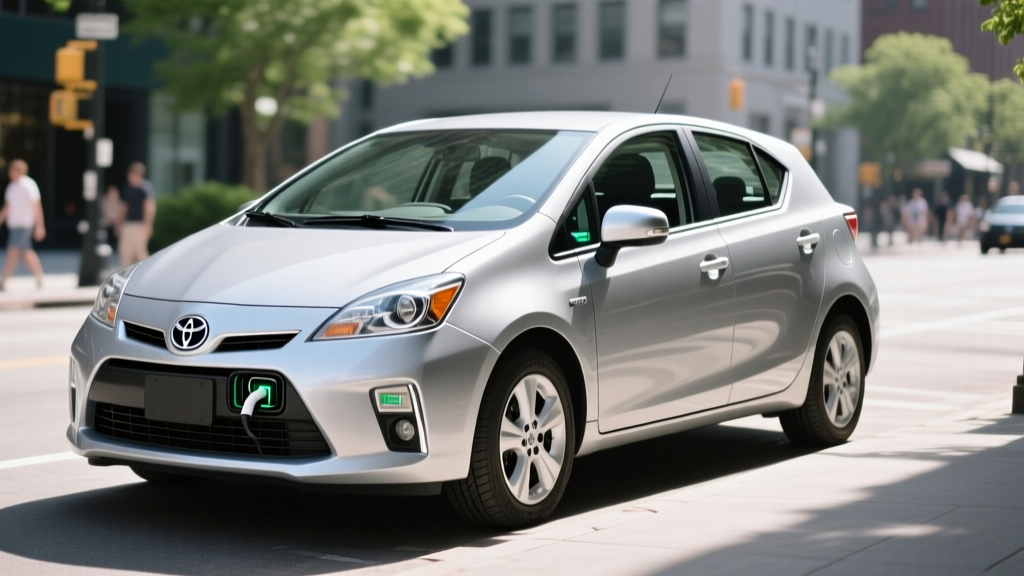
The 2014 Toyota Prius C (known as the Aqua in some markets) occupies a specific niche: a subcompact hatchback hybrid built for maximum city fuel economy on a budget. Toyota discontinued the Prius C after the 2019 model year, but thousands remain on the used market, and at typical prices between $7,000 and $12,000 in 2026, it draws buyers who want hybrid efficiency without a plug-in premium. This guide covers the exact numbers you need — EPA MPG, powertrain specs, battery health considerations, and total ownership cost — to decide whether a used 2014 Prius C fits your commute.
What Is the 2014 Toyota Prius C? HEV vs PHEV Clarified
The 2014 Prius C is a conventional hybrid electric vehicle (HEV), not a plug-in hybrid. This distinction matters because it determines how the car operates, what it costs to run, and what infrastructure you need.
HEV vs PHEV vs BEV — Where the Prius C Fits
| Feature | HEV (Prius C) | PHEV (e.g., Prius Prime) | BEV (e.g., Bolt EV) |
|---|---|---|---|
| Plug-in charging required? | No — self-charging via engine + regen | Yes — plug in for electric-only range | Yes — sole propulsion source |
| Electric-only driving | ~1 mile at very low speed | 25–44 miles (model dependent) | 200–400+ miles |
| Battery size | 0.9 kWh (NiMH) | 8.8–13.6 kWh (Li-ion) | 40–100+ kWh (Li-ion) |
| Gas engine | Yes — primary power source | Yes — backup after battery depletes | No engine |
| Federal tax credit (new) | None | Up to $7,500 (§30D) | Up to $7,500 (§30D) |
The Prius C uses Toyota's Hybrid Synergy Drive system: a 1.5-liter gasoline engine paired with an electric motor and a small nickel-metal hydride (NiMH) battery pack. The battery recharges through regenerative braking and the engine — you never plug it in. This makes it ideal for apartment dwellers or anyone without access to home charging who still wants to cut fuel costs significantly.
EPA Fuel Economy and Real-World MPG
The headline number for the 2014 Prius C is its fuel economy. Here is the official EPA data from fueleconomy.gov:
| Driving Cycle | EPA Rating |
|---|---|
| City | 53 MPG |
| Highway | 46 MPG |
| Combined | 50 MPG |
Real-World MPG: What Owners Actually See
The Prius C is one of the rare vehicles where real-world city driving often matches or exceeds the EPA city estimate. The hybrid system recovers energy during stop-and-go braking, so dense urban commutes with frequent stops yield the best results — owners regularly report 52–56 MPG in city driving.
Highway driving is the Prius C's relative weak point. The 1.5L engine works harder at sustained 70–80 mph speeds, and the car's light weight (roughly 2,500 lbs) and tall profile create aerodynamic drag. Expect 40–44 MPG on sustained highway trips. In cold weather (below 30°F), the engine runs more frequently to maintain cabin heat and battery temperature, reducing combined MPG to roughly 42–46 MPG until the powertrain warms up.
With a 9.5-gallon fuel tank, real-world total range sits between 380 and 475 miles depending on driving mix — enough for most commuters to visit a gas station once every two weeks.
Powertrain Specs: Engine, Motor, and Performance
| Specification | 2014 Toyota Prius C |
|---|---|
| Engine | 1.5L 4-cylinder Atkinson cycle |
| Engine horsepower | 73 hp @ 4,800 rpm |
| Electric motor output | 60 hp (45 kW) |
| Net combined system HP | 99 hp |
| Transmission | eCVT (planetary gearset) |
| Battery type | Nickel-metal hydride (NiMH) |
| Battery capacity | 0.9 kWh (usable ~0.5 kWh) |
| 0–60 mph | ~10.8 seconds |
| Curb weight | ~2,500 lbs |
| Drivetrain | Front-wheel drive |
With 99 combined horsepower, the Prius C is not a performance vehicle. The 0–60 mph time of roughly 10.8 seconds means highway merging requires planning, and steep grades will tax the powertrain. However, the electric motor's instant torque (available from 0 rpm) gives the car surprisingly responsive acceleration from a stoplight up to about 30 mph — the speed range that defines most city driving.
The eCVT is not a belt-and-pulley CVT like those in some Nissan or Subaru models. Toyota's eCVT uses a planetary gearset that seamlessly blends engine and motor power with no belts to wear out. This design is one reason the Prius powertrain has earned a reputation for exceptional longevity.
Battery Health, Warranty, and Replacement Cost
Original Hybrid Battery Warranty
When new, the 2014 Prius C hybrid battery was covered for 8 years / 100,000 miles (10 years / 150,000 miles in California and states that follow CARB emissions rules). By 2026, the original factory warranty has expired on all 2014 models unless an extended warranty was purchased separately.
How Long Does the Prius C Hybrid Battery Last?
Toyota's NiMH battery packs in the Prius family have demonstrated strong longevity. Data from owner surveys and fleet usage indicate that most Prius C hybrid batteries retain functional capacity well past 150,000 miles. The NiMH chemistry degrades more gracefully than early lithium-ion packs — rather than sudden capacity cliff, you'll notice a gradual reduction in electric-assist contribution and a slight MPG decline (typically 2–4 MPG over 100,000+ miles).
For a 2014 model in 2026, the battery is 12 years old. Age matters as much as mileage for NiMH cells. A Prius C with 90,000 miles that sat unused for long periods may have more battery degradation than one with 140,000 miles driven consistently. Before buying, check for these battery health indicators:
- Dashboard warnings: A "Check Hybrid System" light signals potential battery or inverter issues — do not ignore this.
- Charge/discharge behavior: On the energy monitor screen, the battery should show 2–3 bars of fluctuation during normal driving. If it rapidly swings from full to empty in minutes, cells may be imbalanced.
- Fan noise: The hybrid battery cooling fan is located near the rear seat. Excessive fan noise can indicate the battery is running hot, a sign of aging cells.
- Third-party diagnostics: A Toyota dealer or hybrid specialist can run a battery health check using Techstream software, measuring internal resistance and cell voltage variance across all modules.
Battery Replacement Cost
If the hybrid battery does fail, replacement options for the 2014 Prius C include:
- New OEM Toyota battery: $2,000–$2,500 installed at a dealership. Toyota also offers a refurbished battery through its exchange program for approximately $1,500–$1,800 installed.
- Aftermarket refurbished battery: $1,000–$1,500 installed at independent hybrid shops.
- Individual module replacement: If only one or two of the battery's 20 modules are weak, a hybrid specialist can replace just those for $300–$600. This is a cost-effective fix when the rest of the pack tests healthy.
Compared to a full EV battery replacement (often $8,000–$18,000), the Prius C's small NiMH pack is remarkably affordable to service. This is a meaningful ownership advantage for budget-conscious buyers.
Does the 2014 Prius C Qualify for Any Tax Credit?
No. The 2014 Toyota Prius C does not qualify for the federal §30D clean vehicle tax credit. That credit applies only to new plug-in electric vehicles (PHEVs and BEVs) with battery packs of at least 7 kWh. The Prius C is a conventional HEV with a 0.9 kWh battery and no plug-in capability.
When purchased new, the Prius C was never eligible for the federal hybrid tax credit that existed prior to 2011 (that credit had already expired for Toyota due to the manufacturer's cumulative sales cap). Some states offered their own hybrid incentives at the time, but those programs have largely ended.
For used buyers in 2026, the Used Clean Vehicle Credit (§25E) offers up to $4,000 — but again, only for used PHEVs and BEVs, not conventional hybrids. The Prius C does not qualify under this provision either.
The trade-off is straightforward: the Prius C costs significantly less upfront than a comparable PHEV or EV, and the fuel savings (50 MPG vs. 25–30 MPG for a typical gas subcompact) effectively serve as an ongoing "incentive" at the pump.
Pricing and Value in the 2026 Used Market
Original MSRP for the 2014 Prius C ranged from approximately $19,080 (Two trim) to $23,760 (Four trim with navigation). In the 2026 used market, typical transaction prices are:
- 100,000–140,000 miles, fair condition: $6,500–$8,500
- 70,000–100,000 miles, good condition: $8,500–$10,500
- Under 70,000 miles, excellent condition: $10,500–$13,000
At 50 MPG and a national average gas price of roughly $3.20/gallon (early 2026), the Prius C costs about $0.064 per mile in fuel. A comparable gas-only subcompact getting 30 MPG combined costs $0.107 per mile. Over 15,000 annual miles, the Prius C saves approximately $645 per year in fuel alone. Over a 5-year ownership period, that's roughly $3,225 in fuel savings — a meaningful return on a sub-$10,000 purchase.
Who Should Buy the 2014 Prius C — And Who Shouldn't
Pros
- 50 MPG combined EPA; often exceeds in city driving
- Low purchase price on the used market ($7K–$12K)
- Proven Toyota Hybrid Synergy Drive reliability
- Affordable battery replacement if needed ($1K–$2.5K)
- No plug-in charging required — works for apartment dwellers
- Low annual fuel cost (~$960/year at 15K miles)
- Hatchback cargo versatility (17.1 cu ft behind rear seats)
Cons
- Slow acceleration (10.8 sec 0–60); merging requires planning
- Highway MPG lower than city (46 EPA, ~40–44 real-world)
- Basic interior materials and limited sound insulation
- No modern ADAS features (no automatic emergency braking, no lane-keeping)
- Small rear seat — tight for adults on long trips
- Original hybrid battery warranty expired on all 2014 models
- No Apple CarPlay / Android Auto (aftermarket head unit required)
Choose the 2014 Prius C If:
- You commute primarily in city or suburban stop-and-go traffic
- You cannot install a home charger (apartment, condo, street parking)
- Your budget is under $12,000 and you want maximum fuel efficiency
- You want a proven, low-risk hybrid with cheap maintenance
- You drive under 15,000 miles per year and don't need highway performance
Consider a PHEV or BEV Instead If:
- You have home charging access and want electric-only commuting (look at a used Prius Prime or Chevrolet Volt)
- You drive mostly highway miles — a diesel or efficient gas car may match the Prius C's highway MPG at lower cost
- You want modern safety tech (automatic emergency braking, blind-spot monitoring) — step up to a 2018+ Prius or a newer BEV
- You need a full-size rear seat or substantial cargo room — consider a used Prius V or a compact BEV like the Bolt EUV
Frequently Asked Questions
How many MPG does the 2014 Toyota Prius C hybrid get?
The EPA rates the 2014 Prius C at 53 MPG city, 46 MPG highway, and 50 MPG combined. In real-world city driving, many owners report 52–56 MPG. Highway driving typically yields 40–44 MPG, and cold weather can reduce combined economy to 42–46 MPG.
Does the Prius C need to be plugged in?
No. The 2014 Prius C is a conventional hybrid (HEV). Its small battery recharges through regenerative braking and the gasoline engine. You simply fill it with gas like any other car.
How far can the 2014 Prius C drive on electric power alone?
Less than one mile, and only at speeds below about 25 mph. The Prius C's 0.9 kWh NiMH battery is designed to assist the engine and capture braking energy, not to provide meaningful electric-only range. If you want 25+ miles of electric driving, you need a PHEV like the Prius Prime.
Is the 2014 Prius C reliable?
Yes. Toyota's Hybrid Synergy Drive is one of the most thoroughly proven hybrid powertrains in the world. The eCVT has no belts or clutches to fail, the 1.5L engine is under-stressed, and the NiMH battery typically lasts 150,000+ miles. The most common age-related issues are the 12V auxiliary battery (standard replacement every 4–5 years), brake actuator wear, and inverter coolant pump failure — all well-documented and repairable. NHTSA records show no major systemic defects for this model year.
What does a replacement hybrid battery cost for the Prius C?
A new OEM Toyota battery runs $2,000–$2,500 installed. Refurbished options cost $1,000–$1,800 installed. If only individual modules are weak, a specialist can replace them for $300–$600. These costs are far lower than EV battery replacements.
Does the 2014 Prius C qualify for any federal tax credit?
No. Federal tax credits (§30D for new vehicles, §25E for used) apply only to plug-in electric vehicles — PHEVs and BEVs with batteries of at least 7 kWh. The Prius C is a conventional hybrid with a 0.9 kWh battery and no plug-in capability. It qualifies for no federal EV or hybrid credits.
How does the Prius C compare to a full EV for daily commuting?
If you have home charging and a commute under 30 miles, a used BEV (like a 2017–2019 Chevrolet Bolt or Nissan Leaf) will cost less per mile to operate and requires no oil changes. But if you lack charging access, drive longer distances, or want to eliminate range anxiety entirely, the Prius C's 50 MPG and 400+ mile gas range make it the more practical choice. The Prius C also has a lower upfront purchase price than most used BEVs in 2026.
What should I check before buying a used 2014 Prius C?
Prioritize a hybrid battery health check (cell voltage variance via Techstream), verify no "Check Hybrid System" warnings, confirm the 12V battery is recent, check brake actuator function, and review maintenance records for inverter coolant service. A pre-purchase inspection at a Toyota dealer or hybrid specialist is strongly recommended for any 12-year-old hybrid.