Quick Verdict: A Proven Hybrid SUV That Still Delivers
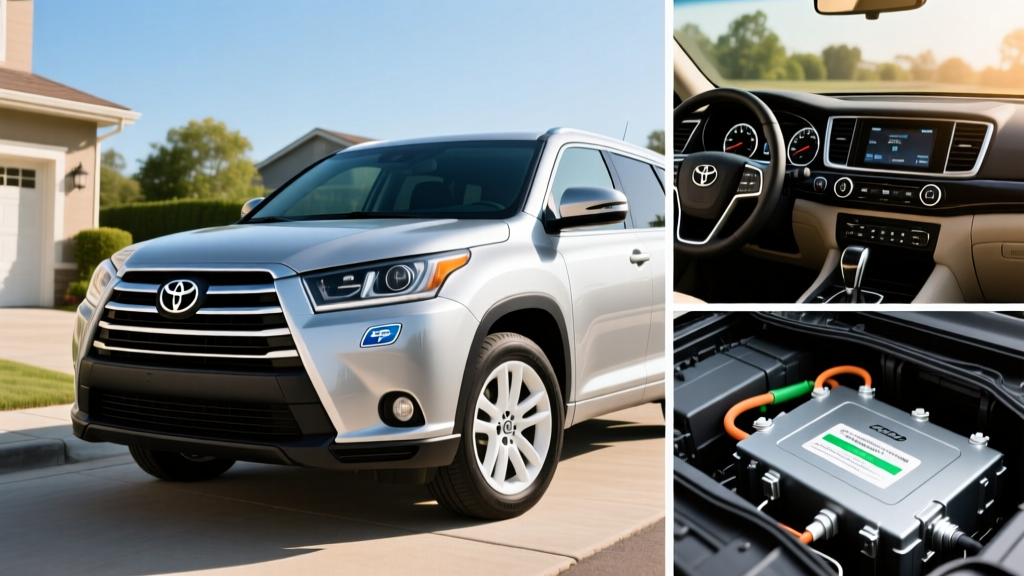
The 2014 Toyota Highlander Hybrid remains one of the most dependable three-row hybrid SUVs on the used market. With an EPA-estimated 28 MPG combined, standard all-wheel drive, and Toyota's reputation for hybrid powertrain longevity, it's a pragmatic choice for families who want fuel savings without plugging in. A decade after its launch, the third-generation Highlander Hybrid's 3.5-liter V6 paired with Toyota's Hybrid Synergy Drive continues to post respectable numbers at the pump — and its hybrid battery is proving far more durable than early skeptics predicted.
This guide covers everything a 2026 used-car buyer needs to know: real-world MPG, battery health expectations, replacement costs, and how this conventional hybrid (HEV) stacks up against modern PHEVs and full EVs.
HEV vs PHEV: What the 2014 Highlander Hybrid Actually Is
The 2014 Highlander Hybrid is a conventional hybrid (HEV), not a plug-in hybrid (PHEV). This is a critical distinction for buyers cross-shopping electrified vehicles:
| Feature | HEV (2014 Highlander Hybrid) | PHEV (e.g., 2026 RAV4 Prime) | BEV (e.g., 2026 Tesla Model Y) |
|---|---|---|---|
| Plug-in charging | No — charges via engine & regen | Yes — Level 1/2 AC | Yes — Level 1/2/DC fast |
| Electric-only range | ~1 mile at low speed | 35-42 miles | 270-330 miles |
| Total range | ~530 miles | ~550 miles (gas + electric) | 270-330 miles |
| Battery size | ~1.9 kWh (NiMH) | ~18.1 kWh (lithium-ion) | 60-82 kWh (NMC/LFP) |
| Federal tax credit (new) | None | Up to $7,500 (§30D) | Up to $7,500 (§30D) |
| Used EV credit (§25E) | Not eligible | Up to $4,000 | Up to $4,000 |
The Highlander Hybrid's small nickel-metal hydride (NiMH) battery recovers energy during braking and deceleration, then assists the gas engine during acceleration. You never plug it in — it operates entirely on gasoline, just more efficiently than a conventional V6 SUV.
Fuel Economy: EPA Numbers and Real-World MPG
The EPA rates the 2014 Toyota Highlander Hybrid at the following fuel economy figures:
| Driving Cycle | EPA Estimate |
|---|---|
| City | 27 MPG |
| Highway | 28 MPG |
| Combined | 28 MPG |
Source: fueleconomy.gov
Real-World MPG: What Owners Actually Report
Toyota hybrids tend to perform close to or slightly above EPA estimates in city driving, where regenerative braking and electric-motor assist do the most work. Highway driving at sustained 70-80 MPH speeds yields slightly lower returns because the gas engine carries the full load.
- City / suburban driving: 27-30 MPG — regen braking maximizes hybrid benefit
- Highway (70-75 MPH): 25-27 MPG — less electric assist at sustained speed
- Cold weather (below 32°F): 23-25 MPG — engine runs more often for cabin heat and battery warmup
- Owner-reported average (Fuelly data): ~26.5 MPG lifetime across mixed driving
Real-world range estimate: With a 17.2-gallon fuel tank and an observed 26-28 MPG combined, expect 445-480 miles per tank in typical driving, or roughly 530 miles under ideal conditions.
Powertrain and Performance Specs
| Specification | 2014 Highlander Hybrid |
|---|---|
| Engine | 3.5L V6 Atkinson-cycle |
| Engine horsepower | 236 HP (engine only) |
| Combined net horsepower | 280 HP (engine + electric motors) |
| Electric motors | Front (167 HP) + Rear (67 HP) |
| Transmission | eCVT (planetary gearset, no belt) |
| Drivetrain | AWD-i (electric rear axle, no driveshaft) |
| 0-60 MPH | ~7.8 seconds |
| Towing capacity | 3,500 lbs |
| Battery type | NiMH (nickel-metal hydride) |
| Battery capacity | ~1.9 kWh (gross) |
| Curb weight | ~4,655 lbs |
| Seating | 7 passengers (3 rows) |
| Cargo (behind 3rd row) | 13.8 cu ft |
| Cargo (all rows folded) | 83.2 cu ft |
The AWD-i system is worth highlighting: instead of a mechanical driveshaft connecting front and rear axles, the Highlander Hybrid uses a dedicated rear electric motor that engages when slip is detected or during hard acceleration. This means fewer moving parts, less parasitic loss, and one less thing to break over 150,000+ miles.
Hybrid Battery Longevity and Replacement Cost
Original battery warranty: 8 years / 100,000 miles (10 years / 150,000 miles in CARB states including CA, CT, ME, MA, NJ, NY, OR, RI, VT, WA). Since the 2014 model year, the original warranty has expired for most owners unless the vehicle was registered in a CARB state and driven under 150,000 miles.
How Long Does the NiMH Battery Last?
Toyota's NiMH hybrid batteries have an exceptional track record. Data from owner communities and fleet reports show:
- Typical lifespan: 150,000-200,000+ miles before significant degradation
- Failure mode: Gradual capacity loss (reduced MPG, more engine cycling) rather than sudden failure
- 12-year real-world data: Many 2014 Highlander Hybrids still running on original batteries at 160,000+ miles with minimal MPG loss
The NiMH chemistry is less energy-dense than modern lithium-ion but is remarkably tolerant of the shallow charge-discharge cycles that hybrid duty imposes. Toyota's battery management system keeps the pack between roughly 40-80% state of charge, avoiding the extremes that accelerate degradation.
Hybrid Battery Replacement Cost (2026 Pricing)
| Option | Cost Range | Notes |
|---|---|---|
| New OEM Toyota battery | $3,500 - $4,500 (parts + labor) | Dealership; full warranty |
| Remanufactured battery | $1,800 - $2,800 | Replaced weak cells; 1-3 yr warranty |
| Used/salvage battery | $800 - $1,500 | Risky; unknown SoH; short warranty |
| Individual cell/module replacement | $400 - $900 | Independent hybrid specialist; requires diagnostics |
For a 2014 model now worth roughly $10,000-$16,000 depending on mileage and condition, a remanufactured battery at $2,000-$2,800 is the most cost-effective path if the original pack fails. Independent hybrid shops in most metro areas can perform this service.
Pricing and Tax Credit Eligibility in 2026
Used Market Pricing
As of early 2026, the 2014 Toyota Highlander Hybrid trades in the used market at approximately:
- 100,000-130,000 miles: $12,000 - $15,000
- 130,000-170,000 miles: $9,500 - $12,500
- 170,000+ miles: $7,500 - $10,000
Prices vary significantly by region, trim level (Limited was the primary trim), accident history, and documented hybrid-battery health.
Tax Credit Status
The 2014 Highlander Hybrid does not qualify for any current federal tax credit:
- §30D New Clean Vehicle Credit: Not applicable — this is a used vehicle, and the credit was not structured for HEVs at the time of sale.
- §25E Used Clean Vehicle Credit: This credit (up to $4,000 or 30% of sale price) applies only to used BEVs and PHEVs with a minimum 4 kWh battery capacity that are sold through a dealer. Conventional hybrids like the Highlander Hybrid are excluded under IRS §25E rules.
Some states offer registration incentives or HOV-lane access for hybrids, but these vary by jurisdiction. Check your state's DMV or energy office for current programs.
Who Should Buy the 2014 Highlander Hybrid in 2026?
Pros
- 28 MPG combined in a 7-passenger AWD SUV — still competitive
- Proven NiMH battery with 150K-200K+ mile lifespan
- AWD-i system with no mechanical driveshaft to fail
- Strong Toyota reliability; abundant parts and service network
- 3,500-lb towing capacity
- No plug-in required — works with any gasoline infrastructure
Cons
- NiMH battery is dated; replacement cost is $2K-$4.5K if it fails
- No electric-only driving beyond ~1 mile at low speed
- 13.8 cu ft cargo behind 3rd row is tight for the class
- eCVT drone under hard acceleration (no stepped gears)
- Outdated infotainment; no Apple CarPlay or Android Auto
- No federal tax credit eligibility (new or used)
Decision Framework
Choose the 2014 Highlander Hybrid if:
- You need three rows and AWD but want to keep fuel costs around $1,800-$2,200/year (at 15,000 miles/year and $3.50/gal)
- You lack access to home or workplace charging (no plug required)
- You want a vehicle likely to reach 200,000+ miles with basic maintenance
- Your budget is $10,000-$15,000 for a used family SUV
Look at a PHEV (e.g., 2026 RAV4 Prime, Kia Sorento PHEV) if:
- You have home Level 2 charging and a commute under 35 miles — you could drive months without using gas
- You want the §30D $7,500 credit on a new purchase or the §25E $4,000 credit on a used PHEV
Look at a full BEV (e.g., Tesla Model Y, Hyundai Ioniq 5) if:
- You want zero gasoline, lower per-mile energy cost (~$0.04-$0.06/mile on home electricity vs ~$0.13/mile on gas)
- You have reliable home charging and your daily driving is under 250 miles
Pre-Purchase Inspection Checklist for Used Highlander Hybrids
Before buying a 2014 Highlander Hybrid with 100,000+ miles, verify these hybrid-specific items:
- Hybrid battery health check: Ask a Toyota dealer or hybrid specialist to run a battery health diagnostic. Look for voltage delta between modules — a spread greater than 0.20V under load suggests weak cells.
- Hybrid system warning lights: Confirm no "Check Hybrid System" codes are present or recently cleared.
- Inverter coolant: The hybrid inverter has its own coolant loop. Verify it was flushed per schedule (~100,000 miles).
- Brake actuator: Toyota's regenerative brake actuator has known failure points on this generation. Listen for abnormal pump cycling when pressing the brake pedal at standstill.
- 12V auxiliary battery: Located in the rear cargo area. A weak 12V battery can prevent the hybrid system from booting — a $200 fix, but worth knowing.
- AWD-i rear motor: Confirm the rear electric motor engages. On a wet or gravel surface, accelerate from stop — the rear axle should contribute.
Frequently Asked Questions
How many MPG does the 2014 Toyota Highlander Hybrid get?
The EPA rates it at 27 city / 28 highway / 28 combined. Real-world driving typically yields 25-30 MPG depending on conditions, with city driving often matching or slightly exceeding the EPA estimate thanks to regenerative braking.
Does the 2014 Highlander Hybrid need to be plugged in?
No. It is a conventional hybrid (HEV), not a plug-in hybrid. The battery charges through regenerative braking and the gasoline engine. There is no charging port.
How long does the hybrid battery last?
Toyota's NiMH hybrid batteries routinely last 150,000-200,000+ miles. Many 2014 Highlander Hybrids are still on their original battery packs at 12 years old. Failure is typically gradual (reduced MPG) rather than sudden.
What does a replacement hybrid battery cost?
A new OEM battery runs $3,500-$4,500 installed at a dealer. Remanufactured batteries cost $1,800-$2,800 and are the most popular choice for a vehicle of this age. Individual module replacement at a hybrid specialist can cost as little as $400-$900 if only a few cells are weak.
Does the 2014 Highlander Hybrid qualify for any tax credit?
No. Conventional hybrids are not eligible for the federal §30D new vehicle credit or the §25E used clean vehicle credit. Only plug-in hybrids (PHEVs) and battery electric vehicles (BEVs) with at least 4 kWh of battery capacity qualify. Check your state for any local hybrid incentives.
Is the 2014 Highlander Hybrid reliable?
Yes. The 3.5L V6 (2GR-FXE) and Toyota's Hybrid Synergy Drive are among the most proven powertrains in production. The eCVT has no belt or clutch packs to wear out — it uses a planetary gearset. NHTSA and owner surveys consistently rank this generation highly for long-term reliability. See NHTSA safety data for crash ratings and recalls.
How does it compare to a modern hybrid SUV?
Current models like the 2026 Toyota Grand Highlander Hybrid (36 MPG combined) and Hyundai Santa Fe Hybrid (34 MPG combined) offer meaningfully better fuel economy thanks to more efficient engines and lithium-ion batteries. However, they cost $40,000-$50,000 new. At $10,000-$15,000, the 2014 Highlander Hybrid delivers strong value per dollar for a three-row AWD SUV.
Can I tow with the 2014 Highlander Hybrid?
Yes — it's rated for 3,500 lbs, which covers a small boat trailer, utility trailer, or a pair of jet skis. The hybrid system's combined 280 HP provides adequate power for light towing, though expect fuel economy to drop to 18-22 MPG when pulling a load.