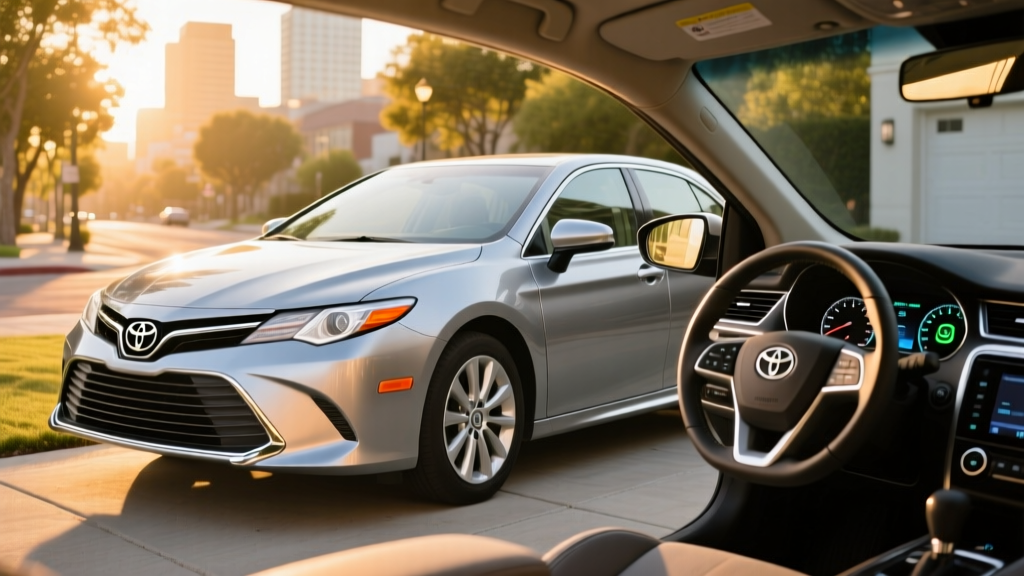
If you are shopping the used midsize-sedan market for a fuel-sipping daily driver, the 2014 Toyota Camry Hybrid XLE sedan is one of the most researched nameplates for good reason. It pairs Toyota's proven Hybrid Synergy Drive with the top-tier XLE trim's comfort features, delivering EPA-rated 40 MPG combined without ever needing a plug. But with these cars now crossing the 10-year mark, the real questions shift from sticker MPG to battery longevity, replacement cost, and whether a decade-old hybrid still makes financial sense versus a newer EV or gas alternative.
This guide breaks down every number that matters — EPA and real-world fuel economy, powertrain output, hybrid battery warranty and failure cost, and a clear framework for deciding whether this HEV fits your garage in 2026.
HEV vs PHEV: What the 2014 Camry Hybrid Actually Is
Before diving into specs, it is critical to understand what you are buying. The 2014 Camry Hybrid is a conventional hybrid electric vehicle (HEV), not a plug-in hybrid (PHEV). This distinction changes how you use and maintain the car:
| Feature | HEV (2014 Camry Hybrid) | PHEV (e.g., Prius Prime) | BEV (e.g., Tesla Model 3) |
|---|---|---|---|
| Plug-in charging required? | No — self-charging via regen & engine | Yes — Level 1/2 for EV range | Yes — Level 2/DC fast charging |
| Electric-only range | ~1 mile at low speed | 25–44 miles (typical) | 250–360+ miles |
| Total range | ~570 miles (17 gal tank) | 400–600 miles combined | 250–360+ miles |
| Federal tax credit (new) | None (expired long ago) | Up to $7,500 (§30D, if eligible) | Up to $7,500 (§30D, if eligible) |
| Used EV credit (§25E) | Not eligible | Eligible if ≤$25,000 sale price | Eligible if ≤$25,000 sale price |
The Camry Hybrid captures energy through regenerative braking and its gasoline engine to keep a small traction battery charged. You simply fill it with gas and drive. There is no plug, no charging cable, and no electric-only commute to plan around. For buyers without home charging access, this simplicity is the entire appeal.
Fuel Economy: EPA Ratings vs Real-World MPG
The EPA rates the 2014 Toyota Camry Hybrid (LE and XLE trims share the same powertrain) at:
| Cycle | EPA Rating | Real-World Expectation |
|---|---|---|
| City | 40 MPG | 38–43 MPG (hybrids often beat EPA in stop-and-go) |
| Highway | 38 MPG | 34–38 MPG (sustained 70+ mph reduces regen benefit) |
| Combined | 40 MPG | 36–41 MPG depending on driving mix |
Source: fueleconomy.gov — 2014 Toyota Camry Hybrid
Toyota's Hybrid Synergy Drive shines in city traffic, where the electric motor handles low-speed launches and the engine shuts off at stops. In real-world ownership, many drivers report exceeding the 40 MPG city figure on commutes heavy with stoplights and congestion. Highway efficiency drops because the 2.5-liter Atkinson-cycle engine carries more of the load at sustained speeds, and the aerodynamic profile of a midsize sedan creates more drag than a purpose-built hybrid like the Prius.
With the 17.0-gallon fuel tank, expect a real-world total range of roughly 540–620 miles between fill-ups — enough for most drivers to visit a gas station once every two weeks.
Powertrain and Performance Specs
| Specification | 2014 Camry Hybrid XLE |
|---|---|
| Engine | 2.5L 4-cylinder Atkinson-cycle (156 hp, 156 lb-ft) |
| Electric Motor | Permanent-magnet AC synchronous (105 kW / 141 hp) |
| Net Combined System Output | 200 hp |
| Transmission | eCVT (electronically controlled continuously variable) |
| Hybrid Battery | 1.6 kWh nickel-metal hydride (NiMH), sealed, air-cooled |
| 0–60 mph | ~7.6 seconds (Motor Trend tested) |
| Drivetrain | Front-wheel drive |
| Curb Weight | ~3,435 lbs |
| Fuel Tank | 17.0 gallons (regular 87 octane) |
| EPA Combined MPG | 40 MPG |
The 200 net horsepower figure is competitive with the 4-cylinder gas Camry of the same year (178 hp) and gives the Hybrid XLE adequate passing power on the highway. The eCVT is not a belt-and-pulley CVT — it uses a planetary gearset to blend engine and motor power, which means there is no belt to fail and no rubbery "drone" under acceleration typical of some competitors. Acceleration feels linear and immediate off the line thanks to the electric motor's instant torque.
XLE Trim: What You Get Over the LE
The XLE was the top trim for the 2014 Camry Hybrid, and it adds meaningful comfort and technology over the base LE Hybrid:
- Smart Key System with push-button start and proximity entry on all four doors
- Leather-trimmed seats with heated front seats (8-way power driver, 4-way power passenger)
- Auto-dimming rearview mirror with HomeLink universal transceiver
- Blind Spot Monitor (BSM) with Rear Cross-Traffic Alert (RCTA)
- Upgraded JBL audio (on equipped examples) with 10 speakers
- Dual-zone automatic climate control
- 17-inch alloy wheels with lower-rolling-resistance tires
On the used market in 2026, the XLE trim typically commands a $1,000–$2,000 premium over the LE Hybrid in equivalent condition. The BSM/RCTA and leather are the features that hold value best.
Hybrid Battery Longevity, Warranty, and Replacement Cost
This is the single biggest concern for any used-hybrid buyer, and it deserves a thorough answer.
Original Hybrid Battery Warranty (When New)
- Federal emissions states: 8 years / 100,000 miles
- CARB states (CA, NY, MA, and others): 10 years / 150,000 miles
- Coverage: Defects and capacity loss below a Toyota-defined threshold
For a 2014 model, the original hybrid battery warranty has now expired for all owners regardless of mileage or state. You are on your own for battery replacement costs. Here is what that looks like in practice:
| Replacement Option | Estimated Cost (2026) | Warranty on Replacement |
|---|---|---|
| New OEM Toyota NiMH battery (dealer) | $3,500–$4,500 installed | 3 years / 36,000 miles |
| Refurbished/reconditioned battery | $1,500–$2,500 installed | 1–3 years (varies by shop) |
| Individual module replacement (cell-level repair) | $500–$1,200 | Often none; specialist shops only |
| Used/salvage battery from wrecking yard | $800–$1,500 installed | 30–90 days typical |
The good news: Toyota's NiMH hybrid batteries from this generation have proven remarkably durable. Data from owner communities and fleet reports show many 2012–2017 Camry Hybrids reaching 180,000–250,000 miles on the original battery pack. The NiMH chemistry degrades more gracefully than early lithium-ion packs, losing capacity slowly rather than failing catastrophically. When a cell does weaken, specialist hybrid shops can now replace individual modules rather than the entire pack, keeping costs manageable.
Before buying any used 2014 Camry Hybrid, request a hybrid battery health check from a Toyota dealer or qualified hybrid specialist. They can read the State of Health (SoH) via the OBD-II port using Toyota's Techstream diagnostic software. Look for less than 15–20% capacity loss as a healthy baseline for a 10-year-old pack.
Tax Credits and Incentives in 2026
Because the 2014 Camry Hybrid is a conventional HEV (not a PHEV or BEV), it does not qualify for the federal §30D Clean Vehicle Credit, which applies only to plug-in vehicles meeting battery sourcing, MSRP cap, and buyer income requirements per IRS guidelines.
It also does not qualify for the §25E Used Clean Vehicle Credit, which requires a plug-in electric or fuel-cell vehicle sold for $25,000 or less.
Some states offer minor incentives for used hybrid purchases (reduced registration fees, HOV lane access in certain states for hybrids purchased during qualifying periods), but these are increasingly rare and targeted at plug-in vehicles. Check your state's DMV or energy office for current programs. There is no meaningful financial incentive at the federal level to buy this car in 2026 — the value proposition is purely the low fuel cost.
Reliability and Ownership Costs
The 2014 Camry Hybrid benefits from Toyota's reputation for durability and the mechanical simplicity of its hybrid system. Key reliability notes:
- eCVT transmission: The planetary gearset design has no clutch packs, belts, or torque converter to wear out. Failures are extremely rare when fluid is changed per the maintenance schedule (~60,000-mile intervals).
- Brake pads: Regenerative braking handles much of the deceleration, so friction brake pads often last 70,000–100,000 miles — roughly double a conventional Camry.
- 12V auxiliary battery: Like any car, the standard 12V lead-acid battery will need replacement every 4–6 years (~$150–$200). This is separate from the high-voltage hybrid battery.
- Engine: The 2AR-FXE 2.5L Atkinson-cycle engine is a detuned variant of Toyota's widely used 2AR-FE. Timing chain (not belt), no turbo, and minimal stress from the hybrid system mean 200,000+ mile engine life is common with regular oil changes.
According to NHTSA, the 2014 Camry Hybrid has no major recurring safety recalls specific to the hybrid system. Always run the VIN through NHTSA's recall lookup before purchasing.
Who Should Buy This Hybrid vs an EV or Gas Car?
Choose the 2014 Camry Hybrid XLE if:
- You drive 12,000–20,000 miles/year, mostly city or suburban, and want to minimize fuel cost without plugging in
- You lack access to home Level 2 charging (apartment, street parking, no garage)
- Your budget is $8,000–$14,000 for a reliable daily driver with low operating cost
- You want a proven, low-risk ownership experience with abundant parts and repair knowledge
Choose a PHEV (e.g., Prius Prime, RAV4 Prime) if:
- You have home charging and a short commute (under 30 miles) that could be fully electric
- You want some EV driving feel and the flexibility of gas for road trips
- You can spend $25,000–$45,000 and potentially qualify for the §25E used EV credit ($4,000)
Choose a full BEV if:
- You have reliable home Level 2 charging and your daily driving is under 250 miles
- You want zero tailpipe emissions, minimal maintenance, and the lowest per-mile energy cost
- You are willing to spend $25,000+ for a used EV and can benefit from the §25E credit
Choose a conventional gas Camry if:
- You drive mostly highway miles (where the hybrid's MPG advantage shrinks to ~5–7 MPG)
- Your budget is tight and you want the lowest possible purchase price ($6,000–$10,000)
- You plan to keep the car under 3 years and want to avoid hybrid battery replacement risk entirely
Pros
- 40 MPG combined EPA — real-world city often exceeds 40
- No plug-in charging required; works with any gas station
- Proven NiMH battery durability (180K–250K mi typical lifespan)
- XLE trim adds leather, BSM, heated seats, Smart Key
- Low brake wear thanks to regenerative braking
- Strong resale value and parts availability
Cons
- Hybrid battery warranty expired; replacement is $1,500–$4,500 out of pocket
- No federal or state tax credit eligibility in 2026
- Highway MPG drops to mid-30s at sustained 70+ mph speeds
- Infotainment is dated (no Apple CarPlay/Android Auto without aftermarket head unit)
- eCVT acceleration feel is smooth but uninspiring
- NiMH battery is heavier and less energy-dense than modern lithium-ion
Frequently Asked Questions
How many MPG does the 2014 Toyota Camry Hybrid XLE get?
The EPA rates it at 40 city / 38 highway / 40 combined MPG. In real-world city-heavy driving, many owners report 38–43 MPG. Highway-only trips at 75 mph may drop to 34–36 MPG. With the 17-gallon tank, expect 540–620 miles of total range.
Does the 2014 Camry Hybrid need to be plugged in?
No. This is a conventional hybrid (HEV), not a plug-in. The battery charges itself through regenerative braking and the gasoline engine. You never plug it in — just fill it with regular 87-octane gasoline.
How long does the hybrid battery last, and what does replacement cost?
Toyota's NiMH hybrid batteries in this generation commonly last 180,000–250,000 miles before significant degradation. The original 8-year/100,000-mile warranty (10 years/150,000 in CARB states) has expired for all 2014 models. Replacement costs range from $500–$1,200 for individual cell repair to $3,500–$4,500 for a new OEM battery at a dealer.
Is the 2014 Camry Hybrid reliable?
Yes. The 2AR-FXE engine, planetary eCVT, and NiMH battery are among the most proven hybrid components in the industry. With regular maintenance (oil changes, eCVT fluid service, cabin air filter), these cars routinely reach 200,000+ miles with minimal major repairs. The main risk on a 10-year-old example is hybrid battery age — get a pre-purchase battery health check.
Does it qualify for any tax credit in 2026?
No. Conventional hybrids like the Camry Hybrid do not qualify for the federal §30D new vehicle credit or the §25E used clean vehicle credit. Those programs are limited to plug-in electric vehicles (PHEVs and BEVs) and fuel-cell vehicles. The Camry Hybrid's financial benefit comes entirely from fuel savings, not incentives.
What should I check before buying a used 2014 Camry Hybrid?
Prioritize a hybrid battery State of Health (SoH) diagnostic via OBD-II, a full maintenance history (especially eCVT fluid changes), and a standard pre-purchase inspection. Verify the VIN against NHTSA's recall database to confirm all safety recalls were addressed. Check for rust in the undercarriage if the car was driven in salt-belt states.
How does the 2014 Camry Hybrid compare to a 2014 Prius?
The Prius rates higher on EPA fuel economy (50 MPG combined) but is smaller, slower, and less refined on the highway. The Camry Hybrid trades ~10 MPG for a significantly quieter cabin, more rear-seat and trunk space, a smoother ride, and the XLE's premium features. If comfort and highway manners matter more than squeezing every last mile per gallon, the Camry Hybrid is the better daily driver.