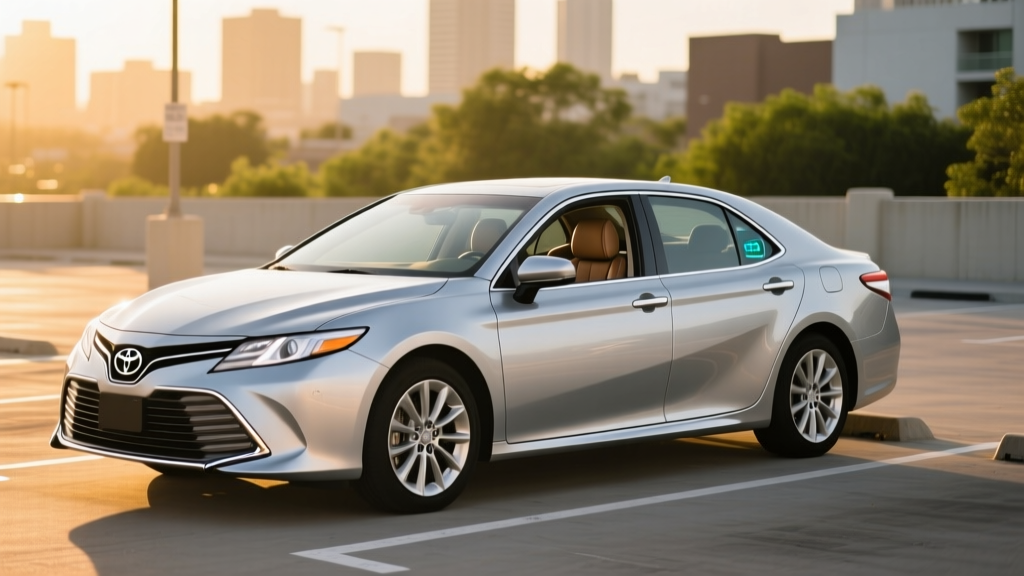
Quick Verdict: The 2014 Toyota Camry Hybrid in 2026
More than a decade after it rolled off the assembly line, the 2014 Toyota Camry Hybrid remains one of the most sensible used hybrid sedans you can buy. With an EPA-rated 41 MPG combined, a bulletproof 2.5-liter Atkinson-cycle powertrain, and a track record of nickel-metal hydride (NiMH) battery packs lasting well past 150,000 miles, this car is a case study in hybrid longevity. If you are shopping the used market for a fuel-sipping commuter that requires no plug, no range anxiety, and minimal maintenance beyond standard service, the 2014 Camry Hybrid deserves a serious look.
But buying a 12-year-old hybrid means confronting the battery question head-on. This guide covers everything you need to know: real-world MPG, battery lifespan and replacement costs, how this conventional hybrid (HEV) differs from plug-in alternatives, and whether it still stacks up against newer hybrids and EVs in 2026.
HEV vs PHEV vs EV: Where the 2014 Camry Hybrid Fits
The 2014 Toyota Camry Hybrid is a conventional hybrid (HEV). It cannot be plugged in. It has no electric-only driving range to speak of. It recharges its small battery pack entirely through regenerative braking and the gasoline engine. If you are looking for plug-in capability, Toyota offered the Camry Hybrid as an HEV only in 2014 — there was no plug-in Camry variant that year.
Understanding the distinction matters for your daily routine and your budget:
| Feature | HEV (2014 Camry Hybrid) | PHEV (e.g., 2026 RAV4 Prime) | BEV (e.g., 2026 Tesla Model 3) |
|---|---|---|---|
| Plug-in required? | No | Yes (optional) | Yes (mandatory) |
| Electric-only range | ~0.5 mi at low speed | 25–42 mi typical | 250–360 mi typical |
| Home charging needed? | No | Recommended (Level 2) | Essential |
| Fuel | Gasoline only | Gasoline + electricity | Electricity only |
| Tailpipe emissions | Low (still burns gas) | Low to zero (depends on mode) | Zero |
| Federal tax credit (new) | None | Up to $7,500 (§30D) | Up to $7,500 (§30D) |
| Used price range (2026) | $8,000–$14,000 | $25,000–$40,000 | $15,000–$35,000 |
For buyers who lack access to home or workplace charging — apartment dwellers, street parkers, those in rural areas with sparse charging infrastructure — the HEV architecture of the 2014 Camry Hybrid is a genuine advantage. You fuel it like any other car and let the hybrid system handle the rest.
Fuel Economy: EPA Ratings vs Real-World MPG
The EPA rates the 2014 Toyota Camry Hybrid at 40 MPG city / 38 MPG highway / 40 MPG combined for the LE trim. The XLE trim, with its slightly heavier equipment load, drops to 40 city / 38 highway / 39 combined, according to fueleconomy.gov.
| Trim | City MPG | Highway MPG | Combined MPG |
|---|---|---|---|
| LE | 40 | 38 | 40 |
| XLE | 40 | 38 | 39 |
Real-World MPG: What Owners Actually Report
Hybrids routinely beat their EPA city estimates in stop-and-go traffic, where regenerative braking recaptures energy that a gas-only car wastes as heat. The 2014 Camry Hybrid is no exception. Owner-reported data on Fuelly and similar platforms shows many drivers averaging 42–45 MPG in mixed city-heavy commutes, while sustained highway driving at 75+ MPH can dip to 35–37 MPG.
Real-World Expectation: In temperate conditions with a mix of city and suburban driving, expect 40–43 MPG combined. In winter or on long highway trips at high speed, plan for 35–38 MPG. Cold weather reduces battery efficiency and increases engine idling for cabin heat, cutting fuel economy by 10–15%.
With a 17.2-gallon fuel tank, that translates to roughly 600–680 miles of real-world range between fill-ups — competitive with many modern EVs and far less stressful to replenish at any gas station.
Powertrain Specs: Engine, Motor, and Combined Output
| Specification | 2014 Toyota Camry Hybrid |
|---|---|
| Engine | 2.5L 4-cyl Atkinson-cycle |
| Engine horsepower | 156 hp @ 5,700 rpm |
| Electric motor output | 105 kW (141 hp) |
| Net combined system hp | 200 hp |
| Transmission | eCVT (planetary gearset) |
| Drivetrain | Front-wheel drive |
| 0–60 mph | ~7.6 seconds |
| Hybrid battery type | NiMH (nickel-metal hydride) |
| Hybrid battery capacity | ~1.6 kWh (gross) |
| Curb weight | ~3,435 lbs (LE) |
| Fuel tank | 17.2 gallons |
| EPA combined MPG | 40 (LE) / 39 (XLE) |
The 200-hp combined output made the 2014 Camry Hybrid one of the more powerful midsize hybrid sedans of its era. The eCVT is not a belt-driven continuously variable transmission — it uses a planetary gearset that seamlessly blends engine and motor power with no rubber bands or shifting clunks. This design is remarkably durable; eCVT failures are rare compared to conventional automatic or belt-CVT transmissions.
The NiMH battery pack, at roughly 1.6 kWh gross, is tiny by modern standards. A 2026 plug-in hybrid might carry 18–20 kWh. But the Camry Hybrid's pack doesn't need to store much energy — it acts as a buffer, capturing braking energy and deploying it for electric assist during acceleration. Toyota's Hybrid Synergy Drive system manages this cycle thousands of times per drive, keeping the battery in a narrow state-of-charge window that minimizes degradation.
Battery Lifespan, Warranty, and Replacement Cost
This is the question every used hybrid buyer asks first. The 2014 Camry Hybrid's NiMH battery pack was originally covered by Toyota's hybrid battery warranty: 8 years / 100,000 miles (10 years / 150,000 miles in California Air Resources Board states including CA, NY, MA, CT, RI, VT, ME, NH, NJ, OR, WA, and MD).
Warranty status in 2026: The original factory hybrid battery warranty has expired for virtually every 2014 Camry Hybrid on the road. Any battery failure is an out-of-pocket expense unless you purchased an extended warranty that specifically covers the hybrid battery.
How Long Do These Batteries Actually Last?
Toyota's NiMH hybrid batteries have a strong longevity record. Data from owner communities and fleet operators indicates that most 2014 Camry Hybrid battery packs reach 150,000–200,000 miles before significant capacity loss triggers a check-hybrid-system warning. Many exceed 200,000 miles with proper care. The NiMH chemistry degrades more gracefully than early lithium-ion packs — you typically see a gradual decline in fuel economy (perhaps 2–4 MPG loss) rather than a sudden failure.
Battery Replacement Cost
If your battery does fail, here is what you can expect to pay in 2026:
- New OEM Toyota battery pack: $2,500–$3,500 (parts) + $500–$1,000 (labor) = $3,000–$4,500 installed
- Refurbished/remanufactured pack: $1,200–$2,000 (parts) + $500–$800 (labor) = $1,700–$2,800 installed
- Individual cell/module replacement: Some independent hybrid specialists can diagnose and swap failed modules within the pack for $500–$1,200, though this is a temporary fix if other modules are also aging
Given that a clean 2014 Camry Hybrid sells for $8,000–$14,000 in 2026, a full OEM battery replacement at $4,000+ can represent 30–50% of the car's value. This is the single biggest financial risk of buying a high-mileage used hybrid. Before purchasing, have the hybrid battery's state of health checked using a scan tool that reads individual module voltages — a healthy pack shows modules within 0.2V of each other.
Pricing, Tax Credits, and Total Cost of Ownership
Used Market Pricing (2026)
Based on current used-car market data, expect to pay:
- High-mileage (150k+ miles, fair condition): $6,500–$9,000
- Average mileage (100k–140k, good condition): $9,000–$12,000
- Low-mileage (under 80k, excellent condition): $12,000–$15,000
Does the 2014 Camry Hybrid Qualify for Any Tax Credit?
No. The federal §30D clean vehicle credit applies only to new qualifying plug-in electric vehicles (PHEVs and BEVs) and, under separate rules, to used EVs and PHEVs (the §25E used clean vehicle credit, capped at $4,000 or 30% of sale price, whichever is less). Conventional hybrids like the 2014 Camry Hybrid — which have no plug and no meaningful electric-only range — do not qualify for any federal tax credit, whether purchased new or used. This has been the case since the original hybrid credit provisions expired for Toyota back in 2007. Per IRS guidelines, only vehicles with a plug and sufficient battery capacity are eligible.
Some states offer rebates for used hybrids, but these are rare and typically modest ($250–$500). Check your state's energy office or DMV for current programs.
5-Year Cost of Ownership Estimate
| Expense Category | 2014 Camry Hybrid (est.) | Comparable Gas Sedan (est.) |
|---|---|---|
| Purchase price | $10,500 | $9,000 |
| Fuel (15k mi/yr, 5 yrs) | $6,200 (at $3.30/gal, 40 MPG) | $9,200 (at $3.30/gal, 27 MPG) |
| Insurance (5 yrs) | $5,500 | $5,200 |
| Maintenance (5 yrs) | $2,800 | $3,200 |
| Potential battery replacement | $0–$3,500 | $0 |
| Estimated 5-yr total | $25,000–$28,500 | $26,600 |
The fuel savings are real — roughly $3,000 over five years compared to a 27-MPG gas-only midsize sedan. But that savings can be wiped out by a single battery replacement. The math works best if you find a low-mileage example with a recently replaced battery (get documentation) or one that has already passed the 180,000-mile mark with its original pack still healthy, suggesting exceptional longevity.
Reliability and Common Issues Beyond the Battery
The 2014 Camry Hybrid benefits from Toyota's reputation for conservative engineering. The NHTSA gave it a 5-star overall safety rating, and it earned IIHS Top Safety Pick+ honors. Beyond the hybrid battery, here is what to watch for:
- Brake actuator assembly: Some 2012–2014 Camry Hybrids have experienced premature wear of the brake actuator, a $1,200–$1,800 repair. Listen for unusual buzzing from the brake pedal area at startup.
- Water pump (electric): The electric water pump can fail around 100,000–130,000 miles. Replacement runs $400–$700.
- Inverter coolant pump: Check that the inverter coolant reservoir shows turbulence when the car is in READY mode — a stagnant surface suggests pump failure.
- 12V auxiliary battery: Like any car, the 12V battery (located in the trunk) will need replacement every 4–6 years. Use an AGM-type replacement to match OEM specs.
The eCVT transmission, engine, and electric motor/generators are overwhelmingly reliable. Toyota's hybrid powertrain has accumulated billions of real-world miles across the Prius, Camry, and Highlander lineups with very few systemic failures.
Who Should Buy the 2014 Camry Hybrid (and Who Shouldn't)
Choose the 2014 Camry Hybrid if:
- You commute in heavy stop-and-go traffic where hybrids shine (40+ MPG city)
- You lack access to home or workplace charging (apartment, street parking)
- You want a proven, low-risk used car with cheap insurance and widely available parts
- You drive 12,000–20,000 miles per year and want to minimize fuel spend without going electric
- Your budget is under $15,000 and you want maximum efficiency per dollar
Look elsewhere if:
- You want electric-only driving or zero tailpipe emissions (consider a used BEV like the Chevy Bolt or Nissan Leaf)
- You want plug-in capability with some electric-only range (look at a used Toyota Prius Prime or Chevy Volt)
- You are buying a car with 180,000+ miles and cannot budget $3,000–$4,500 for a potential battery replacement
- You want modern ADAS features like automatic emergency braking or lane-keeping assist — the 2014 Camry Hybrid predates these as standard equipment
Pros
- 40 MPG combined EPA; 42–45 MPG real-world in city driving
- 200 hp — adequate highway merging and passing power
- Spacious cabin, large trunk (13.1 cu ft), comfortable ride
- No plug-in required — zero charging infrastructure dependency
- Proven eCVT and Hybrid Synergy Drive reliability
- Low insurance and maintenance costs
- Strong resale value relative to non-hybrid competitors
Cons
- Hybrid battery replacement is a $3,000–$4,500 risk
- No federal tax credit available (new or used)
- Dated infotainment — no Apple CarPlay or Android Auto
- Pre-dates standard automatic emergency braking
- NiMH battery less efficient than modern lithium-ion hybrid packs
- Highway MPG drops noticeably at 75+ MPH
Frequently Asked Questions
How many MPG does the 2014 Toyota Camry Hybrid get?
The EPA rates it at 40 city / 38 highway / 40 combined for the LE trim, and 40/38/39 for the XLE. In real-world city-heavy driving, many owners report 42–45 MPG. Highway-only driving at high speed drops to 35–37 MPG.
Does the 2014 Camry Hybrid need to be plugged in?
No. It is a conventional hybrid (HEV), not a plug-in hybrid. The battery recharges through regenerative braking and the gasoline engine. You fuel it exclusively at gas stations.
How far can the 2014 Camry Hybrid go on electric only?
Effectively zero miles in practical terms. The hybrid system can propel the car on electric power alone for roughly half a mile at very low speeds (under 25 MPH) on a full battery charge, but this is not a usable electric-only range. The system is designed for electric assist, not electric-only driving.
Is the 2014 Camry Hybrid reliable, and what does a battery replacement cost?
Yes, it is widely regarded as one of the most reliable midsize sedans of its era. The NiMH hybrid battery typically lasts 150,000–200,000+ miles. A new OEM replacement costs $3,000–$4,500 installed; a refurbished pack runs $1,700–$2,800 installed.
Does the 2014 Toyota Camry Hybrid qualify for any tax credit?
No. Federal clean vehicle tax credits (§30D for new, §25E for used) apply only to plug-in electric vehicles (PHEVs and BEVs). Conventional hybrids are not eligible. The original hybrid-specific credit for Toyota vehicles expired in 2007.
How does the 2014 Camry Hybrid compare to a newer hybrid like the 2026 Camry Hybrid?
The 2026 Camry Hybrid (5th generation) uses a lithium-ion battery, produces 225 hp, and achieves an EPA 52 MPG combined — a significant improvement. However, a used 2026 model will cost $28,000–$35,000, versus $8,000–$14,000 for the 2014. If your budget is tight and you can accept the battery risk, the 2014 delivers 75% of the efficiency for 35% of the price.
What should I check before buying a used 2014 Camry Hybrid?
Have a qualified mechanic or hybrid specialist perform a hybrid battery health check (individual module voltage readings). Verify the brake actuator is functioning normally. Check for inverter coolant flow. Review maintenance records for water pump and 12V battery replacements. Confirm there are no outstanding recalls via the NHTSA VIN lookup tool.