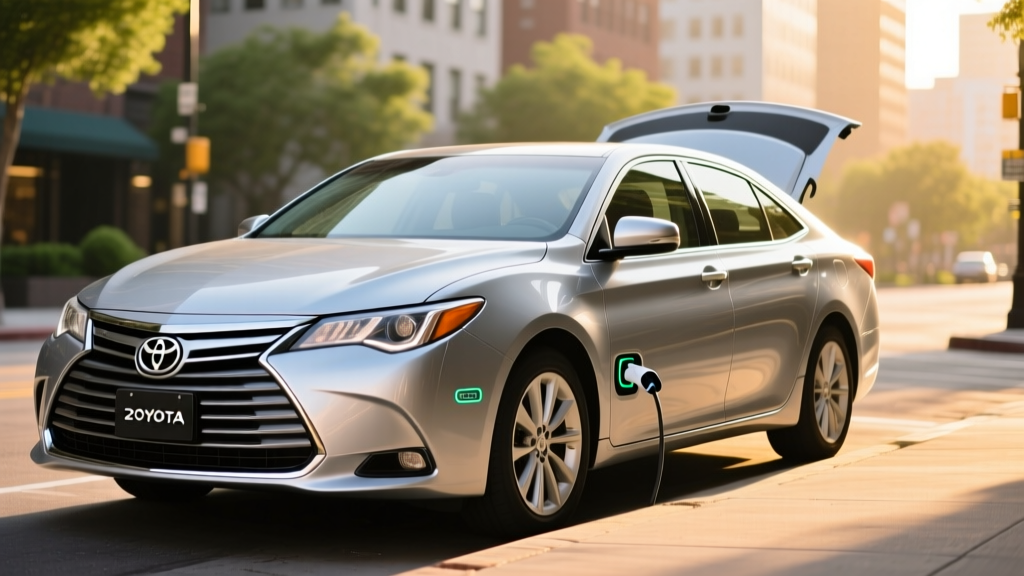
The 2014 Toyota Avalon Hybrid occupies a specific niche in the used-car market: a full-size sedan that delivers midsize fuel economy without requiring a plug, a charging routine, or any change in driving habits. More than a decade after its debut, it remains a popular search for buyers who want Toyota's hybrid reliability in a spacious, comfortable package. But with the EV and PHEV landscape shifting dramatically by 2026, does a 12-year-old conventional hybrid still make financial sense?
This guide covers the exact EPA fuel economy figures, real-world MPG expectations, hybrid battery longevity, replacement costs, and how the 2014 Avalon Hybrid stacks up against modern PHEVs and EVs for today's buyers.
HEV vs PHEV vs EV: Where the 2014 Avalon Hybrid Fits
Before examining specs, it is critical to understand what the 2014 Avalon Hybrid is—and what it is not. It is a conventional hybrid electric vehicle (HEV), meaning it pairs a gasoline engine with a small electric motor and a compact battery that recharges through regenerative braking and engine power. You never plug it in. There is no electric-only driving range to speak of (the motor assists at low speeds for brief moments, but the engine is always the primary power source).
Quick Reference: Hybrid Types
| Feature | HEV (2014 Avalon Hybrid) | PHEV (e.g., Prius Prime) | BEV (e.g., Tesla Model 3) |
|---|---|---|---|
| Plug-in charging required? | No | Yes (Level 1/2) | Yes (Level 2/DCFC) |
| Electric-only range | ~0 miles (motor assist only) | 25–45 miles typical | 250–400+ miles |
| Battery size | 1.6 kWh (NiMH) | 8–18 kWh (Li-ion) | 50–100+ kWh (Li-ion) |
| Fuel source | Gasoline + regen | Gasoline + grid electricity | Grid electricity only |
| Federal tax credit (§30D) | Not eligible | Up to $7,500 (if eligible) | Up to $7,500 (if eligible) |
The Avalon Hybrid is for drivers who want better fuel economy with zero behavioral change. If you lack home charging access or frequently take long road trips where DC fast-charging infrastructure is sparse, the HEV approach eliminates those concerns entirely.
Fuel Economy: EPA Ratings and Real-World MPG
The 2014 Toyota Avalon Hybrid carries an EPA rating of 40 MPG city / 39 MPG highway / 40 MPG combined, according to fueleconomy.gov. These numbers were class-leading for a full-size sedan at launch and remain impressive for a vehicle of this size.
| Driving Condition | EPA Rating | Real-World Expectation |
|---|---|---|
| City | 40 MPG | 41–44 MPG (hybrids excel in stop-and-go) |
| Highway | 39 MPG | 35–38 MPG (sustained high speed reduces regen benefit) |
| Combined | 40 MPG | 38–42 MPG depending on driving mix |
| Cold weather (below 30°F) | — | 34–37 MPG (engine runs more for cabin heat) |
Why real-world city MPG often exceeds the EPA sticker: Conventional hybrids recapture kinetic energy during braking and low-speed driving, which is exactly what city commutes provide. Highway driving at 70–80 MPH relies more heavily on the gasoline engine, reducing the hybrid system's advantage. In warm-weather city driving, owners consistently report 42–45 MPG on flat terrain.
With a 17.2-gallon fuel tank, the Avalon Hybrid delivers approximately 680–700 miles of total range under mixed driving conditions—comparable to many modern EVs but with the convenience of a five-minute gas station stop.
Powertrain Specs: Engine, Motor, and Combined Output
| Specification | 2014 Toyota Avalon Hybrid |
|---|---|
| Engine | 2.5L inline-4 Atkinson-cycle |
| Engine horsepower | 156 HP @ 5,700 RPM |
| Electric motor output | 105 kW (141 HP) |
| Net combined system HP | 200 HP |
| Transmission | eCVT (planetary gearset, not a belt CVT) |
| Battery type | Nickel-Metal Hydride (NiMH) |
| Battery capacity | 1.6 kWh (gross), ~0.9 kWh usable |
| Drivetrain | Front-wheel drive |
| 0–60 MPH | ~7.8 seconds |
| Curb weight | ~3,638 lbs |
Toyota's Hybrid Synergy Drive in this generation uses a power-split device (planetary gearset) rather than a traditional belt-driven CVT. This design is mechanically simpler, more durable, and avoids the rubber-band acceleration feel associated with older CVTs. The 200 HP combined output provides adequate passing power for a 3,600-lb sedan, though it is not a performance vehicle.
The 1.6 kWh NiMH battery is small by modern standards—a contemporary PHEV like the 2026 Prius Prime carries an 13.6 kWh lithium-ion pack. However, the Avalon's battery only needs to buffer energy for regenerative braking and brief motor assist, not sustain electric-only driving. Its small size is a feature, not a limitation, for an HEV.
Hybrid Battery Longevity, Warranty, and Replacement Cost
Battery lifespan is the single most common concern for used hybrid buyers. Here is what the data shows for the 2014 Avalon Hybrid's NiMH pack:
Toyota Hybrid Battery Warranty (Original)
- Coverage: 8 years / 100,000 miles (10 years / 150,000 miles in CARB states including CA, NY, MA, and others)
- Capacity threshold: Toyota does not publish a specific degradation percentage trigger; coverage applies to battery failure or significant performance loss
- Current status for 2014 models: Original 8-year/100k warranty has expired for most vehicles; 10-year/150k CARB warranty may still apply through 2024 for low-mileage examples in qualifying states
Real-world battery lifespan: Toyota's NiMH hybrid batteries have a strong track record of lasting 150,000–200,000+ miles with gradual capacity loss. Unlike the lithium-ion packs in EVs and PHEVs, NiMH chemistry degrades more slowly under the shallow charge-discharge cycles used in HEVs. The battery management system keeps the pack between roughly 40% and 80% state of charge, avoiding the deep cycles that accelerate degradation.
Replacement cost (2026 estimates):
- New OEM Toyota battery: $2,500–$3,500 (part) + $500–$800 (labor) = $3,000–$4,300 total
- Refurbished/remanufactured battery: $1,200–$2,000 (part) + $500–$800 (labor) = $1,700–$2,800 total
- Individual cell module replacement: Some independent hybrid shops can diagnose and replace only the failed modules within the battery pack for $500–$1,000, though this is a short-term fix if other modules are aging
For a 2014 model with 120,000+ miles, budgeting $2,000–$3,000 for a potential battery replacement within the next few years is prudent. However, many examples exceed 200,000 miles on the original pack. A pre-purchase inspection that includes a hybrid battery health check (many Toyota dealers and independent hybrid specialists offer this) is strongly recommended.
Pricing and Tax Credit Eligibility in 2026
The 2014 Toyota Avalon Hybrid was originally offered in three trims with MSRP pricing of approximately $36,000–$41,000. In the 2026 used market:
- XLE trim (base): $8,500–$11,000 (80,000–120,000 miles)
- XLE Premium / Touring: $10,000–$13,500 (70,000–110,000 miles)
- Limited trim (top): $12,000–$15,500 (60,000–100,000 miles)
Federal tax credit: The 2014 Avalon Hybrid does not qualify for the federal §30D new clean vehicle credit, which applies only to new PHEVs and BEVs meeting battery-sourcing, MSRP, and buyer-income requirements per IRS guidelines. As a conventional HEV, it was never eligible for the federal EV credit even when new.
Used EV credit (§25E): The federal used clean vehicle credit (up to $4,000 or 30% of sale price, whichever is less) applies only to used BEVs and PHEVs—not conventional hybrids. The 2014 Avalon Hybrid does not qualify.
State incentives: A small number of states have offered hybrid-specific rebates or HOV lane access in the past, but most have shifted incentives toward PHEVs and BEVs. Check your state's current energy or DMV website for any residual programs. Some states offer reduced registration fees for hybrid vehicles.
Reliability, Maintenance Costs, and Common Issues
The 2014 Avalon Hybrid benefits from Toyota's reputation for hybrid system durability. The Hybrid Synergy Drive has no traditional starter motor, alternator, or accessory drive belt—components that commonly fail on gas-only vehicles. The eCVT has no clutch packs or bands to wear out. Brake pad life is significantly extended (often 80,000–100,000+ miles) because regenerative braking handles most deceleration.
Known issues to watch for:
- Hybrid battery cooling fan: The battery cooling fan filter (located behind the rear seat on the passenger side) should be cleaned regularly. A clogged filter causes the battery to overheat, accelerating degradation. This is a $15 maintenance item that many owners overlook.
- 12V auxiliary battery: Like all hybrids, the Avalon has a standard 12V battery that powers electronics. It typically lasts 4–6 years and costs $150–$250 to replace. If the 12V dies, the car will not start—even if the hybrid battery is fully charged.
- Water pump (engine): The engine coolant water pump on the 2.5L 2AR-FXE engine can fail around 100,000–130,000 miles. Replacement runs $400–$600.
- Inverter coolant pump: The hybrid inverter has its own electric coolant pump. Failure is uncommon but can cost $500–$800 to replace.
According to NHTSA records, the 2014 Avalon Hybrid has relatively few recalls and technical service bulletins compared to its peers. Toyota's hybrid-specific components have proven more reliable than conventional automatic transmissions in many cases.
2014 Avalon Hybrid vs. Modern Alternatives: Which Should You Choose?
The used-car market in 2026 offers several electrified alternatives at similar or slightly higher price points. Here is how the Avalon Hybrid compares:
| Vehicle | Typical Used Price (2026) | Combined MPG / MPGe | Plug-in? | Electric-Only Range |
|---|---|---|---|---|
| 2014 Toyota Avalon Hybrid | $9,000–$15,000 | 40 MPG | No | N/A |
| 2017–2019 Toyota Prius Prime (PHEV) | $16,000–$22,000 | 54 MPG + 133 MPGe | Yes | 25 miles |
| 2020–2022 Toyota Camry Hybrid | $18,000–$25,000 | 52 MPG | No | N/A |
| 2018–2020 Chevrolet Bolt EV (used) | $12,000–$17,000 | 118 MPGe | Yes (BEV) | 238–259 miles |
| 2019–2021 Honda Clarity PHEV | $18,000–$24,000 | 42 MPG + 110 MPGe | Yes | 47 miles |
Choose the 2014 Avalon Hybrid If:
- You lack access to home or workplace charging
- You need a full-size rear seat and large trunk (16.0 cu ft)
- You want the lowest upfront cost for a proven hybrid
- You drive 15,000+ miles/year and want predictable fuel costs
- You prefer not to manage charging routines or apps
Look at a PHEV or EV Instead If:
- You have Level 2 home charging and a short commute (<40 miles)
- You want to minimize gasoline use and emissions
- You qualify for state PHEV/EV incentives or HOV lane access
- You want a more modern infotainment and safety suite
- You plan to keep the vehicle 5+ years and want lower fuel cost per mile
Ownership Cost Snapshot: 5-Year Projection
Assuming a purchase price of $11,000, 15,000 miles/year, and $3.40/gallon regular unleaded:
| Annual Cost Category | 2014 Avalon Hybrid (40 MPG) | Comparable Gas Sedan (25 MPG) |
|---|---|---|
| Fuel (15,000 mi/yr) | $1,275 | $2,040 |
| Annual fuel savings | $765/year for the hybrid | |
| 5-year fuel cost | $6,375 | $10,200 |
| Insurance (avg.) | $1,100–$1,400/yr | $1,100–$1,400/yr |
| Maintenance (avg.) | $400–$600/yr | $500–$800/yr |
Over five years, the fuel savings alone (~$3,825) largely offset the purchase price differential between the Avalon Hybrid and a gas-only equivalent. If the hybrid battery lasts the full ownership period—which is statistically likely—the total cost of ownership is very competitive.
Frequently Asked Questions
How many MPG does the 2014 Toyota Avalon Hybrid get?
The EPA rates it at 40 MPG city / 39 MPG highway / 40 MPG combined. Real-world city driving often yields 41–45 MPG thanks to regenerative braking. Highway driving at sustained speeds typically returns 35–38 MPG. Cold weather reduces efficiency to roughly 34–37 MPG as the engine runs more frequently for cabin heat.
Does the 2014 Avalon Hybrid need to be plugged in?
No. It is a conventional hybrid (HEV), not a plug-in hybrid. The battery recharges through regenerative braking and the gasoline engine. You fuel it exactly like a regular car at any gas station.
Is the 2014 Avalon Hybrid reliable, and what does a battery replacement cost?
Toyota's hybrid systems are among the most reliable in the industry. The NiMH battery pack typically lasts 150,000–200,000+ miles. A new OEM replacement battery costs $3,000–$4,300 installed; a refurbished pack runs $1,700–$2,800 installed. Many 2014 examples still run on their original battery at 120,000+ miles.
Does the 2014 Toyota Avalon Hybrid qualify for any federal tax credit?
No. The federal §30D new clean vehicle credit and §25E used clean vehicle credit both apply only to plug-in vehicles (PHEVs and BEVs). Conventional hybrids like the Avalon Hybrid have not qualified for federal tax credits since the mid-2000s. Some states may offer minor registration-fee reductions for hybrids—check your local DMV.
How does the 2014 Avalon Hybrid compare to a modern PHEV or EV?
The Avalon Hybrid trades the electric-only range and lower per-mile fuel cost of a PHEV or EV for simplicity: no plug, no charging apps, no range planning, and a lower purchase price. If you drive long distances regularly, lack home charging, or want to minimize upfront cost, the Avalon Hybrid remains a practical choice. If you have home charging and a short commute, a used PHEV like the Prius Prime or a used EV like the Chevy Bolt will save more on fuel over time.
What should I check before buying a used 2014 Avalon Hybrid?
Request a hybrid battery health report from a Toyota dealer or qualified hybrid specialist. Verify the hybrid battery cooling fan filter has been cleaned (or clean it yourself—it takes five minutes). Check for any outstanding recalls on NHTSA's recall lookup. Confirm the 12V auxiliary battery age, and review maintenance records for the engine coolant water pump and inverter coolant system.