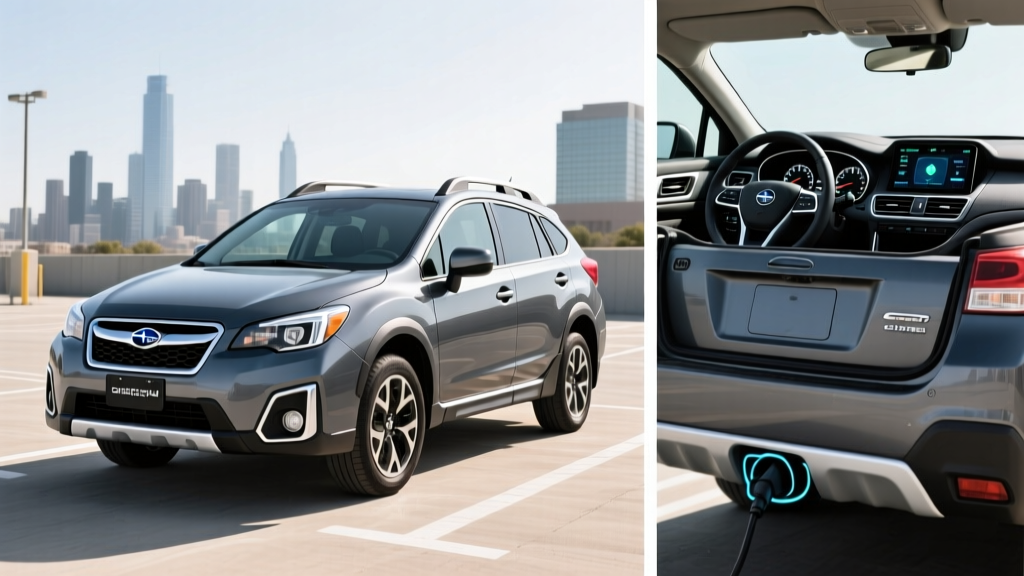
The 2014 Subaru XV Crosstrek Hybrid SUV was Subaru's first production hybrid, pairing its familiar 2.0-liter boxer engine with a modest electric motor to squeeze extra efficiency out of the brand's standard all-wheel-drive formula. More than a decade later, this compact crossover remains a fixture on the used market, attracting buyers who want Subaru's legendary AWD traction without committing to a full EV or a newer plug-in hybrid. But with a hybrid battery now well past its warranty window, the real question for 2026 shoppers isn't whether the XV Crosstrek Hybrid was a good car when new — it's whether it's still a smart buy today.
This guide breaks down the exact fuel economy, powertrain specs, battery longevity data, and ownership costs you need to evaluate a used 2014 Crosstrek Hybrid against modern alternatives.
HEV vs PHEV: What the 2014 Crosstrek Hybrid Actually Is
The 2014 Subaru XV Crosstrek Hybrid is a conventional hybrid electric vehicle (HEV), not a plug-in hybrid (PHEV). This distinction matters because it defines everything about how you own and operate the car.
| Feature | HEV (2014 Crosstrek Hybrid) | PHEV (e.g., 2024 Crosstrek Hybrid) |
|---|---|---|
| Plug-in charging | No — charges via engine and regenerative braking only | Yes — plug in for electric-only driving |
| Electric-only range | ~1 mile at very low speeds | 17 miles EPA (2024 model) |
| Battery size | 0.5 kWh (nickel-metal hydride) | 10.7 kWh (lithium-ion) |
| Federal tax credit (new) | None | Up to $7,500 (§30D, subject to eligibility) |
| Owner behavior change | None — drive like a normal gas car | Benefit from home charging routine |
As an HEV, the 2014 Crosstrek Hybrid never needs to be plugged in. The small battery recharges through the gasoline engine and regenerative braking during deceleration. You fuel it at any gas station and drive it exactly like a conventional car. The hybrid system simply makes that process more efficient by supplementing the engine with electric torque at low speeds and capturing energy that would otherwise be lost as heat during braking.
Fuel Economy: EPA Ratings vs Real-World MPG
The EPA rated the 2014 Subaru XV Crosstrek Hybrid at the following fuel economy figures:
| Driving Cycle | EPA Rating | Real-World Expectation |
|---|---|---|
| City | 29 MPG | 27–31 MPG |
| Highway | 33 MPG | 28–32 MPG |
| Combined | 31 MPG | 28–30 MPG |
Source: EPA Fuel Economy
The 2014 Crosstrek Hybrid's 31 MPG combined represented a 3 MPG improvement over the non-hybrid 2014 Crosstrek with the automatic transmission (28 MPG combined). In real-world driving, owners report that the hybrid system delivers its greatest advantage in stop-and-go city traffic, where the electric motor handles low-speed launches and the engine shuts off at stops. Highway driving at sustained speeds yields less benefit because the electric motor contributes minimally above 40 mph.
Expect slightly lower numbers if you're driving in mountainous terrain — the Crosstrek's 5,900-pound curb weight (roughly 300 pounds heavier than the gas model due to the battery and motor) works against it on long climbs. Cold-weather operation also reduces efficiency by 5–10%, consistent with all hybrids, because the engine runs more frequently to maintain cabin heat and operating temperature.
Powertrain and Performance Specs
| Specification | 2014 XV Crosstrek Hybrid |
|---|---|
| Engine | 2.0L 4-cylinder boxer (FB20) |
| Engine output | 148 HP / 145 lb-ft torque |
| Electric motor | 13.4 HP (10 kW) / 48 lb-ft torque |
| Combined system output | 160 HP |
| Transmission | Lineartronic CVT (continuously variable) |
| Drivetrain | Symmetrical All-Wheel Drive |
| Battery type | Nickel-metal hydride (NiMH) |
| Battery capacity | 0.5 kWh |
| 0–60 mph | ~10.1 seconds |
| Curb weight | ~3,395 lbs |
| Ground clearance | 8.7 inches |
| Cargo volume | 22.3 cu ft (rear seats up) |
The hybrid system's 13.4 HP electric motor sits between the engine and the CVT, integrated into the transmission housing. It provides torque fill at low RPMs where the boxer engine is weakest, giving the Crosstrek Hybrid noticeably better off-the-line acceleration than the gas model in city driving. The combined 160 HP is adequate for merging and passing, though the 10-second 0–60 time won't satisfy anyone looking for sporty performance.
The electric motor also functions as a generator during deceleration, providing mild regenerative braking. Unlike full EVs or modern hybrids with aggressive one-pedal driving modes, the 2014 Crosstrek Hybrid's regen is subtle — you'll barely notice it compared to the conventional brake feel. The friction brakes do most of the work, which means brake wear is similar to the non-hybrid model.
Battery Lifespan, Warranty, and Replacement Cost
Original Hybrid Battery Warranty: 8 years / 100,000 miles (10 years / 150,000 miles in CARB states including California, New York, Massachusetts, and others adopting California emissions standards).
Current status (2026): All 2014 models are now outside the factory warranty window. Battery replacement is an out-of-pocket expense.
The 2014 Crosstrek Hybrid uses a nickel-metal hydride (NiMH) battery pack, a mature and well-understood chemistry that Toyota and Honda also used extensively in that era. NiMH batteries are generally less energy-dense than modern lithium-ion cells but are known for predictable, gradual degradation rather than sudden failure.
Expected lifespan: Most NiMH hybrid batteries in vehicles of this era last 120,000–180,000 miles before degradation becomes noticeable. "Degradation" in an HEV doesn't mean the car stops running — it means the battery holds less charge, the engine kicks on more frequently, and fuel economy gradually drops toward the non-hybrid model's 28 MPG combined. You may lose 2–4 MPG over the battery's life, but the car remains fully drivable.
Battery replacement cost (2026 estimates):
- Subaru OEM replacement: $2,500–$3,500 (part + labor at a dealership)
- Aftermarket/refurbished pack: $1,200–$2,000 installed at an independent hybrid specialist
- Individual cell replacement: $400–$800 if only one or two cells have failed (requires a shop with hybrid battery diagnostic equipment)
Before purchasing a used 2014 Crosstrek Hybrid, request a hybrid battery health check. Many Subaru dealerships and independent hybrid shops can read the battery's state of health (SoH) through the OBD-II port, showing individual cell voltages and internal resistance. If cell voltages vary by more than 0.2V under load, the pack is approaching end of life. Factor a $1,500–$3,000 battery replacement into your purchase budget if the vehicle has over 120,000 miles and no documented battery service.
Pricing and Tax Credit Eligibility
The 2014 Subaru XV Crosstrek Hybrid originally carried an MSRP of $26,780 (Touring trim, the only trim offered for the hybrid), roughly $3,000 more than the equivalent gas-powered Crosstrek Limited with the automatic transmission.
Used market pricing (2026):
- 100,000–130,000 miles: $7,500–$10,500
- 130,000–160,000 miles: $5,500–$8,000
- 160,000+ miles: $4,000–$6,500
Prices vary significantly by region, condition, and battery health documentation. Examples with a recently replaced hybrid battery command a $1,500–$2,000 premium.
Tax credit eligibility: The 2014 Crosstrek Hybrid does not qualify for the federal §30D new clean vehicle credit — it was never eligible as an HEV (the credit has always required plug-in capability with a minimum battery capacity of 4 kWh for PHEVs, or full battery-electric operation). The Used Clean Vehicle Credit (§25E) also does not apply, as it requires the vehicle to be a qualified plug-in EV or fuel cell vehicle with a battery capacity of at least 7 kWh. The Crosstrek Hybrid's 0.5 kWh NiMH pack falls far short of this threshold.
Check with your state's environmental agency for any local incentives on used hybrid purchases, as a handful of states have offered rebates on used HEVs, though these are uncommon and frequently change. Always verify current rules through your state's official energy or DMV website.
Reliability and Common Issues
The 2014 Crosstrek Hybrid shares most of its mechanical components with the conventional Crosstrek, which benefits from Subaru's generally strong reliability record for this generation. Key reliability notes:
- Hybrid system: The electric motor and inverter have proven durable, with very few reported failures. The NiMH battery is the primary longevity concern, as discussed above.
- CVT transmission: Subaru's Lineartronic CVT in this era had occasional reports of valve body issues and shuddering at 80,000–120,000 miles. Subaru extended the CVT warranty to 10 years/100,000 miles on many 2014 models — check whether a specific vehicle's CVT warranty was extended and whether any service was performed under it.
- Head gaskets: The FB20 engine largely resolved the head gasket issues that plagued older Subaru EJ engines, but minor oil consumption (1 quart per 3,000–5,000 miles) has been reported by some owners.
- Wheel bearings: A known wear item on this generation, typically requiring replacement at 100,000–140,000 miles ($300–$500 per corner).
- Brakes: The hybrid's regenerative system reduces front brake wear slightly compared to the gas model. Expect 50,000–70,000 miles on front pads and rotors.
Overall, the 2014 Crosstrek Hybrid is a moderately reliable vehicle when properly maintained. The hybrid components themselves have not been a major failure point — the primary risk is the aging battery, which is a predictable maintenance expense rather than a catastrophic failure.
Who Should Buy This Hybrid vs a Modern EV or PHEV
Pros
- Standard AWD with 8.7" ground clearance — genuine light off-road and snow capability
- No plug-in required — operates like a conventional car with better fuel economy
- Lower purchase price ($5,500–$10,500) than any new EV or PHEV
- Subaru reliability and widely available parts/service
- Better city MPG (29) than the gas Crosstrek (25)
Cons
- Only 3 MPG combined improvement over the gas model — modest efficiency gain for added complexity
- Hybrid battery out of warranty; replacement adds $1,200–$3,500
- No electric-only driving to speak of (~1 mile at low speeds)
- No federal or state tax credits available
- Heavier than gas model (300 lbs penalty) with identical cargo space
- Slow 0–60 time (10.1 sec) and CVT drone under hard acceleration
Choose the 2014 Crosstrek Hybrid if:
- You need AWD and ground clearance for snow, dirt roads, or light trails
- You cannot charge at home or work (no plug-in access)
- Your budget is under $12,000 and you want a capable compact SUV
- You drive primarily in the city where the hybrid system delivers its best MPG gains
- You're comfortable budgeting $1,500–$3,000 for a potential battery replacement
Choose a modern PHEV or full EV instead if:
- You have home charging access and want electric-only daily commuting (a 2024+ Crosstrek Hybrid PHEV gives 17 electric miles)
- You want to qualify for the §30D federal tax credit (up to $7,500 on eligible new PHEVs/EVs)
- You drive mostly highway miles, where the 2014 hybrid's advantage is minimal
- You want modern safety tech (automatic emergency braking, lane-keeping) — the 2014 model lacks these
- You want a warranty-covered battery and lower long-term maintenance risk
Frequently Asked Questions
How many MPG does the 2014 Subaru XV Crosstrek Hybrid get?
The EPA rates it at 29 MPG city, 33 MPG highway, and 31 MPG combined. Real-world owners typically see 28–30 MPG combined, with city driving yielding the best results and sustained highway speeds reducing the hybrid advantage. As the battery ages, expect a gradual drop of 2–4 MPG unless the pack is replaced.
Does the 2014 Crosstrek Hybrid need to be plugged in?
No. It is a conventional hybrid (HEV), not a plug-in hybrid. The battery charges through the gasoline engine and regenerative braking. You never need to plug it in — simply fill it with regular unleaded gasoline like any other car.
Can the 2014 Crosstrek Hybrid drive on electric power only?
Only marginally. The electric motor can propel the car at very low speeds (under 20 mph) for roughly one mile on a full battery charge, such as creeping through a parking lot. It is not designed for electric-only commuting or meaningful zero-emission driving. For electric-only range, you need a PHEV or a full BEV.
Is the 2014 Crosstrek Hybrid reliable, and what does a battery replacement cost?
The hybrid system itself has proven reliable, with few reports of motor or inverter failures. The main concern is the aging NiMH battery, which is now past its 8-year/100,000-mile factory warranty. Replacement costs range from $400–$800 for individual cell repair to $2,500–$3,500 for a full OEM pack at a dealership. Aftermarket refurbished packs cost $1,200–$2,000 installed. The rest of the vehicle shares the conventional Crosstrek's moderate-to-good reliability, with CVT and wheel bearings as the other items to watch.
Does the 2014 Crosstrek Hybrid qualify for any tax credits?
No. As a conventional hybrid (HEV) with a 0.5 kWh battery, it does not qualify for the federal §30D new vehicle credit or the §25E used clean vehicle credit. Both require plug-in capability and minimum battery capacities the Crosstrek Hybrid does not meet. Some states may offer minor incentives for used hybrids, but these are rare — check your state's energy office for current programs.
Hybrid vs PHEV vs EV — which is the right choice for me?
A conventional hybrid (HEV) like the 2014 Crosstrek Hybrid is best if you have no charging access and want incremental fuel savings with no behavior change. A plug-in hybrid (PHEV) is ideal if you can charge at home and want 15–40 miles of electric-only daily commuting with a gas engine for longer trips — it eliminates range anxiety while cutting fuel use significantly. A full EV (BEV) makes sense if you have reliable home charging, want the lowest per-mile fuel cost ($0.03–$0.05/mile vs. $0.12–$0.15/mile for gas), and your daily driving is under 250 miles. For a detailed breakdown of total cost of ownership across all three, compare your annual mileage, local electricity rates, and charging access.
What should I check before buying a used 2014 Crosstrek Hybrid?
Request a hybrid battery state-of-health diagnostic (cell voltage balance and internal resistance), check for CVT service records or warranty extension coverage, verify timing chain condition at high mileage, inspect wheel bearings for play or humming, and confirm the vehicle has had regular CVT fluid changes (every 60,000 miles is recommended). A pre-purchase inspection at a Subaru dealer or hybrid specialist is strongly recommended.