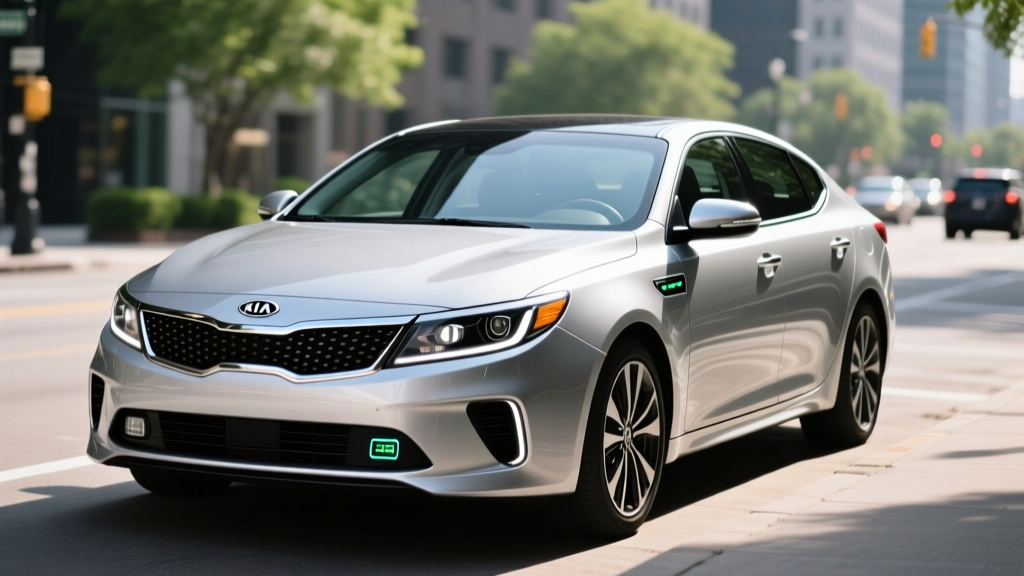
Quick Verdict: The 2014 Kia Optima Hybrid in 2026
The 2014 Kia Optima Hybrid is a conventional hybrid electric vehicle (HEV) — it recovers energy through regenerative braking and engine optimization, requires no plug, and delivers an EPA-rated 35 MPG combined. Over a decade after its debut, it remains one of the more affordable used-hybrid sedans on the market, with examples typically trading between $6,000 and $11,000 depending on mileage and condition. But at 10–12 years old, the critical question shifts from fuel economy to battery health and long-term reliability.
This guide breaks down the exact specs, real-world efficiency, battery replacement economics, and ownership profile so you can decide whether a used 2014 Optima Hybrid is a smart buy or a risk better avoided.
HEV vs PHEV: What the 2014 Kia Optima Hybrid Actually Is
Before diving into specs, it's essential to distinguish the two hybrid categories — confusion here leads to disappointed buyers.
| Feature | Conventional Hybrid (HEV) | Plug-In Hybrid (PHEV) |
|---|---|---|
| Plug-in charging? | No — self-charging via engine + regen | Yes — plug into Level 1 or Level 2 |
| Electric-only driving | Limited, low-speed only (~1 mile) | 20–40+ miles at full speed |
| Battery size | Small (1–2 kWh) | Larger (10–25+ kWh) |
| Tax credit (new) | None under current §30D rules | Up to $7,500 (subject to sourcing/income caps) |
| Example | 2014 Kia Optima Hybrid | 2026 Kia Sportage PHEV |
The 2014 Optima Hybrid is firmly in the HEV column. You never plug it in. Its 1.6 kWh lithium-polymer battery charges exclusively through regenerative braking and the gasoline engine. Kia did not offer a plug-in variant of the Optima until later model years in select markets, and the US-market Optima PHEV arrived for the 2017 model year.
Fuel Economy: EPA Ratings vs Real-World MPG
The EPA rates the 2014 Kia Optima Hybrid at 35 MPG combined, broken down as follows:
| Driving Cycle | EPA MPG | Real-World Expectation |
|---|---|---|
| City | 36 MPG | 34–38 MPG (hybrids excel in stop-and-go) |
| Highway | 34 MPG | 31–35 MPG (less regen benefit at steady speed) |
| Combined | 35 MPG | 33–36 MPG |
Hybrids often exceed their EPA city rating in real-world urban driving because regenerative braking recovers more energy in stop-and-go traffic than the EPA test cycle simulates. Highway driving, however, tends to fall slightly short of the EPA number since the electric motor contributes less at sustained high speeds and aerodynamic drag dominates.
According to fueleconomy.gov, owner-reported averages for the 2014 Optima Hybrid cluster around 33–36 MPG combined — consistent with the EPA estimate. Cold weather, aggressive acceleration, and heavy cargo loads can push real-world figures down to the high 20s.
Powertrain and Performance Specs
| Specification | 2014 Kia Optima Hybrid |
|---|---|
| Engine | 2.4L 4-cylinder Atkinson-cycle (169 hp) |
| Electric Motor | 35 kW (47 hp) permanent-magnet synchronous |
| Combined System Output | 206 hp @ 6,000 rpm |
| Transmission | 6-speed automatic (torque-converter, no CVT) |
| Hybrid Battery | 1.6 kWh lithium-polymer (not plug-in) |
| 0–60 mph | ~8.5 seconds |
| Drivetrain | Front-wheel drive |
| Curb Weight | ~3,496 lbs |
| EPA Combined MPG | 35 MPG |
| Fuel Tank | 17.2 gallons |
| Total Range | ~602 miles |
Kia paired the 2.4L Atkinson-cycle engine with a 35 kW electric motor sandwiched between the engine and a conventional 6-speed automatic. Unlike Toyota's planetary-gear e-CVT approach, Kia's setup uses a traditional torque-converter automatic, which delivers more familiar shift feel but slightly less seamless electric-to-gas transitions. The combined 206 hp output is adequate for highway merging and passing, though the added weight of the hybrid system (roughly 200 lbs more than the gas-only Optima) is noticeable from a stop.
Hybrid Battery: Warranty, Lifespan, and Replacement Cost
Original Battery Warranty: 10 years / 100,000 miles (whichever comes first) for the hybrid battery pack, plus 5 years / 60,000 miles for the basic vehicle warranty.
2026 Status: The 10-year/100,000-mile battery warranty has expired for most 2014 examples unless the vehicle was purchased very late in the model year and has unusually low mileage. Check the in-service date on the original window sticker or dealer paperwork.
The 2014 Optima Hybrid uses a 1.6 kWh lithium-polymer battery pack manufactured by LG Chem. Lithium-polymer chemistry offers good thermal stability and a compact form factor, but like all hybrid batteries, it degrades over time and with heat exposure.
Expected battery lifespan: Most Kia hybrid battery packs from this era last 120,000–150,000 miles before capacity loss becomes noticeable (reduced electric-assist, slightly lower MPG). Some units fail earlier; others exceed 180,000 miles without issue.
Replacement cost: A new OEM hybrid battery for the 2014 Optima Hybrid runs approximately $2,500–$3,800 for the part alone, with labor adding $300–$600 at a dealership. Independent hybrid specialists may offer refurbished packs for $1,500–$2,200 installed. Given the vehicle's current resale value of $6,000–$11,000, a battery replacement represents a significant percentage of the car's worth — a key factor in the used-buy decision.
Reliability and Known Issues
The 2014 Optima Hybrid carries average-to-slightly-below-average reliability ratings for its class. Common issues reported by owners and tracked by NHTSA include:
- Hybrid system warning lights: Some owners report intermittent hybrid system fault codes, occasionally related to the hybrid control module or battery temperature sensors rather than cell failure.
- Transmission shudder: The 6-speed automatic can exhibit low-speed shudder during engine-to-electric transitions, particularly as the vehicle ages and transmission fluid degrades.
- Brake feel: The transition between regenerative braking and friction braking can feel abrupt — a characteristic of the system design, not necessarily a defect, but worth testing on a drive.
- 12V auxiliary battery drain: Like many hybrids, if the car sits unused for extended periods, the 12V battery can drain, preventing the vehicle from starting even though the hybrid battery has charge.
Before purchasing, have the hybrid battery's state of health (SoH) checked using an OBD-II scanner with hybrid-specific software (such as Torque Pro with the appropriate Kia PID set). A healthy pack should show cell voltage variance under 0.2V across all modules.
Pricing, Tax Credits, and Used-Buyer Economics
Current used market pricing (2026):
- High mileage (120,000+ miles): $6,000–$7,500
- Average mileage (80,000–120,000 miles): $7,500–$9,500
- Low mileage (under 80,000 miles): $9,500–$11,500
Tax credit eligibility: The 2014 Kia Optima Hybrid does not qualify for the federal §30D clean vehicle credit, even as a used purchase. Under current IRS rules, the used-EV credit (up to $4,000) applies only to battery electric vehicles and fuel-cell vehicles purchased used — conventional hybrids are excluded. The original new-vehicle hybrid tax credit provisions expired years ago for Kia models as well.
Some states offer registration fee reductions or HOV-lane access for hybrids, but these vary by jurisdiction and are increasingly being phased out. Check your state's DMV or energy office for current programs.
Who Should Buy the 2014 Kia Optima Hybrid?
Pros
- Low entry price for a hybrid sedan ($6K–$11K)
- Solid 35 MPG combined with no plug-in requirement
- Spacious midsize cabin and 14.3 cu ft trunk
- Conventional 6-speed automatic avoids CVT drone
- Low insurance costs relative to EVs
Cons
- Hybrid battery warranty likely expired
- $2,500–$3,800 battery replacement is a major risk at this price point
- No electric-only highway driving capability
- Below-average reliability reputation for the year
- No federal tax credit eligibility (new or used)
Choose the 2014 Optima Hybrid if: You need an affordable, no-plug commuter with strong city MPG, you can verify hybrid battery health before purchase, and you're comfortable budgeting for a potential $2,500+ battery replacement down the road.
Consider a newer PHEV (e.g., 2022+ Kia Niro PHEV) if: You have home charging access and want 25–33 miles of electric-only commuting plus potential used-EV tax credit eligibility.
Consider a full BEV (e.g., used Chevrolet Bolt EV) if: You want zero gas costs, lower maintenance, and qualify for the $4,000 used clean-vehicle credit under §25E.
Frequently Asked Questions
How many MPG does the 2014 Kia Optima Hybrid get?
The EPA rates it at 36 MPG city, 34 MPG highway, and 35 MPG combined. Real-world driving typically yields 33–36 MPG combined, with city driving sometimes exceeding the EPA estimate thanks to regenerative braking in stop-and-go traffic.
Does the 2014 Kia Optima Hybrid need to be plugged in?
No. It is a conventional hybrid (HEV), not a plug-in hybrid (PHEV). The battery charges through regenerative braking and the gasoline engine. There is no charging port.
Is the hybrid battery still under warranty?
Almost certainly not. Kia's original hybrid battery warranty was 10 years / 100,000 miles. For a 2014 model, that coverage expired in 2024 at the latest. Any battery issues are the owner's financial responsibility.
How much does it cost to replace the hybrid battery?
Expect $2,500–$3,800 for an OEM replacement plus $300–$600 in labor at a dealer. Refurbished packs from independent hybrid shops may cost $1,500–$2,200 installed. Given the car's $6,000–$11,000 resale value, this is a significant expense.
Does the 2014 Kia Optima Hybrid qualify for any tax credit?
No. It does not qualify for the federal §30D new-vehicle credit or the §25E used clean-vehicle credit. Both programs exclude conventional hybrids — only battery electric vehicles (BEVs) and fuel-cell vehicles (FCVs) are eligible under current IRS rules.
Hybrid vs PHEV vs EV — which should I buy?
If you lack home charging access and want simplicity, a conventional hybrid like the Optima HEV works. If you can charge at home and want electric-only commuting with gas backup, a PHEV (like the Kia Niro PHEV or Toyota RAV4 Prime) offers the best of both. If you want the lowest operating cost and have reliable charging, a full BEV (like a used Bolt EV or Model 3) eliminates gas entirely and may qualify for tax credits.
Is the 2014 Optima Hybrid reliable?
It carries average reliability for its class. The hybrid system itself is generally robust, but transmission shudder, hybrid control module faults, and 12V battery drain are known issues. A pre-purchase inspection with hybrid-specific diagnostics is strongly recommended.