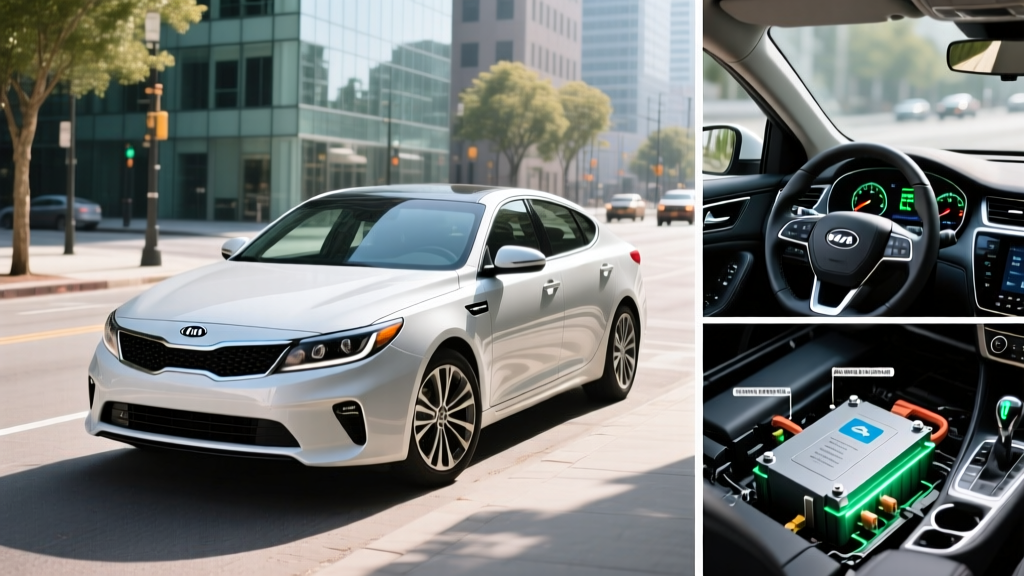
The 2014 Kia Optima Hybrid EX sedan was Kia's second-year attempt at the midsize hybrid market, competing directly with the Toyota Camry Hybrid and Ford Fusion Hybrid. Built on the third-generation Optima platform, this conventional hybrid (HEV) pairs a 2.4-liter four-cylinder engine with an electric motor and a compact lithium-polymer battery pack — no plug required. For used-car shoppers in 2026 evaluating whether a decade-old hybrid still makes financial sense, this guide breaks down real-world fuel economy, battery longevity expectations, ownership costs, and how it compares to modern electrified alternatives.
2014 Kia Optima Hybrid EX: Key Specifications at a Glance
| Specification | 2014 Optima Hybrid EX |
|---|---|
| Powertrain Type | Conventional Hybrid (HEV) — no plug |
| Engine | 2.4L inline-4 (169 HP) |
| Electric Motor | 35 kW (47 HP) |
| Combined System Output | 199 HP / 195 lb-ft torque |
| Transmission | 6-speed automatic |
| Hybrid Battery | 1.43 kWh lithium-polymer |
| EPA Fuel Economy (City / Hwy / Combined) | 36 / 40 / 38 MPG |
| Fuel Tank Capacity | 17.2 gallons |
| Total Driving Range | ~653 miles (EPA combined) |
| 0–60 MPH | ~8.5 seconds |
| Original MSRP (2014) | ~$26,500 |
| Typical Used Price (2026) | $6,500–$10,000 |
How Many MPG Does the 2014 Optima Hybrid Actually Get?
The EPA rates the 2014 Kia Optima Hybrid EX at 36 MPG city, 40 MPG highway, and 38 MPG combined. These figures were competitive in 2014, though the Camry Hybrid (40/38/41 MPG) edged it out in city driving, where hybrids typically shine.
| Driving Condition | EPA Estimate | Real-World Expectation |
|---|---|---|
| City | 36 MPG | 34–38 MPG (regenerative braking helps in stop-and-go) |
| Highway | 40 MPG | 36–39 MPG (less electric assist at sustained speed) |
| Combined | 38 MPG | 35–39 MPG depending on driving style |
| Cold Weather (below 32°F) | — | 30–34 MPG (engine runs more for cabin heat) |
Real-world data from fueleconomy.gov owner submissions show a spread: some drivers report low-to-mid 30s, while hypermilers push past 40 MPG on mixed routes. The Optima Hybrid's 6-speed automatic transmission — unlike the CVTs in most competitors — delivers a more traditional driving feel but sacrifices some efficiency optimization that CVTs provide.
With 17.2 gallons of fuel capacity and 38 MPG combined, you can expect roughly 650 miles between fill-ups under normal conditions. In winter or aggressive driving, plan for 500–550 miles.
Hybrid (HEV) vs Plug-In Hybrid (PHEV) vs Full EV: Which Fits You?
The 2014 Optima Hybrid is a conventional hybrid (HEV), meaning it generates all its electricity internally through regenerative braking and engine-driven generation. You never plug it in. Kia did not offer a plug-in hybrid (PHEV) variant of the 2014 Optima — that arrived later with the 2017 Optima PHEV.
HEV vs PHEV vs BEV — Quick Decision Guide
- HEV (this car): No plug, 35–40 MPG, zero behavior change from a gas car. Best for drivers without home charging access who want better fuel economy.
- PHEV: Plugs in for 20–40 miles of electric-only range, then operates as a hybrid. Best for drivers with short commutes and home charging who occasionally take longer trips.
- BEV (full EV): All-electric, 200–350+ mile range, lowest per-mile fuel cost. Best for drivers with reliable home or workplace charging who want minimal maintenance.
If you're cross-shopping the used 2014 Optima Hybrid against a newer PHEV or a modern EV like the Chevrolet Bolt EV (used, ~$12,000–$15,000 in 2026), the trade-off is clear: the Optima Hybrid costs less upfront and requires zero charging infrastructure, but a BEV will cost significantly less per mile to operate and eliminate oil changes entirely.
Powertrain Deep Dive: Engine, Motor, and the 6-Speed Choice
Kia's hybrid system in the 2014 Optima uses a parallel hybrid architecture. The 2.4-liter Atkinson-cycle four-cylinder produces 169 HP and 156 lb-ft of torque. A 35 kW (47 HP) electric motor sits between the engine and the 6-speed automatic, contributing up to a combined 199 HP and 195 lb-ft.
Unlike Toyota's Hybrid Synergy Drive, which uses a planetary gearset (eCVT), Kia opted for a traditional 6-speed automatic with a torque converter replaced by the electric motor and a clutch. This gives the Optima Hybrid a more familiar shift feel — no rubber-band CVT drone — but it also means slightly less seamless blending of electric and gas power at low speeds.
The 1.43 kWh lithium-polymer battery pack is small by modern standards. It provides brief electric-only motoring at low speeds (under ~25 MPH for short distances) but is primarily designed for assist during acceleration and regenerative capture during braking. It is not designed for sustained electric-only driving.
Battery Health, Warranty, and Replacement Cost
Battery Warranty (Original)
Kia originally covered the 2014 Optima Hybrid's battery with a 10-year / 100,000-mile warranty (8 years/100,000 miles in states that don't follow California emissions standards). This warranty applies only to the original owner and does not transfer to subsequent owners in most cases. By 2026, the original factory battery warranty has expired for nearly all examples on the road.
The lithium-polymer pack in the 2014 Optima Hybrid is relatively small (1.43 kWh) and operates within a conservative state-of-charge window, which helps longevity. Based on long-term ownership data and industry patterns for Kia/Hyundai hybrid batteries of this era:
- Expected battery lifespan: 150,000–200,000 miles before significant degradation (below 70% capacity)
- Degradation symptoms: Reduced MPG (typically 2–5 MPG drop), less electric assist during acceleration, more frequent engine cycling
- Replacement cost (2026): $2,000–$3,500 for a new OEM battery pack installed at a dealership; $1,200–$2,000 for a refurbished/reconditioned unit from an independent hybrid specialist
Before buying any used 2014 Optima Hybrid, request a hybrid battery health check. A Kia dealer can pull the battery's state-of-health (SoH) data through the OBD-II system. Look for SoH above 75% — below that, factor a battery replacement into your purchase negotiation.
Reliability Track Record and Common Issues
The 2014 Optima Hybrid carries a mixed reliability reputation. According to NHTSA records and owner surveys, the hybrid-specific components (battery, motor, inverter) have been relatively trouble-free. The conventional mechanicals tell a different story:
- Theta II 2.4L engine: This engine family is associated with oil consumption and bearing wear issues. Kia extended engine warranties under a class-action settlement, covering certain 2011–2014 Optima engines for up to 15 years/150,000 miles. Verify whether a specific VIN is covered under this settlement before purchasing.
- Hybrid system cooling: The inverter cooling system should be inspected for leaks or corrosion, particularly in salt-belt states.
- Brake feel: The regenerative braking transition to friction braking can feel abrupt — this is a design characteristic, not a defect, but test-drive to confirm you're comfortable with it.
- 12V auxiliary battery: Like all hybrids, the Optima has a standard 12V battery for electronics. It tends to die every 3–5 years, same as any conventional car.
The engine warranty extension is a critical factor. Visit Kia's official site or call a dealer with the VIN to confirm coverage status — this can save you thousands if the engine fails.
Does the 2014 Optima Hybrid Qualify for Any Tax Credit?
No. The 2014 Kia Optima Hybrid does not qualify for the federal §30D new clean vehicle tax credit (up to $7,500) — that credit applies only to new vehicle purchases, and the Optima Hybrid's credit was exhausted years ago.
It also does not qualify for the federal used clean vehicle credit (up to $4,000 under IRC §25E), because that credit requires the vehicle to be a plug-in electric vehicle (BEV or PHEV) with at least 4 kWh of battery capacity. The Optima Hybrid's 1.43 kWh pack and lack of a plug disqualify it entirely.
There are no state-level hybrid-specific incentives remaining for conventional HEVs in 2026. Your cost savings come exclusively from reduced fuel consumption, not from tax incentives.
Ownership Economics: Is It Still Worth It in 2026?
At typical used prices of $6,500–$10,000, the 2014 Optima Hybrid EX represents a budget-friendly entry into better fuel economy. Here's a realistic 5-year ownership projection assuming 12,000 miles/year and $3.40/gallon regular fuel:
| Cost Category | 5-Year Estimate |
|---|---|
| Purchase Price (mid-range) | $8,000 |
| Fuel (60,000 mi ÷ 36 MPG × $3.40) | $5,667 |
| Insurance (avg) | $5,400 |
| Maintenance (oil, brakes, tires, 12V battery) | $3,000 |
| Potential Hybrid Battery Replacement | $0–$3,000 (if needed) |
| Estimated 5-Year Total | $22,067–$25,067 |
Compared to a non-hybrid 2014 Optima (28 MPG combined), you'd save roughly $2,100 in fuel over five years. Compared to a modern BEV charged at home (averaging $0.13/kWh), the EV would save an additional $3,500+ in fuel and $1,500+ in maintenance over the same period. The Optima Hybrid's advantage is its low purchase price and zero infrastructure requirement.
Pros
- 38 MPG combined — meaningful fuel savings vs gas-only midsize sedans
- No plug required — works for apartment dwellers and street parkers
- Comfortable ride, spacious rear seat, large trunk (13.4 cu ft)
- Low used purchase price ($6,500–$10,000)
- Theta II engine warranty extension may still apply
Cons
- Original hybrid battery warranty expired — replacement is out-of-pocket
- No electric-only driving range — always uses gasoline
- Theta II engine oil consumption risk (check settlement coverage)
- Older infotainment — no Apple CarPlay/Android Auto
- No federal or state tax credits available
Who Should Buy the 2014 Optima Hybrid — and Who Should Look Elsewhere?
Choose the 2014 Optima Hybrid EX if:
- You need a reliable commuter sedan under $10,000 and cannot install a home charger
- You drive 10,000–15,000 miles/year and want 35–38 MPG without changing your fueling habits
- You prefer a conventional automatic transmission feel over a CVT
- You've verified the engine warranty settlement covers the specific VIN
Look at a PHEV or BEV instead if:
- You have home or workplace charging access — a used PHEV (like a 2017+ Prius Prime) or BEV (like a used Bolt EV or Leaf) will cost less per mile
- Your commute is under 30 miles round-trip — a PHEV can cover that entirely on electricity
- You want modern safety tech (automatic emergency braking, lane-keep assist) — the 2014 Optima lacks these
- You plan to keep the car 5+ years and want to minimize maintenance — a BEV eliminates oil changes and has fewer moving parts
Frequently Asked Questions
How many MPG does the 2014 Kia Optima Hybrid get in real-world driving?
The EPA rates it at 36 city / 40 highway / 38 combined. Real-world owners typically see 35–39 MPG combined in moderate weather. Cold weather drops it to 30–34 MPG due to increased engine operation for cabin heating.
Does the 2014 Optima Hybrid need to be plugged in?
No. It is a conventional hybrid (HEV), not a plug-in hybrid (PHEV). The battery recharges through regenerative braking and the gasoline engine. You fuel it exactly like a regular car.
How far can it drive on electric power alone?
The 2014 Optima Hybrid has no meaningful electric-only range. The 1.43 kWh battery provides brief electric assist at low speeds (under ~25 MPH for a few hundred yards), but the car always uses gasoline for sustained driving. If electric-only range matters, you need a PHEV or BEV.
Is the hybrid battery reliable, and what does replacement cost?
Kia's hybrid batteries from this era generally last 150,000–200,000 miles. The original 10-year/100,000-mile warranty has expired for nearly all 2014 examples. A new OEM replacement costs $2,000–$3,500 installed; refurbished units run $1,200–$2,000. Always get a battery SoH check before purchasing.
Does the 2014 Optima Hybrid qualify for any tax credit?
No. The federal §30D new vehicle credit and the §25E used EV credit both require plug-in capability and minimum battery capacity. The Optima Hybrid qualifies for neither. No state incentives for conventional HEVs remain in 2026.
What should I check before buying a used 2014 Optima Hybrid?
Prioritize these: (1) hybrid battery state-of-health check via OBD-II, (2) verify Theta II engine warranty settlement coverage by VIN, (3) check for transmission fluid service history, (4) inspect inverter cooling system for leaks, and (5) confirm the 12V battery is less than 3 years old.
How does it compare to a 2014 Camry Hybrid or Fusion Hybrid?
The Camry Hybrid gets better city MPG (41 vs 36) and has a stronger reliability track record, but typically costs $1,000–$2,000 more on the used market. The Fusion Hybrid matches the Optima's efficiency but shares Ford's Sync infotainment quirks. The Optima Hybrid's main advantage is its lower used price and more conventional transmission feel.