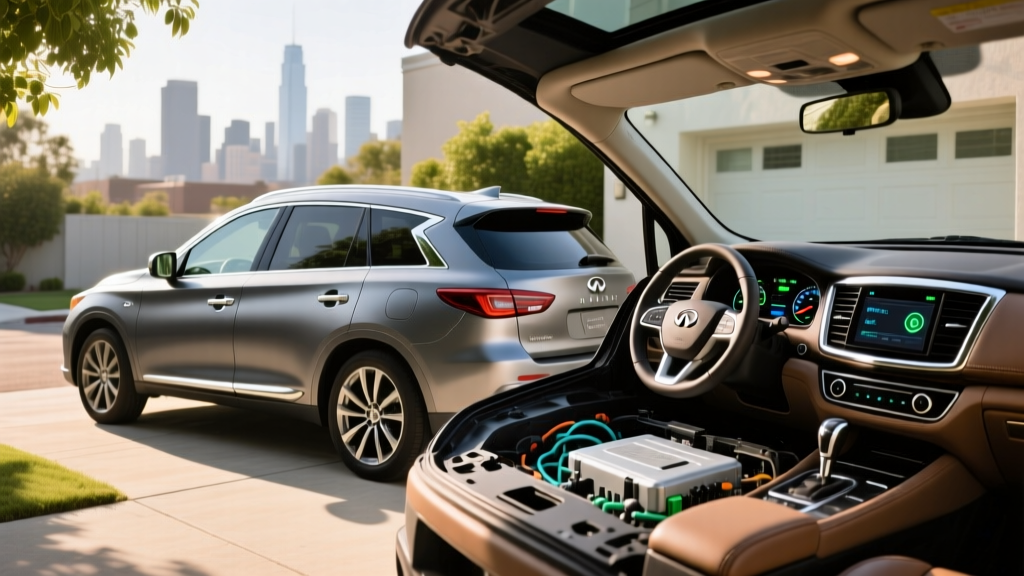
Quick Verdict: The 2014 Infiniti QX60 Hybrid in 2026
The 2014 Infiniti QX60 Hybrid is a conventional hybrid (HEV) luxury three-row SUV — not a plug-in hybrid and not an EV. It pairs a supercharged 2.5-liter inline-four with a 15 kW electric motor integrated into the CVT transmission to deliver 250 combined horsepower and an EPA-estimated 26 MPG combined. For used-car shoppers in 2026, it occupies an unusual niche: a luxury hybrid crossover that can be had for roughly $9,000–$15,000 depending on mileage and condition, with no plug required and no range anxiety.
But is a 12-year-old hybrid battery a ticking time bomb? How does real-world fuel economy compare to the EPA sticker? And does it qualify for any federal tax credit when purchased used? This guide covers every number a prospective buyer needs before signing paperwork.
HEV vs PHEV: What the 2014 QX60 Hybrid Actually Is
Conventional Hybrid (HEV): The 2014 QX60 Hybrid is a self-charging hybrid. It captures energy through regenerative braking and the gasoline engine to recharge a small battery. You never plug it in. There is no meaningful electric-only driving range — the motor assists the engine during acceleration and low-speed operation but cannot propel the vehicle alone for more than brief, low-speed coasting.
Plug-in Hybrid (PHEV): A PHEV has a much larger battery (typically 12–30 kWh), an onboard charger, and a charging port. It can drive 20–50 miles on electricity alone before the gas engine engages. The 2014 QX60 Hybrid is not a PHEV. Infiniti never offered a plug-in variant of this generation.
Full EV (BEV): A battery electric vehicle has no gasoline engine. The QX60 Hybrid retains a full gasoline powertrain supplemented by electric assist.
This distinction matters because some used listings mislabel the QX60 Hybrid as a "plug-in" or imply electric-only range. It has neither. You fuel it with gasoline and drive — the hybrid system works invisibly in the background to improve efficiency.
Fuel Economy: EPA Ratings vs Real-World MPG
| Metric | EPA Estimate | Real-World Expectation |
|---|---|---|
| City MPG | 26 MPG | 25–28 MPG (hybrids often exceed EPA in stop-and-go) |
| Highway MPG | 28 MPG | 24–27 MPG (aerodynamic drag, higher speeds reduce hybrid advantage) |
| Combined MPG | 26 MPG | 24–27 MPG |
| Fuel Tank Capacity | 19.5 gallons | |
| Total Range | ~480–510 miles per tank | |
According to fueleconomy.gov, the 2014 QX60 Hybrid AWD achieves 26 MPG combined (26 city / 28 highway). The FWD variant shares the same rating. For context, the non-hybrid 2014 QX60 with the 3.5L V6 is rated at 21 MPG combined — meaning the hybrid powertrain delivers a roughly 24% improvement in fuel economy.
Real-world note: Hybrid systems shine in city driving where regenerative braking recaptures energy constantly. Owners who do mostly suburban and city driving often report matching or slightly exceeding the EPA city figure. Highway-dominant commutes see the advantage narrow, since the electric motor contributes less at sustained 70+ MPH speeds and the added weight of the hybrid system (roughly 200 lbs over the V6 model) works against efficiency.
Powertrain Specs: Supercharged Four-Cylinder Meets Electric Motor
| Specification | Detail |
|---|---|
| Engine | 2.5L supercharged inline-4 (DOHC, 16-valve) |
| Electric Motor | 15 kW (20 hp) AC motor, integrated into transmission |
| Combined System Output | 250 hp / 243 lb-ft torque |
| Transmission | Continuously Variable Transmission (CVT) |
| Drivetrain | FWD standard; AWD available (Intelligent AWD) |
| Hybrid Battery | ~0.5 kWh lithium-ion (not user-serviceable, not plug-in) |
| 0–60 MPH | ~8.0 seconds (estimated) |
| Towing Capacity | 3,500 lbs (when properly equipped) |
| Curb Weight | ~4,550 lbs (AWD) |
The 2014 QX60 Hybrid uses Nissan/Infiniti's "Direct Super Hybrid" system. The supercharger compensates for the smaller displacement engine (2.5L vs the standard 3.5L V6), while the electric motor fills in torque during initial acceleration and enables engine stop-start at idle. The result is a powertrain that feels adequately responsive around town but lacks the effortless highway passing power of the V6 model. The CVT drones under hard acceleration — a common trait of Nissan/Infiniti CVTs from this era.
Hybrid Battery Reliability, Warranty & Replacement Cost
Original Hybrid Battery Warranty: Infiniti covered the hybrid battery for 8 years / 100,000 miles (96 months / 100,000 miles in CARB states: California, New York, Massachusetts, and others adopting California emissions standards). The warranty guaranteed the battery would maintain sufficient capacity to operate the hybrid system — though unlike EV batteries, there is no published degradation percentage threshold for conventional hybrids.
Warranty status in 2026: A 2014 model's original 8-year hybrid battery warranty expired in 2022. The 10-year/100,000-mile CARB-state warranty will expire in 2024 for most vehicles. This means virtually every 2014 QX60 Hybrid on the used market is now out of hybrid battery warranty unless an extended warranty was purchased and transferred.
How long do these batteries last? Nissan/Infiniti's lithium-ion hybrid batteries in this generation have proven reasonably durable. Most reports indicate 120,000–180,000 miles before significant capacity loss or failure. The battery pack is small (~0.5 kWh) and operates within a narrow state-of-charge window (roughly 40–80%), which reduces stress on the cells compared to full EV batteries.
Battery replacement cost: If the hybrid battery fails out of warranty, expect to pay between $2,500 and $4,500 for a replacement, including parts and labor. Refurbished or aftermarket packs may be available for $1,800–$3,000. Dealership OEM replacement tends toward the higher end of this range. For a vehicle worth $10,000–$15,000, a battery failure is a significant but not catastrophic expense — comparable to a transmission replacement on a conventional car.
Other reliability concerns: The CVT transmission in Nissan/Infiniti vehicles from this era carries a mixed reputation. While the hybrid-specific CVT (which integrates the electric motor) is a different unit than the problematic CVTs in the Altima and Rogue, some owners report shuddering or premature wear above 100,000 miles. A pre-purchase inspection by a technician familiar with Nissan CVTs is strongly recommended.
Does the 2014 QX60 Hybrid Qualify for Any Tax Credit?
Federal tax credit (§30D): No. The 2014 QX60 Hybrid is a conventional hybrid (HEV), not a plug-in electric vehicle. The federal Clean Vehicle Credit under IRS §30D applies only to battery electric vehicles (BEVs) and plug-in hybrids (PHEVs) with a battery capacity of at least 7 kWh. The QX60 Hybrid's ~0.5 kWh pack does not come close. This was also true when the vehicle was new in 2014 — it never qualified for the federal EV credit.
Used EV credit (§25E): The used clean vehicle credit (up to $4,000 or 30% of sale price, whichever is less) similarly requires the vehicle to be a qualified plug-in electric or fuel cell vehicle. The QX60 Hybrid does not qualify. See IRS §25E guidelines for the full eligibility list.
State incentives: A handful of states offer rebates or HOV lane access for conventional hybrids, but these programs are rare and frequently expire. Check your state's energy office or DMV for current offerings. Do not count on any incentive when budgeting for this vehicle.
Who Should Buy the 2014 QX60 Hybrid vs an EV or Gas Car?
Pros
- ~24% better fuel economy than the V6 QX60 (26 vs 21 MPG combined)
- No plug-in required — fuel and go like a normal car
- Three-row seating with reasonable cargo space
- Luxury features (leather, Bose audio, around-view monitor) at a used-market discount
- Adequate 3,500-lb towing for a hybrid crossover
Cons
- Hybrid battery out of warranty — potential $2,500–$4,500 replacement liability
- CVT transmission reputation concerns at higher mileage
- No electric-only range; not a PHEV
- No federal or state tax credit eligibility
- Slower and less refined than the V6 model under hard acceleration
- Infiniti brand depreciation steeper than Lexus or Acura competitors
Choose the 2014 QX60 Hybrid if: You want a used luxury three-row SUV with better fuel economy than a V6, you cannot charge at home or work (ruling out PHEVs and EVs), and you accept the hybrid battery risk as part of buying a 12-year-old vehicle. Budget $1,000–$2,000 at purchase time for a preemptive hybrid system inspection and potential battery refurbishment reserve.
Choose a used PHEV instead if: You have access to Level 2 charging at home and want 20–40 miles of electric-only commuting. Vehicles like the 2017–2019 Chrysler Pacifica Hybrid or a used Mitsubishi Outlander PHEV offer plug-in flexibility while retaining a gas engine for road trips.
Choose a used full EV instead if: Your daily driving is under 200 miles, you can install a Level 2 home charger, and you want the lowest per-mile operating cost. A used Tesla Model Y or Chevrolet Bolt EUV eliminates gasoline entirely, though at a higher purchase price.
Choose the non-hybrid V6 QX60 if: You prioritize acceleration smoothness and long-term powertrain simplicity over a 5 MPG improvement. The 3.5L V6 and conventional CVT are well-understood by independent mechanics nationwide.
Pricing & What to Expect on the Used Market in 2026
The 2014 Infiniti QX60 Hybrid originally carried an MSRP of approximately $47,795 (FWD) to $49,395 (AWD), representing a $3,000–$3,500 premium over the V6 model. In 2026, used examples typically list between $9,000 and $15,000 depending on mileage, condition, and region. The hybrid variant tends to depreciate slightly faster than the V6 due to buyer wariness about out-of-warranty hybrid battery costs.
When evaluating a listing, prioritize:
- Mileage under 120,000 — reduces the probability of imminent hybrid battery or CVT failure
- Complete service records — confirms CVT fluid was changed (often neglected)
- Hybrid system diagnostic scan — a dealer or qualified shop can read battery cell voltages and state-of-health data before you buy
- CARB-state origin — vehicles originally sold in California-emissions states may have had the longer 10-year/100,000-mile battery warranty, though this has now expired regardless
Frequently Asked Questions
How many MPG does the 2014 Infiniti QX60 Hybrid get?
The EPA rates it at 26 MPG combined (26 city / 28 highway) for both FWD and AWD variants. Real-world fuel economy ranges from 24–28 MPG depending on driving mix. City-heavy drivers often match or slightly beat the EPA city figure thanks to regenerative braking; highway-dominant driving yields 24–26 MPG.
Can the 2014 QX60 Hybrid drive on electric power only?
Not in any practical sense. The 15 kW electric motor assists the gasoline engine during acceleration and enables engine stop-start at idle, but it cannot propel the vehicle at meaningful speeds on electricity alone. This is a conventional hybrid (HEV), not a plug-in hybrid (PHEV). There is no electric-only range figure.
Is the 2014 QX60 Hybrid reliable, and what does battery replacement cost?
The hybrid system itself has been reasonably reliable, with most batteries lasting 120,000–180,000 miles. The primary concern is the CVT transmission, which has a mixed track record in this era of Nissan/Infiniti products. Hybrid battery replacement costs $2,500–$4,500 out of warranty. The original 8-year/100,000-mile hybrid battery warranty has expired on all 2014 models as of 2022.
Does the 2014 QX60 Hybrid qualify for a federal tax credit?
No. The federal §30D Clean Vehicle Credit and the §25E Used Clean Vehicle Credit both require a plug-in electric or fuel cell vehicle with a battery of at least 7 kWh. The QX60 Hybrid is a conventional hybrid with a ~0.5 kWh battery and has never qualified for federal EV tax incentives — neither when new nor on the used market today. See IRS §30D rules for current eligibility criteria.
Hybrid vs PHEV vs EV — which should I buy in 2026?
It depends on your charging access and driving pattern. A conventional hybrid like the QX60 Hybrid requires no charging infrastructure and suits buyers who park on the street or lack garage access. A PHEV (e.g., Toyota RAV4 Prime, Chrysler Pacifica Hybrid) is ideal if you can install a Level 2 charger at home and want 30–40 miles of electric commuting with gas-engine backup. A full EV (e.g., Tesla Model Y, Hyundai Ioniq 5) offers the lowest per-mile cost and zero tailpipe emissions but requires reliable charging access and a higher upfront budget. For a detailed breakdown, consult fueleconomy.gov's EV technology comparison tool.
What's the difference between the QX60 Hybrid and the non-hybrid V6?
The hybrid uses a supercharged 2.5L four-cylinder plus a 15 kW electric motor for 250 combined hp and 26 MPG. The standard 3.5L V6 produces 265 hp and achieves 21 MPG combined. The V6 is smoother and more responsive under acceleration; the hybrid saves roughly 5 MPG (about 1.5 gallons per 100 miles, or ~$5–$7 per 100 miles at $3.50/gallon). The hybrid carried a ~$3,000 MSRP premium when new, which has largely evaporated on the used market.