The 2014 Infiniti QX60 Hybrid: A Used Luxury Hybrid SUV Worth Considering?
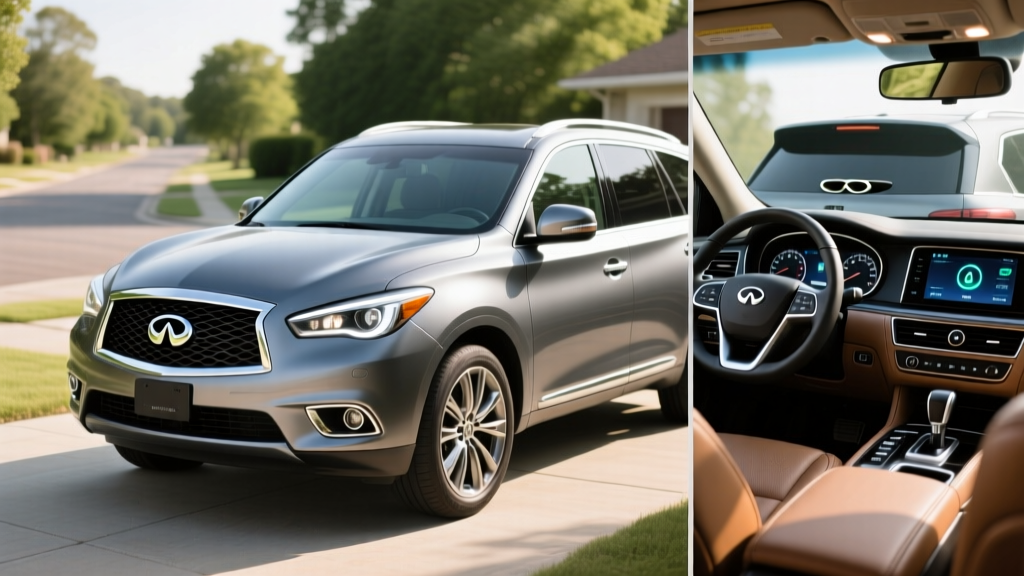
If you've been searching for an Infiniti SUV hybrid 2014 model year, you're looking at a pivotal vehicle in Nissan's luxury division. The 2014 Infiniti QX60 Hybrid was the brand's first attempt at pairing a three-row luxury crossover with a gasoline-electric hybrid powertrain — and it arrived at a time when hybrid SUVs were just beginning to prove themselves beyond the Toyota Prius.
Now in 2026, this vehicle is firmly in used-car territory, which means the questions shift from "Should I buy it new?" to "Is the hybrid system still reliable? What's the real-world MPG after a decade? And what does battery replacement cost?" This guide answers all of that with hard data.
Before we go further, a critical distinction: the 2014 QX60 Hybrid is a conventional hybrid (HEV), not a plug-in hybrid (PHEV). It does not have a charging port, cannot drive on electric power alone for meaningful distances, and never needs to be plugged in. The hybrid system recovers energy from braking and deceleration to assist the gasoline engine. If you're looking for electric-only commuting, you need a PHEV or a full BEV — we'll cover that decision framework below.
HEV vs. PHEV: Understanding What the 2014 QX60 Hybrid Actually Is
Conventional Hybrid (HEV) — 2014 Infiniti QX60 Hybrid
- No plug-in charging required — the battery charges via regenerative braking and the engine
- Small battery (~0.6 kWh usable) — assists the engine but cannot propel the car alone at highway speeds
- No electric-only range to speak of (under 1 mile at very low speeds)
- No federal tax credit for used or new HEVs under current IRS §30D rules
- Lower complexity — no charging infrastructure needed
Plug-In Hybrid (PHEV) — For Comparison
- Must be plugged in to access electric-only range (typically 20–45 miles)
- Larger battery (12–25 kWh typical for modern PHEVs)
- DC fast charging available on some models
- May qualify for tax credits depending on battery sourcing, MSRP caps, and income limits
- Higher upfront cost but lower operating cost for short commutes
The 2014 QX60 Hybrid falls squarely in the HEV camp. Its hybrid system is there to improve fuel economy, not to replace the gasoline engine for daily commuting on electricity alone.
Fuel Economy: EPA MPG and Real-World Numbers
The headline reason anyone considers the hybrid variant of the 2014 QX60 is fuel economy. Here's what the EPA officially rates, along with what owners actually report after years of driving:
| Configuration | City MPG | Highway MPG | Combined MPG |
|---|---|---|---|
| 2014 QX60 Hybrid (FWD) | 26 | 28 | 26 |
| 2014 QX60 Hybrid (AWD) | 25 | 28 | 26 |
| 2014 QX60 Gas (3.5L V6, FWD) | 20 | 26 | 22 |
| 2014 QX60 Gas (3.5L V6, AWD) | 19 | 25 | 21 |
Source: fueleconomy.gov (U.S. EPA)
Real-World MPG vs. EPA Sticker
EPA Combined: 26 MPG (hybrid FWD)
Real-world expectation: Most owners report 24–27 MPG in mixed driving. The hybrid system shines in stop-and-go city traffic, where regenerative braking frequently recharges the small battery and the engine shuts off at stops. Highway driving at 70+ MPH typically yields 25–27 MPG — close to the EPA estimate because the supercharged 2.5L engine operates efficiently at steady cruise. However, heavy cargo loads, aggressive acceleration, and extreme cold can push real-world figures down to 22–23 MPG.
Hybrid vs. gas savings: The hybrid gains roughly 4–5 MPG over the V6 gas model. At 15,000 miles/year and $3.50/gallon, that translates to approximately $350–$450 in annual fuel savings — meaningful but not transformative. The payback period on the original ~$3,000 hybrid premium was roughly 7–8 years at those fuel prices.
Powertrain and Performance Specs
The 2014 QX60 Hybrid uses a powertrain that was genuinely unusual for its time — a supercharged four-cylinder paired with an electric motor, rather than the naturally aspirated V6 found in the gas model. Here's the full breakdown:
| Specification | 2014 QX60 Hybrid |
|---|---|
| Engine | 2.5L supercharged inline-4 |
| Engine Power | 230 HP @ 5,600 RPM |
| Engine Torque | 243 lb-ft @ 3,600 RPM |
| Electric Motor | 15 kW (20 HP), integrated into CVT |
| Combined System Output | 250 HP |
| Transmission | CVT (Continuously Variable Transmission) |
| Drivetrain | FWD or AWD |
| Hybrid Battery | ~0.6 kWh, lithium-ion |
| 0–60 MPH | ~8.2 seconds (estimated) |
| Towing Capacity | 3,500 lbs |
| Seating | 7 passengers (3 rows) |
| Cargo (behind 3rd row) | 15.8 cu ft |
| Cargo (all rows folded) | 76.2 cu ft |
The supercharged 2.5L four-cylinder was Nissan's answer to maintaining adequate power in a heavy three-row SUV while downsizing from the 3.5L V6. The 15 kW electric motor sits between the engine and the CVT, providing torque fill during acceleration and enabling engine-off coasting and idle stop-start. The system is classified as a "mild-to-full" hybrid — it can move the vehicle at very low speeds on electric power alone (such as in a parking lot), but the engine engages almost immediately under any real load.
Performance is adequate, not thrilling. The 250 combined HP moves the ~4,500-lb vehicle competently, but the CVT drones under hard acceleration. Most buyers in this segment prioritize smoothness over sportiness, and the hybrid delivers that — with the added benefit of seamless stop-start that is nearly imperceptible.
Battery Reliability, Warranty, and Replacement Cost
This is the number-one concern for anyone buying a 12-year-old hybrid in 2026. Let's address it directly with data.
Original Hybrid Battery Warranty
Nissan/Infiniti coverage: 8 years / 100,000 miles (whichever comes first) for hybrid system components including the lithium-ion battery, inverter, and electric motor.
California and CARB states: 10 years / 150,000 miles for hybrid battery coverage under emissions warranty rules.
Status in 2026: The original factory warranty has expired for virtually all 2014 QX60 Hybrids. Any battery failure is now an out-of-pocket expense unless an extended warranty was purchased and is still active.
Hybrid Battery Degradation and Failure Rates
The 2014 QX60 Hybrid's lithium-ion battery pack is small (~0.6 kWh) and is managed conservatively by the vehicle's battery management system (BMS). Unlike full EVs or PHEVs that cycle through large portions of battery capacity daily, the QX60 Hybrid's battery operates in a narrow state-of-charge window — typically between 40% and 80% SoC. This shallow cycling dramatically reduces degradation.
Based on owner reports and repair data:
- Most 2014 QX60 Hybrids have experienced no significant hybrid battery failure through 100,000–150,000 miles.
- Gradual capacity loss of 10–15% over 10 years is normal and barely noticeable in daily driving — you might see a 1 MPG drop at most.
- Catastrophic failure (complete battery replacement needed) is uncommon but not unheard of, typically occurring in vehicles stored in extreme heat (Arizona, Texas) with high mileage (150,000+).
Battery Replacement Cost
If the hybrid battery does fail, here's what to budget:
- OEM replacement (Infiniti dealer): $3,000–$5,000 including parts and labor
- Aftermarket/refurbished battery: $1,500–$3,000 from independent hybrid specialists
- Individual cell/module replacement: $500–$1,200 if only specific modules have degraded (a qualified hybrid technician can diagnose this)
For context, this is significantly less expensive than replacing a full EV battery pack ($10,000–$20,000+), because the QX60 Hybrid's battery is small and relatively simple.
Who Should Buy the 2014 QX60 Hybrid vs. Alternatives?
Not every buyer benefits from a hybrid, and the 2014 QX60 Hybrid is no exception. Here's a decision framework based on driving patterns and priorities:
Choose the 2014 QX60 Hybrid if:
- You drive 12,000+ miles/year with significant city/stop-and-go driving (where the hybrid system delivers the most MPG benefit)
- You need three rows of seating and don't want to move to a minivan
- You want a luxury badge at a used-car price point (2014 models typically list for $10,000–$16,000 in 2026 depending on mileage and condition)
- You have no access to home or workplace charging and don't want to deal with plug-in logistics
- You plan to keep the vehicle 3–5 years and can absorb a potential $2,000–$4,000 battery repair if needed
Choose a full EV (BEV) instead if:
- You have reliable Level 2 home charging and a daily commute under 60 miles
- You want zero tailpipe emissions and the lowest per-mile energy cost (~$0.04–$0.06/mile on home electricity vs. ~$0.13–$0.16/mile on gas)
- You want access to HOV lanes (available for BEVs and PHEVs in many states, but not conventional HEVs)
- You're buying new or nearly new and want the latest safety tech and ADAS features
Choose the gas V6 QX60 instead if:
- You mostly drive highway miles (the hybrid advantage shrinks to 1–2 MPG at steady 70+ MPH)
- You want simpler maintenance with no hybrid-system concerns
- You find a gas model at a significantly lower used price (common, since more were produced)
Choose a modern PHEV (e.g., 2025–2026 models) instead if:
- You want electric-only commuting (25–45 miles) but need gasoline range for road trips
- You have Level 2 charging at home and a commute under 40 miles round-trip
- You want to potentially qualify for the federal §30D tax credit (up to $7,500 for qualifying new PHEVs — subject to MSRP caps, income limits, and battery sourcing requirements per IRS rules)
Tax Credit Eligibility for the 2014 QX60 Hybrid
Let's be direct: the 2014 Infiniti QX60 Hybrid does not qualify for any federal EV tax credit under current IRS §30D rules. The §30D credit applies only to new clean vehicles (BEVs and qualifying PHEVs) purchased new, with specific MSRP caps ($80,000 for SUVs), buyer income limits ($300,000 MFJ / $150,000 single), and critical mineral/battery component sourcing requirements.
As a conventional hybrid (HEV), the QX60 Hybrid never qualified for the federal credit even when new. The used-EV credit (§25E, up to $4,000) also does not apply — it covers only used BEVs and PHEVs, not conventional hybrids.
Some states may offer minor incentives for hybrid vehicles, but these vary by jurisdiction and change frequently. Check your state's environmental or energy agency website for current programs. For federal rules, the IRS Clean Vehicle Credits page is the authoritative source.
Pros and Cons of the 2014 Infiniti QX60 Hybrid
Pros
- 4–5 MPG improvement over the V6 gas model, especially in city driving
- No plug-in required — works with existing gas-station infrastructure only
- Three-row seating for 7 passengers in a luxury package
- Smooth, quiet operation with nearly imperceptible stop-start
- Conservative battery management has yielded strong long-term reliability
- Used pricing is attractive — typically $10,000–$16,000 in 2026
- 3,500-lb towing capacity retained from the gas model
Cons
- Small MPG gain relative to the hybrid premium paid at purchase
- CVT drone under hard acceleration — not a sporty driving experience
- Hybrid battery is now out of warranty — potential $2,000–$5,000 repair liability
- No electric-only driving — this is a fuel-economy assist, not an EV experience
- Dated infotainment and safety tech compared to 2024–2026 models (no Apple CarPlay/Android Auto, limited ADAS)
- No federal or state tax credits available
- Supercharger engine adds maintenance complexity vs. a naturally aspirated motor
Buying Tips for a Used 2014 QX60 Hybrid in 2026
If you've decided this vehicle fits your needs, here are the critical inspection points specific to the hybrid system:
- Check hybrid battery health: Ask a qualified hybrid technician to run a battery diagnostic. The Nissan Consult-III Plus scan tool can read individual module voltages and internal resistance. Look for less than 15% variance between modules.
- Review service records: Confirm the CVT fluid was changed per the maintenance schedule (every 60,000 miles under severe conditions). CVT replacement costs $4,000–$6,000 and is a more common failure point than the hybrid battery.
- Test the stop-start system: During your test drive, come to a complete stop and verify the engine shuts off smoothly and restarts without hesitation or shuddering. Rough restarts can indicate hybrid motor or inverter issues.
- Inspect the regenerative braking feel: The brake pedal should transition smoothly between regenerative and friction braking. A grabby or inconsistent pedal may indicate a hybrid system fault.
- Verify the hybrid system warranty status: While the factory warranty is almost certainly expired, some original owners purchased extended coverage. Ask for documentation.
- Check for recalls: Search the VIN on NHTSA's recall database to confirm all safety recalls were performed. The 2014 QX60 had recalls related to the Occupant Classification System and fuel pump.
Frequently Asked Questions
How many MPG does the 2014 Infiniti QX60 Hybrid get?
The EPA rates the 2014 QX60 Hybrid at 26 MPG city, 28 MPG highway, and 26 MPG combined (FWD). The AWD variant is rated at 25/28/26. In real-world mixed driving, owners typically see 24–27 MPG, with city-heavy driving sometimes exceeding the EPA city estimate thanks to regenerative braking.
Can the 2014 QX60 Hybrid drive on electric power alone?
Technically yes, but only at very low speeds (under ~15 MPH) for very short distances (a few hundred feet). The hybrid system is designed to assist the gasoline engine, not replace it. There is no meaningful electric-only range for commuting or errands. If you need electric-only driving, look at a PHEV or BEV.
Is the 2014 Infiniti QX60 Hybrid reliable?
The hybrid system itself has proven reasonably reliable, with the small lithium-ion battery lasting 120,000–180,000 miles in most cases before significant degradation. The greater reliability concern is the CVT transmission, which has a higher failure rate than conventional automatics and is expensive to replace. Regular CVT fluid changes are critical. Overall reliability ratings from sources like Consumer Reports placed the 2014 QX60 in the average-to-below-average range for the luxury midsize SUV segment.
What does it cost to replace the hybrid battery?
An OEM replacement through an Infiniti dealer runs $3,000–$5,000. Aftermarket or refurbished batteries from independent hybrid specialists cost $1,500–$3,000. In some cases, individual battery modules can be replaced for $500–$1,200 if only specific cells have degraded. Given the vehicle's current used value of $10,000–$16,000, a full OEM battery replacement represents a significant percentage of the car's worth.
Does the 2014 QX60 Hybrid qualify for any tax credit?
No. The 2014 QX60 Hybrid is a conventional hybrid (HEV), not a plug-in hybrid or battery electric vehicle. It does not qualify for the federal §30D Clean Vehicle Credit (new vehicles) or the §25E Used Clean Vehicle Credit. No state-level EV incentives apply to conventional hybrids in most jurisdictions. Always verify current rules with the IRS and your state energy office.
How does the 2014 QX60 Hybrid compare to the Toyota Highlander Hybrid?
The 2014 Toyota Highlander Hybrid (EPA 28 MPG combined) offers slightly better fuel economy, a proven hybrid system with exceptional long-term reliability, and a larger hybrid battery. However, the QX60 Hybrid offers a more premium interior, a quieter ride, and typically lower used pricing. The Highlander Hybrid holds its value better, meaning you'll pay more upfront but recoup more at resale.
Should I buy the hybrid or the gas V6 version?
If you drive primarily in the city or in heavy traffic, the hybrid's 4–5 MPG advantage is worthwhile — saving roughly $350–$450 per year in fuel. If you drive mostly highway miles, the advantage shrinks and the gas V6's lower purchase price and simpler powertrain may be the better value. Given that both versions are now well out of warranty, also factor in the hybrid battery replacement risk ($2,000–$5,000) against the fuel savings over your planned ownership period.