Quick Verdict: A Rare Supercharged Hybrid SUV
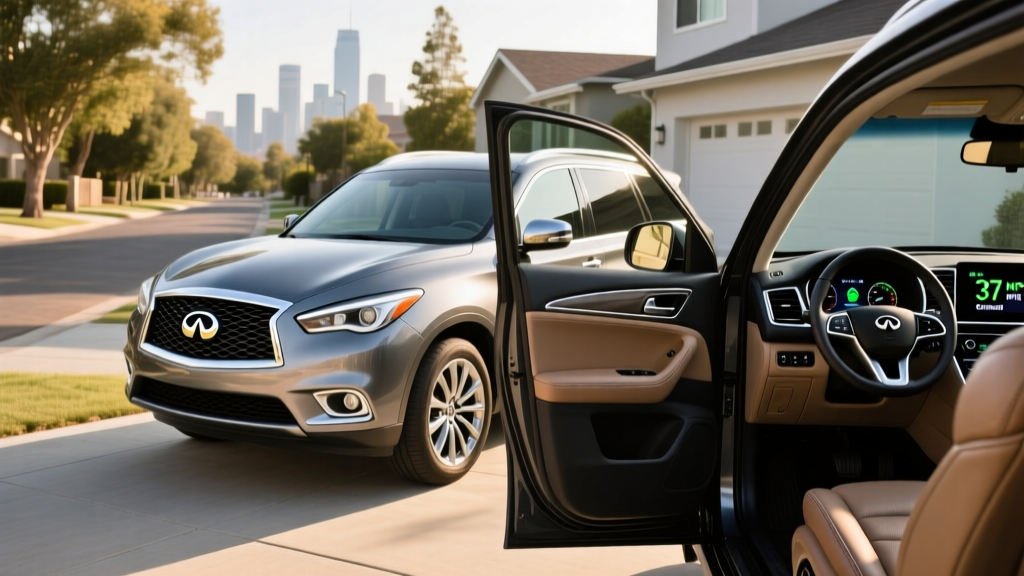
The 2014 Infiniti QX60 Hybrid occupies a strange corner of the used luxury-SUV market. It pairs a 2.5-liter supercharged four-cylinder engine with a 15 kW electric motor integrated into the CVT transmission, producing a combined 250 horsepower. Unlike its Nissan Pathfinder Hybrid sibling, Infiniti tuned this powertrain for smoother low-end torque rather than maximum efficiency. The result is a three-row crossover that achieves a modest 26 MPG combined — roughly 5 MPG better than the standard 3.5L V6 QX60 — at the cost of added drivetrain complexity.
For 2026 used-car shoppers, the QX60 Hybrid is relevant primarily as a budget-friendly family hauler. You will not find plug-in capability, large battery packs, or EV-mode driving here. This is a conventional hybrid (HEV), meaning it charges its small battery entirely through regenerative braking and engine power. No plug, no electric-only range, no federal tax credit eligibility on a used purchase under current IRS §25E rules (the used-EV credit applies only to BEVs and PHEVs, not conventional HEVs).
| Specification | 2014 QX60 Hybrid (FWD) | 2014 QX60 Hybrid (AWD) | 2014 QX60 3.5L V6 (FWD) |
|---|---|---|---|
| Powertrain | 2.5L Supercharged I4 + 15 kW motor | 2.5L Supercharged I4 + 15 kW motor | 3.5L V6 |
| Combined HP / Torque | 250 hp / 243 lb-ft | 250 hp / 243 lb-ft | 265 hp / 240 lb-ft |
| Transmission | CVT with integrated motor | CVT with integrated motor | CVT |
| EPA City / Hwy / Combined | 26 / 28 / 26 MPG | 25 / 27 / 25 MPG | 20 / 26 / 22 MPG |
| Hybrid Battery | ~0.6 kWh lithium-ion | ~0.6 kWh lithium-ion | N/A |
| 0-60 mph (est.) | ~7.8 sec | ~8.1 sec | ~7.5 sec |
| Towing Capacity | 3,500 lbs | 3,500 lbs | 5,000 lbs |
| Original MSRP (base) | $49,695 | $51,295 | $44,095 |
| 2026 Used Price Range | $10,000 – $16,000 | $11,000 – $17,000 | $9,000 – $15,000 |
Understanding the HEV vs. PHEV Distinction
The 2014 QX60 Hybrid is a conventional hybrid (HEV), not a plug-in hybrid (PHEV). This distinction matters enormously for buyer expectations:
| Feature | Conventional Hybrid (HEV) | Plug-In Hybrid (PHEV) |
|---|---|---|
| Plug-in charging? | No — self-charging via engine + regen | Yes — requires Level 1/2 charging |
| Electric-only range | None (motor assists only) | Typically 20–50 miles |
| Battery size | Small (~0.5–2 kWh) | Large (~10–30 kWh) |
| Federal tax credit (new) | None under current §30D rules | Up to $7,500 (subject to sourcing/income/MSRP caps) |
| Used-vehicle credit (§25E) | Not eligible | Up to $4,000 if eligible |
| Example | 2014 Infiniti QX60 Hybrid | 2026 Toyota RAV4 Prime, Chrysler Pacifica PHEV |
The QX60 Hybrid's tiny ~0.6 kWh lithium-ion pack sits beneath the third-row seat. It exists solely to capture regenerative braking energy and provide brief torque-fill during acceleration. You cannot plug this vehicle in, and there is no EV mode button. If you need electric-only commuting, you need a PHEV or BEV — this is not it.
Fuel Economy: EPA Numbers vs. Real-World MPG
According to fueleconomy.gov, the 2014 Infiniti QX60 Hybrid FWD achieves:
| Driving Condition | EPA Estimate | Real-World Expectation |
|---|---|---|
| City | 26 MPG | 24–28 MPG (hybrids often exceed EPA in stop-and-go) |
| Highway | 28 MPG | 25–27 MPG (aerodynamic drag reduces hybrid advantage) |
| Combined | 26 MPG | 24–27 MPG |
The hybrid's advantage over the 3.5L V6 is most pronounced in city driving, where the electric motor's low-speed torque fill and regenerative braking reduce fuel consumption by roughly 30%. On the highway, the gap narrows to about 2 MPG because the supercharged four-cylinder must work hard to move 4,500+ pounds at sustained speed.
Real-world ownership note: Multiple owner forums and Fuelly data suggest that drivers who do mostly suburban driving report 25–27 MPG consistently. Heavy highway commuting or frequent mountain driving can push figures down to 22–23 MPG. Cold-weather operation also reduces efficiency, as the engine runs longer to heat the cabin — expect a 1–3 MPG penalty in winter months.
Powertrain Deep Dive: Supercharged Four + Electric Assist
Infiniti's hybrid system in the QX60 was derived from Nissan's "Intelligent Dual Clutch Hybrid" architecture, though adapted for a single-clutch parallel-hybrid layout. Here is how the components break down:
- Engine: 2.5-liter supercharged inline-4, producing 230 hp and 210 lb-ft on its own
- Electric motor: 15 kW (20 hp), 118 lb-ft, sandwiched between engine and CVT
- Combined output: 250 hp / 243 lb-ft (peak outputs do not occur simultaneously)
- Transmission: Xtronic CVT with integrated motor/generator
- Drivetrain: FWD standard; AWD available with torque on demand
The supercharger is the unusual element here. Most hybrids pair an Atkinson-cycle naturally aspirated engine (like Toyota's approach) for maximum thermal efficiency. Infiniti chose a supercharger to offset the smaller displacement, giving the four-cylinder the low-end punch of a larger engine. The trade-off is slightly higher fuel consumption under hard acceleration compared to Atkinson-cycle designs.
Acceleration is adequate for a family SUV — 0-60 mph in approximately 7.8 seconds for FWD models. The CVT does its usual job of keeping the engine in its optimal power band, though it drones noticeably under hard acceleration. The electric motor's contribution is felt most as smoother initial takeoff from a stop, reducing the "rubber-band" sensation typical of CVTs.
Hybrid Battery Reliability, Warranty, and Replacement Cost
This is the question every used-hybrid buyer asks: will the battery fail, and what will it cost?
Original Hybrid Battery Warranty: 8 years / 100,000 miles (whichever comes first) for the lithium-ion hybrid battery pack. For a 2014 model, this factory warranty expired no later than 2022 or at 100,000 miles.
Current Status (2026): All 2014 QX60 Hybrids are now out of factory hybrid battery warranty. Any battery failure is an out-of-pocket expense.
Reliability track record: The QX60 Hybrid's lithium-ion pack is relatively small and operates within a narrow state-of-charge window (roughly 40–80% SoC), which is favorable for longevity. However, the 2014–2015 model years of the Nissan Pathfinder Hybrid and Infiniti QX60 Hybrid have reported higher-than-average hybrid system issues compared to Toyota's hybrid systems. Common complaints include:
- Hybrid system warning lights related to inverter or motor temperature
- Reduced regenerative braking performance as the battery ages
- CVT shudder or hesitation, sometimes misdiagnosed as hybrid system failure
- 12V auxiliary battery failures (common across all modern vehicles, not hybrid-specific)
Battery replacement cost: A new OEM hybrid battery pack from Infiniti/Nissan runs approximately $3,000–$4,500 for the part alone, with labor adding $500–$1,000. Third-party refurbished packs are available for $1,500–$2,500. Given the vehicle's current used value of $10,000–$17,000, a full battery replacement represents 15–30% of the car's worth — a significant consideration.
Practical advice: Before purchasing a used 2014 QX60 Hybrid, request a hybrid battery health report from a Nissan/Infiniti dealer. The diagnostic scan will show battery capacity retention and any stored fault codes. If the battery shows significant degradation (below ~70% capacity), negotiate the price down by at least $2,000 to account for eventual replacement.
Tax Credits and Incentives: What Applies in 2026?
The 2014 Infiniti QX60 Hybrid does not qualify for any current federal tax credit. Here is why:
- New-vehicle §30D Clean Vehicle Credit: Only available for new BEVs and PHEVs meeting battery-sourcing and critical-mineral requirements. Conventional HEVs have never qualified. This credit is also irrelevant for a 2014 model.
- Used-vehicle §25E Credit (up to $4,000): Available for used BEVs and PHEVs priced at or below $25,000 from a dealer, subject to buyer income caps. Conventional hybrids are explicitly excluded from this credit.
- State incentives: A handful of states historically offered rebates for hybrids, but most have shifted focus to BEVs and PHEVs. Check your state's current energy office or DMV website for any remaining hybrid incentives — but expect none for a 2014 used purchase.
For buyers specifically seeking tax-credit-eligible electrified vehicles, a used PHEV (such as a 2019–2022 Toyota RAV4 Prime or Chrysler Pacifica Hybrid) may qualify for the §25E used-vehicle credit, provided all IRS eligibility requirements are met.
Who Should Buy the 2014 QX60 Hybrid — And Who Shouldn't
Pros
- ~5 MPG improvement over V6 in combined driving
- Smoother low-speed acceleration from electric torque fill
- Three-row seating for up to 7 passengers
- Luxury features at a budget used price ($10K–$17K)
- No plug-in required — fuel and go like a conventional car
Cons
- Reduced towing capacity (3,500 lbs vs. 5,000 lbs for V6)
- Higher drivetrain complexity and repair cost
- Hybrid battery out of warranty on all 2014 models
- No electric-only driving capability
- No federal or state tax credit eligibility
- CVT drone under hard acceleration
Choose the 2014 QX60 Hybrid if:
- You primarily drive in city/suburban traffic where the hybrid advantage is largest
- You need three rows but have a tight budget
- You want better fuel economy without changing your refueling habits
- You can verify hybrid battery health before purchase
Choose the standard V6 QX60 instead if:
- You tow a trailer or boat (5,000-lb capacity vs. 3,500)
- You do mostly highway driving where the MPG gap narrows
- You want simpler mechanics and lower repair risk
Choose a modern PHEV or BEV instead if:
- You want electric-only commuting (PHEV: 20–50 miles; BEV: 200–350+ miles)
- You want to qualify for federal tax credits ($7,500 new / $4,000 used)
- You want current-generation safety tech and warranty coverage
Hybrid vs. PHEV vs. EV: Which Fits Your Situation?
The 2014 QX60 Hybrid represents one point on the electrification spectrum. Here is how it compares to the alternatives for a 2026 buyer:
| Factor | Conventional HEV (e.g., QX60 Hybrid) | PHEV (e.g., RAV4 Prime) | Full BEV (e.g., Tesla Model Y) |
|---|---|---|---|
| Purchase price (used) | $10K–$17K | $25K–$40K | $22K–$45K |
| Fuel cost per mile | ~$0.12–$0.15 | ~$0.04 electric / $0.12 gas | ~$0.03–$0.06 |
| Home charging needed? | No | Recommended (Level 2) | Essential (Level 2) |
| Electric-only range | 0 miles | 20–50 miles | 200–350+ miles |
| Tax credit (used) | None | Up to $4,000 (§25E) | Up to $4,000 (§25E) |
| Maintenance complexity | Engine + hybrid system | Engine + hybrid + larger battery | Minimal (no engine) |
| Best for | Budget buyers, no charging access | Short commutes + road trips | Home chargers, daily driving |
If you have access to Level 2 home charging and a commute under 40 miles, a used PHEV offers dramatically lower operating costs and potential tax-credit eligibility that the QX60 Hybrid cannot match. If charging access is impossible and budget is the primary constraint, the QX60 Hybrid's modest MPG improvement over the V6 may justify the added complexity — provided the battery checks out.
Frequently Asked Questions
How many MPG does the 2014 Infiniti QX60 Hybrid get?
The EPA rates the FWD model at 26 city / 28 highway / 26 combined MPG. The AWD model drops slightly to 25 / 27 / 25 MPG. Real-world driving typically yields 24–27 MPG combined, with city driving sometimes exceeding the EPA estimate and highway driving falling slightly below.
Can the 2014 QX60 Hybrid drive on electric power only?
No. This is a conventional hybrid (HEV) with a very small ~0.6 kWh battery. The electric motor assists the gasoline engine during acceleration and captures energy during braking, but it cannot propel the vehicle on electricity alone. There is no EV mode and no plug-in capability.
Is the 2014 QX60 Hybrid reliable?
Reliability is mixed. The hybrid system adds complexity over the standard V6, and the 2014–2015 model years have reported more hybrid-related issues than Toyota's competing systems. The CVT transmission is also a known wear item. The hybrid battery is now out of warranty on all 2014 examples. A pre-purchase inspection with a hybrid-system diagnostic scan is strongly recommended.
What does it cost to replace the hybrid battery?
An OEM replacement lithium-ion hybrid battery pack costs approximately $3,000–$4,500 for the part, plus $500–$1,000 in labor. Refurbished or third-party packs are available for $1,500–$2,500. Given the vehicle's used value, this is a significant expense that should factor into your purchase decision.
Does the 2014 QX60 Hybrid qualify for any tax credit?
No. Conventional hybrids have never qualified for the federal §30D new-vehicle credit, and they are excluded from the §25E used-vehicle credit. Only BEVs and PHEVs are eligible for current federal incentives. Some states may have offered hybrid incentives historically, but most have expired or shifted to plug-in vehicles.
How does towing capacity compare to the V6 QX60?
The hybrid is rated for 3,500 lbs, which is 1,500 lbs less than the standard 3.5L V6 QX60's 5,000-lb rating. If you tow a camper, boat, or utility trailer regularly, the V6 is the better choice.
Is the 2014 QX60 Hybrid a good buy in 2026?
It can be, at the right price and with a verified battery. At $10,000–$14,000 with a clean hybrid-system diagnostic, it offers luxury features, three-row seating, and a meaningful MPG improvement over the V6. However, buyers who tow, drive mostly highway miles, or want the lowest long-term risk should consider the V6 model or a newer vehicle with remaining warranty coverage.