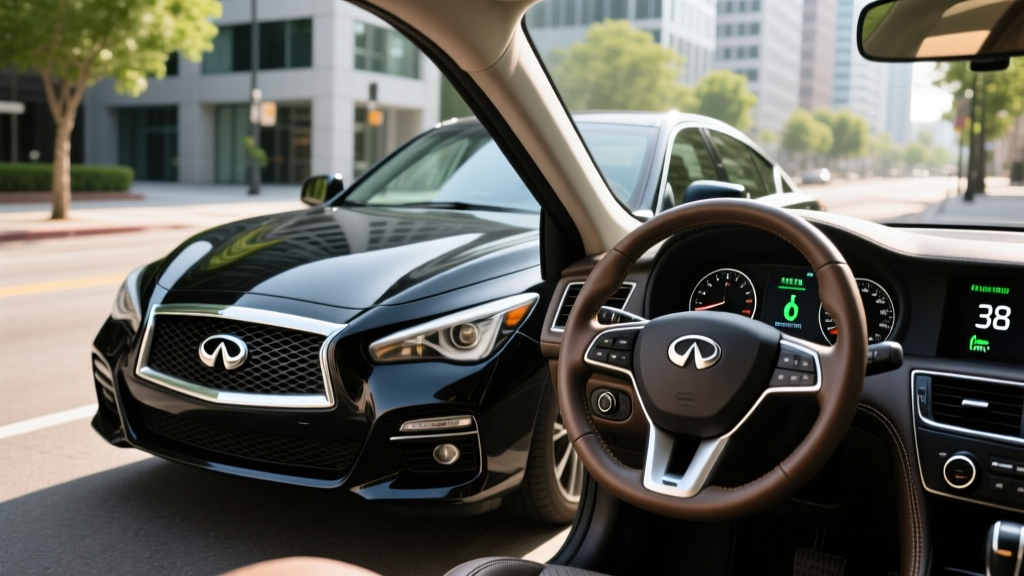
The 2014 Infiniti Q50 Hybrid sedan occupies an unusual space in the used luxury market: a conventional hybrid (HEV) that pairs a supercharged V6 with an electric motor for 354 combined horsepower, yet delivers 29 MPG combined. For buyers in 2026 searching for a fuel-efficient luxury sport sedan without plug-in infrastructure requirements, the Q50 Hybrid remains a compelling — if aging — proposition. This guide breaks down the exact EPA figures, real-world fuel economy, battery longevity, replacement costs, and whether this hybrid still makes sense against modern PHEVs and full EVs.
2014 Infiniti Q50 Hybrid: Powertrain and Performance Specs
The Q50 Hybrid uses Infiniti's Direct Response Hybrid system, combining a 3.5-liter supercharged V6 (302 hp, 258 lb-ft) with a 50 kW electric motor integrated into the 7-speed automatic transmission. Total system output is 354 horsepower and 383 lb-ft of torque. Unlike a plug-in hybrid, this system charges its battery entirely through regenerative braking and the gasoline engine — you never plug it in.
| Specification | 2014 Infiniti Q50 Hybrid |
|---|---|
| Engine | 3.5L supercharged V6 |
| Engine Output | 302 hp / 258 lb-ft |
| Electric Motor | 50 kW (67 hp) / 214 lb-ft |
| Combined System Output | 354 hp / 383 lb-ft |
| Transmission | 7-speed automatic |
| Drivetrain | RWD (AWD available) |
| Hybrid Battery | ~1.4 kWh lithium-ion (non-plug-in) |
| 0-60 mph | ~5.1 seconds (RWD) |
| EPA Fuel Economy (RWD) | 29 city / 33 highway / 31 combined |
| EPA Fuel Economy (AWD) | 27 city / 32 highway / 29 combined |
| Original MSRP (base) | ~$44,550 |
| Used Price Range (2026) | $8,000–$14,000 |
The RWD model's 33 MPG highway figure is impressive for a 3,800-pound luxury sedan with this much power. The AWD variant sacrifices about 2 MPG across the board due to drivetrain losses and added weight.
EPA MPG vs Real-World Fuel Economy
According to fueleconomy.gov, the 2014 Q50 Hybrid RWD achieves 29 city / 33 highway / 31 combined MPG. But how does that translate to real-world driving?
| Driving Scenario | Expected MPG | Notes |
|---|---|---|
| City commuting (stop-and-go) | 27–32 MPG | Hybrid system excels here; regen braking recovers energy |
| Highway cruising (70 mph) | 29–34 MPG | Supercharger parasitic loss limits highway gains vs turbo hybrids |
| Mixed daily driving | 27–31 MPG | Realistic expectation for most owners |
| Cold weather (below 30°F) | 23–27 MPG | Engine runs more for cabin heat; battery efficiency drops |
| Aggressive/sport driving | 20–24 MPG | 354 hp is easy to access; fuel economy drops sharply |
Owner-reported data on fueleconomy.gov averages around 28 MPG combined for the RWD model — about 3 MPG below the EPA sticker. This gap is typical for sporty hybrids where drivers exploit available power. If you drive conservatively in warm weather, hitting or exceeding EPA numbers is achievable, especially in city driving where the hybrid system does its best work.
HEV vs PHEV vs EV: Where Does the Q50 Hybrid Fit?
| Feature | HEV (Q50 Hybrid) | PHEV (e.g., 2026 BMW 330e) | BEV (e.g., 2026 Tesla Model 3) |
|---|---|---|---|
| Plug-in Required? | No | Yes (Level 2 recommended) | Yes (Level 2 or DC fast) |
| Electric-Only Range | ~1 mile at low speed | 20–40 miles | 250–360 miles |
| Total Range | ~530 miles | ~350–400 miles combined | 250–360 miles |
| Fuel Cost per Mile | ~$0.13 (at $3.50/gal) | ~$0.05 electric / $0.12 gas | ~$0.04–$0.08 electric |
| Maintenance | Standard ICE + hybrid | Standard ICE + hybrid + EV | Minimal (no oil, filters) |
| Federal Tax Credit (new) | None | Up to $7,500 (§30D) | Up to $7,500 (§30D) |
| Used Price (2026) | $8K–$14K | $25K–$40K | $20K–$38K |
The Q50 Hybrid is a conventional HEV. Its 1.4 kWh battery provides only brief electric-only assists at very low speeds — essentially coasting through parking lots. It cannot drive meaningful distances on electricity alone. This is fundamentally different from a plug-in hybrid (PHEV) like the BMW 330e, which offers 20+ miles of electric-only range and can be charged at home, or a full battery-electric vehicle (BEV) that uses no gasoline at all.
The Q50 Hybrid's advantage is simplicity: no charging infrastructure needed, no range anxiety, and a lower used-car price point. Its disadvantage is that it still burns gasoline for every mile, and its fuel economy, while good for its performance class, is unremarkable compared to modern hybrids like the 2026 Toyota Camry Hybrid (52 MPG combined).
Hybrid Battery Lifespan, Warranty, and Replacement Cost
Original Warranty: Infiniti covered the 2014 Q50 Hybrid's lithium-ion battery for 8 years / 100,000 miles (96 months / 100K in CARB states: California, New York, Massachusetts, and others adopting CARB standards — up to 10 years / 150,000 miles for emissions-related hybrid components).
2026 Status: For most 2014 Q50 Hybrids, the original hybrid battery warranty has expired or is expiring in 2024–2026 depending on mileage. Any battery failure is now likely an out-of-pocket expense unless an extended warranty was purchased.
The Q50 Hybrid's battery pack is relatively small (~1.4 kWh) compared to PHEV or EV batteries, which actually works in its favor for longevity. Smaller packs experience less thermal stress, and Infiniti/Nissan's hybrid systems from this era have proven reasonably durable. That said, these vehicles are now 12 years old, and lithium-ion cells degrade with time regardless of mileage.
Battery Replacement Cost
If the hybrid battery fails outside warranty, expect the following:
- OEM replacement battery: $2,500–$4,000 for the pack alone
- Labor (dealership): $500–$1,000
- Total dealership replacement: $3,000–$5,000
- Aftermarket/remanufactured pack: $1,500–$2,500 (parts + labor at independent hybrid specialist)
- Individual cell replacement: $800–$1,500 at a hybrid repair shop (if only certain cells have degraded)
Before purchasing a used 2014 Q50 Hybrid, request a hybrid battery health check. A qualified technician can read the battery's State of Health (SoH) via OBD-II diagnostics. Look for SoH above 75%. Also watch for dashboard warning lights related to the hybrid system or noticeable reduction in fuel economy — both can signal battery degradation.
General Reliability
The 2014 Q50 Hybrid's overall reliability is mixed. The powertrain itself — the VQ35 engine family and the hybrid transmission — is well-proven across Nissan and Infiniti products. However, the 2014 model year was the Q50's first year (replacing the G37), and first-year models often carry teething issues. Common complaints include:
- Steering feel inconsistencies with the available Direct Adaptive Steering (drive-by-wire)
- Infotainment system lag and dual-screen usability issues
- Premature brake wear on some units (the regen braking system changes pad wear patterns)
- Hybrid system cooling fan noise
The NHTSA recorded a small number of recalls for the 2014 Q50 (not all hybrid-specific). Check the VIN on NHTSA's recall lookup tool before purchasing.
Tax Credit Eligibility for Used Hybrid Buyers
Here's where the financial picture gets straightforward — and slightly disappointing for bargain hunters:
- Federal §30D New EV Credit: Does NOT apply. The Q50 Hybrid is a conventional HEV, not a plug-in vehicle. Even when new, it never qualified for the federal plug-in credit because it cannot be charged externally.
- Federal §25E Used EV Credit: Does NOT apply. This credit (up to $4,000 or 30% of sale price, whichever is less) is available only for used plug-in EVs and PHEVs with at least 4 kWh of battery capacity. The Q50 Hybrid's 1.4 kWh pack and non-plug-in design make it ineligible.
- State incentives: A small number of states have offered rebates for conventional hybrids in the past, but most have shifted incentives exclusively to plug-in vehicles. Check your state's current energy office or DMV website for any remaining hybrid incentives.
The Q50 Hybrid's financial appeal rests entirely on its used purchase price ($8,000–$14,000), its fuel savings versus the non-hybrid Q50 (roughly 5–7 MPG better), and its performance. There are no tax credits to factor in.
Does the 2014 Q50 Hybrid qualify for any federal tax credit?
- ❌ §30D New Clean Vehicle Credit — requires plug-in capability + ≥7 kWh battery
- ❌ §25E Used Clean Vehicle Credit — requires plug-in capability + ≥4 kWh battery
- ❌ Any current federal hybrid-specific credit — none exist as of 2026
- ✅ Some state-level programs may offer minor hybrid incentives (check local rules)
Who Should Buy the 2014 Q50 Hybrid (and Who Shouldn't)
Pros
- 354 hp with 29+ MPG — rare performance/efficiency combination
- No plug-in required — works with existing gas infrastructure
- Luxury features (leather, Bose audio, available AWD) at a used bargain price
- Strong highway cruiser with comfortable ride
- Well-proven Nissan/Infiniti VQ powertrain
- Total range ~530 miles per tank
Cons
- 12-year-old hybrid battery nearing or past warranty expiration
- No electric-only driving capability (unlike PHEVs)
- Outdated infotainment and driver-assist tech vs 2026 vehicles
- Fuel economy unremarkable vs modern hybrids (Camry Hybrid: 52 MPG)
- No federal tax credit eligibility
- Direct Adaptive Steering (if equipped) has known reliability concerns
- Premium fuel required (91 octane)
Choose the 2014 Q50 Hybrid if:
- You want a fast, comfortable luxury sedan under $14,000
- You cannot install home charging and don't want to rely on public chargers
- You drive 10,000–15,000 miles/year and value the MPG bump over the non-hybrid Q50
- You're comfortable budgeting $2,000–$4,000 for a potential hybrid battery replacement
Choose a PHEV or EV instead if:
- You have home Level 2 charging access and want electric-only daily commuting
- You want current-generation ADAS (automatic emergency braking, lane-keeping) as standard
- You want to minimize fuel costs — a used Tesla Model 3 or Chevy Bolt costs less per mile
- You want federal tax credit eligibility on a used plug-in vehicle (§25E credit)
Ownership Costs: 5-Year Estimate
Buying a used 2014 Q50 Hybrid in 2026 means looking at total cost of ownership, not just the purchase price. Here's a realistic 5-year projection assuming 12,000 miles/year, $3.50/gallon premium fuel, and average maintenance:
| Cost Category | 5-Year Estimate | Notes |
|---|---|---|
| Purchase price | $10,000–$14,000 | Average: ~$11,500 for well-maintained example |
| Fuel (premium 91 octane) | $7,200–$8,500 | At 29 MPG combined, 60K miles, $3.50/gal |
| Insurance | $6,000–$9,000 | Varies heavily by state, age, driving record |
| Maintenance & repairs | $3,500–$6,000 | Includes potential hybrid battery service |
| Depreciation | $3,000–$5,000 | Most depreciation already occurred; slower decline now |
| Total 5-Year Cost | $29,700–$42,500 | Average: ~$35,000 |
For comparison, a 2026 Toyota Camry Hybrid LE ($30,000 new, 52 MPG combined) would cost roughly $34,000–$38,000 over 5 years including purchase — similar total cost but with a full warranty, modern safety tech, and far better fuel economy. The Q50 Hybrid's value proposition is the luxury badge and performance, not pure economics.
Frequently Asked Questions
How many MPG does the 2014 Infiniti Q50 Hybrid get?
The EPA rates the RWD model at 29 city / 33 highway / 31 combined MPG. The AWD version drops to 27 city / 32 highway / 29 combined. Real-world owner averages hover around 27–29 MPG combined, with cold weather and aggressive driving reducing that to 22–26 MPG.
Can the 2014 Q50 Hybrid drive on electric power only?
Only in very limited circumstances. The hybrid system can propel the car at low speeds (under ~25 mph) for roughly one mile on battery power alone, such as creeping through a parking lot. It is not a plug-in hybrid and cannot be charged externally. For meaningful electric-only range, you need a PHEV (20–40 miles) or a full EV.
Is the 2014 Q50 Hybrid reliable?
The powertrain is generally reliable — Nissan's VQ35 engine family and hybrid system are well-established. However, as a 12-year-old vehicle, age-related issues are expected: hybrid battery degradation, suspension wear, and electronics aging. The available Direct Adaptive Steering system (drive-by-wire) has drawn more complaints than the hybrid system itself. Check IIHS ratings for crash safety performance.
What does it cost to replace the hybrid battery?
A dealership OEM replacement runs $3,000–$5,000 (parts and labor). Independent hybrid specialists can install remanufactured packs for $1,500–$2,500, or replace individual failed cells for $800–$1,500. Given the car's current value ($8K–$14K), a full OEM battery replacement represents a significant percentage of the vehicle's worth — factor this into your purchase decision.
Does the 2014 Q50 Hybrid qualify for any tax credit?
No. As a conventional hybrid (HEV) that cannot be plugged in, the Q50 Hybrid is ineligible for both the federal §30D new vehicle credit and the §25E used vehicle credit. These credits require plug-in capability and minimum battery capacity thresholds (7 kWh for new, 4 kWh for used) that the Q50's 1.4 kWh pack does not meet.
Is the Q50 Hybrid better than the non-hybrid Q50?
It depends on your priorities. The hybrid adds roughly 30 hp and 5–7 MPG over the base 2.0T or 3.7L V6 Q50 models, but adds weight, complexity, and potential battery replacement cost. If you drive 15,000+ miles per year, the fuel savings can offset the premium. For lower-mileage drivers, the non-hybrid Q50 (or Q50 3.0T for more power) may be the simpler choice.
Should I buy a 2014 Q50 Hybrid or a modern used EV?
If you have reliable home charging and want the lowest per-mile cost, a used EV like a 2020–2022 Tesla Model 3 or Chevrolet Bolt offers far cheaper "fuel" (~$0.04–$0.08/mile vs $0.13/mile for the Q50 Hybrid), lower maintenance, and may qualify for the $4,000 used EV tax credit. Choose the Q50 Hybrid only if you need a no-plug solution, prefer the Infiniti luxury experience, or lack charging access.
The 2014 Infiniti Q50 Hybrid sedan delivers a compelling blend of luxury, performance, and efficiency for its era — 354 hp and 29 MPG combined was genuinely impressive in 2014. In 2026, it remains a budget-friendly entry into the luxury hybrid segment, but buyers must weigh the aging battery, lack of tax credits, and outdated technology against its low purchase price and proven powertrain. If you can verify battery health before purchase and budget for eventual replacement, the Q50 Hybrid offers a lot of car for the money.