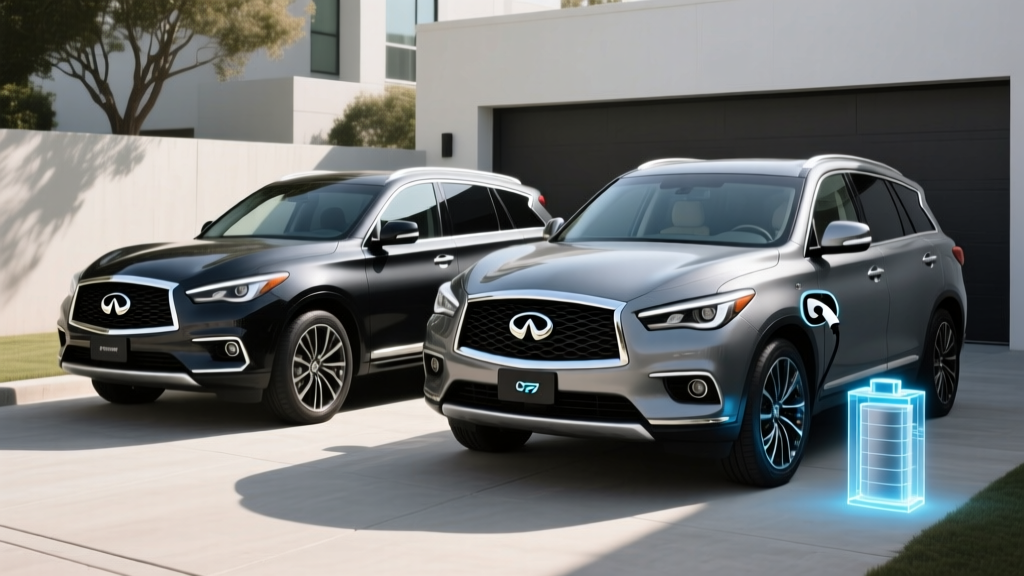
If you're searching for a 2014 Infiniti hybrid SUV on the used market in 2026, you're likely weighing luxury, fuel savings, and long-term reliability against newer electrified alternatives. Infiniti's 2014 hybrid SUV lineup centered on two models: the three-row QX60 Hybrid (a conventional hybrid, or HEV) and the compact QX50 (which, in 2014, was not offered as a hybrid in the U.S. — only as a gasoline V6). This guide focuses on the QX60 Hybrid, the only true 2014 Infiniti hybrid SUV sold stateside, and explains what used buyers need to know about its powertrain, real-world MPG, battery longevity, and whether it still makes sense versus a modern PHEV or full EV.
HEV vs PHEV: What the 2014 Infiniti QX60 Hybrid Actually Is
Conventional Hybrid (HEV): The 2014 Infiniti QX60 Hybrid is a self-charging hybrid. It has a small battery recharged by regenerative braking and the gasoline engine. You never plug it in. It cannot drive on electric power alone for meaningful distances.
Plug-in Hybrid (PHEV): A PHEV has a larger battery (typically 10–25 kWh) that you plug in to recharge, offering 20–50 miles of electric-only range before the gas engine engages. Infiniti did not offer a PHEV SUV in 2014. Today's examples include the Toyota RAV4 Prime or Hyundai Tucson PHEV.
Full EV (BEV): Zero gasoline, large battery (60–100+ kWh), 200–400 miles of range. Examples: Tesla Model Y, Hyundai Ioniq 5.
The QX60 Hybrid uses Nissan's Intelligent Dual Clutch System — a one-motor, two-clutch parallel hybrid architecture shared with the Nissan Pathfinder Hybrid. It pairs a supercharged 2.5-liter inline-4 with a 15 kW (20 hp) electric motor integrated between the engine and the CVT transmission. This is a mild-to-moderate hybrid system, not the full blended hybrid setup found in a Toyota Highlander Hybrid.
2014 Infiniti QX60 Hybrid: Powertrain and Performance Specs
| Specification | 2014 Infiniti QX60 Hybrid |
|---|---|
| Engine | 2.5L supercharged inline-4 |
| Engine Output | 250 hp / 243 lb-ft torque |
| Electric Motor | 15 kW (20 hp) / 118 lb-ft torque |
| Combined System Output | 250 hp (net) |
| Transmission | CVT (Xtronic) with dual-clutch hybrid module |
| Drivetrain | FWD standard; AWD optional |
| Hybrid Battery | ~0.6 kWh lithium-ion (under 3rd-row seat) |
| 0–60 mph | ~8.1 seconds (est.) |
| Towing Capacity | 3,500 lbs |
| Cargo Volume | 15.8 cu ft (behind 3rd row) / 76.2 cu ft (max) |
| Seating | 7 passengers |
The combined 250 hp output is modest for a 4,500+ lb three-row SUV. The supercharger compensates for the smaller displacement engine, and the electric motor fills in torque at low RPMs. Acceleration is adequate for highway merging but not brisk. The CVT keeps the engine in its efficient range, which helps fuel economy but can produce the characteristic drone under hard acceleration.
Fuel Economy: EPA MPG and Real-World Expectations
| Configuration | City MPG | Highway MPG | Combined MPG |
|---|---|---|---|
| QX60 Hybrid FWD | 26 | 28 | 26 |
| QX60 Hybrid AWD | 25 | 28 | 26 |
| QX60 Gas V6 FWD (baseline) | 20 | 26 | 22 |
| QX60 Gas V6 AWD (baseline) | 19 | 25 | 21 |
Source: fueleconomy.gov
The hybrid's 4-MPG combined advantage over the gas V6 translates to roughly 65–80 fewer gallons per year at 15,000 miles driven annually, saving approximately $200–$280 per year at $3.50/gallon. Over a decade of ownership, that's $2,000–$2,800 in fuel savings — meaningful but not transformative compared to a PHEV or EV.
Hybrid Battery Longevity, Warranty, and Replacement Cost
2026 Reality: A 2014 model is now 12 years old. The original factory battery warranty has expired for all owners. Any battery failure is an out-of-pocket expense.
The QX60 Hybrid's battery pack is small (~0.6 kWh) compared to a PHEV or EV, which means fewer cells and lower replacement cost. However, it still uses lithium-ion chemistry that degrades with age and heat cycles.
Expected lifespan: Nissan/Infiniti hybrid batteries from this era typically last 120,000–180,000 miles before significant degradation. Many owners report original batteries still functioning at 150,000+ miles, though with reduced electric-assist contribution (meaning slightly lower MPG than new).
Replacement cost (2026 estimates):
- OEM dealer replacement: $3,500–$5,000 (parts + labor)
- Refurbished/aftermarket pack: $1,800–$3,000
- Individual cell module repair: $800–$1,500 (if only specific modules have failed — requires a qualified hybrid specialist)
Before buying a used 2014 QX60 Hybrid, request a hybrid battery health report from a dealer or hybrid specialist. A scan tool can read the battery's state of health (SoH) and individual cell voltage balance. Avoid vehicles where cell voltage variance exceeds 0.3V — that signals uneven degradation and imminent failure.
Reliability: Known Issues and Ownership Costs
The 2014 QX60 Hybrid carries a mixed reliability record. Key concerns used buyers should investigate:
- CVT transmission: Nissan/Infiniti CVTs from this era have a documented history of premature failure, typically between 80,000–120,000 miles. The hybrid's CVT is a variant of the same unit. A CVT replacement runs $3,500–$5,500. Check for shuddering, whining, or delayed engagement during a test drive.
- Supercharger whine: The Eaton supercharger on the 2.5L engine can develop bearing noise above 100,000 miles. Listen for a high-pitched whine that increases with RPM.
- Brake feel: The regenerative braking system can produce a grabby or inconsistent pedal feel as the transition between regen and friction braking ages. Brake actuator replacement is $1,200–$1,800.
- Electrical gremlins: Some owners report intermittent hybrid system warnings. Most are sensor-related and fixable, but diagnosis requires Infiniti-specific scan tools.
On the positive side, the QX60's interior materials, ride comfort, and three-row practicality remain competitive for a used luxury SUV. The hybrid variant is also slightly quieter at low speeds due to electric-motor assist during initial acceleration.
Used Pricing and Tax Credit Eligibility in 2026
As of early 2026, a used 2014 Infiniti QX60 Hybrid typically lists between $9,000 and $15,000 depending on mileage (80,000–140,000 miles), condition, and region. The gas-only QX60 trades for $1,000–$2,000 less at comparable mileage.
Federal tax credit: The IRS §30D clean vehicle credit applies to new qualifying EVs and PHEVs — not conventional hybrids. The QX60 Hybrid (HEV) does not qualify for any federal tax credit, whether purchased new or used.
The used clean vehicle credit (up to $4,000 / 30% of sale price) under §25E applies only to used plug-in EVs and PHEVs with at least 16 kWh of battery capacity. The QX60 Hybrid's ~0.6 kWh pack falls far short. No federal tax incentive applies to this vehicle.
Some states previously offered hybrid rebates, but most have expired or shifted exclusively to plug-in vehicles. Check your state's current energy office or DMV for any remaining programs.
Who Should Buy the 2014 QX60 Hybrid vs. Alternatives?
- Three-row seating (7 passengers) at a low used price
- 4 MPG advantage over gas V6 (~$250/year fuel savings)
- No plug-in required — works for apartment dwellers
- Comfortable ride, premium interior for the price point
- 3,500-lb towing capacity
- Expired battery warranty — replacement is out-of-pocket
- CVT reliability risk at higher mileage
- No electric-only driving capability
- No federal or state tax credit eligibility
- Modest 250 hp for a heavy SUV
- Outdated infotainment and driver-assist tech by 2026 standards
- You need three rows and luxury badges under $15,000
- You drive mostly city/suburban miles where hybrid efficiency shines
- You cannot charge at home (no plug-in needed)
- You accept the CVT and battery risk as part of a lower purchase price
- You want 30+ MPG combined with electric-only commuting
- You want a current battery warranty and updated safety tech
- You qualify for the §30D tax credit on a new PHEV ($7,500 with income/sourcing requirements)
- You have home Level 2 charging access
- You want to eliminate gasoline costs entirely
- Your daily driving is under 250 miles and you can plan road-trip charging
Frequently Asked Questions
How many MPG does the 2014 Infiniti QX60 Hybrid get?
The EPA rates the FWD model at 26 city / 28 highway / 26 combined MPG. The AWD version is rated 25/28/26 MPG. Real-world city driving often yields 27–29 MPG thanks to regenerative braking, while sustained highway driving at 75+ mph may drop to 25–26 MPG.
Can the 2014 QX60 Hybrid drive on electric power only?
Not meaningfully. As a conventional hybrid (HEV), the QX60 can creep at very low speeds on electric power for a few hundred yards, but the 0.6 kWh battery is far too small for any real electric-only range. You cannot plug it in. If electric-only commuting matters, you need a PHEV or BEV.
Is the 2014 QX60 Hybrid reliable?
Reliability is mixed. The hybrid system itself is generally durable, but the Nissan-sourced CVT has a known failure history at 80,000–120,000 miles, and the supercharger can develop bearing noise. A thorough pre-purchase inspection by a hybrid-qualified technician is essential. Budget $2,000–$4,000 for potential CVT or battery service in your first two years of ownership.
What does it cost to replace the hybrid battery?
An OEM dealer replacement runs $3,500–$5,000. Refurbished packs cost $1,800–$3,000. Individual module repair by a hybrid specialist may cost $800–$1,500 if only specific cells have degraded. Given the vehicle's $9,000–$15,000 used value, a full OEM replacement may not be economically justified — factor this into your purchase negotiation.
Does the 2014 Infiniti QX60 Hybrid qualify for any tax credit?
No. Federal tax credits under IRS §30D and §25E apply only to plug-in vehicles (PHEVs with 7+ kWh batteries or full EVs). The QX60 Hybrid's conventional hybrid system with its ~0.6 kWh battery does not meet the threshold. No federal purchase incentive applies, whether buying new (when available) or used.
Is the 2014 QX60 Hybrid better than the gas V6 version?
It depends on your driving pattern. If most of your miles are city and suburban, the 4-MPG advantage saves ~$250/year in fuel. But the hybrid carried a ~$3,000 premium when new, and on the used market, that gap has narrowed to $1,000–$2,000. If you drive mostly highway, the fuel savings shrink and the gas V6 may be the simpler, lower-risk choice given one fewer complex system (no supercharger, no hybrid battery) to maintain.
How does the QX60 Hybrid compare to a Toyota Highlander Hybrid from the same era?
The 2014 Toyota Highlander Hybrid (35 city / 28 hwy / 28 combined, per fueleconomy.gov) delivers 2–3 MPG better combined and uses a proven full-hybrid system with a stronger reliability track record. The Highlander Hybrid's eCVT (planetary gearset) avoids the belt-driven CVT reliability issues. However, the QX60 offers a more premium interior and a lower entry price on the used market.