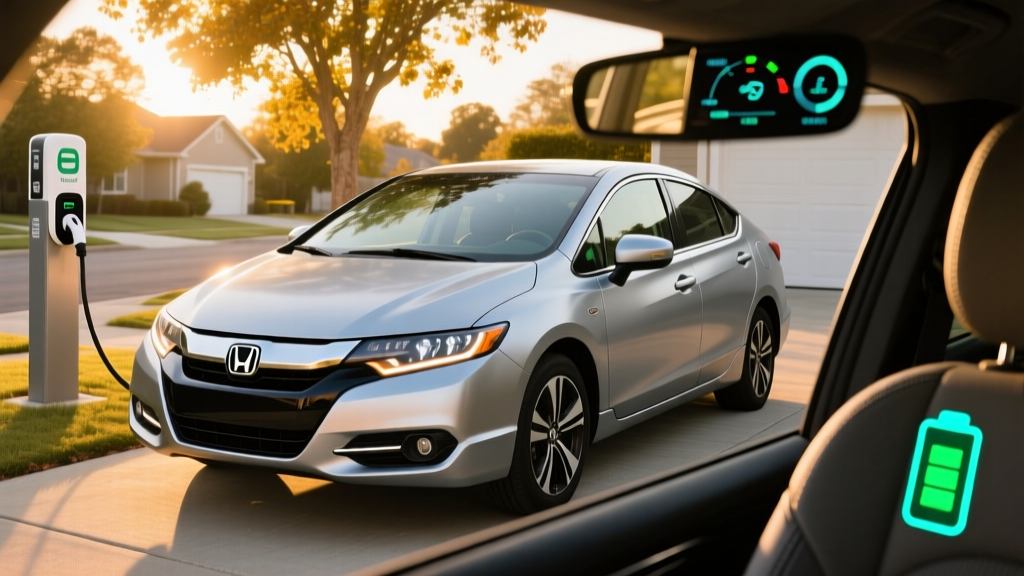
The 2014 Honda Insight was Honda's dedicated hybrid hatchback — a compact, five-door liftback designed to compete directly with the Toyota Prius on fuel economy and price. Now well over a decade old, the Insight has been discontinued (Honda retired the nameplate after the 2022 model year), but the 2014 version remains a popular used-hybrid option for budget-conscious commuters. This guide covers the exact numbers you need: EPA and real-world MPG, the Integrated Motor Assist (IMA) battery's longevity and replacement cost, and whether a used 2014 Insight still makes financial sense in 2026.
HEV, Not PHEV: What the 2014 Insight Actually Is
Before evaluating the Insight, it's essential to classify it correctly. The 2014 Honda Insight is a conventional hybrid electric vehicle (HEV). It is not a plug-in hybrid (PHEV) and it is not a battery-electric vehicle (BEV). You never plug it in — the small lithium-ion battery recharges through regenerative braking and the gasoline engine.
HEV vs. PHEV vs. BEV — Where the Insight Fits
| Feature | 2014 Honda Insight (HEV) | Typical PHEV (e.g., Toyota Prius Prime) | BEV (e.g., Chevy Bolt EV) |
|---|---|---|---|
| Plug-in charging required? | No | Optional (but recommended) | Yes — mandatory |
| Electric-only range | None (motor assists only) | 25–44 miles | 200–350+ miles |
| Gas engine | 1.3L I4 | Yes | None |
| Battery size | ~0.6 kWh (Li-ion) | 13–18 kWh | 60–100+ kWh |
| Federal tax credit (§30D) | Not eligible | Up to $7,500 (new, if eligible) | Up to $7,500 (new, if eligible) |
The Insight's tiny battery is there to assist the gas engine and capture braking energy — not to drive the car on electricity alone.
2014 Honda Insight MPG: EPA Ratings vs. Real-World Results
The headline number for any hybrid is fuel economy. According to fueleconomy.gov (EPA), the 2014 Honda Insight carries these official ratings:
| Cycle | MPG |
|---|---|
| City | 41 |
| Highway | 44 |
| Combined | 42 |
Real-World MPG: What Owners Actually Report
EPA numbers are a baseline, not a guarantee. The Insight's real-world fuel economy depends heavily on driving style, terrain, and climate:
- City commuting (stop-and-go): 40–46 MPG. Hybrids thrive in city driving because regenerative braking recaptures energy that a gas car wastes as heat. Many owners report beating the EPA city figure in moderate-speed urban traffic.
- Highway cruising (70+ mph): 36–42 MPG. At sustained high speeds, the Insight's aerodynamic drag and the engine running continuously reduce efficiency below the EPA highway estimate. This is typical for small hybrids — the EPA highway test cycle is relatively gentle.
- Cold weather (below 35°F): Expect a 10–15% drop, bringing combined MPG to roughly 35–38. The engine runs more frequently to maintain cabin heat and reach operating temperature, reducing the electric motor's contribution.
- Hilly terrain: Highly variable. Uphill segments may drop instantaneous MPG into the low 30s, but regenerative braking on descents partially offsets this.
Owner-reported averages on Fuelly and similar platforms cluster around 39–43 MPG combined, which aligns closely with the EPA's 42 MPG estimate. This is honest, achievable efficiency — not hypermiling fantasy.
Powertrain & Specs: The IMA System Explained
The 2014 Insight uses Honda's Integrated Motor Assist (IMA) system — a parallel hybrid architecture where a thin electric motor is sandwiched between the gasoline engine and the continuously variable transmission (CVT). Unlike Toyota's Hybrid Synergy Drive, which can drive the wheels on electric power alone at low speeds, Honda's IMA primarily assists the gas engine rather than replacing it.
| Specification | 2014 Honda Insight |
|---|---|
| Engine | 1.3L i-VTEC inline-4 |
| Engine horsepower | 88 hp @ 5,800 rpm |
| Electric motor output | 13 hp (10 kW) |
| Combined system horsepower | 98 hp |
| Combined torque | 123 lb-ft |
| Transmission | CVT (continuously variable) |
| Hybrid battery | Lithium-ion, ~0.6 kWh (nominal) |
| Drivetrain | Front-wheel drive |
| 0–60 mph | ~9.8 seconds |
| Curb weight | ~2,835 lbs |
| Fuel tank | 10.6 gallons |
| Total driving range (EPA est.) | ~445 miles |
With 98 combined horsepower and a CVT, the Insight is not quick. The 0–60 time of roughly 9.8 seconds is adequate for city merging and suburban driving but feels strained on steep highway on-ramps. This is a car optimized for efficiency, not performance.
Hybrid Battery Lifespan, Warranty & Replacement Cost
For any used hybrid buyer, the traction battery is the single biggest unknown. Here's what you need to know about the 2014 Insight's IMA battery:
Battery Warranty (Original)
Honda originally warranted the 2014 Insight's IMA battery for 8 years / 100,000 miles (10 years / 150,000 miles in CARB states including California, Connecticut, Maine, Maryland, Massachusetts, New Jersey, New York, Oregon, Rhode Island, Vermont, and Washington). For a 2014 model, this factory warranty has expired as of 2022–2024 depending on state and mileage. Any battery failure in 2026 is an out-of-pocket cost.
How Long Does the IMA Battery Actually Last?
Honda's lithium-ion IMA pack in the 2014 Insight has proven more durable than the earlier nickel-metal hydride (NiMH) batteries used in first-generation Insights (2000–2006). Based on owner reports, forum data, and repair databases:
- Typical lifespan: 120,000–180,000 miles before significant capacity loss or cell failure triggers an IMA warning light.
- Age factor: Even with low mileage, lithium-ion cells degrade over time. A 12-year-old battery (as of 2026) may show reduced assist capability regardless of odometer reading.
- Failure mode: The IMA system typically doesn't fail catastrophically. Instead, individual cells weaken, the system reduces assist, and the car defaults to engine-only operation. You can still drive the car, but fuel economy drops to roughly 30–34 MPG and the 12V battery may not charge properly (since the IMA motor also charges the 12V system).
IMA Battery Replacement Cost in 2026
| Option | Est. Cost |
|---|---|
| New OEM Honda IMA battery (dealer) | $2,500–$3,500 |
| Remanufactured IMA battery (aftermarket) | $1,200–$2,000 |
| Individual cell replacement (DIY/specialist) | $300–$800 |
| Labor (independent shop, 2–3 hours) | $200–$450 |
The most cost-effective route for a used 2014 Insight is typically a remanufactured battery from a hybrid specialist, installed at an independent shop, for a total of roughly $1,500–$2,400. Given that the car's resale value in 2026 is approximately $5,000–$8,500 depending on mileage and condition, a battery replacement represents a significant percentage of the vehicle's worth — factor this into your purchase negotiation.
Does the 2014 Insight Qualify for Any Tax Credit?
No. The 2014 Honda Insight is a conventional hybrid (HEV) and does not qualify for the federal §30D Clean Vehicle Credit. The §30D credit applies only to plug-in electric vehicles (PHEVs and BEVs) with sufficient battery capacity and compliant battery sourcing. The Insight's ~0.6 kWh battery and lack of plug-in capability place it entirely outside the credit's scope.
This is true whether you buy the Insight new (which is no longer possible) or used. The used clean vehicle credit (up to $4,000 under §25E) also requires a plug-in electric or fuel-cell vehicle — conventional hybrids do not qualify.
Some states previously offered rebates for hybrids, but most state-level hybrid incentive programs have sunset or shifted exclusively to PHEVs and BEVs. Check your state's current energy or environmental agency website for any remaining programs, but do not count on incentives for a conventional HEV purchase in 2026.
Used 2014 Insight Pricing & What to Inspect
As of early 2026, the 2014 Honda Insight trades on the used market in these approximate ranges:
- High mileage (130,000+ miles): $4,000–$5,500
- Average mileage (80,000–130,000 miles): $5,500–$7,500
- Low mileage (under 80,000 miles, clean title): $7,500–$9,000
Pre-Purchase Inspection Checklist
If you're considering a used 2014 Insight, prioritize these items during a pre-purchase inspection:
- IMA battery health: Ask a Honda dealer or hybrid specialist to pull the IMA battery state-of-health (SoH) data via OBD-II diagnostic tool. Look for cell voltage imbalance exceeding 0.2V between modules.
- IMA warning light: If the green "IMA" light on the dash is off or flashing, the system may have a stored fault. Walk away or negotiate a steep discount.
- 12V battery condition: The Insight's 12V battery is charged by the IMA system. A failing IMA battery can leave the 12V undercharged, causing starting issues and electrical gremlins.
- CVT operation: The CVT should shift smoothly without shuddering, whining, or hesitation. Honda CVTs from this era are generally reliable, but fluid changes may have been neglected.
- A/C compressor: The Insight uses an electric A/C compressor. Replacement is expensive ($1,200–$1,800). Verify cold air output during a test drive.
Who Should Buy the 2014 Insight — And Who Shouldn't
Pros
- Strong real-world MPG (39–43 combined)
- Low purchase price on the used market
- Honda reliability for engine and transmission
- Hatchback cargo versatility (20.9 cu ft behind rear seats)
- No plug-in infrastructure needed
- Low insurance costs
Cons
- Modest power (98 hp combined) — slow on highway merges
- IMA battery replacement risk ($1,500–$3,500)
- No electric-only driving capability
- No federal or state tax credits
- Ride quality and road noise are budget-tier
- Discontinued — parts availability may narrow over time
Hybrid vs. PHEV vs. EV: Which Fits You?
The 2014 Insight makes sense for a specific buyer profile. Here's a decision framework:
Choose the 2014 Insight (HEV) if:
- Your budget is under $8,000 and you need reliable commuter transportation
- You have no access to home or workplace charging (apartment, street parking)
- Your commute is primarily city/suburban stop-and-go driving
- You want a simple ownership experience with no plug-in habits to learn
Choose a used PHEV (e.g., 2017+ Prius Prime) if:
- You can install a Level 2 charger at home and your commute is under 25 miles each way
- You want electric-only daily driving with gas-engine backup for road trips
- You're willing to pay $12,000–$18,000+ on the used market
Choose a used BEV (e.g., 2018+ Chevy Bolt, 2019+ Nissan Leaf) if:
- You have reliable home Level 2 charging
- Your daily driving is under 150 miles and you rarely take long road trips
- You want zero tailpipe emissions and minimal maintenance (no oil changes, no spark plugs)
- You can budget $10,000–$16,000+ for a used EV with acceptable battery health
2014 Honda Insight FAQ
How many MPG does the 2014 Honda Insight get?
The EPA rates the 2014 Insight at 41 MPG city, 44 MPG highway, and 42 MPG combined. Real-world owners typically report 39–43 MPG combined, with city driving often exceeding the EPA estimate and sustained highway driving falling slightly below it.
Is the 2014 Honda Insight a plug-in hybrid?
No. The 2014 Insight is a conventional hybrid (HEV). It has no plug, no electric-only driving mode, and no external charging capability. The battery recharges solely through regenerative braking and the gasoline engine.
How much does it cost to replace the hybrid battery in a 2014 Insight?
A new OEM IMA battery from a Honda dealer costs roughly $2,500–$3,500 including labor. A remanufactured aftermarket battery installed at an independent shop typically runs $1,500–$2,400 total. Individual cell-level repairs can cost as little as $300–$800 but require a specialist.
Is the 2014 Honda Insight reliable?
The Insight's 1.3L engine, CVT, and general drivetrain are considered reliable with standard maintenance. The primary risk is IMA battery degradation due to age (all 2014 batteries are now 12+ years old). Honda's hybrid components are generally robust, but budget for a potential battery replacement during ownership.
Does the 2014 Insight qualify for a federal tax credit?
No. The §30D Clean Vehicle Credit and the §25E used clean vehicle credit both require a plug-in electric vehicle (PHEV or BEV). The Insight, as a conventional hybrid, is ineligible for any current federal EV tax credit. Check your state's energy office for any remaining hybrid incentives, though most have expired.
Can the 2014 Insight drive on electric power alone?
Only in very limited circumstances. The IMA system can shut off the engine at idle (auto-stop) and provide brief electric assist during acceleration, but the electric motor cannot propel the car independently at meaningful speeds. This is fundamentally different from Toyota's full-hybrid system or any PHEV.
What's the difference between the 2014 Insight and a Toyota Prius of the same year?
The 2014 Prius (third generation) offers more power (134 hp combined), a larger cargo area, and Toyota's full-hybrid system that can drive on electric power alone at low speeds. The Prius is rated at 50 MPG combined vs. the Insight's 42 MPG. However, the Prius typically commands a higher used price ($7,000–$11,000 for a 2014 model) and its NiMH battery also faces age-related replacement risk. The Insight is the budget alternative — less efficient, less powerful, but cheaper to acquire.
Sources: EPA Fuel Economy — 2014 Honda Insight, IRS §30D Clean Vehicle Credit, Honda Automobiles press archives. Pricing estimates reflect US used-market data as of early 2026 and will vary by region, condition, and mileage.