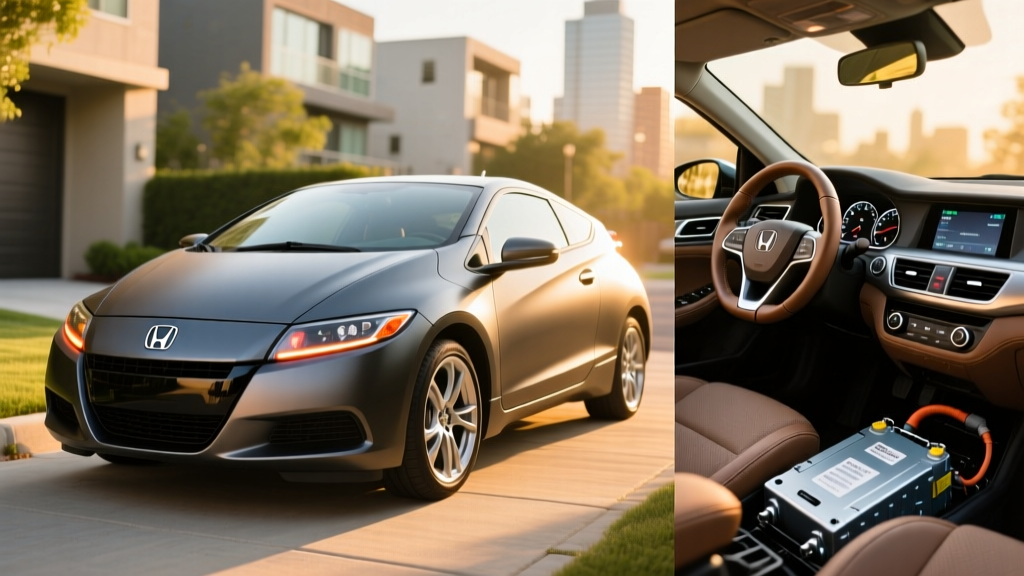
The 2014 Honda CR-Z occupies a strange corner of hybrid history. Marketed as a "sport hybrid," it paired a modest 1.5-liter four-cylinder with Honda's Integrated Motor Assist (IMA) system to deliver respectable fuel economy in a lightweight, two-seat coupe. Honda discontinued the CR-Z after the 2016 model year, but with used examples still circulating in 2026, buyers researching the 2014 Honda CR-Z hybrid need clear data on what this car actually delivers — and where it falls short compared to modern hybrids and EVs.
This guide covers the real-world fuel economy, IMA battery longevity, ownership costs, and whether a decade-old sport hybrid still earns a spot in your driveway.
2014 Honda CR-Z Hybrid: Key Specifications at a Glance
| Specification | Value |
|---|---|
| Powertrain | 1.5L i-VTEC 4-cyl + IMA electric motor |
| Combined Horsepower | 130 hp @ 6,000 rpm |
| Combined Torque | 140 lb-ft (CVT) / 127 lb-ft (6MT) |
| Transmission | 6-speed manual or CVT |
| EPA MPG (City / Hwy / Combined) | 31 / 38 / 34 (CVT); 31 / 37 / 34 (6MT) |
| Hybrid Battery | 0.5 kWh nickel-metal hydride (NiMH) |
| Curb Weight | ~2,850 lbs |
| 0–60 mph | ~9.1 seconds |
| Cargo Volume | 25.1 cu ft (rear seats folded) |
| Original MSRP (2014) | $19,995 (base) – $24,500 (EX-L Navi) |
| Used Price Range (2026 est.) | $7,000 – $13,000 |
Sources: EPA fueleconomy.gov, Honda press archives.
HEV vs PHEV: What the CR-Z Actually Is
Honda's IMA system in the CR-Z is a mild-hybrid architecture. The electric motor sits between the engine and transmission, providing torque assist during acceleration and enabling regenerative braking. Unlike Toyota's Hybrid Synergy Drive or Honda's own later two-motor systems, IMA cannot propel the car on electric power alone at any meaningful speed. The motor's contribution is supplementary — it improves efficiency and smooths stop-start driving, but the 1.5L gas engine does the heavy lifting.
| Feature | HEV (CR-Z) | PHEV (e.g., Prius Prime) | BEV (e.g., Bolt EV) |
|---|---|---|---|
| Plug-in charging? | No | Yes | Yes |
| Electric-only range | None | 25–45 miles | 200–350+ miles |
| Battery size | ~0.5 kWh | 8–18 kWh | 50–100+ kWh |
| Federal tax credit | None | Up to $7,500 (new) | Up to $7,500 (new) |
| Gasoline required? | Yes | Yes (backup) | No |
Fuel Economy: EPA Numbers vs Real-World MPG
| Transmission | City MPG | Highway MPG | Combined MPG |
|---|---|---|---|
| CVT Automatic | 31 | 38 | 34 |
| 6-Speed Manual | 31 | 37 | 34 |
Per fueleconomy.gov, the 2014 CR-Z achieves 34 MPG combined regardless of transmission choice. However, real-world results vary significantly based on driving style and conditions:
- City driving (real-world): 33–38 MPG. The IMA system's regenerative braking and torque assist shine in stop-and-go traffic, where some owners report exceeding the EPA city estimate.
- Highway driving (real-world): 35–42 MPG at steady 65–70 mph speeds. The CR-Z's light weight and aerodynamic shape help here, though aggressive passing maneuvers cut into gains.
- Mixed/aggressive driving: 28–32 MPG. The CR-Z tempts spirited driving with its manual transmission option and sport-tuned suspension. Push it hard, and the small engine drinks fuel like any non-hybrid.
- Cold weather (below 30°F): Expect a 5–10% reduction, landing around 30–32 MPG combined. The IMA battery is less efficient in cold temperatures, and the engine runs richer during warm-up.
The CR-Z also features Honda's Econ mode (throttle response softening and A/C load reduction) and a Sport mode that sharpens throttle response and steering — the latter sacrifices fuel economy for engagement. Drivers who leave Econ engaged in city traffic consistently report the best real-world numbers.
The IMA Hybrid System: How It Works and What to Expect
Honda's Integrated Motor Assist in the 2014 CR-Z uses a 10 kW (13 hp) electric motor sandwiched between the 1.5L engine and the transmission. The system's combined output is 130 hp — a meaningful bump over the gas engine's standalone 112 hp. The nickel-metal hydride (NiMH) battery pack sits behind the rear seats and stores just 0.5 kWh of energy.
Key characteristics of this IMA system:
- No electric-only mode: Unlike Toyota's full-hybrid system, the IMA motor cannot drive the car independently. The gas engine is always engaged when the car is moving (though it can shut off at stops via auto idle-stop).
- Regenerative braking: Lift off the throttle or apply the brakes, and the motor acts as a generator, recovering energy to recharge the NiMH pack.
- Torque fill: The electric motor provides its peak torque from low RPM, filling in the gap before the i-VTEC engine hits its power band. This makes the CR-Z feel peppy from a stoplight despite its modest 130 hp.
- Auto idle-stop: The engine shuts down at red lights and restarts seamlessly when you release the brake (CVT) or engage the clutch (manual).
IMA Battery Longevity, Warranty, and Replacement Cost
This is the single biggest concern for used CR-Z buyers in 2026. The NiMH IMA battery in the CR-Z is now 12 years old, and NiMH chemistry degrades with age regardless of mileage. Here's what to expect:
- Typical IMA battery lifespan: 10–15 years or 120,000–160,000 miles. Many CR-Z owners report IMA battery warning lights between 100,000 and 140,000 miles.
- Symptoms of degradation: Reduced regenerative braking, lower assist during acceleration, IMA warning light on dash, and decreased fuel economy (2–5 MPG drop).
- OEM replacement cost: A new Honda IMA battery pack costs approximately $2,000–$3,000 including labor at a dealership.
- Aftermarket/refurbished options: Reconditioned IMA batteries are available for $800–$1,500 from third-party suppliers, with varying warranty terms (typically 1–3 years).
- Can you drive with a failed IMA battery? Yes, but the car operates as a conventional gas-only vehicle with reduced power (112 hp instead of 130 hp) and lower fuel economy. The 12V battery continues to function normally.
Buyer tip: Before purchasing a used 2014 CR-Z, request an IMA battery health check. Many Honda dealerships can read the battery's State of Health (SoH) via diagnostic scan. If the SoH is below 70%, budget for a replacement within the first year of ownership.
Driving Experience: The Sport Hybrid Promise
The CR-Z's appeal was never purely about fuel economy — it was Honda's attempt to prove hybrids could be fun. The results are mixed but genuine:
- Handling: At 2,850 lbs, the CR-Z is nearly 1,000 lbs lighter than a contemporary Prius. The sport-tuned suspension, quick steering ratio, and low center of gravity make it genuinely tossable on back roads.
- Manual transmission: The 6-speed manual is a rarity in hybrids. Shift quality is crisp, and the IMA torque fill makes the small engine feel adequate in daily driving.
- Acceleration: At 9.1 seconds to 60 mph, the CR-Z is not quick by 2026 standards. It's adequate for merging and passing but won't win any stoplight races.
- Ride and noise: The firm suspension transmits road imperfections, and road noise is prominent at highway speeds. This is a driver's car on a budget, not a luxury cruiser.
Practicality is the CR-Z's weakest point. The two-seat configuration (technically 2+2 with a token rear shelf, not usable seats), limited cargo space, and small door openings make it a poor choice for anyone regularly carrying passengers or bulky items.
Tax Credits, Incentives, and Ownership Costs in 2026
Federal tax credit: The 2014 Honda CR-Z does not qualify for the federal §30D clean vehicle tax credit. That credit applies only to new plug-in vehicles (PHEVs and BEVs) meeting battery sourcing, MSRP, and buyer income requirements per current IRS rules. Conventional hybrids like the CR-Z have never qualified for the §30D credit.
Used EV credit: The §25E used clean vehicle credit (up to $4,000 or 30% of sale price) also does not apply, as it requires a plug-in vehicle with at least 4 kWh of battery capacity. The CR-Z's 0.5 kWh NiMH pack falls far short.
State incentives: A small number of states offered hybrid purchase incentives when the CR-Z was new, but virtually all have expired or shifted to plug-in vehicles. Check your state's current program — but expect no incentive for a used conventional hybrid purchase in 2026.
| Category | Estimated Annual Cost |
|---|---|
| Fuel (12,000 mi/yr @ 34 MPG, $3.40/gal) | ~$1,200 |
| Insurance (national avg, good driver) | ~$1,100 – $1,500 |
| Maintenance (oil, filters, brakes, tires) | ~$400 – $600 |
| Estimated depreciation | ~$500 – $800/yr |
| Total estimated annual cost | ~$3,200 – $4,100 |
The CR-Z is inexpensive to own compared to most vehicles. Parts availability remains good through Honda's dealer network and aftermarket suppliers, and the 1.5L engine is mechanically simple. The wildcard is the IMA battery — a $2,000+ replacement can erase several years of fuel savings if it fails early in your ownership.
CR-Z vs Modern Alternatives: What Should You Actually Buy?
Choose the 2014 CR-Z if:
- You want an affordable, lightweight hybrid with a manual transmission
- Fuel costs are secondary to driving enjoyment on a tight budget ($7K–$13K)
- You're a solo driver or couple with minimal cargo needs
- You're prepared for potential IMA battery replacement costs
Choose a modern PHEV (e.g., 2026 Prius Prime) if:
- You want 40+ miles of electric-only commuting with gas-engine backup
- You qualify for the §30D federal tax credit on a new purchase
- You need four doors and usable rear seats
- You want current safety tech (automatic emergency braking, lane keeping)
Choose a full BEV (e.g., 2026 Bolt, Model 3) if:
- You have home Level 2 charging access
- Your daily commute is under 200 miles
- You want minimal maintenance and the lowest per-mile energy cost
- You want the full §30D credit and point-of-sale transfer
The honest assessment: the 2014 CR-Z makes sense in 2026 only for a narrow buyer — someone who values the manual-transmission hybrid experience, accepts the two-seat limitation, and has budgeted for a potential IMA battery replacement. For everyone else, a modern PHEV delivers far more electric capability, better safety technology, and available tax credits that dramatically lower effective cost.
Frequently Asked Questions
How many MPG does the 2014 Honda CR-Z hybrid get?
The EPA rates the 2014 CR-Z at 31 city / 38 highway / 34 combined MPG with the CVT, and 31/37/34 with the 6-speed manual. Real-world driving typically yields 32–38 MPG in mixed conditions, with city driving sometimes exceeding the EPA estimate thanks to regenerative braking.
Can the 2014 Honda CR-Z drive on electric power only?
No. The CR-Z uses Honda's IMA mild-hybrid system, which cannot propel the car on electric power alone. The gasoline engine is always active when the vehicle is in motion. The electric motor only assists during acceleration and recovers energy during braking.
Is the 2014 CR-Z hybrid reliable?
The 1.5L engine and transmission are generally reliable with standard maintenance. The primary reliability concern is the IMA NiMH battery, which is now 12+ years old. Budget $800–$3,000 for a battery replacement depending on whether you choose refurbished or OEM. Honda's hybrid components (inverter, motor) have proven durable well past 150,000 miles.
What does it cost to replace the CR-Z hybrid battery?
An OEM Honda IMA battery replacement runs approximately $2,000–$3,000 at a dealership. Aftermarket refurbished batteries are available for $800–$1,500. The job typically takes 2–3 hours of labor.
Does the 2014 Honda CR-Z qualify for any tax credit?
No. The CR-Z is a conventional hybrid (HEV) with a 0.5 kWh battery and no plug-in capability. It does not qualify for the federal §30D new vehicle credit or the §25E used vehicle credit. No current federal or typical state incentives apply to this vehicle in 2026.
Is the 2014 CR-Z a good buy in 2026?
At $7,000–$13,000 used, the CR-Z offers affordable hybrid ownership with a fun-to-drive factor that's rare in this segment. However, its two-seat layout, aging IMA battery, lack of modern safety features, and no tax credit eligibility make it a niche choice. Buyers prioritizing efficiency, practicality, or electric-only capability should look at modern PHEVs or BEVs instead.