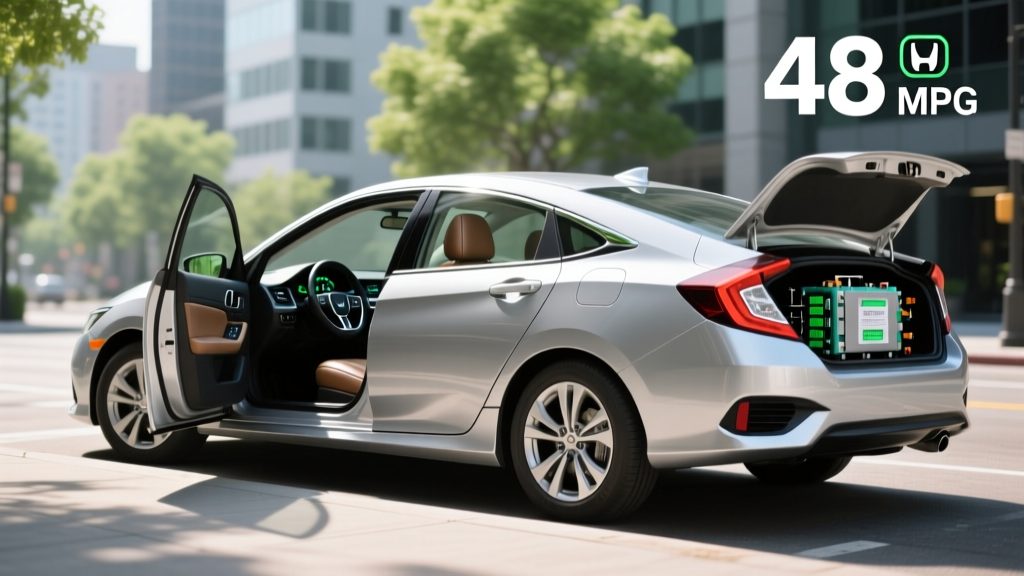
The 2014 Honda Civic Hybrid sedan occupies a specific niche in the used-car market: a compact, fuel-sipping commuter that requires no plug, no range anxiety, and no behavioral change from its driver. Over a decade after its production run ended, it remains relevant for budget-conscious buyers who want hybrid efficiency without the complexity or cost of a plug-in hybrid (PHEV) or battery-electric vehicle (BEV). This guide covers everything a prospective used buyer needs to know — from real-world MPG and Integrated Motor Assist (IMA) battery longevity to replacement costs and how it stacks up against modern alternatives.
HEV vs PHEV vs EV: Where the 2014 Civic Hybrid Fits
Before evaluating this specific model, it is critical to understand the distinction between the three electrified powertrain types, because the 2014 Civic Hybrid is a conventional hybrid (HEV), not a plug-in.
| Feature | Conventional Hybrid (HEV) | Plug-In Hybrid (PHEV) | Battery Electric (BEV) |
|---|---|---|---|
| Plugs in to charge? | No — regenerative braking and engine recharge the battery | Yes — Level 1 or Level 2 | Yes — Level 1, Level 2, or DC fast |
| Electric-only driving | Limited (low-speed assist only) | 20–50 miles typical | 200–400+ miles |
| Gas engine | Yes — primary power source with motor assist | Yes — kicks in after battery depletes | No |
| Federal tax credit (new) | None | Up to $7,500 (§30D, subject to rules) | Up to $7,500 (§30D, subject to rules) |
| Example | 2014 Honda Civic Hybrid | Toyota Prius Prime | Tesla Model 3 |
The 2014 Civic Hybrid never had a plug. Its small lithium-ion battery pack is recharged entirely through regenerative braking and the gasoline engine. This means zero infrastructure requirements — no home charger installation, no dependence on public charging networks. You simply fuel it like any other car and let Honda's Integrated Motor Assist (IMA) system handle the rest.
Fuel Economy: EPA Ratings and Real-World MPG
The headline number for any hybrid buyer is fuel economy. Here is what the EPA published for the 2014 Civic Hybrid sedan:
| Driving Cycle | EPA Rating |
|---|---|
| City | 44 MPG |
| Highway | 44 MPG |
| Combined | 44 MPG |
Source: fueleconomy.gov
The equal city/highway rating is a hallmark of Honda's IMA system, which uses the electric motor primarily to assist during acceleration and low-speed driving — the conditions where gasoline engines are least efficient. Unlike some hybrids (notably the Toyota Prius), the Civic Hybrid does not dramatically favor city driving over highway.
Real-World MPG: What Owners Actually Report
EPA estimates are standardized lab tests. Real-world results vary based on driving style, terrain, climate, and vehicle condition. For a 2014 model with potentially 100,000+ miles on the odometer, several factors influence actual fuel economy:
- City commuting (stop-and-go): 40–46 MPG. The IMA system shines here, with frequent regenerative braking events recharging the battery and the motor handling low-speed acceleration loads.
- Highway cruising (65–75 mph): 38–44 MPG. At sustained highway speeds, the 1.5L engine does most of the work with minimal electric assist. Aerodynamic drag at 75+ mph reduces efficiency noticeably.
- Cold weather (below 40°F): Expect a 5–10% reduction, dropping to roughly 38–42 MPG combined. Cold temperatures reduce battery efficiency and increase engine warm-up fuel consumption.
- High-mileage examples (150,000+ miles): If the IMA battery has degraded significantly, the system provides less electric assist, and the engine compensates — potentially dropping real-world MPG to 36–40 combined.
For context, the non-hybrid 2014 Civic with the 1.8L engine and CVT is rated at 30 MPG combined. The hybrid's 44 MPG represents a 47% improvement in fuel economy — translating to roughly 150 fewer gallons of gasoline per year for a driver covering 15,000 miles annually.
Powertrain Specs: Honda's Integrated Motor Assist System
| Specification | 2014 Honda Civic Hybrid Sedan |
|---|---|
| Engine | 1.5L inline-4 (i-VTEC) |
| Engine horsepower | 110 hp @ 6,000 rpm |
| Electric motor output | 20 hp (15 kW) |
| Combined system output | 110 hp |
| Combined torque | 125 lb-ft @ 1,000–3,500 rpm |
| Transmission | CVT (Continuously Variable) |
| Drivetrain | Front-wheel drive |
| Hybrid system | Honda Integrated Motor Assist (IMA) |
| Hybrid battery type | Lithium-ion (Li-ion) |
| 0–60 mph | ~10.4 seconds |
| Curb weight | ~2,877 lbs |
Honda's IMA system is a mild hybrid architecture. Unlike Toyota's Hybrid Synergy Drive (used in the Prius), which can propel the car on electric power alone at low speeds, Honda's IMA places a thin electric motor between the engine and transmission. This motor assists during acceleration, enables idle stop (the engine shuts off at red lights), and provides regenerative braking — but it cannot drive the car on electricity alone at meaningful speeds.
The result is a simpler, lighter system with fewer failure points, but less electric-only capability than a full hybrid like the Prius. The 20-hp electric motor is best understood as a torque-fill device that reduces the engine's workload rather than as a secondary propulsion source.
Battery Longevity, Warranty, and Replacement Cost
For any used hybrid buyer, the traction battery is the single largest financial risk. Here is what you need to know about the 2014 Civic Hybrid's IMA battery:
Original Battery Warranty
When new, Honda covered the IMA battery for 8 years / 80,000 miles (10 years / 150,000 miles in CARB states including California, New York, Massachusetts, and others that follow California emissions standards). As of 2026, a 2014 model is 12 years old — meaning the original factory warranty has expired for all examples, regardless of mileage.
Expected Battery Lifespan
Honda's IMA lithium-ion battery in the 9th-generation Civic (2012–2015) has demonstrated better longevity than the earlier nickel-metal hydride (NiMH) packs used in 2006–2011 models. Based on owner reports and repair data:
- Typical lifespan before notable degradation: 120,000–170,000 miles or 10–15 years
- Degradation symptoms: Reduced electric assist, lower MPG, more frequent engine cycling, IMA warning light on dashboard
- Complete failure rate: Moderate — not as widespread as early Toyota Prius or 2006–2011 Civic Hybrid batteries, but not uncommon at high mileage
Battery Replacement Cost (2026 Estimates)
| Option | Cost Range | Warranty |
|---|---|---|
| New OEM Honda IMA battery (dealer) | $2,000–$3,000 (parts + labor) | Typically 1 year / 12,000 miles |
| Remanufactured aftermarket battery | $1,200–$2,000 (parts + labor) | Varies, typically 1–3 years |
| Used/salvage yard IMA battery | $400–$800 (parts only) | None or 30–90 days |
| Individual cell replacement (specialist shops) | $600–$1,200 | Varies |
Before purchasing any used 2014 Civic Hybrid, request a battery health check. Many Honda dealers can pull an IMA battery state-of-health (SoH) reading through the OBD-II diagnostic port. An SoH below 70% signals meaningful degradation and should factor into your purchase negotiation or budget for replacement.
Pricing, Tax Credits, and Used Market Value
Original MSRP (2014)
When new, the 2014 Civic Hybrid sedan carried an MSRP of approximately $26,300 (including destination). It was offered in a single, well-equipped trim level with features including a sunroof, heated front seats, HondaLink infotainment, and a rearview camera.
Used Market Pricing (2026)
As of early 2026, used 2014 Civic Hybrid sedans trade in the following ranges depending on mileage, condition, and battery health:
- 80,000–100,000 miles, excellent condition: $7,500–$9,500
- 100,000–140,000 miles, good condition: $5,500–$7,500
- 140,000+ miles, fair condition: $3,500–$5,500
Tax Credit Eligibility
The 2014 Civic Hybrid does not qualify for any current federal tax credit. As a conventional hybrid (HEV), it was never eligible for the §30D New Clean Vehicle Credit, which applies only to plug-in electric vehicles (PHEVs and BEVs) meeting specific battery capacity, MSRP, income, and critical-mineral sourcing requirements per IRS guidelines.
There is no federal used-EV credit applicable here either — the §25E Used Clean Vehicle Credit (up to $4,000) applies exclusively to used BEVs and PHEVs, not conventional hybrids. Some states may offer minimal incentives for hybrid vehicle registration, but these are increasingly rare and typically targeted at new purchases. Check your state's environmental or DMV website for current programs.
Hybrid vs PHEV vs EV: Which Powertrain Fits You?
Choose the 2014 Honda Civic Hybrid (HEV) if:
- You have no access to home or workplace charging (apartment, street parking, no garage)
- Your budget is under $10,000 and you want maximum MPG per dollar
- You drive 10,000–20,000 miles per year in mixed city/highway conditions
- You want zero behavioral change — no plugging in, no range planning
Choose a used PHEV (e.g., Toyota Prius Prime, Honda Clarity PHEV) if:
- You have access to a standard 120V outlet or Level 2 charger at home
- Your daily commute is under 25–40 miles (coverable on electric-only range)
- You want some electric driving without full EV range commitment
Choose a used BEV (e.g., Chevrolet Bolt, Nissan Leaf, Tesla Model 3) if:
- You can install a Level 2 home charger (240V)
- Your daily driving is under 200 miles and you have access to DC fast charging for road trips
- You want to eliminate gasoline entirely and minimize per-mile energy cost
The 2014 Civic Hybrid's advantage in 2026 is simplicity and low entry cost. Its disadvantage is that it cannot access the per-mile fuel savings of a plugged-in PHEV or BEV, nor does it qualify for the tax credits that make newer electrified vehicles more affordable.
Reliability, Safety, and Ownership Costs
The 9th-generation Civic (2012–2015) earned strong reliability marks overall. The non-hybrid variants are widely regarded as durable, low-maintenance commuter cars. The hybrid variant shares the same fundamental chassis, suspension, and interior — adding only the IMA system as a potential maintenance variable.
Safety Ratings
The 2014 Civic sedan earned a 5-star overall safety rating from NHTSA, including 5 stars in frontal crash and side crash tests. The IIHS rated it "Good" in moderate overlap front, side, roof strength, and head restraint tests. See NHTSA vehicle safety data for full results.
Ongoing Ownership Costs
- Annual fuel cost: At 44 MPG combined, 15,000 miles/year, and $3.50/gallon gasoline = ~$1,193/year
- Insurance: Comparable to non-hybrid Civic; typically $1,200–$1,800/year depending on driver profile
- Maintenance: Standard Honda intervals (oil changes, brake pads, CVT fluid). Regenerative braking reduces brake pad wear — many owners report 80,000+ miles on original pads
- Risk factor: IMA battery replacement ($1,200–$3,000) is the primary unplanned expense unique to this model
Pros and Cons of the 2014 Civic Hybrid in 2026
Pros
- 44 MPG combined EPA — proven real-world efficiency
- No plug-in required — zero charging infrastructure needed
- Strong Honda reliability for engine, transmission, and chassis
- 5-star NHTSA safety rating
- Affordable used pricing ($5,500–$9,500 range)
- Well-equipped single trim (sunroof, heated seats, backup camera standard)
- Low brake wear from regenerative braking
Cons
- IMA battery replacement risk ($1,200–$3,000) on aging examples
- Mild hybrid — no electric-only driving capability
- Sluggish acceleration (10.4 sec 0–60 mph)
- No federal or state tax credits available
- CVT driving feel may not appeal to all drivers
- Outdated infotainment (no Apple CarPlay/Android Auto)
- Limited cargo space vs hatchback hybrids (Prius, Insight)
Frequently Asked Questions
How many MPG does the 2014 Honda Civic Hybrid get?
The EPA rates the 2014 Civic Hybrid at 44 MPG city, 44 MPG highway, and 44 MPG combined. Real-world results typically range from 38–46 MPG depending on driving conditions, climate, and battery health. Cold weather and high-speed highway driving reduce efficiency by 5–10%.
Does the 2014 Civic Hybrid need to be plugged in?
No. The 2014 Civic Hybrid is a conventional hybrid (HEV). Its lithium-ion battery is recharged exclusively through regenerative braking and the gasoline engine. There is no plug, no charging port, and no electric-only range to manage.
How long does the IMA battery last in the 2014 Civic Hybrid?
Owner data and repair records suggest the lithium-ion IMA battery typically lasts 120,000–170,000 miles or 10–15 years before notable degradation. As of 2026, most 2014 examples are 12 years old, so battery condition should be a primary inspection point before purchase.
What does it cost to replace the hybrid battery?
A new OEM replacement through a Honda dealer runs $2,000–$3,000 including labor. Remanufactured aftermarket batteries cost $1,200–$2,000 installed. Used/salvage batteries are available for $400–$800 but carry significant risk given their age.
Does the 2014 Civic Hybrid qualify for any tax credit?
No. The 2014 Civic Hybrid is a conventional hybrid (HEV), which does not qualify for the federal §30D New Clean Vehicle Credit or the §25E Used Clean Vehicle Credit. These credits apply only to plug-in electric vehicles (PHEVs and BEVs). No state-level hybrid purchase incentives are widely available in 2026.
Is the 2014 Civic Hybrid reliable?
Overall, yes. The 9th-generation Civic platform is well-regarded for mechanical durability. The primary reliability concern specific to the hybrid variant is IMA battery degradation over time and mileage. The engine, CVT transmission, and electrical systems have strong track records when properly maintained.
How does the 2014 Civic Hybrid compare to a Toyota Prius of the same year?
The 2014 Prius achieves 50 MPG combined EPA — 6 MPG better than the Civic Hybrid. The Prius also offers a hatchback body style with significantly more cargo space and a full-hybrid system capable of low-speed electric-only driving. However, the Civic Hybrid typically costs less on the used market, has a more conventional driving feel, and may appeal to buyers who prefer a traditional sedan layout.
Should I buy a 2014 Civic Hybrid or a newer used EV?
If you lack home charging access or your budget is strictly under $10,000, the Civic Hybrid is a pragmatic choice. If you can charge at home and can stretch your budget to $12,000–$18,000, a used BEV like the Chevrolet Bolt EV (2017–2022) or Nissan Leaf (2018+) offers dramatically lower per-mile energy costs (~$0.04/mile on electricity vs ~$0.08/mile on gasoline) and may still carry remaining battery warranty.