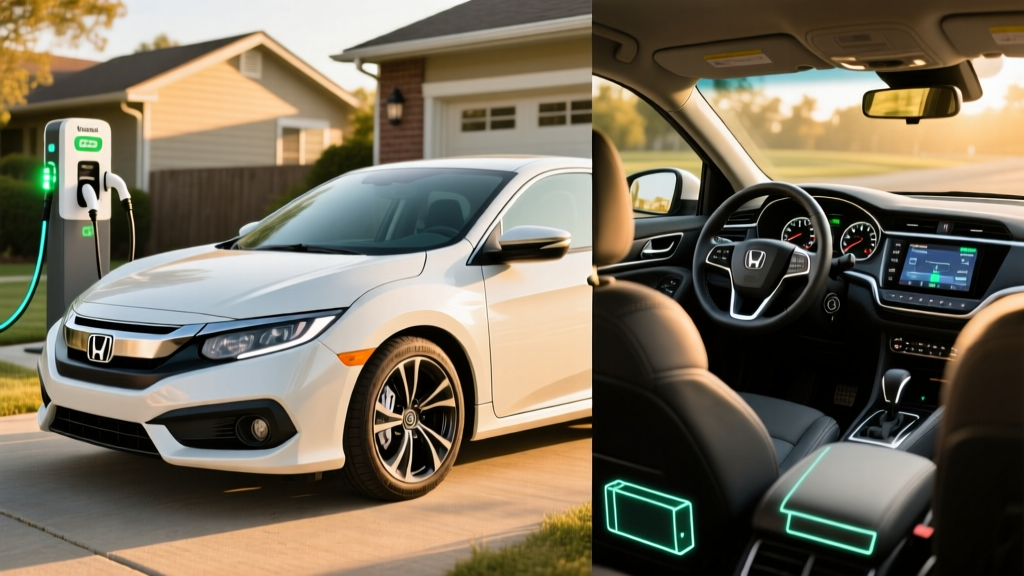
Quick Verdict: The 2014 Civic Hybrid in 2026
The 2014 Honda Civic Hybrid is a conventional hybrid electric vehicle (HEV) — not a plug-in — that pairs a 1.3-liter gasoline engine with Honda's Integrated Motor Assist (IMA) system to deliver an EPA-rated 44 MPG combined. Over a decade after its debut, it remains one of the most fuel-efficient compact sedans available on the used market, typically priced between $7,000 and $12,000 depending on mileage and condition. For budget-conscious commuters who want hybrid efficiency without the complexity of plug-in charging, the 2014 Civic Hybrid still delivers — but buyers must go in with eyes open about the aging IMA battery and what replacement entails.
| Spec | Value |
|---|---|
| Powertrain | 1.3L i-VTEC 4-cyl + IMA electric motor |
| Combined Horsepower | 110 hp @ 5,500 rpm |
| Combined Torque | 127 lb-ft @ 1,000-3,500 rpm |
| Transmission | CVT (continuously variable) |
| Hybrid Battery | Nickel-Metal Hydride (NiMH), ~0.5 kWh |
| EPA Fuel Economy (City / Hwy / Combined) | 44 / 44 / 44 MPG |
| Fuel Tank | 13.2 gallons |
| Total Range | ~580 miles |
| Drivetrain | Front-wheel drive |
| 0-60 mph | ~9.5 seconds (estimated) |
| Cargo Volume | 10.7 cu ft (trunk) |
| Original MSRP (2014) | $24,235 (base) |
| Typical Used Price (2026) | $7,000–$12,000 |
HEV vs PHEV: What the 2014 Civic Hybrid Actually Is
A common source of confusion among used-car shoppers is whether the 2014 Civic Hybrid needs to be plugged in. It does not. This car is a conventional hybrid (HEV), meaning it generates all its electricity internally through regenerative braking and the gasoline engine. There is no charging port, no electric-only driving mode of any meaningful distance, and no plug to deal with.
| Feature | HEV (2014 Civic Hybrid) | PHEV (e.g., Toyota Prius Prime) | BEV (e.g., Tesla Model 3) |
|---|---|---|---|
| Plug-in Charging? | No | Yes | Yes |
| Electric-Only Range | ~1 mile (motor assist only) | 25–44 miles | 250–360+ miles |
| Battery Size | ~0.5 kWh (NiMH) | 13.6–18.1 kWh (Li-ion) | 50–82 kWh (Li-ion) |
| Federal Tax Credit (§30D) | Not eligible | Up to $7,500 (if eligible) | Up to $7,500 (if eligible) |
| Used EV Tax Credit (§25E) | Not eligible | Up to $4,000 (if eligible) | Up to $4,000 (if eligible) |
| Home Charging Needed? | No | Recommended (Level 2) | Essential (Level 2) |
| Real-World Fuel Cost | Gas only | Gas + electricity | Electricity only |
The IMA system in the 2014 Civic Hybrid uses a small electric motor sandwiched between the engine and transmission to assist during acceleration and capture energy during braking. The motor can technically propel the car at low speeds under very light load, but this is not a usable electric-only mode — think of it as a brief glide, not a commute. If you need meaningful electric-only range, you'd need to look at a PHEV like the 2024 Toyota Prius Prime (44 miles EV range) or a full BEV.
Fuel Economy: EPA Numbers vs Real-World MPG
The EPA rates the 2014 Honda Civic Hybrid at 44 MPG city, 44 MPG highway, and 44 MPG combined. That symmetry is unusual — most hybrids favor city driving because regenerative braking recaptures energy in stop-and-go traffic. Honda's IMA system in this generation was tuned for balanced efficiency across driving conditions, though real-world results tell a more nuanced story.
| Driving Scenario | EPA Estimate | Real-World Expectation |
|---|---|---|
| City (stop-and-go) | 44 MPG | 42–48 MPG (regen helps significantly) |
| Highway (65-75 mph) | 44 MPG | 38–43 MPG (aero drag, less regen benefit) |
| Combined | 44 MPG | 40–45 MPG |
| Cold Weather (below 32°F) | Not rated | 35–40 MPG (engine runs more for heat, battery less efficient) |
According to fueleconomy.gov, owner-reported MPG for the 2014 Civic Hybrid clusters around 41–46 MPG combined. City-heavy commuters who drive gently tend to exceed the EPA number; highway-dominant drivers and those in cold climates tend to fall slightly short. The 13.2-gallon fuel tank yields a practical range of roughly 530–590 miles between fill-ups.
Powertrain Details: How the IMA System Works
The 2014 Civic Hybrid uses Honda's Integrated Motor Assist (IMA), a parallel hybrid architecture that was Honda's primary hybrid technology before the company shifted to its two-motor i-MMD system in later models. Here's what's under the hood:
- Engine: 1.3-liter i-VTEC inline-4, producing 88 hp and 88 lb-ft of torque on its own
- Electric Motor: IMA motor integrated into the flywheel, adding approximately 23 hp and 57 lb-ft of torque
- Combined Output: 110 hp and 127 lb-ft (the combined figure is not a simple sum — the engine and motor peak at different RPMs)
- Transmission: Continuously Variable Transmission (CVT) optimized for efficiency
- Battery: Nickel-Metal Hydride (NiMH) pack, approximately 0.5 kWh capacity, located behind the rear seat
The IMA system provides noticeable low-end torque fill that makes the Civic Hybrid feel peppier off the line than its 110-hp figure suggests. However, highway passing and steep hill climbing expose the modest power output. The CVT drones under hard acceleration — a common trait of the era's hybrids. The car also features an ECON mode that softens throttle response and adjusts climate control to maximize fuel savings, and an Eco Assist display that coaches efficient driving habits in real time.
Hybrid Battery Lifespan, Warranty, and Replacement Cost
The single biggest concern for any used hybrid buyer is battery health. The 2014 Civic Hybrid's NiMH IMA battery is smaller and simpler than the lithium-ion packs in modern PHEVs and BEVs, but it is not immune to degradation — especially at 12+ years old.
Battery Warranty & Replacement Facts
- Original Warranty: 8 years / 80,000 miles (10 years / 150,000 miles in CARB states: CA, CT, ME, MA, NJ, NY, OR, RI, VT, WA)
- Warranty Coverage Threshold: Honda warranted the battery to retain sufficient capacity for the IMA system to function; no specific percentage threshold was published (unlike modern BEV/PHEV warranties that guarantee 70% capacity)
- Current Status (2026): Original warranty is expired on all 2014 models unless the vehicle has exceptionally low mileage in a CARB state
- IMA Battery Replacement Cost: $2,000–$3,500 for a new OEM pack from Honda; $800–$1,500 for a refurbished/reconditioned pack from third-party suppliers
- 12V Auxiliary Battery: Standard lead-acid or AGM, $150–$250 replacement — separate from the IMA system
In practice, the IMA NiMH batteries in 9th-generation Civics have shown better longevity than the problematic IMA packs in the 2006–2011 Civic Hybrids, which were notorious for premature failure. Many 2014 examples are still running on their original battery at 120,000–180,000 miles, though capacity loss is inevitable. Signs of a weakening IMA battery include:
- IMA warning light on the dashboard
- Reduced regenerative braking and assist levels
- Lower observed MPG (dropping to 35–38 MPG combined)
- Frequent "recalibration" cycles where the battery charges and discharges visibly on the dash display
If you're evaluating a used 2014 Civic Hybrid, ask for the IMA battery health readout (accessible through the multi-information display) and check for any stored IMA-related diagnostic trouble codes. A pre-purchase inspection by a Honda-certified technician is strongly recommended.
Reliability, Safety, and Ownership Costs
The 2014 Civic Hybrid benefits from Honda's strong reputation for mechanical durability. The 1.3L engine is under-stressed and long-lived, the CVT in this generation is more robust than earlier Honda CVTs, and the overall build quality is solid for the compact segment.
Safety ratings were strong. The NHTSA gave the 2014 Civic sedan a 5-star overall safety rating. The IIHS rated the 2014 Civic as a Top Safety Pick, with Good ratings in moderate overlap front, side, roof strength, and head restraint tests. Standard safety equipment includes stability control, antilock brakes, and six airbags. Honda's LaneWatch camera (passenger-side blind-spot monitor) was available on higher trims.
Annual maintenance costs for the Civic Hybrid are only marginally higher than a gas Civic — the hybrid-specific components (IMA motor, inverter, battery) rarely require service outside of battery replacement. Expect to spend $400–$700 per year on routine maintenance (oil changes, brakes, tires, fluids), per RepairPal data. Insurance rates are typically in line with the gas Civic, averaging $1,200–$1,600 annually depending on your profile and state.
Pros
- 44 MPG EPA combined — real-world often 40–46 MPG
- No plug-in charging required; drives like a normal car
- Low annual maintenance costs
- Strong NHTSA 5-star safety rating
- Affordable used pricing ($7K–$12K in 2026)
- Proven Honda reliability on engine and CVT
- Good cargo space (10.7 cu ft trunk) for a compact
Cons
- IMA battery is 12+ years old — replacement risk is real
- Modest 110 hp; sluggish highway merging
- CVT drone under hard acceleration
- No electric-only driving capability
- No federal or state tax credits available
- Outdated infotainment (no Apple CarPlay/Android Auto)
- NiMH battery less energy-dense than modern Li-ion
Tax Credit Eligibility: What You Can (and Can't) Claim
Here's the bottom line: the 2014 Honda Civic Hybrid does not qualify for any federal tax credit. It is not a plug-in vehicle, so it is ineligible for the IRS §30D New Clean Vehicle Credit (up to $7,500) or the §25E Used Clean Vehicle Credit (up to $4,000). The §25E credit applies only to used BEVs and PHEVs with a minimum 7 kWh battery capacity — the Civic Hybrid's ~0.5 kWh NiMH pack falls far short of that threshold.
Some states previously offered hybrid purchase incentives, but most have expired or shifted focus to plug-in vehicles. Check your state's current incentive database (the AFDC incentives search is a reliable starting point) for any remaining local benefits, but do not count on them for a conventional HEV purchased in 2026.
Who Should Buy the 2014 Civic Hybrid — And Who Shouldn't
This car serves a specific buyer profile well. It makes sense if:
- You're a high-mileage commuter on a tight budget who wants 40+ MPG without changing your fueling habits
- You lack home charging access (apartment, street parking) and can't practically own a PHEV or BEV
- You want hybrid efficiency with minimal complexity — no charging cables, no range planning, no app management
- You're buying a second car for a teen driver or errand-runner where low fuel cost matters
Look elsewhere if:
- You want electric-only driving — consider a used PHEV (Chevrolet Volt, Prius Prime) or a used BEV (Nissan Leaf, Chevy Bolt)
- You need modern tech — the 2014 Civic's infotainment is a generation behind; no CarPlay, no Android Auto, no advanced ADAS
- You prioritize performance — 110 hp and a CVT won't excite anyone; a used Civic Si or a modern turbo-hybrid would be better
- You want tax credit savings — a used BEV or PHEV under $25,000 may qualify for the $4,000 §25E credit, significantly narrowing the price gap
Frequently Asked Questions
How many MPG does the 2014 Honda Civic Hybrid get?
The EPA rates it at 44 MPG city, 44 MPG highway, and 44 MPG combined. Real-world owners report 40–46 MPG combined depending on driving style, climate, and route. City-heavy drivers often exceed the EPA number thanks to regenerative braking; highway-dominant and cold-weather drivers may see 35–40 MPG.
Can you plug in the 2014 Civic Hybrid?
No. The 2014 Civic Hybrid is a conventional HEV, not a plug-in hybrid. It has no charging port. All electricity for the IMA system is generated internally by the gasoline engine and regenerative braking.
How far can the 2014 Civic Hybrid drive on electric only?
Effectively zero meaningful distance. The IMA motor can assist at very low speeds under light load, but there is no electric-only driving mode. This is not a PHEV — it cannot operate as an electric vehicle.
Is the 2014 Civic Hybrid reliable?
Yes, with a major caveat. The engine, transmission, and chassis are well-regarded for long-term durability. The primary reliability risk is the aging IMA NiMH battery, which is now 12+ years old. Many are still on the original pack, but replacement ($2,000–$3,500 OEM, $800–$1,500 refurbished) is a realistic possibility during ownership.
What is the IMA battery replacement cost?
A new OEM IMA battery from Honda costs approximately $2,000–$3,500 installed. Third-party refurbished packs are available for $800–$1,500 installed. Given the car's used value of $7,000–$12,000, a battery replacement represents a significant percentage of the vehicle's worth — factor this into your purchase negotiation.
Does the 2014 Honda Civic Hybrid qualify for any tax credit?
No. It is not eligible for the federal §30D new vehicle credit or the §25E used vehicle credit because it is a conventional hybrid with a battery far below the 7 kWh minimum threshold. Some states may have offered hybrid incentives historically, but most have expired or shifted to plug-in vehicles.
Hybrid vs PHEV vs EV — which is right for me?
Choose a conventional HEV like this Civic Hybrid if you want better MPG with zero lifestyle change and no charging access. Choose a PHEV if you have home charging and want 25–44 miles of daily electric driving with a gas backup for road trips. Choose a BEV if you want the lowest per-mile fuel cost, have reliable charging access, and are ready to plan around range on longer trips. For a detailed comparison of total ownership costs across all three, see our EV vs hybrid vs gas cost guide.