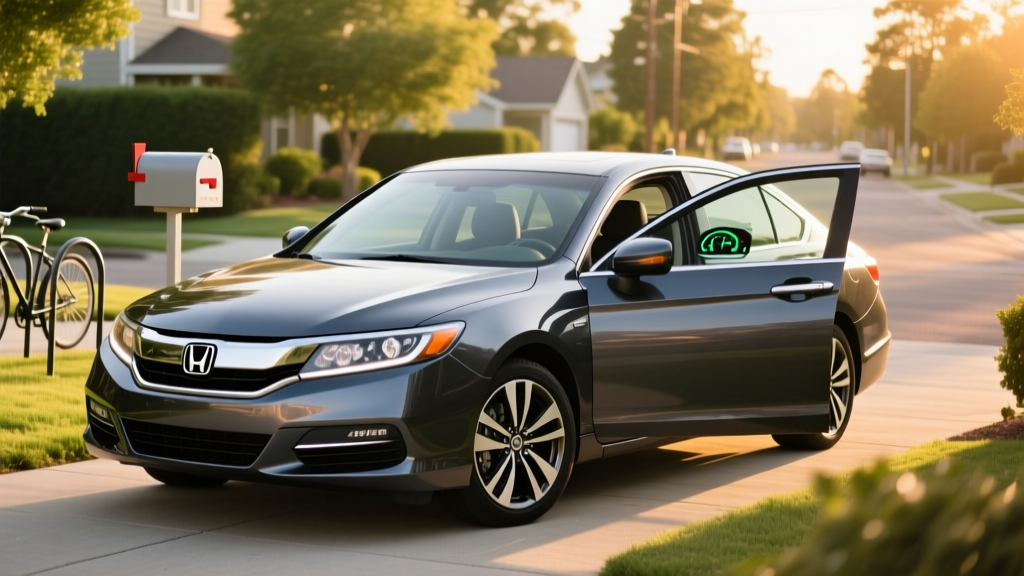
The 2014 Honda Accord Hybrid arrived with a bold claim: 50 MPG in the city from a midsize sedan that didn't look, drive, or feel like a science experiment. Over a decade later, this first-generation two-motor hybrid remains one of the most fuel-efficient used sedans on the market. But how do those EPA numbers hold up in real-world driving, and what should a 2026 buyer expect from a 12-year-old hybrid battery?
This guide covers everything you need to know about the 2014 Honda Accord Hybrid MPG performance, powertrain specs, battery reliability, and how it stacks up against modern hybrids, plug-in hybrids, and full EVs.
2014 Honda Accord Hybrid MPG: EPA Ratings and Real-World Results
The 2014 Accord Hybrid uses Honda's two-motor Intelligent Multi-Mode Drive (i-MMD) system, which operates differently from Toyota's planetary-gear hybrid setup. Instead of a traditional transmission, the Accord Hybrid primarily drives via its electric traction motor, with the gasoline engine acting as a generator in most conditions and only engaging directly at highway cruising speeds.
| Metric | EPA Rating |
|---|---|
| City MPG | 50 |
| Highway MPG | 45 |
| Combined MPG | 47 |
| Fuel Tank Capacity | 12.8 gallons |
| Total EPA Range | ~602 miles |
Source: EPA / fueleconomy.gov
Powertrain: How the Two-Motor i-MMD System Works
Understanding the 2014 Accord Hybrid's fuel economy requires understanding its unconventional powertrain. This is not a mild hybrid with a small electric assist — it's a full series-parallel hybrid that behaves more like an extended-range EV at lower speeds.
| Component | Specification |
|---|---|
| Gasoline Engine | 2.0L Atkinson-cycle inline-4 |
| Engine Power | 141 hp @ 6,200 rpm |
| Engine Torque | 122 lb-ft @ 3,500–6,000 rpm |
| Traction Motor | AC permanent-magnet synchronous |
| Motor Power | 166 hp (124 kW) |
| Motor Torque | 226 lb-ft (306 Nm) |
| Combined System Output | 196 hp |
| Hybrid Battery | 1.3 kWh lithium-ion (panasonic) |
| Transmission | None (direct drive w/ lock-up clutch) |
| 0–60 mph | ~7.2 seconds |
The system operates in three modes:
- EV Drive: Battery powers the traction motor alone (short distances, low speeds)
- Hybrid Drive: Engine spins a generator that feeds electricity to the traction motor; excess charges the battery
- Engine Drive: At steady highway speeds (~45–70 mph), a lock-up clutch connects the engine directly to the wheels for maximum efficiency
This architecture explains why the city rating (50 MPG) exceeds the highway rating (45 MPG) — the opposite of most conventional cars. In the city, the engine rarely runs and regenerative braking recaptures energy constantly. On the highway, aerodynamic drag and the engine's direct-drive efficiency ceiling limit gains.
HEV vs PHEV vs EV: Where the Accord Hybrid Fits in 2026
The 2014 Accord Hybrid is a conventional hybrid (HEV), not a plug-in hybrid. This distinction matters for buyers cross-shopping used vehicles.
HEV vs PHEV vs BEV — Key Differences
| Feature | HEV (Accord Hybrid) | PHEV (e.g., Toyota RAV4 Prime) | BEV (e.g., Tesla Model 3) |
|---|---|---|---|
| Plug-in Charging | No — gas only | Yes — Level 1/2 | Yes — Level 1/2/DC |
| Electric-Only Range | ~1 mile (low speed) | 25–42 miles | 250–360+ miles |
| Total Range | ~602 miles | 400–550 miles | 250–360+ miles |
| Battery Size | 1.3 kWh | 13–18 kWh | 50–100 kWh |
| Home Charging Needed | No | Recommended | Essential |
| Federal Tax Credit (New) | None | Up to $7,500 (§30D) | Up to $7,500 (§30D) |
| Used Vehicle Credit (§25E) | None | Up to $4,000 | Up to $4,000 |
Who should choose the 2014 Accord Hybrid (HEV)?
- Drivers without access to home or workplace charging — you never need to plug in
- High-mileage commuters who want maximum range without fuel stops
- Buyers on a budget — used 2014 models typically sell for $10,000–$16,000 depending on mileage and condition
- Those in apartments or street-parking situations where charging infrastructure isn't available
Who should look at a PHEV or BEV instead?
- Drivers with home Level 2 charging who want electric-only daily commuting (PHEV)
- Those seeking zero tailpipe emissions and lower per-mile energy costs (BEV)
- Buyers wanting modern ADAS features, infotainment, and current-year tax credits
Battery Longevity, Warranty, and Replacement Cost
The 2014 Accord Hybrid's 1.3 kWh lithium-ion battery pack is small by modern standards, but its size is actually an advantage for longevity. Smaller batteries experience less thermal stress per cell, and Honda's battery management system keeps the state of charge in a narrow operating window (roughly 20–80%), minimizing degradation.
Real-world battery lifespan: The 2014 Accord Hybrid has proven more battery-reliable than many contemporaries. The i-MMD system's shallow cycling and conservative SoC management mean most original batteries are still functional at 150,000+ miles. However, age-related degradation is now a factor — lithium-ion cells lose capacity over time regardless of use.
Battery replacement cost (2026 estimates):
- Dealer OEM replacement: $2,500–$4,000 (parts + labor)
- Independent hybrid specialist: $1,800–$3,000
- Refurbished/reconditioned pack: $1,200–$2,000
Before purchasing a used 2014 Accord Hybrid, request a battery health check. A Honda dealer can read the battery's state of health (SoH) via the OBD-II diagnostic system. Look for SoH above 70% — below that threshold, you may notice reduced EV-mode capability and slightly lower MPG, though the car remains drivable.
Trim Levels, Pricing, and Tax Credit Eligibility
The 2014 Accord Hybrid was offered in three trims. Here's what they included and what they cost new vs. the current used market:
| Trim | Original MSRP | 2026 Used Range (est.) | Key Features |
|---|---|---|---|
| Hybrid | $29,305 | $10,000–$13,000 | Dual-zone climate, rear camera, Bluetooth, 17" alloys |
| EX-L | $31,905 | $12,000–$15,000 | Leather, heated seats, sunroof, upgraded audio |
| Touring | $34,905 | $13,500–$16,500 | Navigation, adaptive cruise, lane departure warning, LED headlights |
Tax credit reality for 2026 buyers: The 2014 Accord Hybrid does not qualify for any federal tax credit. When new, it was not eligible for the §30D clean vehicle credit (that credit applies to PHEVs and BEVs with larger battery packs meeting specific kWh thresholds). On the used market, the §25E previously-owned clean vehicle credit (up to $4,000) also does not apply — it requires a PHEV or BEV with at least 7 kWh of battery capacity. The Accord Hybrid's 1.3 kWh pack falls well short.
Some states offer used hybrid incentives or HOV lane access, but these vary by jurisdiction. Check your state's DMV or energy office for current programs.
Reliability, Common Issues, and Ownership Costs
The 2014 Accord Hybrid earns strong reliability marks overall, though it has a few known issues worth investigating before purchase:
- 12V auxiliary battery drain: Like many hybrids, the 12V battery can drain if the car sits for extended periods. A dead 12V battery prevents the car from starting, even if the hybrid pack is full. Replacement: ~$200.
- Brake actuator noise: The regenerative braking system uses an electric servo that some owners report as groaning or clicking. Generally cosmetic, but worth a test-drive check.
- CVT-like drone under acceleration: The engine holds a steady RPM during hard acceleration (similar to a CVT). Not a defect — just the i-MMD system's behavior — but noticeable compared to geared transmissions.
- Infotainment age: The 2014 system lacks Apple CarPlay/Android Auto (added in the 2016 refresh). Aftermarket head unit upgrades are available for $300–$600 installed.
Insurance: Expect rates similar to a conventional Accord — the hybrid variant doesn't carry a significant insurance premium in most states. Average annual cost: $1,100–$1,600 depending on driver profile.
Maintenance: The hybrid system requires no routine maintenance beyond the standard oil change interval (0W-20 synthetic, every 7,500–10,000 miles). The regenerative braking system extends pad life significantly — many owners report 80,000+ miles on original brake pads.
Pros
- 47 MPG combined EPA — among the best of any midsize sedan, any year
- No plug-in charging required — fill up at any gas station
- Smooth, torquey electric-dominant driving feel
- 602-mile total range between fill-ups
- Spacious cabin with 15.5 cu-ft trunk (only 0.3 cu-ft less than gas Accord)
- Strong long-term reliability record for i-MMD system
Cons
- Highway MPG (45) trails city (50) — unusual for a sedan
- Outdated infotainment with no smartphone integration
- Dated ADAS — Touring trim has basic lane departure warning but no automatic emergency braking
- Original battery warranty expired; replacement is an out-of-pocket cost
- Engine drone under hard acceleration
- No federal tax credit eligibility (new or used)
2014 Accord Hybrid vs. Modern Alternatives: What You Give Up
If you're cross-shopping the 2014 Accord Hybrid against newer options, here's how it compares to vehicles available in 2026:
| Vehicle | EPA Combined MPG | HP | Used Price (est.) | Notable Advantage |
|---|---|---|---|---|
| 2014 Honda Accord Hybrid | 47 | 196 | $10K–$16.5K | Best city MPG, proven i-MMD |
| 2017 Toyota Camry Hybrid | 42 | 200 | $14K–$19K | Newer infotainment, strong resale |
| 2020 Toyota Corolla Hybrid | 52 | 121 | $16K–$21K | 52 MPG combined, Toyota Safety Sense |
| 2021 Honda Accord Hybrid | 48 | 212 | $22K–$28K | Modern ADAS, CarPlay/Android Auto |
| 2023 Hyundai Sonata Hybrid | 52 | 192 | $24K–$30K | Solar roof, 8-speed auto, 52 MPG |
The 2014 Accord Hybrid's 50-MPG city rating still holds up against most 2026 hybrids. Where it falls behind is in safety technology (no AEB, no lane-keeping assist), connectivity, and refinement. If those features matter, budget for a 2020+ Accord Hybrid or Camry Hybrid instead.
Frequently Asked Questions
How many MPG does the 2014 Honda Accord Hybrid actually get?
The EPA rates it at 50 city / 45 highway / 47 combined. Real-world owners average 42–49 MPG combined depending on driving mix. City-dominant driving frequently exceeds the 50 MPG city sticker; highway-dominant commutes may dip to 40–43 MPG.
Does the 2014 Accord Hybrid need to be plugged in?
No. The 2014 Accord Hybrid is a conventional hybrid (HEV), not a plug-in. It charges its small 1.3 kWh battery through regenerative braking and the gasoline engine. You fuel it exclusively at gas stations.
How long does the hybrid battery last?
Most 2014 Accord Hybrid batteries remain functional at 150,000+ miles. Honda's original warranty was 8 years/100,000 miles (10/150,000 in CARB states), but all have now expired. Budget $1,800–$4,000 for a replacement if needed.
Is the 2014 Accord Hybrid reliable?
Yes. The i-MMD two-motor system has proven durable, and the 2.0L Atkinson-cycle engine is under-stressed. Main concerns are age-related: 12V battery drain, worn suspension components, and eventual hybrid battery degradation. Overall, it ranks among the more reliable hybrids of its era.
Does the 2014 Accord Hybrid qualify for any tax credit?
No. It did not qualify for federal tax credits when new (the §30D credit requires a larger battery pack and plug-in capability). The used §25E credit also does not apply because the battery is below 7 kWh. Check your state for possible local incentives.
Should I buy a 2014 Accord Hybrid or a used EV?
If you lack reliable home charging access, drive over 40 miles daily, or frequently take road trips, the Accord Hybrid is the pragmatic choice — 602 miles of range, no charging dependency, and low fuel costs. If you have home Level 2 charging and mostly drive under 60 miles daily, a used EV (like a 2018–2020 Chevrolet Bolt or Nissan Leaf) will deliver lower per-mile energy costs and zero tailpipe emissions, though with range and charging trade-offs on longer trips.