Quick Verdict: A Still-Competent Midsize Hybrid Sedan in 2026
The 2014 Ford Fusion Hybrid Titanium remains one of the most fuel-efficient midsize sedans from the early hybrid era. With an EPA-rated 44 MPG combined, a tech-forward Titanium trim, and Ford's proven hybrid synergy architecture, it still holds appeal for budget-conscious buyers who want hybrid efficiency without plug-in complexity. A decade-plus on the road, however, raises real questions about battery health, replacement costs, and whether this generation still makes financial sense versus newer hybrids or a full EV.
This guide covers everything a 2026 used-car shopper needs: exact fuel economy data, powertrain specs, battery longevity expectations, ownership costs, and how the Fusion Hybrid stacks up against modern alternatives.
| Spec | Value |
|---|---|
| EPA Fuel Economy (City / Hwy / Combined) | 44 / 41 / 44 MPG |
| Powertrain | 2.0L Atkinson-cycle I4 + electric motor |
| Combined System Horsepower | 188 hp |
| Transmission | eCVT (planetary gearset) |
| Hybrid Battery | 1.4 kWh lithium-ion (usable ~1.0 kWh) |
| Battery Warranty (Original) | 8 years / 100,000 miles |
| 0–60 mph | ~8.1 seconds |
| Fuel Tank | 13.5 gallons |
| Total Driving Range | ~594 miles (EPA est.) |
| Original MSRP (Titanium) | ~$32,600 |
| Typical 2026 Used Price | $7,500 – $12,500 |
HEV vs. PHEV: Understanding the Fusion Hybrid's Architecture
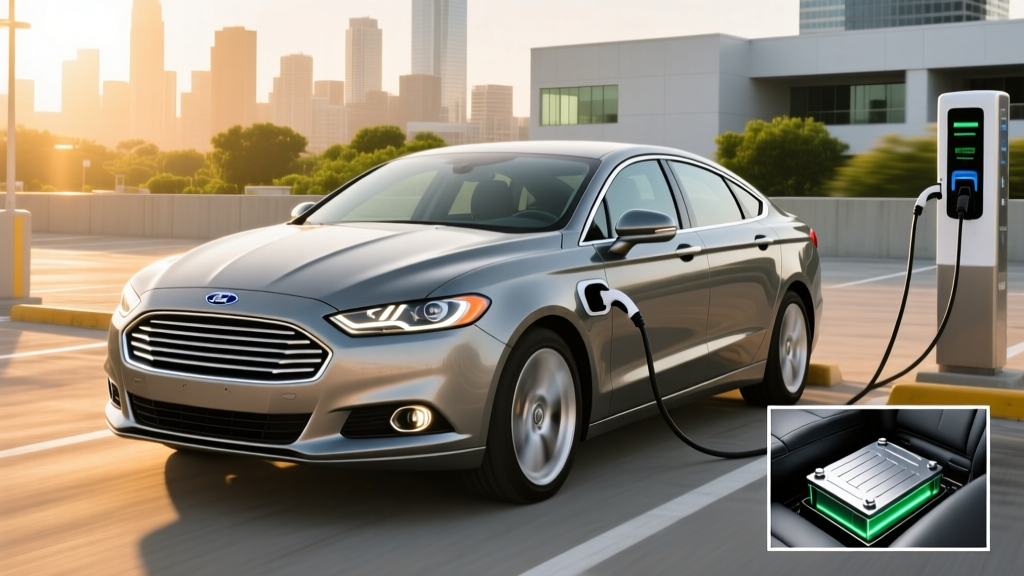
The 2014 Fusion Hybrid is a conventional hybrid electric vehicle (HEV). It does not plug in. There is no charging port, no electric-only range to manage, and no need for any home or public charging infrastructure. The 1.4 kWh lithium-ion battery recharges exclusively through regenerative braking and the gasoline engine.
This is fundamentally different from the Fusion Energi, Ford's plug-in hybrid (PHEV) variant sold alongside the Hybrid in 2014. The Energi featured a larger 7.6 kWh battery, an EPA-rated 19 miles of electric-only range, and a charge port for Level 1/Level 2 AC charging. If you see a Fusion with a fuel door and a charge port, that's the Energi — not the standard Hybrid.
| Feature | Fusion Hybrid (HEV) | Fusion Energi (PHEV) |
|---|---|---|
| Plugs In? | No | Yes (Level 1 / Level 2) |
| Battery Capacity | 1.4 kWh | 7.6 kWh |
| Electric-Only Range | N/A (EV assist only) | 19 miles (EPA) |
| EPA Combined MPG / MPGe | 44 MPG | 38 MPG (gas) / 88 MPGe (elec+gas) |
| Total Range | ~594 miles | ~550 miles |
| DC Fast Charging | No | No |
| Trunk Space | 12.0 cu ft | 8.2 cu ft (battery intrusion) |
Key takeaway: The standard Hybrid sacrifices no trunk space and requires zero behavior change from a gas-car owner. The Energi trades cargo room for short electric commutes — but only if you plug it in nightly.
Fuel Economy: EPA Ratings vs. Real-World MPG
The EPA rates the 2014 Fusion Hybrid at 44 MPG city, 41 MPG highway, and 44 MPG combined, per fueleconomy.gov. That city-dominant rating is typical of conventional hybrids: the electric motor handles low-speed driving where gas engines are least efficient, while highway driving relies more on the gasoline engine alone.
| Driving Cycle | EPA Rating | Real-World Expectation |
|---|---|---|
| City | 44 MPG | 42–48 MPG (hybrids often exceed EPA city) |
| Highway | 41 MPG | 36–40 MPG (highway is the hybrid weak spot) |
| Combined | 44 MPG | 38–44 MPG (depends on driving mix) |
| Cold Weather (Below 30°F) | — | 34–38 MPG (engine runs more for cabin heat) |
Real-world reports on Fuelly and owner forums cluster around 39–43 MPG combined for drivers with a typical city/highway mix. Dedicated city drivers with light feet regularly report 45+ MPG. Highway-heavy commuters at 75+ mph should expect the low-to-mid 30s. Cold weather hits all hybrids hard — engine runtime increases to provide cabin heat, and battery efficiency drops, shaving 10–15% off your combined number in winter months.
For a 2026 buyer comparing this to modern hybrids: the current-generation Toyota Camry Hybrid achieves 52 MPG combined, and the Hyundai Sonata Hybrid lands at 47 MPG combined. The Fusion's 44 MPG was class-leading in 2014 but now trails newer designs by 5–8 MPG.
Powertrain and Driving Experience
The 2014 Fusion Hybrid pairs a 2.0-liter Atkinson-cycle four-cylinder engine (141 hp, 129 lb-ft) with a permanent-magnet electric motor integrated into Ford's eCVT transmission. Combined system output is 188 horsepower. The eCVT is not a belt-and-cone CVT — it's a planetary gearset (similar to Toyota's Hybrid Synergy Drive) that blends engine and motor power seamlessly. There are no fixed gear ratios and no rubber-band rev sensation.
The Titanium trim adds features the SE trim lacks: active noise control, leather-trimmed seats, a 12-speaker Sony audio system, blind-spot monitoring with cross-traffic alert, and MyFord Touch with an 8-inch center touchscreen. In 2014, this was competitive tech; in 2026, the infotainment feels dated — no wireless CarPlay or Android Auto, and the resistive touch panel is sluggish by modern standards.
Acceleration to 60 mph takes roughly 8.1 seconds. That's adequate for merging and passing but noticeably slower than the 2026 Camry Hybrid (7.2 seconds) or any modern EV. The regenerative braking system offers a natural pedal feel — unlike early hybrids with grabby regen, Ford tuned this one for a linear transition between regen and friction braking.
Battery Health, Warranty, and Replacement Cost
The 2014 Fusion Hybrid's 1.4 kWh lithium-ion pack was covered by Ford's hybrid battery warranty: 8 years or 100,000 miles (10 years / 150,000 miles in California Air Resources Board states). As of 2026, every 2014 Fusion Hybrid has aged past its original federal warranty period. CARB-state vehicles may still have residual coverage if under 150,000 miles — verify with a Ford dealer using the VIN.
Battery Replacement Reality for a 2014 Fusion Hybrid in 2026:
- Failure rate: Low. Ford's Gen2 hybrid system has proven durable, with most packs retaining 85–92% capacity at 150,000 miles based on fleet and owner data.
- Dealer replacement cost: $2,500 – $4,000 (OEM pack + labor).
- Aftermarket/refurbished pack: $1,200 – $2,200 from hybrid battery specialists (Green Bean Battery, Dorman remanufactured).
- Individual cell/module replacement: $300 – $800 if only one or two modules are degraded — a hybrid specialist can test and swap individual modules rather than the full pack.
Pre-purchase tip: Ask any used-car seller for a hybrid battery health report. A Ford dealer can pull the State of Health (SoH) percentage via OBD-II. Anything above 80% SoH is acceptable for a 12-year-old pack.
The small 1.4 kWh battery in a conventional hybrid undergoes shallow charge/discharge cycles — it rarely drops below 40% or above 80% State of Charge. This shallow cycling is why HEV batteries typically outlast PHEV and EV batteries in calendar years, even though their energy capacity is far smaller. The chemistry (NMC lithium-ion) degrades primarily from heat and age, not from deep cycling.
Pricing, Tax Credits, and 2026 Used-Buyer Economics
A 2014 Fusion Hybrid Titanium in good condition with 90,000–130,000 miles trades between $7,500 and $12,500 in the 2026 used market, depending on mileage, condition, and region. Clean-title examples from CARB states (where the battery warranty runs longer) command a modest premium.
Tax credit eligibility: The federal §30D new clean vehicle credit does not apply to a 2014 Fusion Hybrid — it was never eligible even when new (the credit structure was different, and the Fusion Hybrid did not qualify as a plug-in vehicle). The Used Clean Vehicle Credit (§25E) provides up to $4,000 (30% of sale price, capped at $4,000) for eligible used EVs and PHEVs — but conventional hybrids like the Fusion Hybrid do not qualify. Only used BEVs and PHEVs with a charge port are eligible under §25E, per IRS guidelines.
Pros
- 44 MPG combined still competitive for a midsize sedan
- No plug-in required — zero behavior change from gas cars
- Titanium trim offers premium features at a used-car price
- Proven, low-failure-rate hybrid powertrain
- Full trunk space (no battery intrusion unlike Energi PHEV)
- Comfortable ride quality and quiet cabin at cruising speed
Cons
- Infotainment is dated — no wireless phone integration
- 8.1-second 0–60 time feels sluggish vs. modern hybrids and EVs
- Original battery warranty expired; replacement is an ownership risk
- No tax credit eligibility (HEV, not PHEV or BEV)
- Highway MPG drops below 40 — less ideal for road-trip-heavy drivers
- Ford discontinued the Fusion in 2020 — long-term parts availability may narrow
Hybrid vs. PHEV vs. EV: Which Powertrain Fits You?
If you're considering a used 2014 Fusion Hybrid, you're likely weighing it against other electrified options at similar or slightly higher price points. Here's a practical decision framework:
Choose the 2014 Fusion Hybrid (HEV) if:
- You have no access to home or workplace charging (apartment, street parking)
- Your budget is strictly under $12,000
- You drive a mix of city and highway and want ~44 MPG without thinking about it
- You want a midsize sedan with a full trunk
Choose a used PHEV (e.g., 2017–2019 Fusion Energi, Prius Prime) if:
- You can plug in at home nightly (even a standard 120V outlet works for small PHEV batteries)
- Your daily commute is under 25 miles — you'll drive mostly on electricity
- You want to reduce gas consumption by 60–80% without full EV range commitment
Choose a used EV (e.g., 2018–2020 Chevy Bolt, 2019 Nissan Leaf Plus) if:
- You have Level 2 home charging installed or can install it ($500–$2,000)
- Your daily driving is under 150 miles and you rarely road-trip beyond 200 miles
- You want the lowest per-mile fuel cost (~$0.04/mile on home electricity vs. ~$0.09/mile in this hybrid)
- You want to qualify for the $4,000 used-EV tax credit under §25E
Is the 2014 Fusion Hybrid Reliable?
Ford's second-generation hybrid system (shared with the C-Max and Lincoln MKZ Hybrid of the same era) has a strong reliability record. The eCVT planetary gearset has no belts, clutches, or bands to wear — it's one of the most durable transmissions in any vehicle category. The NHTSA gave the 2014 Fusion a 5-star overall safety rating, and the IIHS rated it a Top Safety Pick+.
Common non-hybrid issues to watch for on a 12-year-old example:
- 12V battery: Like all cars, the auxiliary 12V battery needs replacement every 4–6 years. A dead 12V will prevent the hybrid system from starting — this is not a traction battery failure.
- Brake actuator: Some owners report a recall-related brake booster concern. Verify recall completion via the VIN on NHTSA.gov.
- MyFord Touch glitches: The infotainment system is prone to freezing. A SYNC software update from Ford can resolve most issues.
- Coolant leaks: The hybrid inverter coolant loop should be inspected. Low coolant can trigger hybrid system warnings.
Overall, a well-maintained 2014 Fusion Hybrid Titanium with a clean battery health report is a defensible used buy — particularly for city-heavy drivers who benefit most from the hybrid system's low-speed electric assist.
Frequently Asked Questions
How many MPG does the 2014 Fusion Hybrid get?
The EPA rates it at 44 MPG city, 41 MPG highway, and 44 MPG combined. Real-world combined driving typically yields 39–43 MPG, with city-heavy drivers sometimes exceeding 45 MPG and highway-heavy drivers seeing 36–40 MPG.
Does the 2014 Fusion Hybrid plug in?
No. The standard Fusion Hybrid is a conventional HEV — it recharges its small 1.4 kWh battery through regenerative braking and the gas engine. If you want a plug-in Fusion, look for the Fusion Energi (PHEV), which has a charge port and 19 miles of electric-only range.
How far can the Fusion Energi PHEV go on electric only?
The 2014 Fusion Energi is EPA-rated for 19 miles of electric-only range on a full charge of its 7.6 kWh battery. That's enough for short commutes but falls well short of modern PHEVs like the 2026 RAV4 Prime (42 miles) or Prius Prime (44 miles).
Is the hybrid battery expensive to replace?
A dealer-installed OEM replacement runs $2,500–$4,000. Aftermarket refurbished packs cost $1,200–$2,200, and individual module replacements (if only part of the pack has degraded) can be as low as $300–$800. Most Gen2 Ford hybrid batteries last 150,000+ miles with 85%+ capacity retention.
Does the 2014 Fusion Hybrid qualify for any tax credit in 2026?
No. The §30D new vehicle credit and §25E used vehicle credit both require plug-in capability (PHEV or BEV). Conventional hybrids like the Fusion Hybrid are not eligible for any federal purchase credit. Some states offer minor hybrid incentives — check your state's energy office for current programs.
How does the Fusion Hybrid compare to a 2026 Camry Hybrid?
The 2026 Toyota Camry Hybrid achieves 52 MPG combined (8 MPG more), produces 225 hp, includes modern infotainment with wireless CarPlay/Android Auto, and carries a full factory warranty. However, it starts around $29,000 new — roughly 3x the cost of a used 2014 Fusion Hybrid Titanium. If budget is the primary constraint, the Fusion remains a cost-effective way to access hybrid efficiency.
What should I check before buying a used 2014 Fusion Hybrid?
Prioritize three things: (1) a hybrid battery State of Health report from a Ford dealer or hybrid specialist, (2) completion of all open recalls (check NHTSA.gov with the VIN), and (3) maintenance records showing regular coolant and transmission fluid service. Avoid examples with hybrid system warning lights or aftermarket battery patches without documentation.