Quick Verdict: A Proven Midsize Hybrid With a Caveat
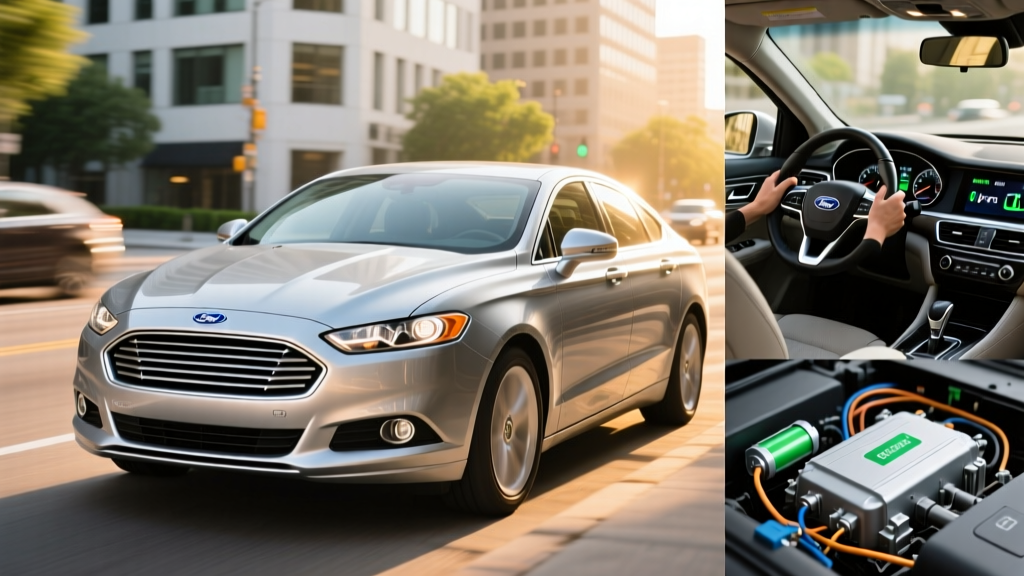
The 2014 Ford Fusion Hybrid Titanium was Ford's top-trim midsize hybrid sedan — a feature-loaded competitor to the Toyota Camry Hybrid and Honda Accord Hybrid. Over a decade later, it remains one of the most affordable entry points into hybrid ownership on the used market, with clean examples trading between $7,000 and $11,000 depending on mileage and condition.
But buying a 12-year-old hybrid in 2026 demands a clear-eyed look at battery health, real-world efficiency, and whether the ownership math still works when a replacement traction battery can cost nearly as much as the car itself. This guide breaks down every number that matters.
| Spec | 2014 Fusion Hybrid Titanium |
|---|---|
| Powertrain | 2.0L Atkinson-cycle I4 + electric motor (HEV) |
| Combined HP | 188 hp (net system) |
| EPA MPG (City / Hwy / Combined) | 44 / 41 / 42 |
| Traction Battery | 1.4 kWh lithium-ion (air-cooled) |
| Transmission | eCVT (planetary gearset) |
| 0–60 mph | ~8.0 seconds |
| Fuel Tank | 13.5 gallons |
| Total Range | ~567 miles (EPA combined) |
| Original MSRP (Titanium) | ~$32,600 |
| Typical 2026 Used Price | $7,000–$11,000 |
| Hybrid Battery Warranty (original) | 8 years / 100,000 miles |
HEV vs. PHEV: Where the Fusion Hybrid Fits
The 2014 Fusion Hybrid is a conventional hybrid (HEV) — not a plug-in hybrid. It does not have a charge port, cannot be plugged in, and has no meaningful electric-only driving range. The small 1.4 kWh battery recharges exclusively through regenerative braking and the gasoline engine.
Ford did offer a plug-in variant called the Fusion Energi for the same model year. The Energi is a PHEV with a larger 7.6 kWh battery, an EPA-rated 19 miles of electric-only range, and a charge port (Level 1/Level 2 J1772, no DC fast charging). If you want plug-in capability from this generation, the Energi is the model to seek — but it sacrifices trunk space (the larger battery intrudes into the cargo area) and carries a higher used-market price.
| Attribute | Fusion Hybrid (HEV) | Fusion Energi (PHEV) |
|---|---|---|
| Plug-in Charging | No — self-charging only | Yes — J1772 (L1/L2) |
| Battery Size | 1.4 kWh | 7.6 kWh |
| Electric-Only Range | Not applicable | 19 miles (EPA) |
| EPA Combined MPG / MPGe | 42 MPG | 38 MPG (gas) / 88 MPGe (electric) |
| Trunk Volume | 12.0 cu ft | 8.2 cu ft |
| DC Fast Charge | No | No |
How Many MPG Does the 2014 Fusion Hybrid Actually Get?
The EPA rates the 2014 Fusion Hybrid at 44 city / 41 highway / 42 combined MPG, according to fueleconomy.gov. Those numbers were class-leading in 2014 and remain respectable today.
| Driving Scenario | EPA Estimate | Real-World Expectation |
|---|---|---|
| City (stop-and-go) | 44 MPG | 42–48 MPG (hybrids often exceed EPA in city) |
| Highway (70+ mph) | 41 MPG | 36–40 MPG (aero drag and less regen opportunity) |
| Combined | 42 MPG | 38–44 MPG depending on route mix |
| Cold Weather (below 30°F) | — | 33–38 MPG (engine runs more for cabin heat) |
Why real-world city MPG can beat the sticker: Conventional hybrids recover the most energy from frequent braking. Stop-and-go driving keeps the battery cycled and the engine off at stops. Highway driving, by contrast, keeps the engine running continuously and offers fewer regen opportunities — so expect a 3–5 MPG drop versus the EPA highway figure at sustained speeds above 70 mph.
Cold-weather penalty: In sub-freezing temperatures, the gasoline engine runs more often to provide cabin heat (there's no electric resistance heater powerful enough to warm the cabin alone on this generation). Expect a 10–15% fuel economy penalty in winter months, bringing combined MPG into the low-to-mid 30s in northern climates.
Battery Health, Replacement Cost, and Warranty Status
This is the single biggest financial risk on any 12-year-old hybrid. The 2014 Fusion Hybrid uses a 1.4 kWh lithium-ion traction battery (supplied by LG Chem), air-cooled via a cabin-temperature ventilation system.
Original Hybrid Battery Warranty: 8 years / 100,000 miles (10 years / 150,000 miles in CARB states including California, New York, Massachusetts, and others adopting California emissions standards).
2026 Reality: The standard 8-year warranty has expired on all 2014 models. Only vehicles in CARB states with under 150,000 miles may still have residual coverage through the 10-year provision — but even that window closes in 2024 for the 2014 model year, meaning no 2014 Fusion Hybrid still has factory battery warranty in 2026.
Battery degradation: The 1.4 kWh pack is small and operates within a narrow state-of-charge window (roughly 40–60% SoC), which limits stress. Most owners report gradual capacity loss of 10–20% over 100,000–150,000 miles. Symptoms include reduced low-speed electric assist, more frequent engine cycling, and a 2–4 MPG drop from original fuel economy.
Replacement cost (2026):
- New OEM battery (Ford dealer): $2,500–$3,500 (part) + $500–$800 labor = $3,000–$4,300 total
- Refurbished/remanufactured battery: $1,200–$2,000 installed
- Individual cell/module replacement (specialist shop): $600–$1,200 if only specific modules have failed
Given that a clean 2014 Fusion Hybrid Titanium sells for $7,000–$11,000, a full OEM battery replacement represents 30–50% of the vehicle's value. This is the critical math every buyer must run before purchase.
Pre-purchase battery check: Before buying, use an OBD-II scanner with hybrid battery diagnostics (or have a hybrid-experienced shop perform the test) to check battery state of health (SoH). Look for voltage delta between modules — a spread greater than 0.3V under load typically signals impending failure. Ford's own diagnostic tool (FORD IDS) can read individual cell voltages and internal resistance.
Powertrain Deep Dive: 188 HP With Surprising Smoothness
The Fusion Hybrid pairs a 2.0-liter Atkinson-cycle four-cylinder engine (141 hp, 129 lb-ft) with an 88 kW (118 hp) permanent-magnet electric motor integrated into the transaxle. Combined net system output is 188 horsepower.
The eCVT is not a belt-driven CVT — it's a planetary gearset (Toyota-licensed power-split device) that seamlessly blends engine and motor power. There are no fixed gear ratios and no rubber bands. Acceleration is linear, with the electric motor providing immediate low-end torque while the engine ramps up.
The 0–60 mph time of approximately 8.0 seconds is adequate for merging and passing but won't win any drag races. What impresses is the refinement: the transition between electric-only motoring (at low speeds and light loads) and engine engagement is among the smoothest in the midsize hybrid class.
Driving modes: The Titanium trim includes Ford's SmartGauge with EcoGuide — a configurable instrument cluster that coaches efficient driving with animated brake-and-accelerate feedback. An "EV" button on the console attempts to maximize electric-only driving at speeds up to ~47 mph, but with only 1.4 kWh available, electric-only range is limited to roughly 1–2 miles under ideal conditions.
Titanium Trim: What You Get at the Top
The Titanium was the premium trim in the 2014 Fusion Hybrid lineup, sitting above the SE. Standard and available equipment that still holds up in 2026:
- Standard: 10-way power driver's seat, leather-trimmed seats, Sony audio (12 speakers), 8-inch touchscreen with SYNC and MyFord Touch, dual-zone automatic climate control, push-button start, ambient lighting, 18-inch alloy wheels
- Available packages: Adaptive cruise control, BLIS (blind-spot information system) with cross-traffic alert, lane-keeping assist, auto high beams, inflatable rear seatbelts, navigation, moonroof
- Driver assistance (SAE Level 1): These features provide basic longitudinal and lateral support but require full driver engagement at all times — this is not autonomous or self-driving capability
Infotainment caveat: MyFord Touch (the predecessor to SYNC 3) was widely criticized for sluggish response and a cluttered interface. It does not support Apple CarPlay or Android Auto. If smartphone integration matters to you, budget for an aftermarket head unit ($400–$700 installed).
Tax Credits and Incentives: What Applies in 2026
The 2014 Fusion Hybrid does not qualify for the federal §30D new clean vehicle credit — that credit applies only to new vehicle purchases, and the Fusion Hybrid was discontinued after the 2020 model year.
Used clean vehicle credit (§25E): Under current IRS rules, a used hybrid may qualify for a credit of up to $4,000 (30% of sale price, capped at $4,000) if purchased from a licensed dealer, the sale price is $25,000 or less, the buyer meets income thresholds ($75,000 single / $150,000 joint), and the vehicle is at least two model years old. However, the vehicle must have a battery capacity of at least 7 kWh to qualify — and the Fusion Hybrid's 1.4 kWh pack falls far short. The Fusion Energi (7.6 kWh) does meet this threshold and may qualify, subject to income and dealer-sale requirements. Verify current rules at irs.gov.
State incentives: Some states offer rebates or HOV lane access for hybrid vehicles, but these programs vary widely and change frequently. Check your state's energy or DMV website for current eligibility.
Who Should Buy This Hybrid vs. a Modern EV or Newer Hybrid?
Choose the 2014 Fusion Hybrid Titanium if:
- Your total vehicle budget is under $12,000
- You drive primarily in city/suburban stop-and-go traffic (where hybrid efficiency shines)
- You have no access to home or workplace charging (no plug needed)
- You want a comfortable, well-equipped midsize sedan with low running costs
- You can budget $1,500–$3,000 for a potential battery replacement in the next 2–3 years
Choose a newer hybrid (2022+ Camry/Accord Hybrid) if:
- You want current safety tech (automatic emergency braking, updated lane-keeping)
- You prefer CarPlay/Android Auto and modern infotainment
- You want remaining factory warranty coverage (including 10-year hybrid battery)
- Your budget allows $25,000+
Choose a full EV if:
- You have reliable home Level 2 charging
- Your daily commute is under 200 miles round-trip
- You want to eliminate gasoline costs entirely and reduce maintenance (no oil changes, no transmission fluid)
- Your budget supports $25,000+ for a used EV or $35,000+ new (where the §30D credit of up to $7,500 may apply, subject to MSRP caps, income limits, and battery sourcing requirements — see IRS §30D guidelines)
Pros
- 42 MPG combined EPA — still competitive with 2026 midsize hybrids
- Titanium trim is well-equipped: leather, Sony audio, adaptive cruise (if optioned)
- Smooth, refined powertrain with no belt-driven CVT drone
- Low purchase price on the used market ($7K–$11K)
- No charging infrastructure needed — works for apartment dwellers
- Strong real-world city MPG (often exceeds EPA in stop-and-go)
Cons
- Hybrid battery warranty has fully expired — replacement risk is on the buyer
- Battery replacement cost ($3,000–$4,300 OEM) is a large percentage of vehicle value
- MyFord Touch infotainment is outdated; no CarPlay/Android Auto
- Highway MPG drops to mid-30s at sustained 75+ mph speeds
- Cold-weather fuel economy penalty of 10–15%
- Safety tech is dated (no standard AEB, older lane-keeping)
Reliability and Long-Term Ownership Data
The 2014 Fusion Hybrid's powertrain has proven more reliable than the conventional (gas-only) Fusion's turbocharged EcoBoost engines, which suffered from coolant intrusion issues in the 1.5L and 2.0L variants. The Atkinson-cycle 2.0L in the hybrid is naturally aspirated and under less thermal stress.
The eCVT planetary gearset has no belts, no clutches, and no torque converter — it is one of the most durable transmission designs in the industry. Toyota pioneered this architecture, and Ford licensed it; failure rates are extremely low.
Common issues to inspect:
- Hybrid battery cooling fan: Located behind the rear seat, this fan can accumulate dust and fail, leading to battery overheating and accelerated degradation. Listen for unusual noise from the rear parcel shelf area.
- 12V auxiliary battery: Like all hybrids, the Fusion has a conventional 12V battery that powers electronics. It typically lasts 3–5 years and is a common cause of "no-start" complaints that owners misattribute to the hybrid system.
- Brake actuator: The regenerative braking system uses an electrohydraulic brake actuator. Some owners report a grinding or buzzing noise as the unit ages; replacement runs $800–$1,400.
- Motorcraft warranty parts: Ford's hybrid-specific components remain available through the dealer network, though some body and interior trim parts are becoming harder to source.
With proper maintenance (regular oil changes using the recommended 5W-20 synthetic, transmission fluid check at 100K miles, brake fluid flush every 3 years), the Fusion Hybrid powertrain is capable of 200,000+ miles. The limiting factor is almost always the traction battery — and whether the owner is willing to invest in replacement when the time comes.
Frequently Asked Questions
How many MPG does the 2014 Ford Fusion Hybrid get in real-world driving?
The EPA rates it at 44 city / 41 highway / 42 combined. In real-world use, expect 42–48 MPG in city driving (hybrids often beat EPA city estimates thanks to regen braking), 36–40 MPG on the highway at 70+ mph, and 33–38 MPG in cold weather below 30°F when the engine runs more frequently for cabin heat.
Is the 2014 Fusion Hybrid a plug-in hybrid?
No. The Fusion Hybrid is a conventional HEV — it has no charge port and cannot be plugged in. The battery charges through regenerative braking and the gasoline engine. If you want plug-in capability, look for the Fusion Energi, which is the PHEV variant with 19 miles of electric-only range and a J1772 charge port.
What does it cost to replace the hybrid battery?
A new OEM battery through a Ford dealer typically costs $3,000–$4,300 installed. Refurbished batteries run $1,200–$2,000 installed, and individual module replacement (if only certain cells have failed) can be done for $600–$1,200 at a hybrid specialist shop. Always get a battery health report before purchasing a used hybrid.
Does the 2014 Fusion Hybrid qualify for any tax credits in 2026?
No. The federal §30D new vehicle credit applies only to new purchases, and the Fusion Hybrid is discontinued. The §25E used clean vehicle credit requires a minimum 7 kWh battery — the Fusion Hybrid's 1.4 kWh pack does not qualify. The Fusion Energi (7.6 kWh) may qualify for the used credit if all other requirements (income, dealer sale, price cap) are met.
Is the 2014 Fusion Hybrid reliable?
The hybrid powertrain (2.0L Atkinson-cycle engine + eCVT) is among Ford's most reliable configurations. The planetary gearset eCVT is exceptionally durable. The main reliability concern is the hybrid traction battery, which is now beyond its warranty period and may need replacement. The infotainment system (MyFord Touch) is also a known frustration point.
How does the Fusion Hybrid compare to a Toyota Camry Hybrid of the same era?
The 2014 Camry Hybrid is rated at 41/38/40 MPG (LE) — slightly below the Fusion's 44/41/42. The Camry benefits from Toyota's longer track record with hybrid batteries and generally stronger resale value. The Fusion Titanium offers more premium features (available adaptive cruise, BLIS, inflatable rear belts) at a similar used price. Battery replacement costs are comparable between the two.
Can I still get parts and service for a 2014 Fusion Hybrid?
Yes. Ford's dealer network continues to stock hybrid-specific components (battery modules, inverters, brake actuators). The naturally aspirated 2.0L engine shares many maintenance parts with other Ford four-cylinders. Independent hybrid shops are also increasingly common in major metro areas and often offer lower labor rates than dealers.