Quick Verdict: A Proven Midsize Hybrid That Still Delivers
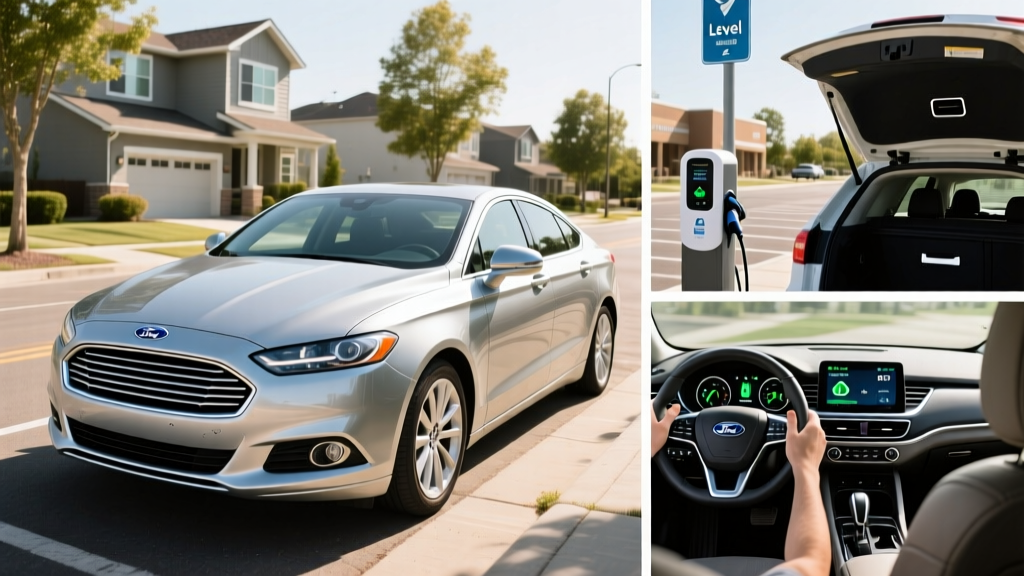
The 2014 Ford Fusion Hybrid SE remains one of the most practical used midsize sedans on the market more than a decade after its debut. With an EPA-estimated 44 city / 41 highway / 42 combined MPG, it undercuts many newer hybrids in city driving while offering a comfortable, tech-forward cabin. As a conventional hybrid (HEV), it requires no plug-in charging — it refuels exactly like a gasoline car and recharges its small battery through regenerative braking and the gasoline engine.
For 2026 used-car shoppers, the Fusion Hybrid SE typically trades between $7,000 and $12,000 depending on mileage and condition. That positions it well below a new Toyota Prius (~$28,550 base MSRP) and makes it an accessible entry point into hybrid ownership. The key question for any 12-year-old hybrid is battery health — and we address that in detail below.
The 2014 Fusion Hybrid is a conventional hybrid (HEV). It cannot be plugged in. Ford also sold a Fusion Energi variant, which is a plug-in hybrid (PHEV) with ~19 miles of electric-only range and a larger 7.6 kWh battery. This guide focuses on the standard Hybrid SE. If you need plug-in electric driving, you want the Energi — not this car.
Powertrain and Performance Specs
| Specification | Value |
|---|---|
| Powertrain Type | Conventional Hybrid (HEV) — no plug |
| Engine | 2.0L Atkinson-cycle inline-4 |
| Engine Output | 141 hp / 129 lb-ft torque |
| Electric Motor | Permanent-magnet AC synchronous, 88 kW (118 hp) |
| Combined System Output | 188 hp |
| Transmission | eCVT (planetary gearset, no fixed gears) |
| Hybrid Battery | 1.4 kWh lithium-ion (air-cooled) |
| Drivetrain | Front-wheel drive |
| 0–60 mph | ~7.9 seconds (Motor Trend tested) |
| Curb Weight | ~3,615 lbs |
| Fuel Tank | 13.5 gallons |
| Total Driving Range | ~567 miles (EPA combined estimate) |
The 2.0L Atkinson-cycle engine prioritizes efficiency over raw power, but the electric motor fills in torque gaps at low speeds. The result is adequate acceleration for merging and passing, though this is not a performance sedan. The eCVT operates without shift shock — it's smooth but can produce the characteristic "rubber-band" drone under hard acceleration that Ford has since improved in newer hybrid models.
Fuel Economy: EPA Ratings vs. Real-World MPG
| Driving Condition | EPA MPG |
|---|---|
| City | 44 MPG |
| Highway | 41 MPG |
| Combined | 42 MPG |
Source: EPA / fueleconomy.gov
The Fusion Hybrid's city MPG exceeds its highway rating — a hallmark of conventional hybrids. Regenerative braking recovers energy in stop-and-go traffic, and the electric motor handles low-speed propulsion more efficiently than the gasoline engine. On the highway, the engine runs more continuously, reducing the hybrid system's advantage.
What Owners Actually Report
Real-world data from fueleconomy.gov user reports and owner forums show most drivers average between 38 and 44 MPG combined in mixed driving. City-heavy commuters often match or slightly exceed the 44 MPG city sticker, while drivers who spend most of their time at 75+ mph on interstates may see 36–38 MPG. Cold weather (below 35°F) typically drops observed fuel economy by 3–5 MPG due to increased engine idling for cabin heat and reduced battery efficiency.
Hybrid vs. Plug-In Hybrid vs. Full EV: Which Fits You?
The 2014 Fusion Hybrid SE is one option in a broader electrified-vehicle landscape. Here's how it compares to the alternatives:
| Factor | HEV (This Car) | PHEV (e.g., Fusion Energi) | Full EV (e.g., Tesla Model 3) |
|---|---|---|---|
| Plug-in Charging Required? | No | Yes (for EV range) | Yes (always) |
| Electric-Only Range | None (EV assist only) | ~19 mi (Energi) | 250–350+ mi |
| Total Range | ~567 mi | ~550 mi combined | 250–350 mi |
| Fuel / Energy Cost per Mile | ~$0.08 (gas at $3.40/gal) | ~$0.04 (electric) / $0.08 (gas) | ~$0.03–0.05 (electric) |
| Home Charging Needed? | No | Recommended | Essential |
| Federal Tax Credit (New) | None | Up to $3,750 (expired) | Up to $7,500 (§30D) |
| Used Price (2026) | $7,000–$12,000 | $9,000–$14,000 | $18,000–$30,000 |
| Maintenance | Standard + hybrid system | Standard + hybrid + larger battery | Minimal (no oil, fewer fluids) |
- Choose the Fusion Hybrid (HEV) if you want lower fuel costs with zero lifestyle change — no charging, no range planning, just fill up with gas and go.
- Choose a PHEV if you have home charging and a short commute (<20 miles) but still want gas-engine flexibility for road trips.
- Choose a full EV if you have reliable home charging, want the lowest per-mile energy cost, and can accommodate charging on longer trips.
Hybrid Battery Health, Warranty, and Replacement Cost
The single biggest concern for any used hybrid buyer is the traction battery. The 2014 Fusion Hybrid uses a 1.4 kWh lithium-ion pack manufactured by LG Chem. This is a small battery by modern standards — its job is to buffer energy for electric assist and regenerative braking, not to drive the car long distances on electricity alone.
How Long Do These Batteries Actually Last?
Data from fleet operators and long-term owner reports indicate the Fusion Hybrid's lithium-ion pack generally retains 85–92% of its original capacity at 150,000 miles. Unlike early nickel-metal-hydride (NiMH) packs in the first-generation Prius, lithium-ion chemistry degrades more gradually and predictably. Complete failure before 200,000 miles is uncommon, though individual cell imbalances can reduce usable capacity over time.
Signs of battery degradation in this model include:
- Reduced EV-mode engagement (the engine starts more frequently at low speeds)
- Lower observed MPG (typically a 2–5 MPG drop)
- State-of-charge gauge cycling rapidly between high and low
- Diagnostic trouble codes P0A7F or P0A0F (hybrid battery capacity/energy storage)
Battery Replacement Cost
If the hybrid battery does need replacement, here's what to budget:
| Option | Estimated Cost (Parts + Labor) |
|---|---|
| New OEM battery (Ford dealer) | $3,500–$5,000 |
| Remanufactured battery (aftermarket) | $1,800–$3,000 |
| Used/salvage battery (junkyard) | $800–$1,500 |
| Individual cell module replacement (specialist shop) | $500–$1,200 |
Before purchasing any used Fusion Hybrid, request a hybrid battery health report from a Ford dealer or an independent hybrid specialist. A scan tool can read the battery's actual capacity versus its original spec — this is the single most important pre-purchase check on this car.
SE Trim Features and What You Get
The SE was the mid-level trim in the 2014 Fusion Hybrid lineup, sitting above the base S and below the Titanium. It came well-equipped for its era:
- Standard: 8-inch SYNC touchscreen with MyFord Touch, dual-zone automatic climate control, push-button start, 17-inch aluminum wheels, power driver's seat (6-way), rearview camera, Bluetooth, SiriusXM satellite radio
- Popular options: Navigation system, leather-trimmed seats, moonroof, BLIS (Blind Spot Information System) with cross-traffic alert, adaptive cruise control, lane-keeping assist, heated front seats
- Safety: 6 airbags, AdvanceTrac stability control, 4-wheel disc brakes with ABS, LATCH child-seat anchors
The 2014 Fusion earned a 5-star overall safety rating from NHTSA and was an IIHS Top Safety Pick (Good ratings in all crashworthiness tests). These remain strong scores for a vehicle of this vintage.
One caveat: the MyFord Touch infotainment system was widely criticized for lag and unresponsiveness when new. Ford issued software updates that improved performance, but by 2026 standards the interface feels dated. Apple CarPlay and Android Auto are not supported — you'll rely on Bluetooth for phone audio and calls.
Pricing and Tax Credit Eligibility
As a used 2014 model, the Fusion Hybrid SE does not qualify for the federal §30D new clean vehicle credit (up to $7,500 for new EVs and PHEVs). It also does not qualify as a PHEV or EV — it's a conventional HEV, which was never eligible for federal purchase incentives even when new.
However, buyers should check two potential savings avenues:
- Used Clean Vehicle Credit (§25E): This credit applies only to used EVs and PHEVs priced under $25,000. Since the Fusion Hybrid is a conventional HEV (not plug-in), it does not qualify.
- State and local incentives: Some states offer registration fee reductions, HOV lane access, or inspection exemptions for hybrid vehicles. Check your state's DMV or energy office for current programs — these vary widely by jurisdiction.
| Condition / Mileage | Typical Price Range |
|---|---|
| Excellent, under 80,000 mi | $10,000–$12,000 |
| Good, 80,000–120,000 mi | $8,000–$10,000 |
| Fair, 120,000–160,000 mi | $6,500–$8,500 |
| High mileage / needs work | $4,500–$6,500 |
Pros and Cons at a Glance
- Strong city MPG (44 EPA) — beats many newer hybrids in urban driving
- No plug-in charging required — zero lifestyle change from a gas car
- Comfortable, spacious midsize sedan with solid ride quality
- 5-star NHTSA safety rating; IIHS Top Safety Pick
- Affordable used pricing ($7K–$12K)
- Proven lithium-ion battery with good longevity data
- Generous total range (~567 miles per tank)
- Highway MPG (41) trails newer hybrids like the 2026 Prius (57 combined)
- MyFord Touch infotainment is slow and lacks CarPlay/Android Auto
- eCVT drone under hard acceleration
- Original battery warranty has expired on most examples
- No electric-only driving capability (unlike PHEV or EV)
- Trunk space reduced by battery pack (~12.0 cu ft vs. 16.0 in gas Fusion)
- Higher-mileage examples may need battery replacement ($1,800–$5,000)
Who Should Buy the 2014 Fusion Hybrid SE in 2026?
This car is best suited for:
- City and suburban commuters who do most of their driving below 50 mph, where the 44 MPG city rating shines
- Budget-conscious buyers who want hybrid efficiency without the $28,000+ cost of a new Prius or the charging infrastructure of an EV
- Rideshare drivers seeking low fuel costs and a comfortable, spacious sedan (check local rideshare vehicle age requirements)
- Drivers without home charging access who still want better fuel economy than a gas-only midsize sedan
Look elsewhere if:
- Your commute is mostly high-speed highway driving (a newer hybrid or diesel may close the MPG gap)
- You want electric-only driving for short trips (consider the Fusion Energi PHEV or a full EV)
- Modern infotainment (CarPlay, Android Auto, OTA updates) is a priority
- You plan to keep the car 5+ years and want full battery warranty coverage
Frequently Asked Questions
How many MPG does the 2014 Ford Fusion Hybrid SE get?
The EPA rates it at 44 city / 41 highway / 42 combined MPG. Real-world owners typically report 38–44 MPG combined depending on driving mix. City-heavy drivers often match or exceed the EPA city number; highway-dominant driving at 75+ mph may yield 36–38 MPG.
Does the 2014 Fusion Hybrid need to be plugged in?
No. The Fusion Hybrid is a conventional hybrid (HEV). It charges its 1.4 kWh battery through regenerative braking and the gasoline engine. You never plug it in — you simply fill the gas tank as you would with any conventional car. If you want plug-in capability, look at the Fusion Energi (PHEV) variant instead.
How far can it drive on electric power alone?
The 2014 Fusion Hybrid can operate in EV mode at speeds up to approximately 62 mph, but only for 1–2 miles at a time under light load with a fully charged battery. This is not a meaningful electric-only range — the system uses electric assist to improve fuel economy, not to replace the gasoline engine for commutes. For usable electric-only range (19 miles), you'd need the Fusion Energi PHEV.
Is the 2014 Fusion Hybrid reliable?
Overall, yes. The 2.0L Atkinson-cycle engine is under-stressed and durable. The eCVT transmission has no clutch packs or bands to wear — it's a planetary gearset with a strong reliability record. The main long-term risk is hybrid battery degradation. At 12 years old, most examples have batteries in acceptable condition, but a pre-purchase hybrid health scan is essential. Consumer Reports historically rated the 2013–2014 Fusion Hybrid as average to above-average in predicted reliability.
What does a replacement hybrid battery cost?
A new OEM battery from a Ford dealer runs $3,500–$5,000 installed. Remanufactured aftermarket batteries cost $1,800–$3,000. Used/salvage units can be found for $800–$1,500. Some specialist shops can replace individual cell modules for $500–$1,200, extending the pack's life at lower cost.
Does the 2014 Fusion Hybrid qualify for any tax credits?
No. As a conventional hybrid (HEV), it was never eligible for the federal §30D plug-in vehicle credit, even when new. It also does not qualify for the §25E used clean vehicle credit (which applies only to used EVs and PHEVs). Some states may offer minor registration or inspection benefits for hybrids — check your local jurisdiction.
How does it compare to a 2026 Toyota Prius?
The current-generation Prius achieves an EPA-estimated 57 MPG combined (LE trim) — a significant 15 MPG improvement over the Fusion Hybrid. However, a new Prius starts at ~$28,550, while a used 2014 Fusion Hybrid SE costs $7,000–$12,000. Over 5 years and 75,000 miles, the Prius saves roughly $1,200–$1,500 in fuel (at $3.40/gal), but costs $16,000–$21,000 more upfront. The Fusion Hybrid wins on total cost for budget buyers who don't need the latest tech.