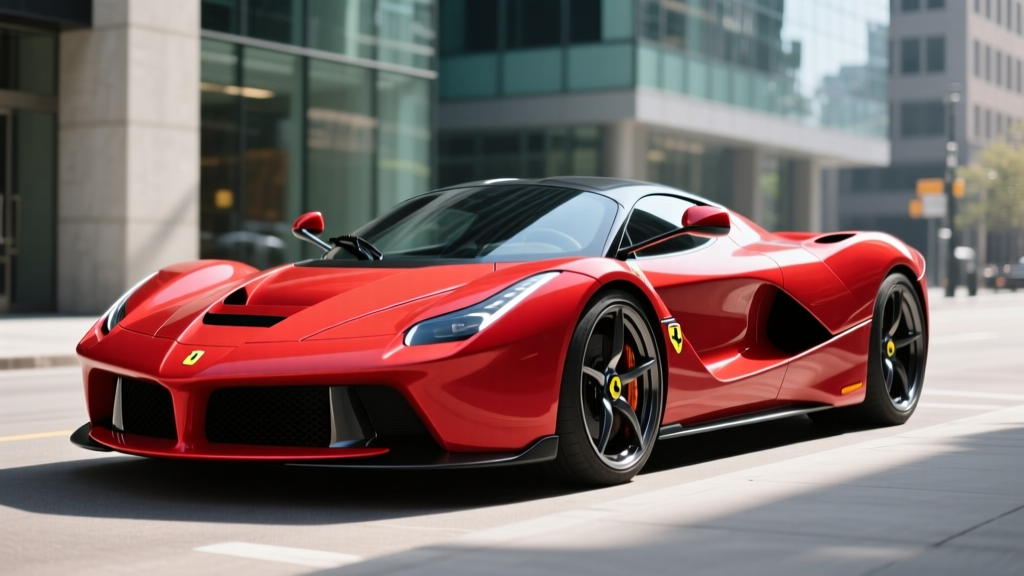
When enthusiasts search for a "2014 Ferrari hybrid," they are almost always looking for one car: the Ferrari LaFerrari. Limited to just 499 units worldwide, the LaFerrari was Ferrari's first production hybrid and one of the "Holy Trinity" hypercars alongside the McLaren P1 and Porsche 918 Spyder. But unlike those rivals — the 918 being a plug-in hybrid — the LaFerrari uses a conventional hybrid (HEV) system that never plugs in.
This guide dissects the LaFerrari's hybrid powertrain from a technical ownership perspective: how the HY-KERS system works, what fuel economy you can expect, battery longevity and replacement costs, and whether this car fits into any modern hybrid buying framework. We also compare it against current Ferrari hybrid offerings for buyers who want the Maranello badge with electrified propulsion.
HEV vs PHEV: Where the LaFerrari Fits
The distinction between a conventional hybrid (HEV) and a plug-in hybrid (PHEV) is the single most important concept for hybrid shoppers. The LaFerrari is firmly an HEV.
| Feature | HEV (LaFerrari) | PHEV (e.g., Ferrari 296 GTB) |
|---|---|---|
| Plugs in to charge? | No — battery charges via regen & engine | Yes — external charging required for EV range |
| Electric-only driving | No (motor assists engine only) | Yes — up to 16 miles on battery alone |
| Battery size | ~2 kWh (small, high-discharge) | 7.45 kWh usable |
| Federal EV tax credit (§30D) | Not eligible | Not eligible (MSRP exceeds $55,000 cap) |
| Primary hybrid goal | Performance boost & torque fill | Emissions compliance + short EV commutes |
The LaFerrari's HY-KERS system was derived from Ferrari's Formula 1 KERS (Kinetic Energy Recovery System). Its purpose is not fuel savings — it's extracting an additional 163 horsepower from an electric motor to supplement the V12, filling torque gaps during gear changes and delivering instantaneous electric thrust.
Powertrain: 950 Horsepower from V12 + Electric Motor
The LaFerrari's hybrid powertrain combines two power sources into one integrated system:
| Component | Specification |
|---|---|
| Internal combustion engine | 6.3L naturally aspirated V12 (F140 FE) |
| Engine output | 789 hp @ 9,000 rpm / 516 lb-ft @ 6,500 rpm |
| Redline | 9,250 rpm |
| Electric motor | 120 kW (163 hp) / 199 lb-ft |
| Motor type | Permanent-magnet synchronous, integrated into transaxle |
| Combined system output | 950 hp / 664 lb-ft |
| Transmission | 7-speed dual-clutch automatic (F1 DCT) |
| Drivetrain | Rear-wheel drive |
| 0–60 mph | ~2.4 seconds |
| Top speed | 217+ mph |
The electric motor draws from a lithium-ion battery pack mounted low in the chassis. A second, smaller electric motor replaces the traditional alternator, recovering energy under braking and during engine overrun. Ferrari claims the HY-KERS system adds roughly 10% to overall powertrain efficiency — but the real story is performance, not economy.
Fuel Economy: EPA MPG and Real-World Expectations
The LaFerrari was never a fuel-economy champion, and the EPA ratings reflect that. Here's what the official numbers look like:
| Driving Cycle | EPA Estimate |
|---|---|
| City | 12 MPG |
| Highway | 17 MPG |
| Combined | 14 MPG |
For context, the LaFerrari's combined 14 MPG is roughly on par with other V12 supercars of its era that lack hybrid assistance. The HY-KERS system recovers energy under braking — which marginally improves city driving over a non-hybrid V12 — but the car's weight, aerodynamic drag, and the driver's right foot dominate consumption.
Real-world note: Owners report seeing 10–11 MPG during spirited canyon driving and track sessions, with 15–16 MPG possible on steady highway cruising at legal speeds. Fuel tank capacity is approximately 19.8 gallons, giving a real-world range of roughly 200–280 miles per fill-up depending on driving style. These figures are consistent with data from owner forums and fueleconomy.gov user reports for comparable V12 hypercars.
Battery System: Size, Chemistry, and Lifespan
The LaFerrari's hybrid battery is fundamentally different from what you'll find in a Toyota Prius or even a modern PHEV:
| Battery Specification | Detail |
|---|---|
| Chemistry | Lithium-ion (high-discharge cells) |
| Capacity | ~2 kWh (estimated) |
| Voltage | ~400V system |
| Cooling | Active liquid cooling |
| Location | Low-center, behind seats in chassis tunnel |
| Charging method | Regenerative braking + engine-driven motor/generator only |
| External plug-in charging | None — not a PHEV |
Battery Warranty & Replacement Cost: Ferrari's original hybrid battery warranty covered 7 years with no mileage limit (Ferrari's standard new-car warranty at the time was 3 years). As a 2014 model, the original warranty has now expired for most examples. Ferrari's Power Warranty extended program can extend coverage up to 15 years from manufacture for qualifying vehicles that pass a dealer inspection.
Replacement cost for the HY-KERS battery pack is estimated at $30,000–$50,000+ including labor, based on specialist service reports. Given the LaFerrari's current market values ($3M–$5M+), this cost is proportionally minor for owners but significant in absolute terms. Battery degradation is minimal in practice because the pack is rarely deeply cycled — it operates in a narrow state-of-charge window, constantly topped up by regeneration.
Reliability and Long-Term Ownership
Hybrid reliability in the LaFerrari centers on two systems: the high-voltage battery and the electric motor integrated into the transaxle. Here's what long-term ownership data suggests:
- Electric motor: The 120-kW motor has proven highly reliable. Electric motors have far fewer moving parts than internal combustion engines and rarely fail in normal use.
- Battery degradation: Because the HY-KERS battery operates in a shallow charge-discharge cycle (never fully depleted, never fully charged), degradation has been minimal across the fleet. Most LaFerrari batteries retain 90%+ of original capacity after a decade.
- Inverter and power electronics: These components manage the DC-to-AC conversion for the motor. Failures are rare but expensive — budget $15,000–$25,000 for out-of-warranty replacement.
- V12 engine: The F140 FE V12 is a derivative of Ferrari's well-proven F140 family (used in the Enzo, 599, and F12). Known issues are minimal when factory maintenance schedules are followed.
Ferrari recommends annual service regardless of mileage. Expect $5,000–$10,000 per year in routine maintenance, with major services (belt changes, fluid flushes, hybrid system checks) running significantly higher. Independent Ferrari specialists can reduce costs by 30–40%.
Pricing, Tax Credits, and Market Value
The LaFerrari's original MSRP was approximately $1.4 million when new in 2014–2015. Today, as a collector hypercar, market values are dramatically higher:
| Condition / Variant | Estimated Market Value (2025–2026) |
|---|---|
| LaFerrari Coupe (good condition) | $3.0M – $4.0M |
| LaFerrari Coupe (low-mile, pristine) | $4.0M – $5.5M |
| LaFerrari Aperta (open-top, 210 made) | $5.0M – $8.0M+ |
Federal tax credit eligibility: The LaFerrari does not qualify for the IRS §30D Clean Vehicle Credit. The credit is capped at vehicles with an MSRP under $55,000 (sedans) or $80,000 (SUVs/trucks/vans), and the LaFerrari exceeds both thresholds by orders of magnitude. Additionally, the §30D credit requires a plug-in electric vehicle with a minimum 7 kWh battery — the LaFerrari's ~2 kWh pack and HEV configuration disqualify it entirely. No federal or state hybrid-specific tax credits apply to vehicles in this price class.
LaFerrari vs. Modern Ferrari Hybrids
If you're considering a Ferrari hybrid in 2026, the LaFerrari isn't the only option. Ferrari now offers multiple plug-in hybrid models:
| Specification | 2014 LaFerrari (HEV) | 2024 Ferrari 296 GTB (PHEV) | 2024 Ferrari SF90 Stradale (PHEV) |
|---|---|---|---|
| Hybrid type | Conventional HEV | Plug-in hybrid | Plug-in hybrid |
| Engine | 6.3L V12 | 3.0L twin-turbo V6 | 4.0L twin-turbo V8 |
| Combined output | 950 hp | 819 hp | 986 hp |
| Electric-only range | None | ~16 miles (EPA) | ~15 miles (EPA) |
| Battery (usable) | ~2 kWh | 7.45 kWh | 7.9 kWh |
| Plugs in? | No | Yes (Level 2 AC) | Yes (Level 2 AC) |
| EPA combined MPG | 14 MPG | 14 MPG (gas) / 64 MPGe | 14 MPG (gas) / 62 MPGe |
| 0–60 mph | ~2.4 sec | ~2.9 sec | ~2.5 sec |
| Base MSRP (new) | $1.4M (2014) | ~$350,000 | ~$525,000 |
| Tax credit eligible? | No | No (MSRP cap) | No (MSRP cap) |
The 296 GTB and SF90 Stradale represent Ferrari's modern PHEV philosophy: using electrification for both performance and regulatory compliance (EU CO₂ fleet targets). Both can drive short distances on electric power alone — useful for silent departures from residential neighborhoods or zero-emission zones in European cities. Neither qualifies for US federal tax credits due to MSRP caps.
Pros: 2014 LaFerrari
- Iconic V12 hybrid — last naturally aspirated V12 Ferrari hypercar
- 950 hp with instantaneous electric torque fill
- Appreciating collector asset ($3M–$5M+ current value)
- No plug-in charging logistics — fully self-contained HEV
- Formula 1-derived HY-KERS technology
- Extremely limited production (499 coupes) ensures exclusivity
Cons: 2014 LaFerrari
- 14 MPG combined — among the thirstiest "hybrids" ever made
- Battery replacement costs $30,000–$50,000+ out of warranty
- No electric-only driving capability
- No federal or state hybrid/EV tax credits
- Annual maintenance runs $5,000–$10,000+
- Essentially impossible to acquire at original MSRP
Who Should Choose This Hybrid?
The LaFerrari does not fit any conventional hybrid buying framework. Here's how to think about it:
Choose the LaFerrari if: You are a Ferrari collector or hypercar investor seeking one of the most significant hybrid performance cars ever built. The HY-KERS system is a historical milestone — the bridge between analog V12 supercars and the electrified future. Fuel economy is irrelevant; appreciation potential and driving experience are the value proposition.
Choose a modern Ferrari PHEV (296 GTB, SF90) if: You want current Ferrari performance with plug-in hybrid practicality — short electric-only commutes, modern infotainment, ADAS features, and manufacturer warranty coverage.
Choose a mainstream PHEV (Toyota RAV4 Prime, Chrysler Pacifica Hybrid) if: Your goal is genuine fuel savings, daily electric-only commuting, and potential tax credit eligibility. These vehicles deliver 30–94 MPGe, 25–42 miles of EV range, and may qualify for the full §30D credit up to $7,500 (subject to income, MSRP, and battery-sourcing requirements).
Frequently Asked Questions
How many MPG does the 2014 Ferrari LaFerrari hybrid get?
The EPA rates the LaFerrari at 12 MPG city, 17 MPG highway, and 14 MPG combined. Real-world consumption ranges from 10–11 MPG under hard driving to 15–16 MPG on gentle highway cruising. The hybrid system provides marginal efficiency gains over a non-hybrid V12 — its primary purpose is performance enhancement.
Can the LaFerrari drive on electric power only?
No. The LaFerrari is a conventional hybrid (HEV), not a plug-in hybrid (PHEV). Its electric motor cannot propel the car independently — it only assists the V12 engine, providing torque fill during acceleration and gear changes. There is no EV mode or electric-only range.
Does the 2014 Ferrari LaFerrari qualify for any tax credit?
No. The LaFerrari is ineligible for the federal §30D Clean Vehicle Credit for multiple reasons: its original MSRP far exceeds the $55,000 sedan cap, its battery capacity (~2 kWh) is well below the 7 kWh minimum, and it is a conventional hybrid rather than a plug-in vehicle. No state-level hybrid credits apply to vehicles in this price range either.
Is the LaFerrari hybrid system reliable?
Yes, with caveats. The electric motor and power electronics have proven robust over a decade of real-world use. The HY-KERS battery degrades slowly because it operates in a shallow charge window. The main reliability risk is cost: any high-voltage component failure outside warranty can cost $15,000–$50,000+. Ferrari's Power Warranty extended program can mitigate this for qualifying vehicles.
What does a LaFerrari hybrid battery replacement cost?
Based on specialist service estimates, a full HY-KERS battery pack replacement runs $30,000 to $50,000 or more, including parts and labor. In practice, very few LaFerrari batteries have required full replacement — most retain 90%+ capacity after 10+ years due to the shallow-cycling design. Individual cell module repairs may be possible at lower cost through independent high-voltage specialists.
Hybrid vs PHEV vs EV — which Ferrari electrified car fits different buyers?
The LaFerrari (HEV) suits collectors who want a historically significant, naturally aspirated V12 with hybrid performance assist — no charging infrastructure needed. Modern Ferrari PHEVs (296 GTB, SF90 Stradale) suit enthusiasts who want current-model performance plus short electric-only range for daily use. For buyers prioritizing efficiency over performance, mainstream PHEVs like the Toyota Prius Prime (44 miles EV, 127 MPGe) or full EVs like the Tesla Model 3 (341 miles range, 132 MPGe) are the appropriate category — not hypercars.
How does the LaFerrari compare to the Porsche 918 Spyder hybrid?
The Porsche 918 Spyder is a PHEV with a 6.8 kWh battery, approximately 12 miles of electric-only range, and plug-in charging capability. It produces 887 combined hp from a 4.6L V8 plus two electric motors. The 918 achieves an EPA-rated 67 MPGe (combined gas + electric) and 22 MPG on gas alone — significantly more efficient than the LaFerrari but with a smaller, turbocharged V8 rather than a naturally aspirated V12. Both appreciate strongly as collector vehicles.
Sources: fueleconomy.gov (EPA ratings), IRS §30D Clean Vehicle Credit rules, Ferrari S.p.A. official technical documentation.