Quick Verdict: A Proven Hybrid Sedan With Real-World Efficiency
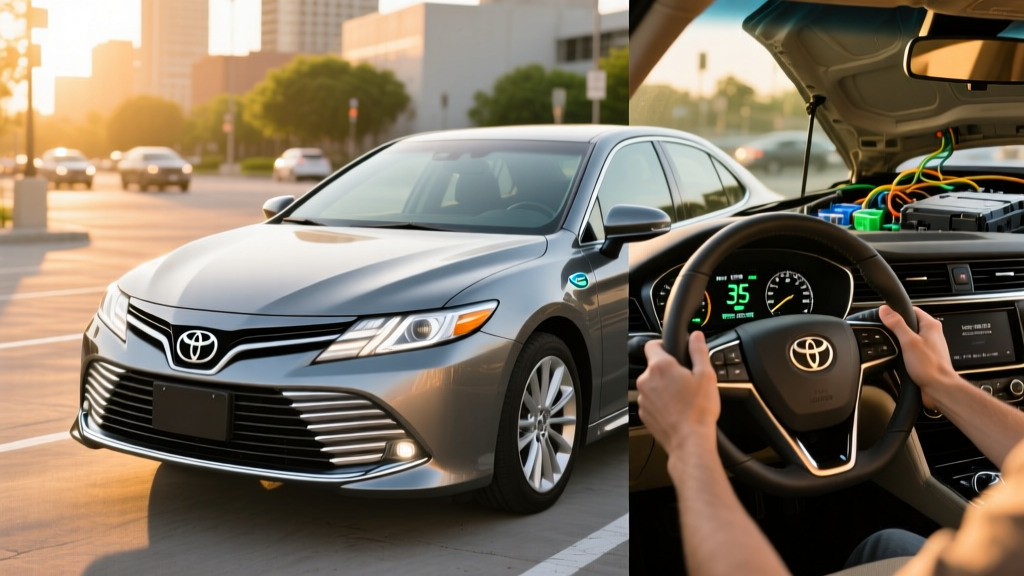
The 2014 Toyota Camry Hybrid XLE remains one of the most practical used midsize sedans on the market more than a decade after its debut. With an EPA-rated 40 MPG city and a reputation for bulletproof reliability, this conventional hybrid (HEV) delivers consistent fuel savings without ever needing to be plugged in. For buyers navigating high gas prices, limited charging access, or simply wanting a dependable daily driver with low running costs, the 2014 Camry XLE Hybrid is still a compelling proposition in the used market.
This guide covers everything a prospective buyer needs: real-world fuel economy versus EPA estimates, the hybrid battery's expected lifespan and replacement cost, how the XLE trim stacks up, and whether this 2014 HEV still makes sense compared to a modern plug-in hybrid (PHEV) or full battery-electric vehicle (BEV).
Fuel Economy: EPA Ratings vs. Real-World MPG
The 2014 Toyota Camry Hybrid is rated by the EPA at 40 MPG city, 38 MPG highway, and 40 MPG combined. These figures apply to all trim levels including the XLE, which adds some weight from premium features but does not significantly alter efficiency.
| Driving Cycle | EPA MPG | Real-World Expectation |
|---|---|---|
| City | 40 MPG | 38–43 MPG (hybrids often beat EPA in stop-and-go) |
| Highway | 38 MPG | 35–39 MPG (aerodynamic drag and A/C load reduce gains) |
| Combined | 40 MPG | 37–41 MPG depending on driving mix |
Hybrids like the Camry tend to exceed their EPA city ratings in real-world stop-and-go driving because regenerative braking recaptures energy that a conventional car wastes as heat. On the highway, where the gasoline engine does most of the work and regenerative opportunities are limited, expect numbers closer to or slightly below the EPA sticker.
According to data aggregated on fueleconomy.gov, owners of the 2014 Camry Hybrid report real-world combined averages between 37 and 43 MPG, with the median hovering around 39 MPG. Cold weather, aggressive acceleration, and sustained high-speed driving will push numbers toward the lower end of that range.
Powertrain: How the 2014 Camry Hybrid Drives
The 2014 Camry Hybrid uses Toyota's Hybrid Synergy Drive (HSD) system, pairing a 2.5-liter four-cylinder Atkinson-cycle gasoline engine with an electric motor-generator and a nickel-metal hydride (NiMH) traction battery. Total system output is 200 horsepower, delivered through an electronically controlled continuously variable transmission (eCVT).
| Specification | Value |
|---|---|
| Gasoline Engine | 2.5L inline-4, Atkinson cycle |
| Engine Horsepower | 156 HP @ 5,700 RPM |
| Electric Motor Output | 105 kW (141 HP) |
| Net System Horsepower | 200 HP |
| Transmission | eCVT (planetary gearset) |
| Traction Battery | NiMH, ~1.6 kWh (gross) |
| 0–60 MPH | ~7.6 seconds |
| Drivetrain | Front-wheel drive |
The eCVT is not a belt-driven CVT like those found in some competitors — it uses a planetary gearset that seamlessly blends engine and motor power. This design has proven exceptionally durable, with very few reported transmission failures across the Camry Hybrid's production run.
Driving dynamics are tuned for comfort rather than sportiness. The XLE trim adds a slightly softer suspension calibration compared to the LE, along with 17-inch alloy wheels. Acceleration is adequate for merging and passing, though the engine note under hard acceleration is noticeable as the eCVT holds the engine at its power peak.
XLE Trim: What You Get Over the LE and SE
The 2014 Camry Hybrid was offered in three trims: LE (base), SE (sport-tuned), and XLE (premium). The XLE commands a premium on the used market but delivers meaningful upgrades:
- Leather-trimmed heated front seats
- Dual-zone automatic climate control
- Smart Key with push-button start
- Auto-dimming rearview mirror with HomeLink
- Blind Spot Monitor with Rear Cross-Traffic Alert (optional on XLE)
- Entune premium audio with navigation (optional)
- 17-inch alloy wheels with lower-rolling-resistance tires
For a used buyer, the XLE is worth seeking out if comfort features matter. The Blind Spot Monitor option is particularly valuable for daily commuting and highway driving. Note that the XLE's additional weight (roughly 60 lbs over the LE) has a negligible impact on fuel economy.
HEV vs. PHEV vs. BEV: Which Fits Your Driving Needs?
The 2014 Camry Hybrid is a conventional hybrid (HEV). It charges its small battery entirely through regenerative braking and the gasoline engine — there is no plug, no electric-only driving range, and no external charging of any kind. This is fundamentally different from a plug-in hybrid (PHEV) or a battery-electric vehicle (BEV).
| Feature | HEV (e.g., 2014 Camry Hybrid) | PHEV (e.g., Toyota Prius Prime) | BEV (e.g., Tesla Model 3) |
|---|---|---|---|
| Plug-in Required? | No | Yes (Level 1 or 2) | Yes (Level 2 or DC fast) |
| Electric-Only Range | None (EV mode at very low speed only) | 25–44 miles typical | 250–350+ miles typical |
| Gasoline Engine? | Yes (primary power) | Yes (backup after EV range) | No |
| Battery Size | ~1.6 kWh | 8–18 kWh | 50–100+ kWh |
| Home Charging Needed? | No | Recommended for EV range | Essential |
| Federal Tax Credit (§30D) | No | Up to $7,500 (new, with eligibility rules) | Up to $7,500 (new, with eligibility rules) |
| Best For | No charging access, want simplicity | Short commute + home charging | Home charging + long-term fuel savings |
The 2014 Camry Hybrid XLE is the right choice if you cannot charge at home or work, want zero lifestyle change from a gas car, and prioritize proven reliability. If you have home charging access and a commute under 30 miles, a modern PHEV like the 2025–2026 Toyota Prius Prime (44 miles electric-only, EPA-rated) could eliminate most of your gasoline use. If you have reliable Level 2 home charging and want to eliminate gas entirely, a BEV offers the lowest per-mile energy cost.
Hybrid Battery Lifespan, Warranty, and Replacement Cost
The 2014 Camry Hybrid's NiMH traction battery is one of the most proven hybrid battery packs Toyota has produced. These batteries have demonstrated remarkable longevity in real-world use.
Expected Battery Lifespan
Toyota's NiMH hybrid batteries routinely last 150,000–200,000+ miles with minimal degradation. Unlike the larger lithium-ion packs in BEVs, the Camry Hybrid's small NiMH battery is never deeply discharged — the system keeps the state of charge (SoC) between roughly 40% and 80%, which dramatically extends cycle life. Many 2007–2011 Camry Hybrids are still running on their original batteries at well over 200,000 miles.
Battery Replacement Cost
If the hybrid battery does fail, replacement options include:
- New OEM Toyota battery: $2,000–$2,500 (part only); $3,000–$4,000 installed at a dealership
- Refurbished/remanufactured battery: $1,000–$1,800 installed at independent hybrid specialists
- Individual module replacement: $300–$600 if only one or two cells have failed (a hybrid shop can test and replace individual modules)
For a used 2014 Camry Hybrid with 100,000–140,000 miles, the battery is likely in good condition but should be verified. Ask for a hybrid battery health check — a Toyota dealer or qualified hybrid shop can pull the battery's internal resistance data and state-of-health metrics via OBD-II.
Used Market Pricing and Tax Credit Eligibility
As of early 2026, the 2014 Toyota Camry Hybrid XLE trades on the used market between $11,000 and $16,500, depending on mileage, condition, and region. Low-mileage examples (under 80,000 miles) with clean titles command the top of that range. High-mileage fleet or rental returns can dip below $11,000.
| Condition / Mileage | Estimated Price Range |
|---|---|
| Excellent, under 70k miles | $14,500–$16,500 |
| Good, 70k–110k miles | $12,500–$14,500 |
| Fair, 110k–150k miles | $11,000–$12,500 |
Tax Credit Situation
The 2014 Camry Hybrid XLE does not qualify for the federal §30D new clean vehicle credit — that credit applies only to new plug-in vehicles (PHEVs and BEVs) meeting battery sourcing and MSRP requirements under current IRS rules. Conventional hybrids (HEVs) have never been eligible for §30D.
There is also no federal used-EV credit (§25E) available for this vehicle, as that credit applies only to used BEVs and PHEVs, not conventional hybrids.
Some states previously offered hybrid purchase incentives, but most have expired or shifted focus to plug-in vehicles. Check your state's energy office or AFDC state incentive database for any remaining local programs, though HEV-specific incentives are increasingly rare.
Reliability, Safety, and Ownership Costs
The 2014 Camry Hybrid is among the most reliable vehicles Toyota has built. The HSD powertrain has been in continuous production since the 2001 Prius, and by 2014 the system was in its third generation with well-documented durability. Consumer surveys and long-term ownership data consistently place the Camry Hybrid at the top of midsize sedan reliability rankings.
Safety Ratings
The 2014 Camry earned a 5-Star Overall safety rating from NHTSA and was an IIHS Top Safety Pick. Standard safety equipment includes 10 airbags, Stability Control, and a tire-pressure monitoring system. The available Blind Spot Monitor on the XLE trim adds a meaningful layer of active safety.
Estimated Annual Ownership Costs
- Fuel: At 38 MPG combined and $3.40/gallon gas, driving 12,000 miles/year costs approximately $1,074 annually
- Insurance: $900–$1,400/year depending on state, age, and driving record (hybrids are not penalized by most insurers)
- Maintenance: $400–$600/year for oil changes, brake service (regenerative braking extends pad life significantly — many owners report 80,000+ miles on original pads), fluid top-offs, and tire rotation
- Tires: $500–$800 per set of four, every 40,000–55,000 miles
Total estimated annual running cost (fuel + maintenance, excluding insurance and depreciation): roughly $1,500–$1,700 per year at 12,000 miles. Compare this to a comparable 2014 gas-only Camry (28 MPG combined), which would cost approximately $1,457/year in fuel alone — the hybrid saves about $380/year in fuel and more in brake wear.
Pros and Cons: The Honest Assessment
Pros
- 40 MPG EPA combined — real-world often matches or exceeds in city driving
- Exceptional powertrain reliability; NiMH battery proven to 200k+ miles
- No plug-in charging required — works with existing gas-station infrastructure
- Spacious cabin with 15.4 cu ft trunk (battery packaged efficiently)
- Strong safety ratings (5-star NHTSA, IIHS Top Safety Pick)
- Low maintenance costs; regenerative braking extends brake life
- Smooth, quiet ride quality on the XLE trim
Cons
- No electric-only driving capability — always burns gasoline
- eCVT engine drone under hard acceleration
- Dated infotainment by 2026 standards (no Apple CarPlay/Android Auto)
- Original hybrid battery warranty expired on most examples
- No federal tax credit eligibility (HEV, not PHEV or BEV)
- Highway MPG (38) trails city MPG (40) — less efficient on long road trips
- Hybrid battery replacement is a $2,000–$4,000 risk on higher-mileage examples
Who Should Buy the 2014 Camry XLE Hybrid?
Choose the 2014 Camry Hybrid XLE if:
- You lack access to home or workplace charging (apartment, street parking, no garage outlet)
- Your priority is low cost of ownership with zero lifestyle change from a gas car
- You drive 10,000–15,000 miles/year in mixed city/highway commuting
- You want proven reliability and don't want to risk a newer, less-tested powertrain
- Your budget is $12,000–$16,000 and you want maximum MPG per dollar
Look at a PHEV or BEV instead if:
- You have Level 2 home charging and a commute under 40 miles (a PHEV like the Prius Prime can cover most trips on electricity)
- You want to eliminate gasoline entirely and have reliable charging access (consider a used BEV like the Chevrolet Bolt EV or Tesla Model 3)
- You want eligibility for the federal used-EV tax credit (up to $4,000 under §25E for qualifying used plug-in vehicles)
- You want modern infotainment, driver-assistance features, and current-year safety tech
Frequently Asked Questions
How many MPG does the 2014 Camry Hybrid XLE get?
The EPA rates the 2014 Camry Hybrid at 40 MPG city, 38 MPG highway, and 40 MPG combined. Real-world owners typically report 37–43 MPG combined, with city driving often exceeding the EPA estimate thanks to regenerative braking.
Does the 2014 Camry Hybrid need to be plugged in?
No. The 2014 Camry Hybrid is a conventional hybrid (HEV). Its battery charges entirely through regenerative braking and the gasoline engine. There is no plug, no charging cable, and no electric-only driving range of any practical distance.
How long will the hybrid battery last?
Toyota's NiMH hybrid batteries routinely last 150,000–200,000+ miles. The battery is never deeply cycled (the system maintains SoC between ~40% and ~80%), which greatly extends lifespan. Many first-generation Camry Hybrids are still on their original battery at high mileage.
How much does a replacement hybrid battery cost?
A new OEM Toyota replacement battery costs $3,000–$4,000 installed at a dealership. Refurbished batteries from independent hybrid shops run $1,000–$1,800 installed. In some cases, individual failed modules can be replaced for $300–$600.
Does the 2014 Camry Hybrid qualify for any tax credit?
No. The federal §30D clean vehicle credit applies only to new plug-in vehicles (PHEVs and BEVs). Conventional hybrids are not eligible. The federal used-EV credit (§25E) also does not apply to non-plug-in hybrids. Check your state's incentive database for any remaining local programs, though HEV-specific incentives are rare.
Is the 2014 Camry Hybrid reliable?
Yes. The 2014 Camry Hybrid is one of the most reliable midsize sedans ever built. The Hybrid Synergy Drive powertrain, eCVT planetary gearset, and NiMH battery have decades of proven durability. The primary maintenance items are standard (oil changes, cabin filters, brake fluid) with the added benefit of extended brake pad life from regenerative braking.
How does the 2014 Camry Hybrid compare to a modern PHEV?
A 2025–2026 PHEV like the Toyota Prius Prime offers 44 miles of electric-only range, 127 MPGe when charged, and potential §30D tax credit eligibility when purchased new. However, a PHEV requires home charging access to realize its efficiency advantage and costs significantly more ($33,000–$38,000 new). The 2014 Camry Hybrid delivers strong MPG with zero charging infrastructure needed, at roughly one-third the price.
What should I check before buying a used 2014 Camry Hybrid?
Prioritize a hybrid battery health check (OBD-II scan showing internal resistance and voltage spread across modules), verify the inverter coolant has been serviced, check for any outstanding recalls via NHTSA's recall lookup, and confirm the 12V auxiliary battery is in good condition — a weak 12V battery can prevent the hybrid system from starting even if the traction battery is healthy.