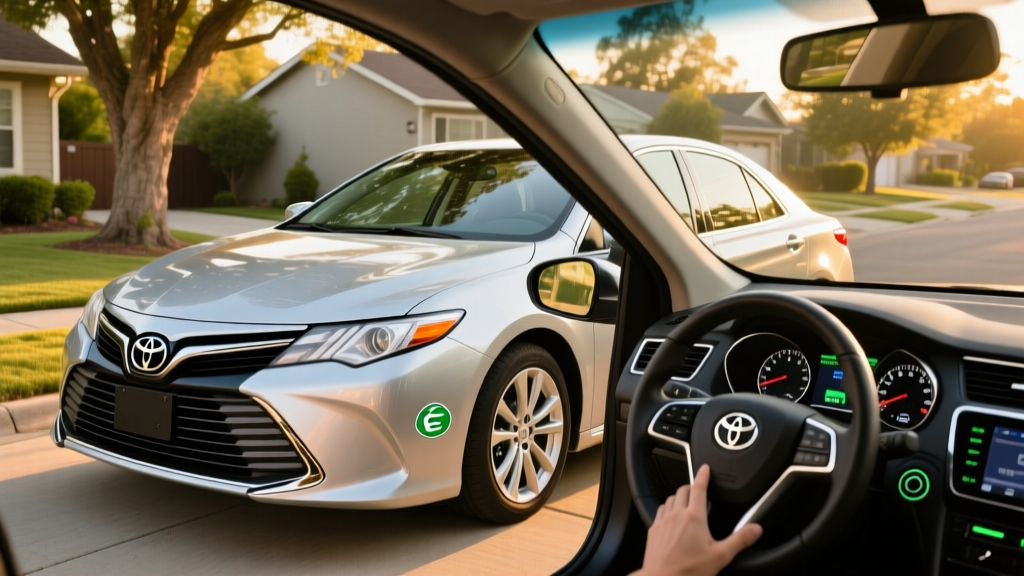
The 2014 Toyota Camry Hybrid LE sits at an interesting crossroads in 2026. As new EVs push past $40,000 and plug-in hybrids grow in complexity, this decade-old conventional hybrid (HEV) continues to deliver 40+ MPG without ever needing a plug. For used-car buyers weighing a fuel-efficient daily driver against newer electrified options, the Camry Hybrid LE demands a hard look at the numbers.
This guide breaks down the 2014 Camry Hybrid LE's EPA fuel economy, real-world MPG expectations, hybrid battery longevity and replacement cost, powertrain specs, and how it compares to PHEVs and full EVs on the used market. If you're searching for a camry le hybrid 2014, here's everything you need to decide.
Fuel Economy: EPA Ratings vs. Real-World MPG
The 2014 Camry Hybrid LE carries an EPA rating of 43 MPG city, 39 MPG highway, and 41 MPG combined, according to fueleconomy.gov. Those figures were class-leading when the car launched and remain competitive against many 2026 hybrids.
| Driving Cycle | EPA MPG | Real-World Expectation |
|---|---|---|
| City | 43 MPG | 42–46 MPG (hybrids excel in stop-and-go) |
| Highway | 39 MPG | 36–40 MPG (less regen benefit at steady speed) |
| Combined | 41 MPG | 38–43 MPG depending on driving mix |
Why Hybrids Often Beat EPA in the City
Unlike gas cars, conventional hybrids recapture kinetic energy through regenerative braking and can shut off the engine entirely at stops. In dense urban traffic with frequent stops, many Camry Hybrid owners report exceeding the 43 MPG city estimate — sometimes reaching 46–48 MPG in warm weather with gentle acceleration.
However, cold weather and short trips reduce efficiency. In sub-freezing temperatures, expect a 10–15% drop in MPG because the engine runs longer to heat the cabin and bring the catalytic converter to operating temperature. A 41 MPG combined car may deliver 35–37 MPG in winter city driving.
HEV vs. PHEV vs. EV: Where Does the Camry Hybrid Fit?
The 2014 Camry Hybrid LE is a conventional hybrid (HEV), not a plug-in hybrid (PHEV) or battery electric vehicle (BEV). Understanding this distinction is critical before you buy.
| Feature | HEV (Camry Hybrid) | PHEV (e.g., Prius Prime) | BEV (e.g., Model 3) |
|---|---|---|---|
| Plug-in Required? | No — gas only | Yes (120V or 240V) | Yes (240V recommended) |
| Electric-Only Range | None (EV assist only) | 25–44 miles (model-dependent) | 250–400+ miles |
| Fuel/Charging Cost | Gas only (~$0.08–0.12/mi) | Electric + gas (~$0.04–0.10/mi) | Electric only (~$0.03–0.06/mi) |
| Home Charging Needed? | No | Recommended | Essential |
| §30D Federal Tax Credit | Not eligible (used or new) | Up to $7,500 (new only, rules apply) | Up to $7,500 (new/used rules vary) |
| Typical Used Price (2026) | $8,000–$13,000 | $15,000–$25,000 | $15,000–$30,000 |
The Camry Hybrid LE's biggest advantage is simplicity: no charging infrastructure required, no plug to manage, no range anxiety in any form. You fuel it like any gas car and let the hybrid system optimize efficiency automatically. For buyers without access to home charging — apartment dwellers, street parkers, those in charging-desert regions — an HEV remains the most practical electrified option.
Who Should Choose This Over a PHEV or EV?
Choose the 2014 Camry Hybrid LE if you lack reliable access to Level 2 home charging, drive a mix of city and highway miles, want a proven low-maintenance powertrain, and prefer the lowest upfront cost. A PHEV or BEV makes more sense only if you can charge at home and want to eliminate or drastically reduce gasoline consumption.
Powertrain Specs: Engine, Motor, and Combined Output
The 2014 Camry Hybrid LE pairs a 2.5-liter Atkinson-cycle four-cylinder engine with an electric motor and a nickel-metal hydride (NiMH) battery pack, all routed through Toyota's eCVT (electronically controlled continuously variable transmission).
| Specification | Value |
|---|---|
| Gas Engine | 2.5L 4-cyl Atkinson cycle, 156 HP / 156 lb-ft torque |
| Electric Motor | 105 kW (141 HP) |
| Net Combined System HP | 200 HP |
| Transmission | eCVT (planetary gearset, no traditional belts) |
| Battery Type | NiMH (nickel-metal hydride) |
| Battery Capacity | ~1.6 kWh (small, engine-recharged) |
| 0–60 MPH | ~7.6 seconds |
| Drivetrain | Front-wheel drive |
The 200 combined horsepower was competitive for a midsize sedan in 2014 and provides adequate acceleration for highway merging and passing. The eCVT is a key reliability advantage — it uses a planetary gearset with no belts, chains, or traditional friction components, which is why Toyota hybrid transmissions rarely require major service.
Note: The ~1.6 kWh battery pack is small by modern standards. It exists to buffer energy from regenerative braking and enable brief electric-only operation at low speeds (typically under 25 MPH for short distances). It is not designed for sustained electric-only driving, and the car cannot be plugged in to charge it.
Hybrid Battery Longevity, Warranty, and Replacement Cost
Battery lifespan is the single most common concern for used hybrid buyers. Here's what the data shows for the 2014 Camry Hybrid LE's NiMH pack.
How Long Do Camry Hybrid Batteries Actually Last?
Toyota's NiMH hybrid batteries have an exceptional track record. Real-world data from fleet operators, taxi services, and high-mileage owners consistently shows these packs lasting 150,000–200,000+ miles before significant degradation. Many 2014 Camry Hybrids still carry their original battery at 120,000–160,000 miles.
NiMH chemistry degrades more gracefully than early lithium-ion packs. Rather than sudden capacity cliff, you'll notice a gradual reduction in electric-assist contribution and a small MPG decline — perhaps 1–3 MPG off the original rating as the battery ages past 150,000 miles.
Battery Replacement Cost in 2026
If the hybrid battery does fail, replacement options include:
- New OEM Toyota battery: $2,500–$3,500 (part) + $500–$800 labor = approximately $3,000–$4,300 total at a dealership
- Refurbished/remanufactured battery: $1,200–$2,000 installed through independent hybrid specialists
- Individual cell/module replacement: $500–$1,000 if only specific modules have failed (requires a qualified hybrid technician to diagnose)
For a used 2014 Camry Hybrid LE valued at $8,000–$13,000 in 2026, a $3,000–$4,000 battery replacement is a significant but not catastrophic expense — especially compared to a transmission or engine replacement on a conventional gas car.
Used Pricing and Tax Credit Eligibility
As of early 2026, the 2014 Toyota Camry Hybrid LE trades in the used market between roughly $8,000 and $13,000, depending on mileage, condition, and region. Clean-title examples under 100,000 miles command the higher end of that range.
Federal Tax Credit: Not Eligible
The 2014 Camry Hybrid LE does not qualify for the IRS §30D federal tax credit. This credit applies only to new plug-in electric vehicles (BEVs and PHEVs) meeting battery-sourcing, MSRP, and buyer-income requirements, or to used BEVs and PHEVs under the §25E used clean vehicle credit (up to $4,000, with strict price and income caps). Conventional hybrids — whether new or used — are excluded from both programs.
Some states offer their own incentives for hybrid purchases, but these vary widely and change frequently. Check your state's energy or DMV website for current programs.
Total Cost of Ownership Advantage
Despite the lack of tax credits, the Camry Hybrid LE's economics remain compelling. At 41 MPG combined with gas at $3.25/gallon (a reasonable 2026 national average), fuel cost runs approximately $0.079 per mile. A comparable 2014 gas-only Camry (25 MPG combined) costs $0.130 per mile. Over 15,000 annual miles, the hybrid saves roughly $765 per year in fuel — or about $3,825 over five years. That saving often exceeds the purchase-price premium over a gas Camry on the used market.
Reliability Record and Maintenance Considerations
The 2014 Camry Hybrid benefits from Toyota's reputation for durability and the inherent simplicity of the hybrid powertrain. Key reliability notes:
- eCVT transmission: The planetary gearset design has virtually no wear components. Failures are extremely rare and typically linked to neglected coolant changes on the transaxle cooling circuit.
- Brake pads: Regenerative braking handles most deceleration, so friction brakes last significantly longer than on gas cars. Original brake pads at 80,000–100,000 miles are common.
- Engine: The 2AR-FXE Atkinson-cycle engine is under-stressed and well-proven. Standard oil changes (5W-30 synthetic, 10,000-mile intervals) keep it running past 200,000 miles.
- Inverter coolant: Toyota recommends replacing the inverter coolant at 100,000 miles. This is a ~$150–$250 service that should not be skipped.
- 12V auxiliary battery: Like any car, the 12V battery may need replacement every 4–6 years. The Camry Hybrid uses a standard group 12V battery, not an exotic part.
NHTSA records show no major systemic recalls specific to the hybrid powertrain for this model year, though buyers should verify all open recalls (airbag-related campaigns affected many Toyota models of this era) have been completed.
Pros and Cons at a Glance
Pros
- 41 MPG combined — still excellent in 2026
- No plug-in charging required
- Proven, durable NiMH battery and eCVT
- Low running costs (fuel + maintenance)
- Spacious midsize sedan interior
- Affordable used pricing ($8K–$13K)
- Strong parts availability and service network
Cons
- No electric-only driving range
- No federal tax credit eligibility
- Dated infotainment (no Apple CarPlay/Android Auto)
- Modest 200 HP — adequate, not sporty
- NiMH battery less energy-dense than modern Li-ion
- Safety tech limited (no auto emergency braking standard)
- Battery replacement cost if it fails ($3K–$4.3K OEM)
Frequently Asked Questions
How many MPG does the 2014 Camry Hybrid LE get?
The EPA rates it at 43 MPG city, 39 MPG highway, and 41 MPG combined. In real-world city driving, many owners report 42–46 MPG. Highway driving typically yields 36–40 MPG. Cold weather and aggressive acceleration reduce these figures by 10–15%.
Can I plug in the 2014 Camry Hybrid to charge it?
No. The 2014 Camry Hybrid LE is a conventional hybrid (HEV), not a plug-in hybrid (PHEV). The small 1.6 kWh NiMH battery recharges itself through regenerative braking and the gas engine. There is no charging port and no plug-in capability.
How far can it drive on electric power alone?
The Camry Hybrid LE can creep at low speeds (under ~25 MPH) on electric power for very short distances — typically a few hundred yards in parking lots or stop-and-go traffic. It cannot sustain highway speeds on electric power alone. If electric-only range matters to you, look at a PHEV like the Toyota Prius Prime or a full BEV.
Is the 2014 Camry Hybrid reliable?
Yes. Toyota's hybrid system is one of the most proven powertrains in the industry. The eCVT has no belts or friction clutches to wear out, regenerative braking extends brake life, and the Atkinson-cycle engine runs under low stress. Many examples have passed 200,000 miles with routine maintenance.
What does a hybrid battery replacement cost?
A new OEM Toyota NiMH battery costs approximately $3,000–$4,300 installed at a dealership. Refurbished batteries from independent hybrid specialists run $1,200–$2,000 installed. Most 2014 Camry Hybrid batteries last 150,000–200,000+ miles before requiring replacement.
Does the 2014 Camry Hybrid qualify for any tax credit?
No. The IRS §30D new clean vehicle credit and §25E used clean vehicle credit apply only to plug-in electric vehicles (BEVs and PHEVs). Conventional hybrids like the Camry Hybrid LE are not eligible for federal tax credits regardless of whether purchased new or used. Check your state for possible local incentives.
Should I buy this or a newer PHEV/EV instead?
If you cannot charge at home, drive a mix of city and highway miles, and want the lowest upfront cost with proven reliability, the 2014 Camry Hybrid LE is an excellent choice. If you have home Level 2 charging access and want to minimize or eliminate gasoline use, a used PHEV (like a 2017+ Prius Prime) or a used BEV (like a 2018+ Chevrolet Bolt) may save more on fuel — but at a higher purchase price and with charging logistics to manage.