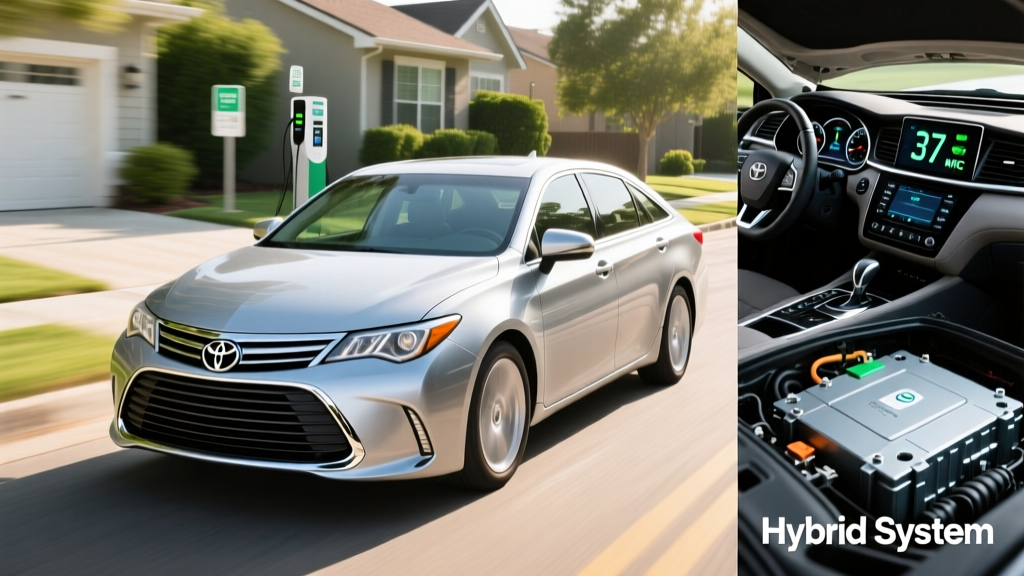
If you are shopping the used full-size sedan market for maximum fuel efficiency without plugging in, the 2014 Toyota Avalon Hybrid remains one of the most compelling options available. A decade after its debut, this fourth-generation Avalon Hybrid continues to deliver mid-size-sedan space with compact-car fuel economy — and it does so with the legendary reliability Toyota's Hybrid Synergy Drive is known for.
This guide covers everything a 2026 buyer needs to know: real-world MPG data, hybrid battery health expectations, replacement costs, and how the 2014 Avalon Hybrid stacks up against modern PHEVs and full EVs.
2014 Avalon Hybrid Fuel Economy: EPA vs Real World
The 2014 Avalon Hybrid carries EPA ratings that still impress more than a decade later. Unlike plug-in hybrids or EVs, this is a conventional hybrid (HEV) — it charges its own battery through regenerative braking and the gasoline engine. You never plug it in.
| Metric | Value |
|---|---|
| City MPG | 40 MPG |
| Highway MPG | 39 MPG |
| Combined MPG | 40 MPG |
| Fuel Tank Capacity | 13.2 gallons |
| Total Range (Estimated) | ~528 miles |
Source: fueleconomy.gov
Powertrain Specs: How the Hybrid System Works
The 2014 Avalon Hybrid pairs Toyota's proven Hybrid Synergy Drive with a 2.5-liter Atkinson-cycle four-cylinder engine. Here is the full powertrain breakdown:
| Specification | Value |
|---|---|
| Engine | 2.5L Atkinson-cycle I4 |
| Engine Horsepower | 156 HP @ 5,700 RPM |
| Electric Motor Output | 105 kW (141 HP) |
| Net Combined System HP | 200 HP |
| Transmission | eCVT (planetary gearset) |
| Drive Type | Front-wheel drive |
| 0–60 MPH | ~8.0 seconds |
| Hybrid Battery | 1.6 kWh Nickel-Metal Hydride (NiMH) |
| Curb Weight | ~3,595 lbs |
The eCVT here is not a traditional belt-driven CVT. It uses a planetary gearset that seamlessly blends engine and motor power with no fixed gear ratios — resulting in smooth, linear acceleration with zero shift shock. This design is one reason Toyota hybrids rarely suffer transmission-related failures.
HEV vs PHEV vs EV: Which Powertrain Fits You?
The 2014 Avalon Hybrid is a conventional hybrid (HEV). Understanding the distinction matters for your daily routine and budget:
| Factor | HEV (Avalon Hybrid) | PHEV (e.g., Prius Prime) | BEV (e.g., Model 3) |
|---|---|---|---|
| Plug-in Required? | No — self-charging | Yes — for EV range | Yes — always |
| Electric-Only Range | ~1 mile (low speed) | 25–44 miles typical | 250–400+ miles |
| Home Charging Needed? | No | Recommended (Level 2) | Essential |
| Fuel Cost per Mile | ~$0.09 | ~$0.04 (EV mode) / $0.08 (hybrid) | ~$0.04–$0.06 |
| Maintenance Level | Low (oil changes, brakes) | Low–Moderate | Minimal |
| Best For | No home charging access | Short commute + road trips | Home charging + mostly local |
Hybrid Battery Longevity and Replacement Cost
Battery anxiety is the single biggest concern for used-hybrid buyers. Here is what the data shows for the 2014 Avalon Hybrid's NiMH pack:
How Long Does the Battery Actually Last?
Toyota's NiMH hybrid batteries have an excellent longevity track record. Based on fleet data and owner reports:
- Typical lifespan: 150,000–200,000 miles before significant capacity loss
- Failure rate before 150K miles: Under 5% for Toyota hybrids of this era
- Common failure trigger: Individual cell imbalance rather than full pack death
Replacement Cost Breakdown
If the battery does fail, here are your options in 2026:
- New OEM Toyota battery: $3,000–$4,000 (parts + dealer labor)
- Refurbished/remanufactured pack: $1,500–$2,500 (installed at a hybrid specialist)
- Individual cell module replacement: $500–$1,200 (if only 1–2 modules are weak — requires a shop with cell-level diagnostic capability)
Before purchasing any used 2014 Avalon Hybrid, request a hybrid battery health check. A Toyota dealer or qualified hybrid shop can read the battery's State of Health (SoH) via OBD-II, showing individual module voltage delta and internal resistance. Look for a module voltage spread of less than 0.2V under load — wider spreads indicate aging cells.
Trim Levels, Pricing, and Tax Credit Status in 2026
The 2014 Avalon Hybrid was offered in three trims. Here are original MSRP figures and current used-market ranges:
| Trim | Original MSRP | 2026 Used Market Range |
|---|---|---|
| XLE Premium | $36,245 | $10,000–$13,500 |
| XLE Touring | $38,095 | $12,000–$15,500 |
| Limited | $41,745 | $14,000–$18,000 |
Tax Credit Eligibility
The 2014 Avalon Hybrid does not qualify for the federal §30D new clean vehicle credit — that credit applies only to new plug-in vehicles (PHEVs and BEVs) meeting current battery-sourcing and MSRP requirements per IRS guidelines.
However, if you purchase this vehicle from a dealer for under $25,000, you may qualify for the Used Clean Vehicle Credit (up to $4,000 or 30% of sale price, whichever is less) — but only if the vehicle is a qualifying plug-in model. Since the Avalon Hybrid is a conventional HEV with no plug-in capability, it does not qualify for any federal EV or hybrid tax credit.
Some states offer separate incentives for efficient used vehicles — check your state's energy office or DMV for current programs.
Reliability, Safety, and Ownership Costs
The 2014 Avalon Hybrid benefits from Toyota's strongest reliability reputation. Key data points:
- Consumer Reports reliability: Rated "Much Better Than Average" for the Avalon Hybrid across powertrain, electrical, and climate systems
- NHTSA safety rating: 5-Star overall crash rating (NHTSA)
- IIHS rating: Good in all crashworthiness tests conducted
- Common maintenance items at 120K+ miles: Brake actuator assembly ($800–$1,200), inverter coolant pump ($300–$500), standard suspension wear
5-Year Estimated Ownership Cost
| Category | Estimated Cost |
|---|---|
| Purchase Price (Avg. Used) | $14,000 |
| Fuel (75,000 mi @ 40 MPG, $3.40/gal) | $6,375 |
| Insurance (5 years) | $5,500–$7,000 |
| Maintenance & Repairs | $2,500–$4,000 |
| Total 5-Year Cost | $28,375–$31,375 |
| Cost Per Mile (All-In) | ~$0.19–$0.21 |
For comparison, a similarly aged gas-only Avalon (28 MPG combined) would cost approximately $1,700 more in fuel over the same period. The hybrid premium pays for itself in fuel savings within 3–4 years of average driving.
Pros and Cons of the 2014 Avalon Hybrid in 2026
Pros
- 40 MPG combined — still class-leading for a full-size sedan
- Spacious cabin with 16 cu ft trunk and generous rear legroom
- Toyota hybrid reliability with proven NiMH longevity
- No plug-in needed — works with any lifestyle
- Smooth, quiet ride quality on par with entry-level luxury sedans
- Strong safety ratings (5-star NHTSA)
Cons
- Dated infotainment — no Apple CarPlay or Android Auto
- eCVT drone under hard acceleration (common to Toyota hybrids of this era)
- Hybrid battery out of factory warranty — pre-purchase inspection essential
- No all-wheel-drive option
- Limited cargo versatility (no folding rear seats on Hybrid trims due to battery placement)
- No federal tax credit eligibility
Who Should Buy the 2014 Avalon Hybrid?
- You want 40 MPG without installing a home charger or changing your fueling habits
- You need a full-size rear seat for family or carpool duty
- You prioritize low cost-per-mile and long-term reliability over the latest tech
- Your budget is $12,000–$18,000 for a dependable daily driver
- You drive 12,000–20,000 miles per year and want to minimize fuel expense
- You have home charging and a commute under 30 miles (a PHEV like the RAV4 Prime or Prius Prime can run mostly on electricity)
- You want the latest infotainment and driver-assistance features
- You qualify for the §30D federal tax credit on a new plug-in vehicle (up to $7,500, subject to IRS income and sourcing rules)
Frequently Asked Questions
How many MPG does the 2014 Avalon Hybrid get?
The EPA rates it at 40 MPG city, 39 MPG highway, and 40 MPG combined. Real-world driving typically yields 38–42 MPG combined, with city-heavy routes often exceeding the EPA figure and sustained highway driving dropping to 35–37 MPG.
Does the 2014 Avalon Hybrid need to be plugged in?
No. This is a conventional hybrid (HEV), not a plug-in hybrid (PHEV). The 1.6 kWh NiMH battery recharges through regenerative braking and the gasoline engine. You fuel it like any other car at a gas station.
How far can the 2014 Avalon Hybrid drive on electric power alone?
Approximately 1 mile at very low speeds (under 25 MPH) on a fully charged hybrid battery. This EV mode is designed for parking-lot maneuvering and stop-and-go traffic assist, not meaningful all-electric commuting. If you want 25+ miles of electric-only range, you need a PHEV.
What does a replacement hybrid battery cost for the 2014 Avalon?
A new OEM battery from Toyota runs $3,000–$4,000 installed. Refurbished packs from hybrid specialists cost $1,500–$2,500. Individual cell module repairs can be as low as $500–$1,200 if only one or two modules have failed. Most 2014 Avalon Hybrids still on the road have not required full battery replacement.
Is the 2014 Avalon Hybrid reliable?
Yes — it is among the most reliable vehicles in its class. Toyota's Hybrid Synergy Drive has no traditional transmission to fail, the eCVT planetary gearset is extremely durable, and the NiMH battery chemistry is proven over millions of vehicles. The main risk for a 2026 buyer is age-related battery degradation, so a pre-purchase hybrid health check is strongly recommended.
Does the 2014 Avalon Hybrid qualify for any tax credits?
No. Federal clean vehicle credits under IRS §30D apply only to plug-in vehicles (PHEVs and BEVs). As a conventional hybrid, the Avalon Hybrid is not eligible for federal or typical state EV incentives. Your fuel savings (roughly $400–$600/year vs. a comparable gas sedan) are the primary financial benefit.