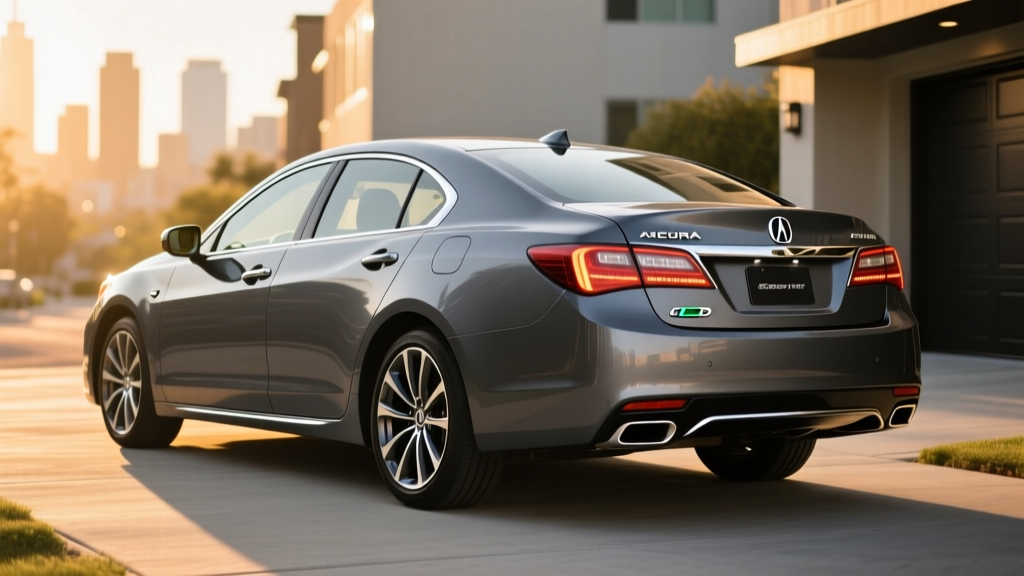
The 2014 Acura RLX Sport Hybrid was a flagship experiment: a 377-horsepower, three-motor luxury sedan that promised V8 performance with four-cylinder fuel economy. Acura's Super Handling All-Wheel Drive (SH-AWD) hybrid system was genuinely innovative, using twin rear electric motors to torque-vector through corners while a front motor assisted the 3.5-liter V6. More than a decade later, this discontinued model remains a curiosity on the used market — and a practical choice for buyers who want luxury hybrid efficiency without plugging in.
This guide breaks down the real-world ownership picture: EPA fuel economy, the Sport Hybrid powertrain, battery longevity, and whether this aging flagship still makes sense in 2026 versus a modern hybrid or EV.
HEV vs PHEV: What the RLX Sport Hybrid Actually Is
The 2014 Acura RLX Sport Hybrid is a conventional hybrid electric vehicle (HEV), not a plug-in hybrid. It cannot be plugged in, has no electric-only driving range, and recharges its small lithium-ion battery entirely through regenerative braking and the gasoline engine.
HEV (RLX Sport Hybrid) vs PHEV vs BEV — Quick Distinction
| Feature | HEV (RLX Sport Hybrid) | PHEV (e.g., Toyota RAV4 Prime) | BEV (e.g., Tesla Model 3) |
|---|---|---|---|
| Plugs in? | No | Yes | Yes |
| Electric-only range | None | 25–42 mi typical | 250–400 mi typical |
| Battery size | ~1.3 kWh (small buffer) | 13–20 kWh | 50–100 kWh |
| Fuel economy | 29 MPG combined | 38–94 MPGe (electric), 35–40 MPG (gas) | No gas — kWh/mi |
| Federal tax credit | No | Up to $7,500 (§30D, if eligible) | Up to $7,500 (§30D, if eligible) |
If you're looking for electric-only commuting, the RLX Sport Hybrid won't deliver that. Its hybrid system is designed to boost performance and improve fuel economy during mixed driving — not to replace gasoline.
Fuel Economy: EPA Ratings and Real-World MPG
The EPA rated the 2014 Acura RLX Sport Hybrid at 28 city / 31 highway / 29 combined MPG. For context, the non-hybrid, front-wheel-drive 2014 RLX (with the same 3.5L V6 but no electric motors) was rated at 20/31/24 MPG. The hybrid's advantage shows most in city driving, where regenerative braking and electric motor assist reduce engine load.
| Driving Cycle | EPA Rating | Real-World Expectation |
|---|---|---|
| City | 28 MPG | 26–30 MPG (hybrids often match or exceed EPA city) |
| Highway | 31 MPG | 28–32 MPG (sustained speeds reduce regen benefit) |
| Combined | 29 MPG | 27–30 MPG depending on driving mix |
Real-world caveat: Hybrid sedans like the RLX Sport Hybrid tend to perform closest to their EPA rating in stop-and-go suburban driving, where regenerative braking recaptures the most energy. On long highway trips at 75+ mph, expect fuel economy closer to 27–28 MPG because the electric motors contribute less at sustained high speeds. In cold weather (below 35°F), expect a 5–10% reduction as the engine runs more frequently to maintain cabin heat and battery temperature.
Owners on fueleconomy.gov's My MPG tracker report averages clustering around 26–29 MPG in mixed driving, consistent with the EPA combined figure. This is not a hypermiler's car — it's a 4,300-pound luxury sedan that returns respectable efficiency for its weight and power output.
Powertrain: 377 HP and Acura's Three-Motor SH-AWD
The RLX Sport Hybrid's powertrain was one of the most complex systems Acura ever put into production. Here's how it works:
| Specification | Value |
|---|---|
| Engine | 3.5L V6 (direct-injected, i-VTEC) |
| Engine output | 310 hp @ 6,500 rpm / 272 lb-ft torque |
| Front electric motor | 47 hp (integrated into 7-speed DCT) |
| Rear electric motors (twin) | 36 hp each (one per rear wheel) |
| Combined system output | 377 hp |
| Drivetrain | SH-AWD (torque-vectoring rear motors, no mechanical rear driveshaft) |
| Transmission | 7-speed dual-clutch automatic (front); direct-drive reduction gear (rear) |
| Hybrid battery | ~1.3 kWh lithium-ion (located behind rear seat) |
| 0–60 mph | ~5.9 seconds |
| Curb weight | ~4,350 lbs |
The rear axle has no mechanical connection to the engine. Instead, the twin rear motors independently drive each wheel, enabling true torque vectoring: the system can send up to 100% of available rear torque to the outside wheel during cornering, which sharpens turn-in and reduces understeer. This is the same concept used in modern EVs with dual-motor AWD, but Acura implemented it a decade ago with a hybrid architecture.
The front electric motor, sandwiched between the engine and the dual-clutch transmission, provides torque fill during gear changes and assists during acceleration. It also acts as a generator during regenerative braking.
Battery Warranty, Reliability, and Replacement Cost
Hybrid Battery Coverage (Original)
Acura warranted the RLX Sport Hybrid's lithium-ion battery pack for 8 years or 80,000 miles (whichever came first). In CARB states (California and states that adopted CARB emissions standards), the hybrid battery warranty extended to 10 years or 150,000 miles.
For a 2014 model, the original factory warranty has expired in all cases as of 2026. Battery condition on used examples depends on mileage, climate exposure, and driving patterns.
Reliability track record: The RLX Sport Hybrid's three-motor system is complex, but Honda/Acura's hybrid components have generally proven durable. The lithium-ion pack is small (~1.3 kWh usable) and operates within a narrow state-of-charge window, which reduces degradation stress compared to larger EV batteries. Most reported issues with the RLX Sport Hybrid relate to the 7-speed dual-clutch transmission (occasional shudder at low speeds) and electronic control modules rather than the hybrid battery itself.
Battery replacement cost: As of 2026, a replacement hybrid battery pack for the RLX Sport Hybrid runs approximately $2,500–$4,500 including labor at an independent hybrid specialist. Dealership pricing can exceed $5,000. Because the pack is small and the system has redundant motors, partial failures (one degraded cell group) can sometimes be repaired rather than requiring a full pack replacement. Independent hybrid shops in major metro areas increasingly offer cell-level reconditioning for Honda/Acura hybrid packs.
The front and rear electric motors are sealed units with no scheduled maintenance. The regenerative braking system significantly extends brake pad life — owners commonly report 60,000–80,000 miles on original brake pads.
Pricing: Used Market and Tax Credit Eligibility
The 2014 Acura RLX Sport Hybrid launched with an MSRP of approximately $65,950 (including destination). It was offered in a single, well-equipped trim with standard features including navigation, leather seats, a 14-speaker Krell audio system, and LED headlights.
As of early 2026, used-market pricing for the RLX Sport Hybrid typically falls between $14,000 and $22,000, depending on mileage (most examples show 80,000–130,000 miles), condition, and regional demand. Low-mileage examples under 60,000 miles command a premium and are relatively rare, as the Sport Hybrid was a low-volume variant.
Federal tax credit: The RLX Sport Hybrid does not qualify for the federal §30D new clean vehicle credit (it was never eligible, as conventional HEVs have not qualified since the early 2010s phase-out of Honda's credit). For used purchases, the IRS used clean vehicle credit (up to $4,000 or 30% of sale price, whichever is less) applies only to PHEVs and BEVs — not conventional hybrids. This means the RLX Sport Hybrid offers no federal tax incentive in 2026.
Some states offer registration discounts or HOV lane access for hybrids, but these vary widely. Check your state's DMV or energy office for current programs.
Who Should Buy This Hybrid vs a Modern PHEV or EV?
Pros
- 377 hp with 29 MPG combined — rare power-efficiency balance for 2014
- SH-AWD torque vectoring provides genuine handling advantage in rain and snow
- No plug-in required — no charging infrastructure dependency
- Strong standard equipment (Krell audio, nav, LED lights)
- Depreciated to $14–22K — luxury sedan value
- Proven Honda/Acura hybrid reliability with small, low-stress battery
Cons
- No electric-only range — 100% gasoline dependent
- 7-speed DCT can feel clunky at low speeds compared to modern hybrids
- Complex three-motor system = higher repair cost if components fail out of warranty
- No federal or state tax incentives
- Rear battery pack reduces trunk space vs non-hybrid RLX
- Infotainment and driver-assist tech are dated by 2026 standards
Decision Framework: Is the RLX Sport Hybrid Right for You?
Choose the 2014 RLX Sport Hybrid if: You want a powerful AWD luxury sedan with better fuel economy than a V6 competitor, you lack home charging access (making a PHEV or EV impractical), and you're comfortable with a 10+ year-old vehicle that may need hybrid system service.
Choose a modern PHEV (e.g., Toyota Crown, Lexus TX 550h+) instead if: You have home Level 2 charging, want 25–40 miles of electric-only commuting, and prefer current safety tech and warranty coverage.
Choose a full EV (e.g., Hyundai Ioniq 6, Tesla Model 3) instead if: You want zero gasoline use, can charge at home, and prioritize the lowest per-mile operating cost with minimal maintenance.
Real-World Ownership Considerations
Maintenance costs: The RLX Sport Hybrid uses a timing chain (not a belt), so there's no scheduled timing belt replacement. Oil changes are standard. The hybrid system adds no routine maintenance items — there's no hybrid-specific fluid to change on a regular interval. However, the dual-clutch transmission fluid should be replaced every 60,000 miles per Acura's severe-service schedule, and this is a specialized job best done at a dealer or experienced independent shop.
Insurance: Expect premiums 10–15% higher than a non-hybrid 2014 RLX, reflecting the higher original MSRP and the cost of hybrid-specific repairs. Get quotes before purchasing.
Tires: The Sport Hybrid's instant electric torque and 4,350-pound curb weight accelerate tire wear. Budget for tire replacement every 35,000–45,000 miles with a quality all-season or grand-touring tire rated for the car's weight and torque output.
Frequently Asked Questions
How many MPG does the 2014 Acura RLX Sport Hybrid get?
The EPA rates it at 28 city / 31 highway / 29 combined MPG. Real-world owners typically see 26–30 MPG combined, with city driving returning the best figures due to regenerative braking.
Does the RLX Sport Hybrid have any electric-only range?
No. It is a conventional hybrid (HEV), not a plug-in hybrid. The small ~1.3 kWh battery assists the engine and powers the rear motors, but the car cannot drive on electricity alone. It never plugs in.
Is the 2014 RLX Sport Hybrid reliable?
Honda/Acura hybrid systems have a strong reliability record. The main concerns for used examples are the dual-clutch transmission (potential shudder, expensive to replace) and aging electronic control modules. The hybrid battery itself has proven durable due to its small size and conservative charge management. Budget $1,500–$2,500 annually for maintenance and potential repairs on a car of this age.
What does a replacement hybrid battery cost?
Expect $2,500–$4,500 at an independent hybrid specialist, or $5,000+ at an Acura dealership. Cell-level reconditioning may be possible for less. The original 8-year/80,000-mile warranty has expired on all 2014 models.
Does the RLX Sport Hybrid qualify for any tax credit?
No. Conventional hybrids do not qualify for the federal §30D credit, and the IRS used clean vehicle credit applies only to PHEVs and BEVs. Check your state for any hybrid-specific incentives, but most have ended.
How does the RLX Sport Hybrid compare to a 2026 hybrid sedan?
Modern hybrids like the Toyota Crown (41 MPG combined) or Honda Accord Hybrid (48 MPG combined) deliver significantly better fuel economy, but neither offers the RLX's 377 hp or torque-vectoring AWD. If efficiency is your priority, a 2026 hybrid wins easily. If you want a used luxury performance sedan that happens to get decent mileage, the RLX Sport Hybrid occupies a unique niche.
Sources: EPA fuel economy data via fueleconomy.gov; IRS used clean vehicle credit rules via irs.gov; NHTSA safety data via nhtsa.gov.