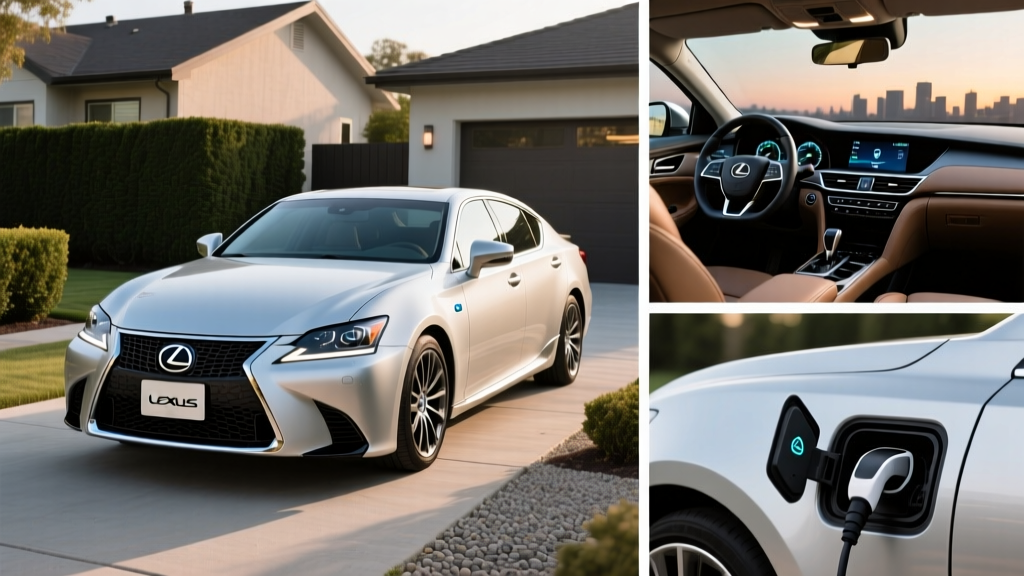
The 2013 Lexus GS 450h hybrid occupies a unique space in the used luxury market: a midsize performance sedan that pairs a 3.5-liter V6 with an electric motor for 338 combined horsepower, while still delivering nearly 30 MPG. More than a decade after its launch, buyers searching for a premium daily driver without range anxiety are rediscovering this rear-wheel-drive hybrid. But with a high-voltage battery now entering its second decade, prospective owners need hard data on fuel economy, battery longevity, replacement costs, and how this conventional hybrid (HEV) stacks up against modern plug-in hybrids and full EVs.
2013 Lexus GS 450h: Key Specifications
| Attribute | Value |
|---|---|
| Powertrain | 3.5L V6 + electric motor (HEV) |
| Combined Horsepower | 338 hp |
| Transmission | CVT (e-CVT) |
| Drivetrain | Rear-wheel drive |
| Hybrid Battery | Nickel-Metal Hydride (NiMH), ~1.9 kWh (not plug-in) |
| EPA Fuel Economy | 29 city / 34 highway / 31 combined MPG |
| 0–60 mph | 5.6 seconds |
| Original MSRP (2013) | ~$59,710 (base) |
| Typical Used Price (2026) | $12,000–$18,000 depending on mileage/condition |
| Hybrid Battery Warranty (original) | 8 years / 100,000 miles (10 yr/150,000 mi in CARB states) |
EPA MPG vs. Real-World Fuel Economy
The EPA rates the 2013 GS 450h at 29 MPG city, 34 MPG highway, and 31 MPG combined. These figures remain competitive for a 4,000-pound luxury sedan, especially one that hits 60 mph in under six seconds.
| Driving Condition | EPA Estimate | Real-World Expectation |
|---|---|---|
| City / Stop-and-Go | 29 MPG | 28–32 MPG (regenerative braking excels here) |
| Highway (70 mph cruise) | 34 MPG | 29–33 MPG (aero drag and weight penalty) |
| Combined | 31 MPG | 28–31 MPG |
| Cold Weather (below 35°F) | N/A | 24–27 MPG (engine runs more for cabin heat) |
Like most Toyota/Lexus hybrids, the GS 450h tends to exceed its EPA city rating in moderate-climate stop-and-go driving, where regenerative braking recaptures energy and the electric motor handles low-speed propulsion. Highway driving tells a different story: at sustained 70–80 mph speeds, the gasoline engine carries most of the load, and the heavy NiMH battery becomes dead weight. Expect a 3–5 MPG drop below the highway sticker in real-world interstate driving.
In cold weather, fuel economy drops further because the V6 must run continuously to provide cabin heat — the GS 450h uses a conventional coolant-based heating system, not an electric heat pump. Owners in northern climates should budget for 24–27 MPG in winter months.
HEV vs. PHEV vs. EV: Where the GS 450h Fits
The 2013 GS 450h is a conventional hybrid electric vehicle (HEV). It does not plug in. It has no meaningful electric-only range. The small ~1.9 kWh NiMH battery charges exclusively through regenerative braking and the gasoline engine. This is fundamentally different from a plug-in hybrid (PHEV) or a battery electric vehicle (BEV).
| Feature | HEV (GS 450h) | PHEV (e.g., 2026 RAV4 Prime) | BEV (e.g., 2026 BMW i5) |
|---|---|---|---|
| Plugs In? | No | Yes (Level 1/2) | Yes (Level 2/DCFC) |
| Electric-Only Range | ~0.5 mi at low speed | 35–42 mi | 250–350 mi |
| Total Range | ~460 mi (14.5-gal tank) | ~520 mi combined | 250–350 mi |
| Battery Size | ~1.9 kWh (NiMH) | 18.1 kWh (Li-ion) | 81–100 kWh (Li-ion) |
| Charging Required? | Never — gas only | Optional (runs as HEV when depleted) | Mandatory |
| Federal Tax Credit (new) | None | Up to $7,500 (§30D) | Up to $7,500 (§30D) |
The GS 450h is ideal for buyers who want luxury-sedan fuel savings without changing their refueling habits. You fill up at any gas station and never think about charging infrastructure. If you have home charging access and a commute under 40 miles, a modern PHEV delivers dramatically lower fuel costs by running on electricity most days. If you want zero tailpipe emissions and have reliable charging, a BEV eliminates gasoline entirely — but at a higher purchase price.
Powertrain Deep Dive: V6 Meets Electric Motor
The GS 450h pairs a 3.5-liter 2GR-FXE V6 engine (286 hp on its own) with a water-cooled permanent-magnet electric motor integrated into the transmission housing. Combined system output is 338 horsepower, routed through a continuously variable transmission (e-CVT) to the rear wheels.
This is not a mild hybrid system. The electric motor provides genuine low-end torque fill, and the car can creep at low speeds (under ~15 mph) on electric power alone for very short distances — roughly half a mile on a fully charged hybrid battery. The transition between electric and gasoline power is seamless; Lexus refined this powertrain across multiple generations, and it shows.
The e-CVT uses a planetary gearset rather than a belt-and-pulley design, making it far more durable than conventional CVTs. There are no fixed gear ratios to "shift" through — the system continuously optimizes the gear ratio for efficiency or power. The result is smooth, linear acceleration with no shift shock, though some drivers find the droning engine note under hard acceleration less engaging than a traditional automatic.
Hybrid Battery Longevity, Warranty, and Replacement Cost
Battery Warranty (Original)
8 years / 100,000 miles (federal)
10 years / 150,000 miles (CARB states: CA, NY, MA, CT, ME, MD, NJ, OR, RI, VT, WA, CO, and others adopting CARB standards)
Current status for a 2013 model: The original hybrid battery warranty has expired for all 2013 GS 450h vehicles as of 2023 at the latest. Any battery failure is now an out-of-pocket expense.
The GS 450h uses a nickel-metal hydride (NiMH) battery pack, the same chemistry Toyota and Lexus relied on for decades before transitioning to lithium-ion in newer hybrids. NiMH batteries are known for predictable, gradual degradation rather than sudden failure. Many Toyota/Lexus hybrids with NiMH packs have exceeded 200,000 miles on the original battery.
However, a 2013 model is now 13 years old. Calendar degradation — the slow loss of capacity that occurs regardless of mileage — is the primary concern. Most owners report the hybrid battery lasting 12–16 years before needing replacement or reconditioning, depending on climate and driving habits. Hot climates (Arizona, Texas, Florida) accelerate degradation because heat is the primary enemy of NiMH chemistry.
Battery replacement costs in 2026:
- New OEM battery (Lexus dealer): $3,500–$5,000 installed
- Remanufactured battery: $1,800–$2,800 installed
- Reconditioned/used battery: $800–$1,500 (higher risk, shorter expected life)
- Individual cell/module replacement: $400–$900 if only a few cells have failed (requires a qualified hybrid technician to diagnose)
Before purchasing a used 2013 GS 450h, request a hybrid battery health check from a Lexus dealer or a hybrid-specialist shop. A scan tool can read the battery's state of health (SoH), individual cell voltages, and internal resistance. If cell voltages are imbalanced by more than 0.3V, the pack is approaching end-of-life.
Reliability and Ownership Costs
The 2013 GS 450h benefits from Lexus's reputation for build quality and the proven reliability of Toyota's hybrid synergy drive system. The 2GR-FXE V6 is a well-understood engine with no major systemic failures, and the e-CVT is essentially bulletproof in normal use. NHTSA crash data and owner surveys consistently place Lexus GS hybrids above average for long-term dependability.
Common issues to watch for on high-mileage examples:
- Hybrid battery degradation (as discussed — the #1 cost risk)
- Brake actuator assembly: The regenerative braking system uses an electrohydraulic brake actuator that can fail around 100,000–130,000 miles. Replacement runs $1,200–$1,800. Symptoms include a firm brake pedal, brake warning lights, or reduced regenerative braking.
- 12V auxiliary battery: Like all hybrids, the GS 450h has a conventional 12V battery that powers electronics and boots the hybrid system. If this dies, the car won't start even if the high-voltage pack is full. Replacement is straightforward (~$200–$300).
- Water pump (electric): The hybrid system uses an electric water pump for the inverter cooling circuit. Failure is uncommon but can trigger a hybrid system warning. ~$400–$600 replacement.
Insurance costs are moderate for the luxury segment. Expect $1,400–$2,200 annually depending on your driving record, location, and coverage level. The GS 450h doesn't carry the insurance surcharge that high-performance EVs like the Tesla Model S Plaid do.
Federal and State Tax Credits
The 2013 Lexus GS 450h does not qualify for any federal tax credit. Under current IRS §30D rules, the federal clean vehicle credit applies only to new plug-in electric vehicles (PHEVs and BEVs) that meet battery sourcing, critical mineral, MSRP cap, and buyer income requirements. Conventional hybrids (HEVs) have never qualified for the §30D credit.
When the GS 450h was new, it did qualify for a now-expired alternative motor vehicle credit (IRC §30B), which offered up to $2,550 based on fuel economy improvement over a baseline vehicle. That credit has been unavailable for over a decade.
Some states offer their own incentives for hybrid vehicles, but most have shifted their programs to favor plug-in vehicles. Check your state's department of revenue or energy office for any current hybrid-specific rebates — but do not count on them.
For used buyers, the used clean vehicle credit (§25E) also excludes conventional hybrids. Only used PHEVs and BEVs priced under $25,000 qualify for the up-to-$4,000 used-EV credit.
Who Should Buy the 2013 GS 450h in 2026?
Pros
- 338 hp with 31 MPG combined — rare performance/efficiency balance
- No plug-in charging required — zero infrastructure dependency
- Lexus build quality, quiet cabin, premium materials
- Proven hybrid powertrain with extensive service history
- Smooth e-CVT with no belt-and-pulley failure risk
- Strong highway passing power from V6 + electric torque fill
Cons
- Hybrid battery warranty expired — $2,000–$5,000 replacement risk
- NiMH chemistry limits electric-only assist to low speeds
- No federal or state tax credit eligibility
- Real-world highway MPG drops to 29–33 at 70+ mph
- Brake actuator replacement can exceed $1,500
- Outdated infotainment by 2026 standards (no wireless CarPlay)
Decision Framework
Choose the 2013 GS 450h if: You want a luxury sedan with strong acceleration and ~30 MPG, you lack access to home or workplace charging, you drive a mix of city and highway miles, and you're comfortable budgeting $2,000–$4,000 for a potential hybrid battery replacement within your ownership period.
Choose a modern PHEV (e.g., Lexus NX 450h+, BMW 330e) if: You can charge at home, your daily commute is under 40 miles, and you want electric-only driving most days with a gasoline backup for road trips. Modern PHEVs also qualify for the §30D credit when purchased new.
Choose a full EV (e.g., BMW i5, Mercedes EQE) if: You have reliable Level 2 home charging, want zero tailpipe emissions, and are ready to accept the higher purchase price and charging-planning requirements of a BEV.
Frequently Asked Questions
How many MPG does the 2013 Lexus GS 450h get?
The EPA rates it at 29 city / 34 highway / 31 combined MPG. In real-world driving, expect 28–32 MPG in city conditions (where regenerative braking helps most) and 29–33 MPG on the highway. Cold weather can drop combined figures to 24–27 MPG.
Does the 2013 GS 450h need to be plugged in?
No. The GS 450h is a conventional hybrid (HEV), not a plug-in hybrid. Its small NiMH battery charges exclusively through regenerative braking and the gasoline engine. You refuel only at gas stations.
How far can the GS 450h drive on electric power alone?
Less than one mile, and only at very low speeds (under ~15 mph). This is normal for conventional hybrids — the electric motor assists the gasoline engine rather than replacing it. If you want meaningful electric-only range, you need a PHEV or BEV.
Is the 2013 GS 450h hybrid reliable?
Yes, with caveats. The powertrain itself (V6, e-CVT, hybrid system) is among the most reliable in the luxury segment. The main risks on a 13-year-old example are hybrid battery degradation ($2,000–$5,000 replacement) and brake actuator failure ($1,200–$1,800). A pre-purchase hybrid health scan is strongly recommended.
What does it cost to replace the hybrid battery?
A new OEM battery from a Lexus dealer runs $3,500–$5,000 installed. Remanufactured batteries cost $1,800–$2,800 installed. Individual cell/module repairs can be as low as $400–$900 if only a few cells have failed. Many owners report 12–16 years of service from the original NiMH pack.
Does the 2013 GS 450h qualify for any tax credit?
No. The federal §30D clean vehicle credit applies only to plug-in vehicles (PHEVs and BEVs). Conventional hybrids are ineligible. The used-EV credit (§25E) also excludes HEVs. Some states may offer minor hybrid incentives — check your state's energy office.
How does the GS 450h compare to the GS 350 (non-hybrid)?
The GS 350 uses the same 3.5L V6 without the hybrid system, producing 306 hp and getting 19 city / 26 highway / 21 combined MPG. The GS 450h delivers 32 more horsepower and roughly 50% better fuel economy for a weight penalty of about 200 pounds. If fuel costs matter, the 450h pays for its price premium within 3–5 years of average driving.
Is the GS 450h a good used car buy in 2026?
At $12,000–$18,000, a well-maintained GS 450h offers genuine luxury and performance at a fraction of its original $60,000 MSRP. The key is verifying hybrid battery health before purchase and budgeting for potential battery replacement. If the battery checks out, it's one of the best value propositions in the used luxury-hybrid market.