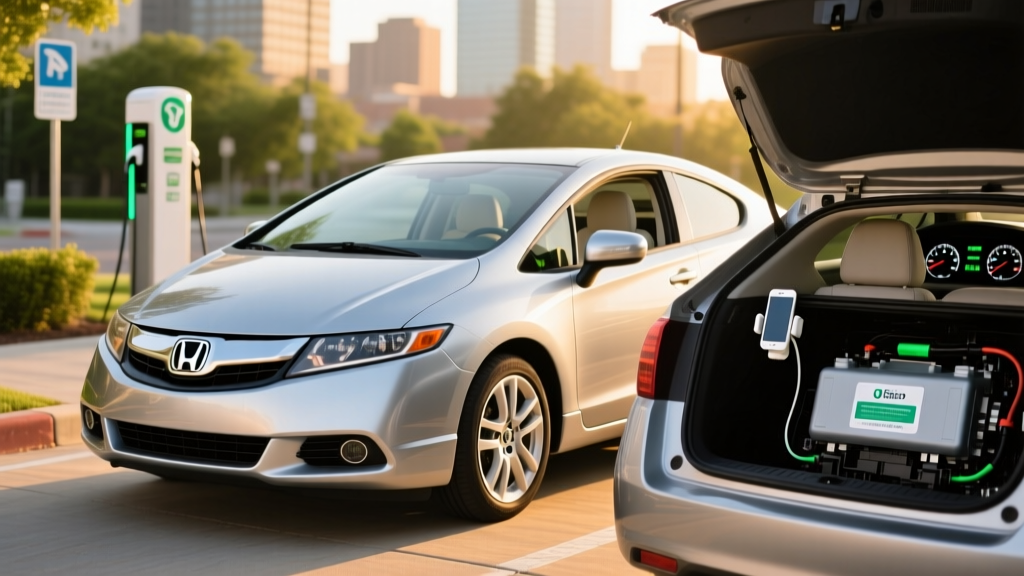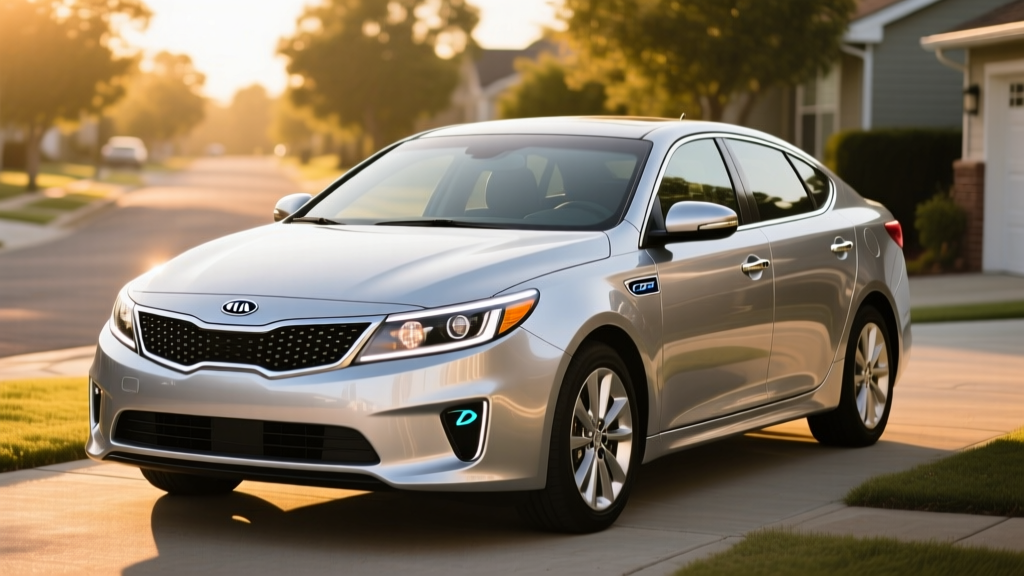
The 2013 Kia Optima Hybrid EX occupies a specific niche in the used-car market: a midsize conventional hybrid (HEV) sedan from a brand that was still proving its electrified credentials. With an EPA rating of 35 MPG combined and a refined 2.4-liter Atkinson-cycle powertrain, it offered a compelling alternative to the Toyota Camry Hybrid and Honda Accord Hybrid of its era. Now well into its second decade on the road, the real question for prospective buyers is whether the battery, drivetrain, and overall reliability hold up — and whether it still makes financial sense versus a modern plug-in hybrid or full battery-electric vehicle.
This guide breaks down every number that matters: EPA and real-world MPG, the hybrid battery's expected lifespan and replacement cost, powertrain specs, and how the 2013 Optima Hybrid EX stacks up against current electrified options in 2026.
2013 Kia Optima Hybrid EX: Powertrain and Key Specifications
The 2013 Optima Hybrid uses a parallel hybrid architecture — not a plug-in system. It pairs a 2.4-liter four-cylinder Atkinson-cycle gasoline engine with a 35 kW (47 hp) electric motor integrated into the six-speed automatic transmission. There is no plug, no electric-only driving mode of meaningful distance, and no DC fast-charging capability. The system recharges its small lithium-polymer battery pack through regenerative braking and engine-driven generation, exactly like a Toyota Prius or Camry Hybrid.
| Specification | Value |
|---|---|
| Powertrain type | Conventional hybrid (HEV), parallel |
| Gas engine | 2.4L 4-cyl Atkinson-cycle, 159 hp |
| Electric motor | 35 kW (47 hp), 151 lb-ft torque |
| Combined system output | 199 hp / 195 lb-ft torque |
| Transmission | 6-speed automatic (no CVT) |
| Hybrid battery | 1.4 kWh lithium-polymer (not plug-in) |
| EPA MPG (city / hwy / combined) | 35 / 39 / 35 (per fueleconomy.gov) |
| Fuel tank capacity | 17.2 gallons |
| Total driving range (est.) | ~602 miles |
| 0–60 mph | ~8.4 seconds |
| Cargo volume | 10.8 cu ft (trunk) |
| Original MSRP (2013) | ~$26,700 (EX trim) |
| Typical used price (2026) | $4,500 – $8,000 depending on mileage/condition |
A notable engineering choice: Kia used a traditional six-speed automatic rather than the planetary e-CVT found in most Toyota hybrids. This gives the Optima Hybrid a more conventional driving feel — gear shifts are perceptible, and highway passing doesn't produce the drone associated with CVTs. The trade-off is slightly less seamless electric-motor integration at low speeds.
Fuel Economy: EPA Ratings vs. Real-World MPG
The EPA rates the 2013 Optima Hybrid EX at 35 MPG city, 39 MPG highway, and 35 MPG combined. The slightly unusual city-lower-than-highway split is a characteristic of this particular hybrid system — the six-speed automatic and smaller battery limit the electric motor's contribution in stop-and-go traffic compared to Toyota's e-CVT system, which excels in city driving.
| Driving Condition | EPA MPG | Real-World Expectation |
|---|---|---|
| City | 35 MPG | 32–37 MPG |
| Highway | 39 MPG | 36–41 MPG |
| Combined | 35 MPG | 33–38 MPG |
| Cold weather (below 35°F) | — | 28–33 MPG |
In real-world ownership, most drivers report combined figures in the 33–38 MPG range. The hybrid system's effectiveness depends heavily on driving style and conditions:
- City driving with frequent stops: Regenerative braking recovers energy, but the system can't sustain EV-only mode for long due to the 1.4 kWh battery. Expect 32–37 MPG.
- Steady-state highway cruising (65–70 mph): The Atkinson-cycle engine is efficient here, and some owners report exceeding 40 MPG on flat terrain.
- Cold weather: As with all hybrids, fuel economy drops 10–15% in winter. The engine runs more frequently to provide cabin heat, and battery efficiency decreases. Expect 28–33 MPG combined in freezing conditions.
- Aggressive driving: Heavy acceleration forces the gasoline engine to do most of the work, dropping economy to the high 20s.
For context, the 2013 Toyota Camry Hybrid LE achieved 41/38/40 MPG EPA — a meaningful advantage in city driving. The 2013 Honda Accord Hybrid (a limited production year) rated 50/45/47 MPG, though it was scarce. The Optima Hybrid traded some efficiency for a more engaging driving experience and Kia's then-competitive feature set.
HEV vs. PHEV vs. EV: Where Does the Optima Hybrid Fit?
Understanding where the 2013 Optima Hybrid sits in the electrification spectrum is critical for buyers cross-shopping used vehicles against newer alternatives.
Conventional Hybrid (HEV) — What the Optima Hybrid Is
A conventional hybrid like the 2013 Optima Hybrid never plugs in. It generates all its electricity from the gasoline engine and regenerative braking. The small 1.4 kWh battery assists the engine during acceleration and enables brief engine-off coasting, but cannot propel the car on electricity alone for more than a fraction of a mile at very low speeds. You fuel it exactly like a gas car — at the pump — and it simply uses less fuel doing so.
Plug-In Hybrid (PHEV) — What the Optima Hybrid Is Not
A plug-in hybrid (such as the later 2017+ Kia Optima PHEV) has a larger battery (typically 8–15 kWh) that charges from a wall outlet or public charger and provides 20–40 miles of electric-only driving before the gas engine engages. Kia did not offer a PHEV Optima in 2013; the PHEV variant arrived for the 2017 model year.
Battery-Electric Vehicle (BEV) — The Fully Electric Option
A BEV has no gasoline engine at all. Modern examples like the Hyundai Ioniq 6 or Tesla Model 3 offer 270–360 miles of EPA range, home charging, and zero tailpipe emissions — but require charging infrastructure and a higher purchase price.
| Factor | HEV (e.g., 2013 Optima Hybrid) | PHEV (e.g., 2024 Toyota Prius Prime) | BEV (e.g., 2025 Hyundai Ioniq 6) |
|---|---|---|---|
| Plugs in? | No | Yes (Level 1/2) | Yes (Level 1/2/DC fast) |
| Electric-only range | N/A (assist only) | 25–44 miles | 270–360 miles |
| Total range | ~600 miles | 400–500+ miles | 270–360 miles |
| Combined efficiency | 35 MPG | 48 MPG + 120 MPGe | 130+ MPGe |
| Used price (2026) | $4,500–$8,000 | $25,000–$35,000 | $22,000–$45,000 |
| Federal tax credit (new) | None | Up to $7,500 (§30D) | Up to $7,500 (§30D) |
| Home charging needed? | No | Recommended | Essential |
Hybrid Battery Reliability, Lifespan, and Replacement Cost
The lithium-polymer hybrid battery in the 2013 Optima Hybrid is a top concern for used buyers — and rightfully so for a vehicle now 13 years old. Here is what the data shows:
Battery Warranty (Original)
Kia warranted the 2013 Optima Hybrid's battery pack for 10 years / 100,000 miles (in CARB states, extended to 10 years / 150,000 miles for emissions-related hybrid components). This warranty has expired for all 2013 models as of the 2023 model year, meaning any battery failure is now an out-of-pocket expense unless an extended warranty was purchased and remains active.
Expected battery lifespan: Kia's lithium-polymer cells in this generation have shown moderate longevity. Based on owner reports and hybrid battery failure databases, most 2013 Optima Hybrid batteries begin showing noticeable capacity loss (reduced electric assist, lower MPG) between 120,000 and 160,000 miles. Complete failure requiring replacement typically occurs between 140,000 and 180,000 miles, though some units have exceeded 200,000 miles with proper thermal management.
Battery replacement cost (2026):
- New OEM battery pack: $2,500 – $3,800 (parts) + $500 – $900 (labor) = $3,000 – $4,700 total
- Refurbished/remanufactured pack: $1,500 – $2,500 installed
- Individual cell/module replacement: $800 – $1,500 if only specific modules have failed (requires a hybrid-savvy technician with cell-balancing equipment)
The cost-benefit math matters here. With a used 2013 Optima Hybrid EX valued at $4,500–$8,000, a $3,500 battery replacement represents 45–75% of the vehicle's value. This makes a pre-purchase hybrid battery health check essential.
Pre-purchase battery inspection tips:
- Use an OBD-II scanner with hybrid-specific capabilities (e.g., Hyundai/Kia GDS tools) to read individual cell voltages and battery state of health (SoH).
- Check for significant variance between cell groups — a spread greater than 0.2V between modules indicates imbalance and impending failure.
- Test-drive in EV mode (if the battery has sufficient charge): the car should creep forward on electric power at low speeds without the engine immediately engaging.
- Review maintenance records for any prior hybrid system service or battery replacement.
Driving Experience, Technology, and Interior
The 2013 Optima Hybrid EX was well-equipped for its era. Standard features on the EX trim included leather seats, heated front seats, dual-zone automatic climate control, a 4.2-inch TFT instrument cluster display (showing hybrid energy flow and economy data), Bluetooth, and a premium audio system. The navigation and Infinity audio upgrade package added an 8-inch touchscreen.
Driving dynamics distinguish the Optima Hybrid from its Japanese rivals. The six-speed automatic and sport-tuned suspension give it a firmer, more responsive feel than the Camry Hybrid's comfort-oriented setup. The electric power steering is weighted appropriately, though it lacks the feedback of the non-hybrid Optima's hydraulic system.
NVH (noise, vibration, harshness) is a weak point. The 2.4-liter engine becomes vocal under hard acceleration, and the transition between electric and gasoline power is less seamless than Toyota's system. Wind and road noise at highway speeds are noticeable, reflecting the 2013 Optima's platform limitations.
From a safety perspective, the 2013 Optima earned a Top Safety Pick rating from the IIHS with Good ratings in moderate overlap front, side, roof strength, and rear crash tests. Standard safety equipment included stability control, antilock brakes, and front/side/curtain airbags. Advanced driver-assistance features (lane-keeping, adaptive cruise, automatic emergency braking) were not available on this generation.
Ownership Costs and Tax Credit Eligibility
The 2013 Kia Optima Hybrid EX does not qualify for any federal tax credit on the used market. The IRS §25E used clean vehicle credit (up to $4,000 or 30% of sale price, whichever is lower) requires the vehicle to be a plug-in electric vehicle (PHEV or BEV) with a battery capacity of at least 7 kWh. The Optima Hybrid's 1.4 kWh battery and conventional HEV architecture make it ineligible.
For new vehicle purchases, conventional hybrids have never qualified for the §30D new clean vehicle credit — only PHEVs and BEVs with sufficient battery capacity and compliant critical-mineral/battery-component sourcing do.
| Cost Category | 5-Year Estimate | Notes |
|---|---|---|
| Purchase price | $6,000 | Mid-range used example, ~100K miles |
| Fuel (gasoline) | $7,200 | 35 MPG combined, $3.35/gal avg |
| Insurance | $5,400 | ~$90/month, varies by state/driver |
| Maintenance | $3,000 | Oil, brakes, tires, fluids |
| Potential battery replacement | $0 – $3,500 | Risk factor — not certain |
| Depreciation | $2,500 | Estimated resale ~$3,500 after 5 yrs |
| Total (without battery failure) | ~$24,100 | |
| Total (with battery replacement) | ~$27,600 |
For comparison, a 2025 Toyota Prius LE (57 MPG combined) purchased new at ~$29,000 would cost roughly $4,400 in fuel over 5 years — saving about $2,800 in fuel alone, though with a much higher purchase price. The used Optima Hybrid's advantage is its low entry cost; its risk is the aging battery.
Who Should Buy the 2013 Kia Optima Hybrid EX?
Choose the 2013 Optima Hybrid EX If:
- You need a low-cost entry into hybrid ownership (under $8,000).
- You drive 10,000–15,000 miles per year and want 35 MPG without plugging in.
- You lack access to home or workplace charging (ruling out PHEVs and BEVs).
- You prefer a conventional driving feel over the CVT drone of a Prius or Camry Hybrid.
- You can verify battery health before purchase and budget for a potential replacement.
Look Elsewhere If:
- You want electric-only commuting — consider a used PHEV (Chevy Volt, Prius Prime) or a BEV with home charging.
- You drive mostly in the city — the Toyota Camry Hybrid or Prius deliver significantly better city MPG.
- You want modern ADAS features (automatic emergency braking, lane-keeping) — these weren't available in 2013.
- The vehicle you're considering exceeds 140,000 miles with no battery replacement history — the financial risk is high.
Frequently Asked Questions
How many MPG does the 2013 Kia Optima Hybrid EX get?
The EPA rates it at 35 MPG city, 39 MPG highway, and 35 MPG combined. Real-world results typically fall between 33 and 38 MPG combined, with cold weather reducing economy to 28–33 MPG.
Does the 2013 Optima Hybrid plug in?
No. The 2013 Optima Hybrid is a conventional hybrid (HEV). It has no plug, no electric-only driving range, and charges its battery solely through regenerative braking and the gasoline engine. Kia did not offer a plug-in Optima until the 2017 model year.
How far can it drive on electric power alone?
Effectively zero miles in practical terms. The 1.4 kWh battery can power very low-speed creep (under 20 mph) for a few hundred feet when fully charged, but the gasoline engine engages almost immediately during normal driving. This is not an electric-only vehicle in any meaningful sense.
Is the 2013 Kia Optima Hybrid reliable?
Mechanically, the 2.4-liter engine and six-speed transmission are proven components with a reasonable reliability record. The primary risk is the hybrid battery pack, which is now 13 years old and may require replacement ($3,000–$4,700) if it hasn't been serviced. Non-hybrid components (suspension, electronics, interior) align with typical Kia durability of this era — acceptable but not class-leading.
What is the hybrid battery replacement cost?
A new OEM battery pack costs $3,000–$4,700 installed. Refurbished packs run $1,500–$2,500 installed. Individual cell module replacement, if available from a hybrid specialist, can cost $800–$1,500. Given the vehicle's used value ($4,500–$8,000), a battery failure is a significant economic event.
Does the 2013 Optima Hybrid qualify for any tax credit?
No. The federal §25E used clean vehicle credit and §30D new clean vehicle credit both require plug-in electric vehicles (PHEVs or BEVs) with minimum battery capacities. The Optima Hybrid's 1.4 kWh conventional hybrid system does not qualify. No state-level hybrid credits currently apply to conventional HEVs either.
How does it compare to a 2013 Toyota Camry Hybrid?
The Camry Hybrid LE rated 41 city / 38 highway / 40 combined — a 5 MPG combined advantage over the Optima Hybrid, primarily in city driving where Toyota's e-CVT excels. The Camry Hybrid also has a longer track record of battery reliability and wider parts availability. The Optima Hybrid counters with sportier handling, a more upscale interior (EX trim), and typically lower used prices.