Quick Verdict: A Proven Early-Generation Hybrid at a Bargain Price
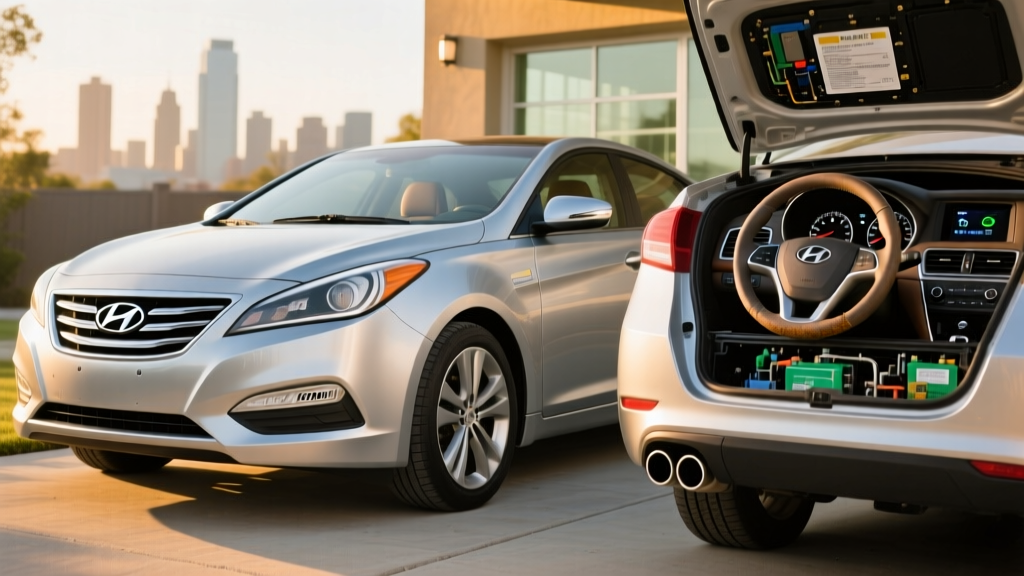
The 2013 Hyundai Sonata Hybrid is a conventional hybrid electric vehicle (HEV) — not a plug-in — that pairs a 2.4-liter four-cylinder engine with an electric motor for an EPA-rated 36 MPG combined. In 2026, well-maintained examples trade between $5,500 and $9,000 on the used market, making it one of the most affordable entry points into hybrid ownership. But with the original hybrid battery now 13 years old, prospective buyers need to understand battery degradation risk, replacement costs, and how this early-generation system stacks up against modern hybrids, PHEVs, and full EVs.
This guide covers everything you need to know before buying a 2013 Sonata Hybrid today: real-world fuel economy, powertrain specs, battery longevity, ownership costs, and where it fits in the 2026 electrified vehicle landscape.
HEV vs. PHEV: What the 2013 Sonata Hybrid Actually Is
Before diving into specs, it's critical to understand what you're buying. The 2013 Sonata Hybrid is a conventional hybrid (HEV). It does not plug in. There was no plug-in hybrid (PHEV) version of the Sonata in 2013 — Hyundai didn't introduce the Sonata PHEV until the 2016 model year.
HEV vs. PHEV vs. BEV at a Glance
| Feature | HEV (2013 Sonata Hybrid) | PHEV (e.g., 2026 Tucson PHEV) | BEV (e.g., 2026 Ioniq 6) |
|---|---|---|---|
| Plugs in? | No | Yes | Yes |
| Electric-only range | ~1 mile at low speed | 30–40 miles | 250–360 miles |
| Total range | ~520 miles | ~400+ miles | 250–360 miles |
| Refueling/Recharging | Gas station only | Gas + Level 1/2 charging | Level 1/2/DC fast charging |
| Federal tax credit (new) | None | Up to $7,500 (§30D) | Up to $7,500 (§30D) |
| Used EV credit (§25E) | Not eligible | Eligible (up to $4,000) | Eligible (up to $4,000) |
The Sonata Hybrid recovers energy through regenerative braking and uses its small battery pack to assist the gas engine and enable brief electric-only motoring at low speeds. You never need to find a charger — you simply fill up at any gas station. This simplicity is both its greatest advantage and its limitation in an era of increasingly capable plug-in options.
Fuel Economy: EPA Ratings and Real-World MPG
The 2013 Sonata Hybrid carries EPA ratings of 36 MPG city / 40 MPG highway / 37 MPG combined, according to fueleconomy.gov. Note: Hyundai revised its official EPA numbers downward slightly for the 2013 model year compared to 2011–2012 after restesting. The figures above reflect the updated EPA data.
| Driving Condition | EPA Rating | Real-World Expectation (2026) |
|---|---|---|
| City | 36 MPG | 34–38 MPG (hybrids often exceed EPA in stop-and-go) |
| Highway | 40 MPG | 36–42 MPG (varies with speed and terrain) |
| Combined | 37 MPG | 34–39 MPG |
| Cold weather (below 32°F) | N/A | 30–34 MPG (engine runs more for cabin heat) |
Real-world note: Conventional hybrids like the Sonata tend to perform best in city driving, where regenerative braking and electric assist do the most work. On the highway at sustained 70+ MPH speeds, the gas engine carries most of the load, and fuel economy converges closer to a efficient non-hybrid sedan. Owner reports on forums and fuel-tracking apps consistently show combined averages in the 34–39 MPG range for vehicles with healthy batteries. A degraded hybrid battery will reduce these numbers by 2–5 MPG as the system relies more heavily on the gas engine.
With a 18.5-gallon fuel tank, total range sits around 680 miles in ideal conditions, though expect 580–650 miles in typical mixed driving.
Powertrain Specs: Engine, Motor, and Combined Output
| Specification | 2013 Hyundai Sonata Hybrid |
|---|---|
| Engine | 2.4L inline-4 (Theta II) Atkinson-cycle |
| Engine horsepower | 169 HP @ 6,000 RPM |
| Engine torque | 156 lb-ft @ 4,500 RPM |
| Electric motor | 35 kW (47 HP) permanent-magnet synchronous |
| Combined system output | 206 HP |
| Transmission | 6-speed automatic (no CVT) |
| Hybrid battery | 1.4 kWh lithium-polymer (270V nominal) |
| 0–60 MPH | ~8.5 seconds |
| Curb weight | 3,496 lbs |
| Drivetrain | Front-wheel drive |
The 2013 Sonata Hybrid uses Hyundai's TMED (Transmission-Mounted Electric Device) architecture, which places the electric motor between the engine and a conventional 6-speed automatic transmission. Unlike Toyota's planetary-gear hybrid system (used in the Camry Hybrid), this setup delivers a more traditional driving feel with actual gear shifts. The trade-off is slightly less seamless electric-to-gas blending, though Hyundai refined this considerably for the 2013 model year over the rougher 2011 launch version.
The 1.4 kWh lithium-polymer battery pack is small by modern standards — a 2026 Tucson PHEV carries 13.8 kWh — but it's sufficient for the HEV role of buffering regenerative energy and providing torque assist during acceleration.
Hybrid Battery Health: Degradation, Warranty, and Replacement Cost
Original Battery Warranty
Coverage: 10 years / 100,000 miles (original owner, CARB states) or 8 years / 80,000 miles (federal emissions states, transferable to second owner).
2026 reality: All 2013 Sonata Hybrids have aged past the 10-year mark. Unless the vehicle has under 100,000 miles AND was originally registered to the current owner in a CARB state, the factory hybrid battery warranty has expired. Budget accordingly.
The lithium-polymer pack in the 2013 Sonata Hybrid was engineered with a conservative state-of-charge window — Hyundai never charges it to true 100% or drains it to 0% — which helps slow degradation. That said, after 13 years of service, most original batteries will have lost 20–35% of their original capacity. Symptoms of a degraded hybrid battery include:
- Noticeably lower fuel economy (3–5 MPG drop from baseline)
- More frequent and louder engine engagement
- Reduced regenerative braking strength
- Dashboard warnings: "Check Hybrid System" or reduced-power limp mode
Battery replacement costs in 2026:
| Option | Cost Range | Notes |
|---|---|---|
| New OEM battery (Hyundai dealer) | $3,200 – $4,500 | Full pack replacement, includes labor |
| Refurbished/reconditioned pack | $1,500 – $2,800 | Aftermarket specialists; quality varies |
| Individual cell/module replacement | $600 – $1,200 | Only viable if 1–2 modules are weak; requires diagnostics |
| Used/salvage yard pack | $400 – $900 | High risk — unknown remaining life |
Is it reliable? The 2013 Sonata Hybrid's powertrain is generally durable, but the Theta II 2.4L engine family has a documented history of connecting-rod bearing failures in some units — a concern that applies to both hybrid and non-hybrid Sonata models of this era. Hyundai issued extended warranty coverage and recalls for certain Theta II engines. Before purchasing, verify the vehicle's recall status on NHTSA.gov using the VIN, and request maintenance records showing regular oil changes (critical for Theta II longevity).
The hybrid-specific components — inverter, electric motor, and battery cooling system — have proven relatively robust. Most high-mileage examples that fail do so from battery degradation (expected and replaceable) rather than catastrophic hybrid system failure.
Tax Credits and Incentives: What Applies in 2026?
Because the 2013 Sonata Hybrid is a conventional HEV (not a PHEV or BEV), it does not qualify for the federal §30D Clean Vehicle Credit, which is reserved for plug-in vehicles. It also does not qualify for the §25E Used Clean Vehicle Credit (up to $4,000), which similarly requires a plug-in powertrain.
At the time of its original sale, the 2013 Sonata Hybrid was not eligible for the federal alternative fuel vehicle credit either (that credit had different eligibility rules and has since expired for this model).
State-level incentives: A handful of states offered hybrid purchase incentives in 2013, but nearly all have expired or transitioned to plug-in-only programs. Check your state's current energy office or DMV website for any residual benefits, but expect none for a used HEV purchase today.
The financial case for the 2013 Sonata Hybrid rests entirely on its low purchase price and strong fuel economy — not on tax incentives.
Ownership Economics: Cost Per Mile in 2026
At a national average gas price of approximately $3.30/gallon (early 2026) and 37 MPG combined, the Sonata Hybrid costs roughly $0.089 per mile in fuel. Compare that to a similarly aged non-hybrid midsize sedan averaging 26 MPG combined at $0.127 per mile — a savings of about $0.038 per mile, or $570 per year at 15,000 miles driven annually.
Over a 3-year ownership horizon at 15,000 miles/year:
| Cost Factor | 2013 Sonata Hybrid | 2013 Sonata 2.4L (Gas) |
|---|---|---|
| Fuel cost (3 years) | ~$4,005 | ~$5,712 |
| Purchase price (avg used) | ~$7,000 | ~$5,500 |
| Insurance (est. annual) | ~$1,100 | ~$1,050 |
| Maintenance (est. 3-yr) | ~$1,200 | ~$1,300 |
| Potential battery replacement | $0–$3,500 | N/A |
| Estimated 3-year total | $13,305 – $16,805 | $13,562 |
The breakeven math hinges on whether you need a hybrid battery replacement. If the existing battery is healthy, the Sonata Hybrid saves money through fuel alone. If you budget $2,000–$3,500 for a battery replacement within your ownership window, the gas-only Sonata may edge ahead on pure cost — though the hybrid still delivers a smoother, quieter driving experience in city traffic.
Who Should Choose the 2013 Sonata Hybrid vs. a Modern PHEV or EV?
Pros
- Low used purchase price ($5,500–$9,000)
- Proven 36–37 MPG combined without plugging in
- No charging infrastructure needed
- Spacious midsize sedan with 16.4 cu-ft trunk
- 6-speed automatic feels natural (no CVT drone)
- Strong highway range (~600+ miles per tank)
Cons
- Hybrid battery likely near end of service life
- No electric-only driving capability
- No federal or state tax credits available
- Theta II engine bearing risk (check recall status)
- Dated infotainment (no Apple CarPlay/Android Auto)
- No DC fast charging (not applicable — HEV)
Choose the 2013 Sonata Hybrid If:
- You want a cheap, fuel-efficient commuter and cannot install a home charger
- You drive 12,000–18,000 miles/year mostly in city/suburban traffic
- You can verify a healthy hybrid battery (via OBD2 SoC test or dealer diagnostic)
- You're comfortable budgeting $1,500–$3,000 for a potential battery replacement
Look at a Used PHEV or BEV Instead If:
- You have home charging access and want electric-only commuting
- You want to claim the §25E used clean vehicle credit (up to $4,000 for qualifying PHEVs/BEVs priced under $25,000)
- You want modern ADAS features (automatic emergency braking, lane-keeping) not available on the 2013 Sonata
- You drive under 40 miles round-trip daily — a PHEV like a used Prius Prime or Clarity PHEV could eliminate gas use on most trips
Frequently Asked Questions
How many MPG does the 2013 Hyundai Sonata Hybrid get?
The EPA rates it at 36 city / 40 highway / 37 combined. Real-world owners typically see 34–39 MPG combined, with city driving yielding the best results thanks to regenerative braking and electric assist.
Does the 2013 Sonata Hybrid plug in?
No. It is a conventional hybrid (HEV) and does not have a charging port. The battery recharges through regenerative braking and the gas engine. Hyundai did not offer a plug-in Sonata until the 2016 model year.
How far can it drive on electric power alone?
Essentially zero meaningful distance. The 1.4 kWh battery can propel the car at very low speeds (under 25 MPH) for roughly half a mile under ideal conditions, but the system is designed for assist, not electric-only driving. This is fundamentally different from a PHEV, which can travel 25–40 miles on electricity.
Is the 2013 Sonata Hybrid reliable?
The hybrid system itself (motor, inverter, transmission) is generally reliable. The main concerns are age-related hybrid battery degradation (expected at 13 years old) and the Theta II 2.4L engine's documented bearing-wear issues. Verify recall completion and maintenance history before purchasing. Check your specific VIN at NHTSA.gov.
What does a replacement hybrid battery cost?
Expect $3,200–$4,500 for a new OEM pack at a Hyundai dealer, or $1,500–$2,800 for a refurbished unit from a reputable hybrid specialist. Individual module replacement can cost $600–$1,200 if only a few cells are weak.
Does it qualify for any tax credit in 2026?
No. The federal §30D new-vehicle credit and §25E used-vehicle credit both require plug-in capability (PHEV or BEV). Conventional hybrids like the Sonata HEV are not eligible for federal purchase incentives. Some states may offer minimal registration-fee reductions for hybrids, but check your local jurisdiction.
How does it compare to a used Toyota Camry Hybrid of the same year?
The 2013 Camry Hybrid (43 city / 39 highway / 41 combined EPA) edges out the Sonata Hybrid in city fuel economy and carries a stronger long-term reliability reputation, particularly regarding engine durability. The Sonata counters with a lower used purchase price, a more conventional driving feel (6-speed auto vs. Toyota's eCVT), and slightly more rear-seat room. Both face similar hybrid battery aging concerns at this point.
Should I buy a 2013 Sonata Hybrid or save for a newer PHEV?
If your budget is firmly under $10,000 and you lack home charging, the Sonata Hybrid is a rational choice — just budget for a potential battery replacement. If you can stretch to $15,000–$20,000 and have a garage or driveway with a 120V outlet, a used PHEV (like a 2017–2019 Prius Prime or 2018–2020 Hyundai Ioniq PHEV) offers 25+ miles of electric commuting, potential §25E tax credit eligibility, and a newer battery with more remaining life.