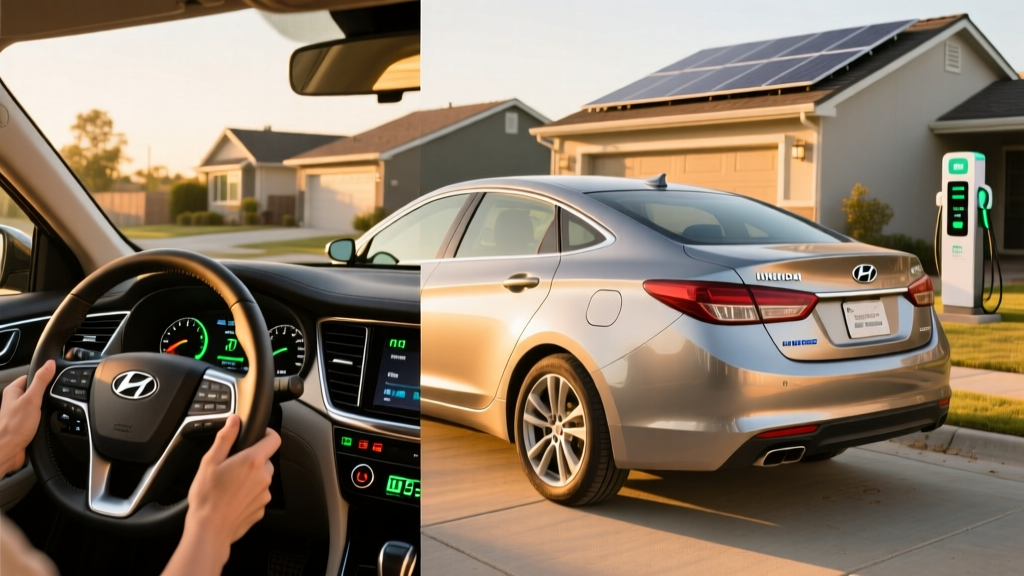
The 2013 Hyundai Sonata Hybrid Limited occupies a specific niche in the used-car market: a midsize conventional hybrid sedan that undercuts Toyota Camry Hybrid pricing while delivering competitive fuel economy. As a pure hybrid electric vehicle (HEV), it requires no plug, no charging routine, and no range-anxiety management — you fuel it like any gas car and let the hybrid system handle the rest.
This guide covers the 2013 Sonata Hybrid Limited specifically — the top trim with leather, navigation, and premium audio — examining its EPA-rated efficiency, real-world MPG behavior, battery longevity, and whether it remains a smart used buy in 2026 versus newer hybrids, plug-in hybrids, or full battery-electric vehicles.
2013 Sonata Hybrid Limited: Powertrain and Key Specs
| Specification | Value |
|---|---|
| Powertrain Type | Conventional Hybrid (HEV) — no plug |
| Engine | 2.4L 4-cylinder Atkinson-cycle (159 hp) |
| Electric Motor | 35 kW (47 hp) permanent-magnet synchronous |
| Combined System Output | 206 hp |
| Transmission | 6-speed automatic |
| Hybrid Battery | 1.43 kWh lithium-polymer (LiPB) |
| EPA MPG (City / Hwy / Combined) | 36 / 40 / 37 |
| Fuel Tank Capacity | 17.2 gallons |
| Total Driving Range | ~636 miles (EPA combined) |
| 0–60 mph | ~8.2 seconds (est.) |
| Original MSRP (Limited trim) | $31,850 (2013) |
| Typical Used Price (2026) | $6,500–$10,000 depending on mileage/condition |
| Battery Warranty (original) | 8 years / 100,000 miles (10 yr/150k mi in CARB states) |
Fuel Economy: EPA Ratings vs. Real-World MPG
The EPA rates the 2013 Sonata Hybrid at 36 MPG city, 40 MPG highway, and 37 MPG combined (fueleconomy.gov). These numbers held up as competitive for the 2013 model year, though the Toyota Camry Hybrid (41/38/40 city/hwy/combined for the LE trim) edged ahead in city driving.
Real-World MPG: What Owners Actually Report
Conventional hybrids like the Sonata Hybrid often exceed EPA city ratings in stop-and-go traffic because regenerative braking recovers energy that a gas car wastes as heat. On the highway, however, hybrids lose some advantage because the electric motor assists less at sustained speeds and aerodynamic drag dominates.
Based on owner-reported data from Fuelly and Edmunds forums, real-world combined MPG for the 2013 Sonata Hybrid clusters around 33–38 MPG combined, with most drivers averaging 34–36 MPG in mixed driving. City-dominant commutes can push toward 38–40 MPG, while sustained highway trips at 75+ mph often drop to 32–35 MPG.
| Driving Scenario | Expected MPG | Notes |
|---|---|---|
| City (stop-and-go) | 36–40 | Regen braking maximizes hybrid advantage |
| Highway (65 mph) | 37–40 | Close to EPA highway rating |
| Highway (75+ mph) | 32–35 | Aero drag reduces hybrid benefit |
| Mixed commute | 34–37 | Most common owner-reported range |
| Cold weather (below 30°F) | 30–34 | Engine runs more for cabin heat; battery less efficient |
Hybrid Battery Health, Warranty, and Replacement Cost
The 2013 Sonata Hybrid uses a 1.43 kWh lithium-polymer (LiPB) battery pack manufactured by LG Chem. This is a small pack by modern standards — for comparison, a 2026 Toyota Prius Prime PHEV carries a 13.6 kWh pack — but the Sonata Hybrid's battery only needs to buffer energy for short electric-assist bursts and regenerative braking capture, not sustain electric-only driving.
Battery Degradation and Lifespan
Hyundai's lithium-polymer chemistry in this generation has proven reasonably durable. Unlike early nickel-metal-hydride (NiMH) packs in first-generation hybrids, LiPB chemistry offers better energy density and more consistent charge/discharge behavior. Most 2013 Sonata Hybrid batteries are holding up adequately at the 10–13 year mark, but capacity loss of 15–25% from new is typical for packs of this age.
Symptoms of a degrading hybrid battery include: reduced fuel economy (the engine runs more often), the battery gauge not reaching full charge, or a dashboard warning light. A complete failure triggers a check-engine light and forces the car to operate on the gasoline engine alone with reduced performance.
Battery Replacement Cost
If the hybrid battery fails outside warranty, replacement options include:
- New OEM battery from Hyundai: $2,500–$3,500 (part + labor at a dealership)
- Remanufactured/refurbished pack: $1,200–$2,000 from aftermarket suppliers
- Individual cell replacement: $500–$900 at a hybrid-specialist shop (requires diagnostic to identify weak cells)
- Used pack from a salvage yard: $400–$800, but carries unknown remaining life
Before purchasing any 2013 Sonata Hybrid, request a hybrid battery health check — many independent shops with hybrid diagnostic tools (like a GDS scanner) can report State of Health (SoH) as a percentage. A pack showing below 70% SoH is a negotiation point or a walk-away.
Driving Experience and the Limited Trim Advantage
The Limited trim was the top-of-the-line Sonata Hybrid for 2013, and it adds meaningful equipment over the base hybrid trim:
- Leather seating surfaces with heated front and rear seats
- Navigation system with 7-inch touchscreen
- Infinity premium audio (9 speakers + subwoofer)
- Hybrid-specific blue-lit instrument cluster with energy-flow display
- Auto-dimming rearview mirror with HomeLink
- Chrome exterior accents and 16-inch alloy wheels
The driving experience is sedan-comfortable rather than engaging. The 206 combined horsepower is adequate for merging and passing, and the 6-speed automatic (a conventional torque-converter unit, not a CVT) gives the Sonata Hybrid a more natural acceleration feel than the Toyota Camry Hybrid's e-CVT, which drones under hard acceleration. The trade-off: the 6-speed automatic is slightly less efficient at keeping the engine in its optimal RPM range, contributing to the Sonata Hybrid's 3–4 MPG deficit versus the Camry Hybrid in city driving.
Who Should Buy the 2013 Sonata Hybrid Limited in 2026?
Choose This Hybrid If…
- You want a comfortable midsize sedan under $10,000 with strong fuel economy
- You lack access to home or workplace charging (no plug required)
- Your commute is city-heavy, where the hybrid system shines
- You prefer a conventional automatic transmission over a CVT
- You want lower upfront cost than a newer PHEV or BEV
Look Elsewhere If…
- You want electric-only driving (consider a PHEV like the Prius Prime)
- You need the latest safety tech — the 2013 model lacks AEB, lane-keep, and blind-spot monitoring as standard
- You drive mostly highway miles at 75+ mph (the hybrid advantage shrinks)
- You want federal tax credits — no credits apply to used HEVs under current IRS §30D rules
- Battery replacement cost ($1,500–$3,500) would strain your budget
Hybrid vs. PHEV vs. Full EV: Which Fits Your Situation?
The 2013 Sonata Hybrid is one option among three electrified vehicle categories. Here's how to decide:
| Factor | HEV (e.g., Sonata Hybrid) | PHEV (e.g., Prius Prime) | BEV (e.g., Tesla Model 3, Ioniq 6) |
|---|---|---|---|
| Plug-in required? | No | Yes (for EV range) | Yes (always) |
| Electric-only range | ~1 mile at low speed | 25–44 miles (2026 models) | 250–360+ miles |
| Fuel/energy cost per mile | ~$0.10–$0.12 | ~$0.04 (EV) / $0.10 (gas) | ~$0.03–$0.05 |
| Home charging needed? | No | Recommended | Essential |
| Federal tax credit (new) | None | Up to $7,500 (§30D) | Up to $7,500 (§30D) |
| Maintenance cost | Low (oil changes, standard) | Low (less engine use in EV mode) | Lowest (no oil, fewer fluids) |
| Best for | No-charging-access buyers | Short-commute + road-trip flexibility | Home-charging access + lowest running cost |
Tax Credits and Incentives for the 2013 Sonata Hybrid
There is no federal tax credit available for purchasing a 2013 Hyundai Sonata Hybrid in 2026 — whether new-old-stock (effectively nonexistent) or used. Here's why:
- Original hybrid credit: The federal hybrid tax credit that applied to the Sonata Hybrid when new (up to $2,400 under the pre-2022 tax code) expired long ago and was never renewed for conventional hybrids.
- IRS §30D Clean Vehicle Credit: Under current IRS §30D rules, only plug-in electric vehicles (PHEVs and BEVs) with at least 7 kWh of battery capacity qualify. The Sonata Hybrid's 1.43 kWh pack does not meet this threshold.
- Used EV credit (§25E): The up-to-$4,000 used clean vehicle credit applies only to used BEVs and PHEVs, not conventional hybrids.
- State incentives: Some states offer rebates for hybrids, but these vary widely and often target new purchases. Check your state's energy or environmental agency for current programs.
Reliability, Safety, and Common Issues
The 2013 Sonata Hybrid carries an average reliability record. Key data points:
- NHTSA Safety Rating: 5 stars overall (NHTSA)
- IIHS Rating: Good in most crash tests; Acceptable in the small-overlap front test (a common weak point for 2011–2014 Sonata models)
- Common issues: Hybrid battery degradation (discussed above), occasional inverter cooling system complaints, and standard Sonata issues like paint quality and brake wear
- Recalls: Check the NHTSA VIN lookup for any open recalls — some 2013 Sonatas were recalled for airbag and brake-light switch issues
The hybrid system itself (inverter, motor, battery management) has proven more reliable than the conventional Sonata's Theta II 2.4L engine, which had widely reported oil-consumption and seizing issues in non-hybrid models. The Atkinson-cycle variant used in the hybrid has a different operating profile and fewer reported failures.
Frequently Asked Questions
How many MPG does the 2013 Hyundai Sonata Hybrid get?
The EPA rates it at 36 city / 40 highway / 37 combined. Real-world mixed driving typically yields 34–37 MPG, with city-dominant commutes sometimes reaching 38–40 MPG and sustained high-speed highway driving dropping to 32–35 MPG.
Can the 2013 Sonata Hybrid drive on electric power only?
Only at very low speeds (under ~25 mph) for distances under one mile. This is a conventional hybrid, not a plug-in hybrid. The electric motor assists the gasoline engine; it cannot sustain highway speeds on electricity alone.
Does the 2013 Sonata Hybrid qualify for any tax credit?
No. Under current IRS rules, conventional hybrids do not qualify for the §30D Clean Vehicle Credit or the §25E used EV credit. Only plug-in hybrids (PHEVs) and battery-electric vehicles (BEVs) are eligible.
Is the hybrid battery reliable, and what does replacement cost?
The 1.43 kWh lithium-polymer pack has held up reasonably well at 10–13 years old, but degradation of 15–25% is typical. A full OEM replacement costs $2,500–$3,500; remanufactured packs run $1,200–$2,000. The original 8-year/100,000-mile warranty has expired on all 2013 models.
How does the 2013 Sonata Hybrid compare to the Toyota Camry Hybrid?
The Camry Hybrid LE (2013) achieves 41 city / 38 highway / 40 combined — roughly 3 MPG better in mixed driving. However, the Sonata Hybrid offers a more conventional 6-speed automatic (no CVT drone), more rear-seat legroom, and often lower used-car pricing. If maximum MPG is your priority, the Camry Hybrid wins. If driving feel and value matter more, the Sonata Hybrid is competitive.
Should I buy this or a newer PHEV or full EV?
If you have home charging access and can spend $20,000–$35,000, a newer PHEV (like a 2022+ Prius Prime) or a used BEV (like a 2020+ Tesla Model 3 or Chevrolet Bolt) will deliver lower per-mile energy costs, modern safety features, and available tax credits. The 2013 Sonata Hybrid makes sense at $6,500–$10,000 for buyers who need a no-plug, budget-friendly, fuel-efficient daily driver.