Quick Verdict: A Proven First-Gen Hybrid Bargain
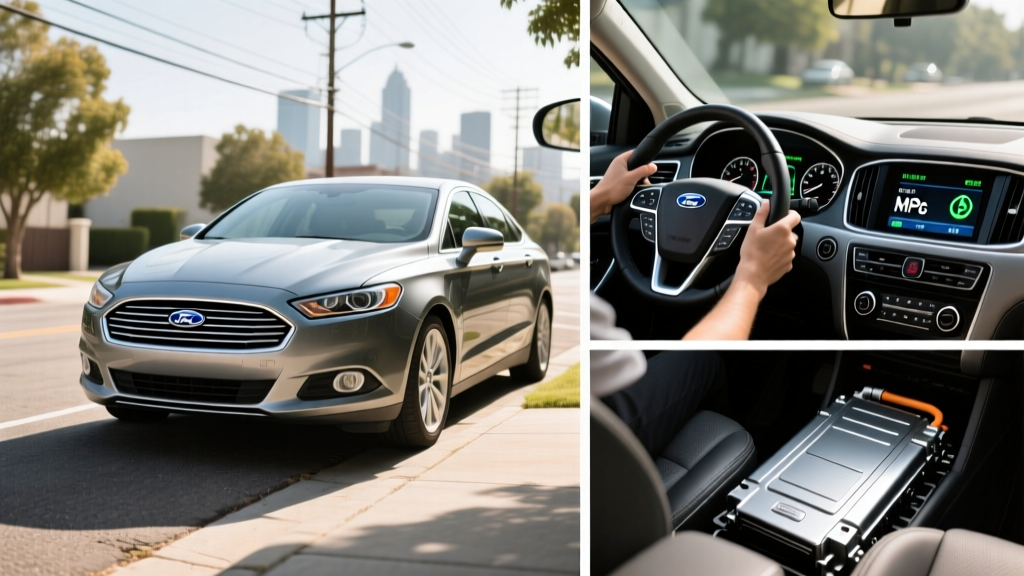
The 2013 Ford Fusion Hybrid was Ford's second-generation hybridized midsize sedan, and it arrived with a bold EPA rating of 47 MPG combined — a number that still holds up against modern hybrids. For used-car shoppers in 2026, a well-maintained Fusion Hybrid represents one of the most cost-efficient ways to cut fuel spending without plugging in, changing driving habits, or worrying about charging infrastructure.
But a 13-year-old hybrid battery raises legitimate questions. Below, we cover the exact fuel economy you can expect, what the battery warranty actually means today, replacement costs, and how this car stacks up against buying a newer hybrid, a PHEV, or a full EV.
| Spec | 2013 Ford Fusion Hybrid |
|---|---|
| Powertrain | 2.0L Atkinson-cycle I4 + electric motor |
| Combined Horsepower | 188 hp (net system) |
| Transmission | eCVT (planetary gearset) |
| EPA MPG (City / Hwy / Combined) | 47 / 47 / 47 |
| Hybrid Battery | 1.4 kWh (usable ~1.0 kWh), Lithium-ion |
| Battery Warranty (Original) | 8 years / 100,000 miles |
| 0–60 mph | ~8.5 seconds |
| Fuel Tank | 13.5 gallons |
| Total Range (EPA est.) | ~634 miles |
| Original MSRP | $27,200 (base) – $32,950 (loaded) |
| 2026 Used Price Range | $5,500 – $10,500 |
Fuel Economy: EPA Numbers vs. Real-World MPG
The 2013 Fusion Hybrid's headline number is 47 MPG across the board — city, highway, and combined — according to fueleconomy.gov. This symmetric rating is typical of conventional hybrids (HEVs), which recapture energy through regenerative braking in stop-and-go driving and rely on the Atkinson-cycle engine for highway cruising.
| Driving Condition | EPA Rating | Real-World Expectation |
|---|---|---|
| City | 47 MPG | 42–48 MPG (often exceeds EPA) |
| Highway (70+ mph) | 47 MPG | 38–43 MPG |
| Combined | 47 MPG | 40–45 MPG typical |
| Cold Weather (below 30°F) | — | 34–39 MPG |
Why real-world varies: Conventional hybrids like this one actually tend to exceed their EPA city rating in warm-weather urban driving because frequent stops maximize regenerative braking. Highway driving at sustained high speeds, however, reduces the hybrid advantage — the electric motor assists less, and aerodynamic drag dominates. Cold weather further cuts efficiency because the gasoline engine runs more often to heat the cabin and maintain battery temperature.
Owners on hybrid-focused forums consistently report lifetime averages between 40 and 44 MPG, which translates to roughly $1,100–$1,300 in annual fuel costs at 15,000 miles/year and $3.20/gallon (2026 national average). That's roughly half the fuel cost of a comparable 25 MPG gas-only midsize sedan.
HEV vs. PHEV vs. EV: Which Powertrain Fits You?
The 2013 Fusion Hybrid is a conventional hybrid (HEV). It does not plug in. It cannot drive on electric power alone for meaningful distances (brief low-speed EV mode only, under ~1 mile). The battery recharges through regenerative braking and the gasoline engine.
Ford also sold the Fusion Energi, a plug-in hybrid (PHEV) variant, starting with the 2013 model year. The Energi featured a larger 7.6 kWh lithium-ion battery, approximately 19 miles of electric-only range, and a plug for Level 1/Level 2 charging. If you're seeing "Fusion Hybrid" listings, verify whether it's the HEV or the Energi PHEV — the badging and charge port (left front fender on Energi) are the giveaways.
| Factor | 2013 Fusion Hybrid (HEV) | 2013 Fusion Energi (PHEV) | Modern EV (e.g., 2025 Bolt) |
|---|---|---|---|
| Plug-in Required? | No | Yes (for EV range) | Yes |
| Electric-Only Range | ~0.5 mi at low speed | ~19 mi (EPA) | 259 mi (EPA) |
| Total Range | ~634 mi | ~588 mi (EV + gas) | 259 mi |
| Fuel Economy (gas mode) | 47 MPG combined | 38 MPG combined (hybrid mode) | N/A (electric) |
| Home Charging Needed? | No | Recommended | Required |
| Best For | No plug access, high-mileage commuters | Short commutes + home charging | Home charging + under 250 mi/day |
Choose the HEV if: You lack reliable access to a plug (apartment, street parking), you drive high annual mileage, and you want maximum simplicity with no behavioral change.
Choose a PHEV if: You can charge at home, your commute is under 20 miles, and you want some electric driving without range anxiety on road trips.
Choose a full EV if: You have home Level 2 charging, your daily driving is under 200 miles, and you want to eliminate gasoline entirely.
Powertrain and Driving Character
The 2013 Fusion Hybrid pairs a 2.0-liter Atkinson-cycle four-cylinder engine (141 hp, 129 lb-ft) with a 118 hp electric motor integrated into the transmission. Net system output is 188 horsepower, routed through Ford's eCVT — not a belt-driven CVT, but a planetary gearset that seamlessly blends engine and motor power. This is the same fundamental architecture Toyota pioneered with its Hybrid Synergy Drive, and it's extremely durable because there are no clutch packs or belts to wear.
The driving experience is competent rather than exciting. The 0–60 mph time of roughly 8.5 seconds is adequate for merging but won't win any stoplight races. The transition between electric-only and engine power is one of the smoothest in its class for that era. Brake feel is the weak point — the regenerative-to-friction brake handoff is noticeable and takes getting used to, a common trait of early-2010s hybrids.
The Fusion Hybrid also features Ford's SmartGauge cluster with EcoGuide, which uses animated coaching displays to encourage efficient driving habits. It's a useful tool for maximizing your real-world MPG.
Battery Health, Warranty Status & Replacement Cost
This is the number-one concern for anyone buying a 13-year-old hybrid. Here's what you need to know.
Original Battery Warranty
Ford covered the 2013 Fusion Hybrid's lithium-ion battery pack for 8 years / 100,000 miles (extended to 10 years / 150,000 miles in California and states adopting CARB emissions standards). As of 2026, every 2013 Fusion Hybrid has aged out of its original federal battery warranty. California-state vehicles with under 150,000 miles may still have had coverage through 2023, but that window has now closed as well.
Degradation reality: The Fusion Hybrid's 1.4 kWh battery pack is small and is never fully charged or fully discharged — the hybrid control system maintains a roughly 40–60% state-of-charge window to prolong cell life. This buffer strategy means most original batteries still function adequately at 150,000+ miles, though with reduced capacity. Symptoms of a degrading hybrid battery include:
- Noticeably reduced fuel economy (dropping below 38 MPG consistently)
- The engine running more frequently, even at low speeds
- Reduced regenerative braking feel
- A battery-state-of-charge display that swings rapidly between high and low
Replacement cost breakdown (2026):
| Option | Cost Range | Notes |
|---|---|---|
| New OEM battery (Ford dealer) | $2,500 – $3,800 (parts + labor) | Full factory pack, best longevity |
| Refurbished/remanufactured pack | $1,200 – $2,200 | Replaced weak cells; 1–3 year warranty typical |
| Used/salvage yard pack | $500 – $1,000 | Highest risk; unknown remaining life |
| Individual cell replacement (specialist) | $600 – $1,200 | Requires a hybrid-savvy shop; not widely available |
The good news: hybrid battery replacement is not the catastrophic expense that EV battery replacement can be. The Fusion Hybrid's small pack keeps costs manageable, and independent hybrid repair shops have become far more common since 2020.
Reliability Record and Known Issues
The 2013 Fusion Hybrid rates as above average for reliability in its model year cohort. The hybrid powertrain itself — the eCVT, motor, and battery — has proven robust, with many examples surpassing 200,000 miles without major hybrid-system repairs. Ford's hybrid system is less complex than a conventional automatic transmission because the eCVT has fewer moving parts.
Common issues to watch for on a used 2013 Fusion Hybrid:
- Inverter coolant pump: Some units fail between 80,000–120,000 miles. Listen for unusual whining from the engine bay and verify coolant levels. Replacement: ~$400–$700.
- 12V auxiliary battery: Like all hybrids, the Fusion has a standard 12V battery that can fail independently of the hybrid pack. If the car won't start or shows electrical gremlins, check this first. ($150–$250 replacement.)
- Brake actuator: The regenerative braking system's actuator has been known to develop issues past 100,000 miles. A firm or pulsating brake pedal at low speeds warrants inspection. ($800–$1,500 replacement.)
- SYNC infotainment system: The MyFord Touch system in 2013 models is slow and prone to freezing. This is an annoyance, not a mechanical concern. Many owners upgrade to an aftermarket head unit.
Before purchasing, request a pre-purchase inspection from a shop familiar with hybrid systems. Ask them to read the hybrid battery's state-of-health (SoH) data through an OBD-II scanner with hybrid-capable software — this gives a percentage readout of remaining battery capacity relative to new.
Pricing, Tax Credits, and Total Cost of Ownership
As of early 2026, a 2013 Ford Fusion Hybrid in good condition (80,000–130,000 miles) trades between $5,500 and $10,500 depending on trim, mileage, and regional market. The SEL and Titanium trims command premiums for leather, upgraded audio, and driver-assist features.
Federal tax credit status: The 2013 Fusion Hybrid does not qualify for the federal §30D new clean vehicle credit — that credit applies only to new vehicle purchases and has specific MSRP, income, and battery-sourcing requirements per IRS guidelines. The used EV credit (§25E, up to $4,000) applies only to used battery-electric vehicles and plug-in hybrids (PHEVs) with at least 4 kWh of battery capacity — the conventional HEV Fusion Hybrid does not qualify. The Fusion Energi PHEV variant could potentially qualify for the used credit if purchased from a dealer for under $25,000 and the buyer meets income limits.
5-year ownership cost estimate (2026):
| Cost Category | 2013 Fusion Hybrid | 2013 Gas-Only Fusion (2.5L) |
|---|---|---|
| Purchase Price (avg.) | $7,500 | $6,000 |
| Fuel (5 yr / 75,000 mi) | $5,800 | $9,600 |
| Insurance (5 yr avg.) | $6,500 | $6,200 |
| Maintenance (5 yr) | $2,800 | $3,200 |
| Potential Battery Replacement | $1,800 (budget reserve) | $0 |
| Total 5-Year Cost | ~$24,400 | ~$25,000 |
The hybrid's fuel savings largely offset its slightly higher purchase price and the battery replacement reserve. The break-even point versus the gas-only model typically arrives around year 3 or 4, assuming 15,000 miles driven annually.
Who Should Buy the 2013 Fusion Hybrid in 2026?
Pros
- 47 MPG EPA — still competitive with 2026 hybrids
- No plug required — fuel anywhere, no infrastructure dependency
- Low purchase price ($5,500–$10,500 used)
- Proven, durable eCVT powertrain
- Comfortable ride, spacious rear seat for the class
- Hybrid battery replacement is affordable ($1,200–$3,800)
Cons
- Original battery warranty has fully expired
- Dated infotainment (MyFord Touch is slow)
- Highway MPG drops noticeably above 70 mph
- Brake feel is grabby during regen-to-friction transition
- No federal tax credit eligibility for the HEV
- 0–60 time of ~8.5s feels sluggish by 2026 standards
Buy this car if: You want a cheap, fuel-efficient daily driver, you don't have home charging access, you commute in mixed city/highway driving, and you're comfortable budgeting $1,500–$2,500 for a potential hybrid battery replacement within your ownership period.
Skip this car if: You want a plug-in experience, you need modern ADAS features (adaptive cruise, lane centering), or you plan to keep the car 7+ years and want warranty coverage. In that case, consider a newer used Toyota Prius, Honda Accord Hybrid, or a certified pre-owned Ford Escape Hybrid with remaining warranty.
Frequently Asked Questions
How many MPG does the 2013 Ford Fusion Hybrid actually get?
The EPA rates it at 47 MPG city, 47 highway, and 47 combined. In real-world driving, expect 42–48 MPG in city conditions, 38–43 MPG on the highway, and 34–39 MPG in cold weather. Most owners average 40–44 MPG over the life of the vehicle.
Does the 2013 Fusion Hybrid need to be plugged in?
No. The Fusion Hybrid is a conventional hybrid (HEV). It charges its own battery through regenerative braking and the gasoline engine. You simply fill it with gasoline like any other car. Only the Fusion Energi (PHEV variant) requires plugging in to access its electric-only range.
How far can the Fusion Hybrid drive on electric power alone?
The conventional HEV can creep at very low speeds (under 25 mph) on electric power for roughly half a mile under ideal conditions. This is not meaningful electric-only driving — it's a brief assist function. If you want genuine electric-only range, look at the Fusion Energi PHEV (19 miles EV) or a full battery-electric vehicle.
What does it cost to replace the hybrid battery?
A new OEM battery from a Ford dealer runs $2,500–$3,800 including labor. Refurbished packs cost $1,200–$2,200 and are widely available from hybrid specialists. Used salvage packs start around $500 but carry significant risk. Many 2013 Fusion Hybrids still run on their original battery at 150,000+ miles thanks to the conservative charge-window management.
Is the 2013 Fusion Hybrid reliable?
Yes, it rates above average for its model year. The eCVT and hybrid system are durable. Key items to watch are the inverter coolant pump, brake actuator, and the 12V auxiliary battery. A pre-purchase inspection with hybrid battery state-of-health readout is strongly recommended.
Does the 2013 Fusion Hybrid qualify for any tax credit?
No. The conventional HEV does not qualify for the federal §30D new vehicle credit or the §25E used clean vehicle credit. Only plug-in vehicles (PHEVs and BEVs) are eligible. The Fusion Energi PHEV variant may qualify for the used EV credit (up to $4,000) if purchased from a licensed dealer for under $25,000 and the buyer meets IRS income caps. Check current rules at irs.gov.
How does it compare to a 2026 hybrid like the Toyota Prius?
The current-generation Toyota Prius achieves 57 MPG combined and comes with a full factory warranty, modern safety tech, and a starting MSRP around $28,000. The 2013 Fusion Hybrid gives up 10 MPG and all modern features, but costs $18,000–$22,000 less to acquire. If budget is the primary constraint, the Fusion Hybrid remains a rational choice. If you can finance newer, the efficiency and safety gap is significant.