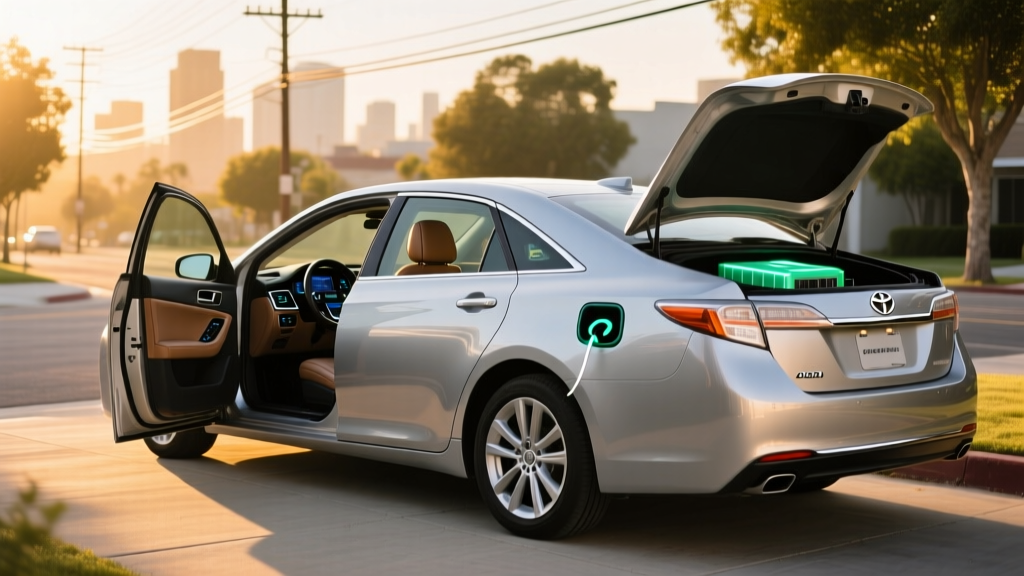
The 2013 Toyota Avalon Hybrid arrived as Toyota's answer to full-size sedan buyers who wanted Buick-sized comfort without Buick-sized fuel bills. More than a decade later, it remains one of the most compelling used hybrid sedans on the market — a five-passenger cruiser that consistently delivers 40 MPG in real-world driving while asking almost nothing of its owner in terms of maintenance or behavioral change.
If you're shopping the used market in 2026 and considering this car, this guide covers every number that matters: real-world MPG versus EPA estimates, the hybrid battery's expected lifespan and replacement cost, powertrain specs, and how this conventional hybrid (HEV) stacks up against modern plug-in hybrids and full EVs.
2013 Avalon Toyota Hybrid: EPA MPG and Real-World Fuel Economy
The EPA rates the 2013 Avalon Hybrid at 40 MPG city / 39 MPG highway / 40 MPG combined. These figures come from fueleconomy.gov and apply to all trims (XLE, XLE Premium, XLE Touring, Limited) since they share the same powertrain.
| Driving Cycle | EPA MPG | Real-World Expectation |
|---|---|---|
| City | 40 MPG | 38–43 MPG (hybrids often beat EPA in stop-and-go) |
| Highway | 39 MPG | 35–38 MPG (sustained 70+ mph reduces regen benefit) |
| Combined | 40 MPG | 37–41 MPG depending on commute mix |
Why Real-World MPG Often Exceeds EPA in the City
Like most Toyota hybrids using the eCVT power-split device, the Avalon Hybrid benefits disproportionately from city driving. Every stop becomes an energy-recovery event: the regenerative braking system captures kinetic energy that a conventional sedan would waste as heat, storing it in the 1.6 kWh nickel-metal hydride (NiMH) battery. Owners who commute in dense urban traffic frequently report 41–43 MPG on city-heavy routes. Highway driving, by contrast, keeps the 2.5-liter Atkinson-cycle four-cylinder engine running more continuously, which is why highway numbers dip slightly below the city rating — unusual for a gas car, but typical for hybrids.
In cold weather (below 30°F), expect a 5–10% fuel economy reduction during short trips. The engine must run longer to warm the cabin and bring the catalytic converter to operating temperature, reducing the electric-only driving intervals that make the hybrid system so efficient.
Powertrain Specs: Engine, Motor, and Combined Output
| Component | Specification |
|---|---|
| Gasoline Engine | 2.5L Atkinson-cycle 4-cylinder (2AR-FXE) |
| Engine Power | 156 hp @ 5,700 rpm / 156 lb-ft @ 4,500 rpm |
| Electric Motor | Permanent-magnet synchronous (integrated into transaxle) |
| Motor Power | 105 kW (141 hp) |
| Net System Output | 200 hp combined |
| Transmission | eCVT (power-split device, not a belt-driven CVT) |
| Drivetrain | Front-wheel drive |
| 0–60 mph | ~8.0 seconds |
| Curb Weight | ~3,595 lbs |
The 200 hp net system output is the figure that matters. Toyota's Hybrid Synergy Drive blends engine and motor output through a planetary gearset — not a traditional transmission — so power delivery is seamless and free of the rubber-band effect associated with belt-driven CVTs. The Avalon Hybrid accelerates with the quiet confidence of a larger sedan, merging onto highways without strain. It's not a sports sedan, but it's never trying to be one.
HEV vs PHEV vs EV: Where the 2013 Avalon Hybrid Fits
The 2013 Avalon Hybrid is a conventional hybrid (HEV). This is a critical distinction for buyers cross-shopping electrified vehicles:
| Feature | HEV (This Avalon) | PHEV (e.g., Prius Prime) | BEV (e.g., Tesla Model 3) |
|---|---|---|---|
| Plug-in Charging Required? | No — refuels with gas only | Yes — for electric-only miles | Yes — sole energy source |
| Electric-Only Range | ~1 mile at low speed | 25–45 miles (modern PHEVs) | 250–370+ miles |
| Home Charger Needed? | No | Recommended (Level 2) | Essential (Level 2) |
| Fuel Type | Gasoline (regular 87 octane) | Gasoline + electricity | Electricity only |
| Federal Tax Credit (New) | None | Up to $7,500 (§30D) | Up to $7,500 (§30D) |
| Best For | No home charging access; long highway commutes | Short commutes + occasional road trips | Home charging + daily driving under 250 mi |
The Avalon Hybrid requires zero infrastructure changes to your life. You fuel it at any gas station, and the hybrid system handles energy management automatically. There is no plug, no charging cable, no app to monitor. For buyers who lack access to home or workplace charging — apartment dwellers, street parkers, or those who simply don't want to think about charging — this remains a significant advantage over PHEVs and BEVs.
Battery Health, Warranty, and Replacement Cost
2013 Avalon Hybrid Battery: Key Facts
- Chemistry: Nickel-Metal Hydride (NiMH)
- Capacity: 1.6 kWh (nominal)
- Original Warranty: 8 years / 100,000 miles (10 years / 150,000 miles in CARB states including CA, NY, MA, and others)
- Current Status (2026): Original warranty expired for most vehicles; Toyota's hybrid battery coverage transferred to subsequent owners if within the time/mileage window
How Long Do Avalon Hybrid Batteries Last?
Toyota's NiMH hybrid batteries have an exceptionally well-documented longevity record. Data from owner forums, taxi fleet usage, and independent surveys consistently show these packs lasting 150,000 to 200,000+ miles before significant capacity loss triggers a check-engine light or noticeable efficiency decline. The 2013 Avalon's battery is now 13 years old in 2026, so many examples will be approaching or past the point where individual cell degradation may require attention.
However, NiMH chemistry degrades more gracefully than early lithium-ion packs. Rather than a sudden cliff, you'll typically see a gradual reduction in electric-assist frequency and a 2–4 MPG drop over time. The battery management system (BMS) in Toyota's Hybrid Synergy Drive is conservative — it never allows the pack to fully charge or fully discharge, keeping the NiMH cells in a longevity-friendly middle zone (roughly 40–80% state of charge).
Battery Replacement Cost
If the hybrid battery does fail, replacement costs in 2026 break down as follows:
- Toyota dealership (new OEM pack): $3,000–$4,500 installed
- Independent hybrid specialist (remanufactured pack): $1,500–$2,800 installed
- DIY individual cell replacement: $500–$900 in parts (advanced owners only; requires high-voltage safety knowledge)
Many independent hybrid shops now offer reconditioned packs with 1–3 year warranties, making replacement far more affordable than the catastrophic-cost scenario some buyers fear. The hybrid inverter and electric motor/transaxle are generally more durable than the battery pack itself and rarely require replacement before 250,000 miles.
Pricing and Tax Credit Eligibility in 2026
The 2013 Avalon Hybrid was originally priced between approximately $35,555 (XLE) and $41,405 (Limited) when new. In the 2026 used market, expect to pay:
| Condition / Mileage | Typical Price Range |
|---|---|
| Excellent, under 80,000 miles | $13,000–$16,500 |
| Good, 80,000–130,000 miles | $9,500–$13,000 |
| Fair, 130,000–180,000 miles | $6,500–$9,500 |
Does the 2013 Avalon Hybrid Qualify for a Tax Credit?
No. The 2013 Avalon Hybrid does not qualify for the federal §30D clean vehicle credit. That credit applies only to plug-in electric vehicles (PHEVs and BEVs) with sufficient battery capacity, and only when purchased new (or as a qualified used EV under the separate §25E used-EV credit, which also requires plug-in capability). Conventional hybrids like this Avalon receive no federal purchase incentive.
Some states historically offered hybrid tax credits or HOV lane access, but most of these programs expired years ago or shifted exclusively to plug-in vehicles. Check your state's current incentive database for any residual benefits, but do not expect credits at the federal level.
Reliability, Safety, and Ownership Costs
The 2013 Avalon Hybrid benefits from one of the strongest reliability reputations in the Toyota lineup. The 2AR-FXE engine is a proven, low-stress Atkinson-cycle design shared with the Camry Hybrid. The eCVT power-split device has no belts, clutches, or friction materials to wear out — it's a set of planetary gears that Toyota has refined since the 1997 Prius. Common maintenance items are limited to standard fluid changes, brake pads (which last exceptionally long thanks to regenerative braking — often 80,000+ miles), and the occasional 12V auxiliary battery replacement.
The 2013 Avalon earned a Top Safety Pick designation from the Insurance Institute for Highway Safety (IIHS) with Good ratings in moderate overlap front, side, roof strength, and head restraint tests. NHTSA awarded it 5 stars overall in crash testing.
Annual Operating Cost Estimate
At 40 MPG combined and $3.25/gallon regular unleaded (2026 national average), driving 12,000 miles per year costs roughly $975 annually in fuel. For comparison, a similarly sized non-hybrid sedan averaging 25 MPG would cost approximately $1,560 per year — a savings of about $585 annually with the Avalon Hybrid.
Pros, Cons, and the Verdict
Pros
- 40 MPG combined EPA — verified by thousands of owner reports
- Spacious, quiet cabin with genuine five-adult seating
- No plug-in charging required — zero lifestyle change
- Proven Toyota Hybrid Synergy Drive reliability (200,000+ mi typical)
- Low brake wear from regenerative braking
- Strong IIHS/NHTSA safety ratings
- Affordable used pricing ($6,500–$16,500 depending on condition)
Cons
- 2013-era infotainment is dated (small screen, no Apple CarPlay/Android Auto)
- NiMH battery is 13 years old — replacement may be needed soon
- No federal or state tax credit eligibility
- Highway MPG (39 EPA) slightly trails city — less efficient on long road trips than some modern hybrids
- eCVT drone under hard acceleration (common to all Toyota hybrids of this era)
- No DC fast charging (not applicable — this is an HEV)
Who Should Buy the 2013 Avalon Toyota Hybrid?
Choose this car if: You want a reliable, fuel-efficient full-size sedan without changing your fueling habits. You lack access to home or workplace charging. Your commute is city-heavy or mixed. You value low operating costs and Toyota's long-term durability record. You're comfortable with older infotainment technology.
Look elsewhere if: You want electric-only driving for short commutes (consider a used Prius Prime or RAV4 Prime PHEV). You want the lowest possible operating cost and have home charging access (a used BEV like the Chevrolet Bolt or Tesla Model 3 will cost less per mile). You need modern infotainment with smartphone integration (look at 2019+ models or newer platforms).
Frequently Asked Questions
How many MPG does the 2013 Avalon Toyota Hybrid get?
The EPA rates it at 40 MPG city / 39 MPG highway / 40 MPG combined. Real-world results typically range from 37–43 MPG depending on driving conditions, with city-heavy commutes often exceeding the EPA city estimate thanks to frequent regenerative braking opportunities.
Does the 2013 Avalon Hybrid need to be plugged in?
No. This is a conventional hybrid (HEV), not a plug-in hybrid (PHEV). It charges its small 1.6 kWh battery entirely through regenerative braking and the gasoline engine. You fuel it exclusively at gas stations with regular 87-octane gasoline.
Is the hybrid battery reliable, and what does replacement cost?
Toyota's NiMH hybrid batteries routinely last 150,000–200,000+ miles. At 13 years old in 2026, some 2013 Avalons may need battery attention. A remanufactured replacement from an independent hybrid specialist costs $1,500–$2,800 installed; a new OEM pack from a Toyota dealer runs $3,000–$4,500.
Does the 2013 Avalon Hybrid qualify for any tax credit?
No. Federal §30D tax credits apply only to plug-in electric vehicles (PHEVs and BEVs). Conventional hybrids like this Avalon receive no federal purchase incentive, new or used. Some state-level incentives historically covered hybrids, but most have expired or shifted to plug-in vehicles.
Hybrid vs PHEV vs EV — which should I choose?
If you cannot charge at home or work, a conventional hybrid like the Avalon is the practical choice — it requires zero infrastructure. If you have home charging and a short commute (under 40 miles), a PHEV lets you drive electrically most days while keeping a gas engine for road trips. If you have reliable home charging and drive under 250 miles daily, a full BEV offers the lowest per-mile operating cost and minimal maintenance.
What is the 0–60 mph time for the 2013 Avalon Hybrid?
Approximately 8.0 seconds. The 200 hp combined system output provides adequate acceleration for highway merging and passing, though it prioritizes smoothness and efficiency over performance.