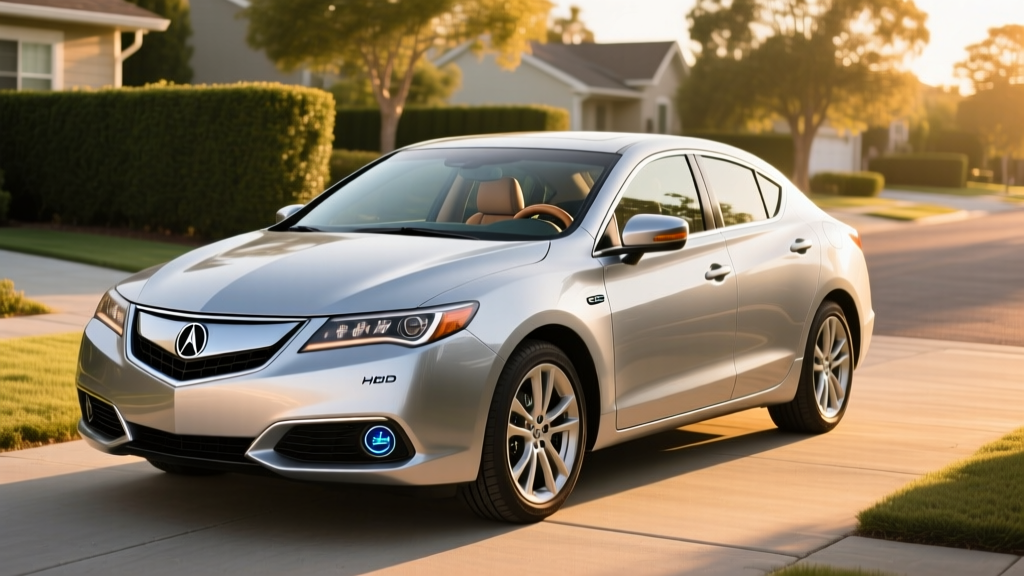
The 2013 Acura ILX Hybrid occupies a narrow slice of automotive history: a compact luxury sedan that paired Honda's Integrated Motor Assist (IMA) mild-hybrid system with premium badge appeal. Acura dropped the hybrid variant after just one model year, making the 2013 ILX Hybrid a one-year-only proposition on the used market. For buyers considering this car in 2026 — now 13 years old — the critical questions center on real-world fuel economy, IMA battery longevity, and whether the modest hybrid premium over the gas-only ILX still makes sense.
This guide covers every number that matters: EPA city/highway/combined MPG, powertrain output, battery warranty and replacement cost, and a clear-eyed look at who should (and shouldn't) buy this car today.
2013 ILX Hybrid Fuel Economy: EPA and Real-World MPG
The headline reason the ILX Hybrid existed was fuel efficiency. Here is the official EPA data from fueleconomy.gov:
| Metric | Value |
|---|---|
| City MPG | 39 |
| Highway MPG | 38 |
| Combined MPG | 38 |
| Fuel Type | Regular Unleaded (87 octane) |
| Fuel Tank Capacity | 13.2 gallons |
| Total Driving Range (EPA est.) | ~502 miles |
For context, the non-hybrid 2013 ILX with the 2.0L four-cylinder and 5-speed automatic was rated at 24 city / 35 highway / 28 combined. The hybrid's 10-MPG combined advantage was substantial — roughly a 36% improvement in fuel economy.
Real-World MPG vs. EPA Sticker
The IMA system excels in stop-and-go city driving, where the electric motor assists during acceleration and regenerative braking recaptures energy. In real-world use, owners typically report:
- City driving: 36–42 MPG (many drivers match or slightly exceed the 39 city EPA figure in moderate climates)
- Highway cruising (70+ mph): 34–38 MPG (aerodynamic drag reduces the hybrid advantage at sustained speed)
- Cold weather (below 30°F): Expect a 5–10% drop, roughly 33–36 combined, as the engine runs more frequently for cabin heat and the battery's charge acceptance drops
The ILX Hybrid's real-world combined figure of 35–40 MPG remains competitive with many modern non-plug-in compact hybrids, though it falls short of the Toyota Prius (52+ combined) and the current-generation Honda Civic Hybrid (49 combined).
Powertrain: How the IMA Hybrid System Works
The 2013 ILX Hybrid uses Honda's Integrated Motor Assist (IMA) — a mild-hybrid architecture, not a full hybrid like the Toyota Prius system. This distinction is critical for buyers to understand.
| Component | Specification |
|---|---|
| Engine | 1.5L inline-4, i-VTEC |
| Engine Output | 90 hp @ 5,500 rpm / 97 lb-ft @ 1,000–3,000 rpm |
| Electric Motor | 20 hp (15 kW) / 35 lb-ft |
| Combined Net Output | 111 hp @ 5,500 rpm / 125 lb-ft @ 1,000–2,500 rpm |
| Transmission | Continuously Variable Transmission (CVT) |
| Drivetrain | Front-Wheel Drive |
| 0–60 mph (est.) | ~10.1 seconds |
The IMA system places a thin electric motor between the engine and transmission. Unlike a full hybrid (such as Toyota's Hybrid Synergy Drive), the IMA motor cannot propel the car on electric power alone at meaningful speeds. The engine must be running whenever the car is moving, except during brief idle-stop events at traffic lights. The motor's primary role is torque assist during acceleration and energy regeneration during braking.
The 2013 ILX Hybrid is a conventional hybrid electric vehicle (HEV). It has no plug, no electric-only driving mode, and a very small battery pack (~0.5 kWh nominal). You never plug it in — it generates electricity solely through regenerative braking and the engine. This is fundamentally different from a plug-in hybrid (PHEV) like the Toyota Prius Prime, which offers 40+ miles of electric-only range and a larger battery you charge from a wall outlet. The ILX Hybrid cannot travel any distance on electricity alone.
HEV vs. PHEV vs. EV: Which Should You Choose?
If you're cross-shopping the used 2013 ILX Hybrid, you're likely also considering other electrified options. Here is how the three categories compare for a typical driver in 2026:
| Factor | HEV (ILX Hybrid) | PHEV (e.g., Prius Prime) | BEV (e.g., Tesla Model 3) |
|---|---|---|---|
| Plug-in Required? | No | Yes (for EV range) | Yes (always) |
| Electric-Only Range | 0 miles | 25–45 miles | 250–370 miles |
| Fuel Cost (per mile) | ~$0.10 | ~$0.04 (EV mode) / $0.10 (gas) | ~$0.04 |
| Home Charging Needed? | No | Recommended | Essential |
| Maintenance | Oil changes, standard | Oil changes, less brake wear | Minimal — no oil, fewer fluids |
| Federal Tax Credit (§30D) | None | Up to $7,500 (new only) | Up to $7,500 (new); up to $4,000 (used) |
| Best For | No charging access, simple ownership | Short commute + road trips | Home charging + daily driving |
- Choose the 2013 ILX Hybrid if: You lack access to home or workplace charging, want a low-maintenance hybrid with premium badging, drive mostly in the city, and want a sub-$10,000 used car with strong fuel economy.
- Choose a PHEV if: You can install a Level 2 charger at home, your daily commute is under 40 miles round-trip, and you want to eliminate most gasoline use without range anxiety on longer trips.
- Choose a full EV (BEV) if: You have reliable home charging, want the lowest per-mile fuel and maintenance costs, and are ready to plan around DC fast charging on road trips.
Battery Lifespan, Warranty, and Replacement Cost
For any 13-year-old hybrid, battery condition is the single most important variable. The ILX Hybrid's IMA battery is a nickel-metal hydride (NiMH) pack — not the lithium-ion chemistry found in modern EVs and PHEVs.
| Specification | Value |
|---|---|
| Chemistry | Nickel-Metal Hydride (NiMH) |
| Nominal Capacity | ~0.5 kWh |
| Voltage | ~144V nominal |
| Original Warranty | 8 years / 80,000 miles (10 yr / 150,000 mi in CARB states) |
| Warranty Status in 2026 | Expired (all original warranties ended by 2023 at latest) |
As of 2026, an IMA battery replacement for the 2013 ILX Hybrid costs approximately:
- New OEM battery (dealer): $2,000–$3,000 (parts + labor)
- Remanufactured aftermarket battery: $1,200–$2,000 (installed)
- Individual cell reconditioning (specialist shops): $800–$1,400
Because the original hybrid warranty has expired on all 2013 ILX Hybrids, replacement is entirely out-of-pocket. Before purchasing, request an IMA battery health check from a qualified Honda/Acura technician — they can read the battery's State of Health (SoH) via the OBD-II port.
IMA Battery Longevity — What to Expect
Honda's NiMH IMA packs have a mixed reliability record. Many original batteries lasted 100,000–150,000 miles before degradation triggered an IMA warning light. Some failed earlier, particularly in hot climates where sustained high temperatures accelerated cell degradation. Key factors affecting remaining battery life in 2026:
- Mileage: Packs with 120,000+ miles are in the risk zone — budget for replacement
- Climate: Cars from the Southwest (AZ, TX, NV) saw higher failure rates due to heat
- Usage pattern: Frequent short trips with many start-stop cycles actually keep the IMA battery exercised and can extend life; long-term sitting is harmful
- Warning signs: Reduced assist, lower MPG than expected, IMA dashboard light, or the battery gauge showing fewer bars than normal
Does the 2013 ILX Hybrid Qualify for Any Tax Credit?
No. The 2013 Acura ILX Hybrid does not qualify for any federal tax credit — neither the new-vehicle §30D Clean Vehicle Credit (up to $7,500) nor the used-vehicle credit (up to $4,000 under §25E). The IRS used-EV credit applies only to battery electric vehicles (BEVs) and plug-in hybrids (PHEVs) with a minimum battery capacity of 7 kWh. The ILX Hybrid's ~0.5 kWh NiMH pack falls far short of this threshold, and conventional hybrids (HEVs) are categorically excluded from federal purchase incentives.
Some states previously offered hybrid rebates, but nearly all current state-level programs (as of 2026) are limited to PHEVs and BEVs. Check your state's energy or DMV website for any remaining conventional-hybrid incentives, but do not count on them.
Used Market Pricing and Ownership Costs in 2026
The 2013 ILX Hybrid was originally priced at approximately $29,995 MSRP (including destination). Thirteen years later, used values reflect typical compact-luxury depreciation:
| Condition / Mileage | Approximate Price |
|---|---|
| Excellent (under 80,000 mi, IMA healthy) | $9,000–$11,500 |
| Good (80,000–120,000 mi, minor wear) | $7,000–$9,000 |
| Fair (120,000+ mi, IMA may need service) | $5,000–$7,000 |
Five-Year Ownership Cost Snapshot
Assuming a purchase price of $8,000, 12,000 miles/year, and national average gas prices of ~$3.30/gallon:
- Annual fuel cost: ~$1,040 (at 38 MPG combined)
- Annual insurance (est.): ~$1,100–$1,400 (varies heavily by driver/location)
- Maintenance: ~$400–$600/year (oil, filters, brakes — CVT fluid change recommended every 30,000 mi)
- Budget for IMA battery: Set aside $1,500–$2,500 as a contingency if the pack hasn't been replaced
Total estimated 5-year running cost (excluding purchase price): $13,000–$18,000, with the wide range driven by IMA battery condition and insurance variability.
Pros and Cons of the 2013 ILX Hybrid Today
- 38 MPG combined — strong for a luxury-badged sedan
- No plug-in required — works with any driving/living situation
- Acura interior quality: leather, quiet cabin, premium audio
- Low annual fuel cost (~$1,040/year at 12k mi)
- Regular unleaded fuel — no premium required
- Honda/Acura parts availability remains strong
- Modest 111 hp — leisurely acceleration (10+ sec 0–60)
- IMA system provides no electric-only driving
- Hybrid battery warranty expired — replacement is out-of-pocket
- One-year-only model — limited used inventory
- Small 13.2-gal fuel tank means more frequent fill-ups
- No federal or state tax credits available
- CVT drone under hard acceleration
Frequently Asked Questions
How many MPG does the 2013 Acura ILX Hybrid get?
The EPA rates the 2013 ILX Hybrid at 39 city / 38 highway / 38 combined MPG. In real-world driving, expect 35–42 MPG combined depending on conditions. City driving yields the best results thanks to regenerative braking and idle-stop; sustained highway speeds above 70 mph reduce efficiency to the mid-30s.
Can the 2013 ILX Hybrid drive on electric power only?
No. The ILX Hybrid uses Honda's IMA mild-hybrid system, which cannot propel the vehicle on electric power alone at any meaningful speed. The gasoline engine must run whenever the car is moving. If you want electric-only driving, you need a PHEV (plug-in hybrid) or a BEV (battery electric vehicle).
Is the 2013 ILX Hybrid reliable?
The powertrain — the 1.5L engine and CVT — is generally durable with proper maintenance. The primary reliability concern is the IMA NiMH battery pack, which has a known failure pattern after 100,000–150,000 miles or 10+ years of age. Since all 2013 ILX Hybrids are now 13 years old with expired warranties, battery replacement cost ($1,200–$3,000) is a real ownership risk. Pre-purchase battery diagnostics are essential.
Does the 2013 ILX Hybrid qualify for any tax credit?
No. The ILX Hybrid is a conventional hybrid (HEV), not a plug-in vehicle. Federal tax credits under §30D (new vehicles) and §25E (used vehicles) require plug-in capability and minimum battery capacity thresholds that the ILX Hybrid does not meet. State incentives for conventional hybrids have also largely disappeared as of 2026.
What is the difference between the ILX Hybrid and the gas-only ILX?
The gas-only 2013 ILX came with either a 2.0L four-cylinder (150 hp) or a 2.4L four-cylinder (201 hp). The hybrid traded peak power for fuel economy: 111 hp combined vs. 150+ hp, but 38 MPG combined vs. 28 MPG combined. The hybrid also came with a CVT only, while the gas model offered a 5-speed automatic or 6-speed manual. If acceleration matters to you, the gas ILX is noticeably quicker; if fuel cost is the priority, the hybrid wins clearly.
Should I buy the 2013 ILX Hybrid or a newer used hybrid?
If your budget is under $10,000, the ILX Hybrid offers strong MPG and premium features for the price. However, a 2014–2017 Toyota Prius or a 2016+ Honda Civic Hybrid will deliver similar or better fuel economy with more modern infotainment, better safety technology, and potentially more remaining battery life due to lower age. The ILX Hybrid's advantage is its Acura badge and interior refinement — if that matters to you, it's a reasonable pick with the IMA battery caveat firmly in mind.