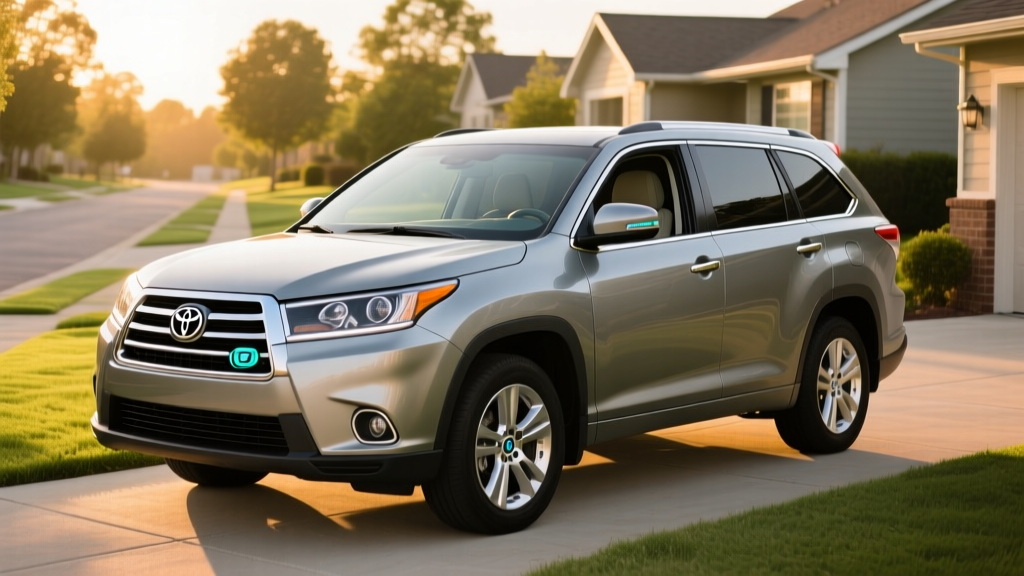
The 2012 Toyota Highlander Hybrid SUV occupies a specific niche in the used-vehicle market: a three-row, all-wheel-drive family hauler that returns nearly 30 MPG in city driving without ever needing to be plugged in. More than a decade after its debut, this second-generation Highlander Hybrid remains one of the most reliable hybrid crossovers ever built — and a practical stepping stone for buyers not yet ready to commit to a full battery-electric vehicle.
This guide breaks down the real-world fuel economy, hybrid battery longevity, replacement costs, and ownership economics of the 2012 Highlander Hybrid so you can decide whether it still makes sense as a used purchase in 2026.
What Is the 2012 Toyota Highlander Hybrid?
The 2012 Highlander Hybrid is a conventional hybrid electric vehicle (HEV) — not a plug-in hybrid (PHEV) and not a battery-electric vehicle (BEV). It pairs a 3.5-liter V6 gasoline engine with Toyota's Hybrid Synergy Drive system, using a nickel-metal hydride (NiMH) battery pack that recharges exclusively through regenerative braking and engine power. You never plug it in; you simply fuel it like any other gasoline vehicle and let the hybrid system optimize efficiency automatically.
HEV vs PHEV: Key Distinction
This vehicle is an HEV (conventional hybrid). It has no electric-only driving range, no charging port, and no plug. A PHEV like the modern Toyota RAV4 Prime offers ~42 miles of electric-only range and requires plugging in to realize its efficiency advantage. The 2012 Highlander Hybrid offers zero electric-only miles but requires zero infrastructure changes — no home charger, no public charging dependency.
Fuel Economy: EPA Ratings and Real-World MPG
The 2012 Highlander Hybrid's fuel economy was rated by the EPA at 28 MPG combined, with 28 MPG city and 28 MPG highway. These numbers were competitive for a 4,500-pound, three-row AWD SUV in 2012 and remain respectable today.
| Metric | EPA Rating | Real-World Expectation |
|---|---|---|
| City MPG | 28 MPG | 26–30 MPG (hybrids often exceed EPA in stop-and-go) |
| Highway MPG | 28 MPG | 25–27 MPG (hybrid advantage diminishes at sustained speed) |
| Combined MPG | 28 MPG | 26–28 MPG |
| Fuel Tank Capacity | 17.2 gallons | ~450–480 miles per tank |
Why City MPG Matches Highway MPG
Unlike conventional gas vehicles, the Highlander Hybrid achieves its best efficiency in city driving. The hybrid system shuts off the engine at stops, uses the electric motor for low-speed acceleration, and recovers energy through regenerative braking. On the highway, the gasoline engine does most of the work, so the hybrid advantage narrows. Owners who do mostly suburban and city driving frequently report 29–30 MPG, while highway-heavy commutes may drop to 25–26 MPG.
Comparison to the Gas-Only 2012 Highlander
The non-hybrid 2012 Highlander with the 3.5L V6 and AWD was rated at 18 city / 24 highway / 20 combined MPG. The hybrid's 28 MPG combined represents a 40% improvement in fuel economy — translating to roughly $400–$600 in annual fuel savings at 2026 gas prices (assuming 15,000 miles/year and $3.50/gallon).
Powertrain and Performance Specifications
| Specification | 2012 Highlander Hybrid |
|---|---|
| Engine | 3.5L V6 Atkinson-cycle |
| Engine Power | 245 hp @ 6,000 rpm |
| Electric Motor | Permanent magnet synchronous (front + rear) |
| Combined Net Horsepower | 280 hp |
| Transmission | eCVT (electronically controlled continuously variable) |
| Drivetrain | AWD-i (electronic on-demand AWD via rear motor) |
| 0–60 mph | ~7.8 seconds |
| Towing Capacity | 3,500 lbs |
| Curb Weight | ~4,500 lbs |
| Battery Type | NiMH (Nickel-Metal Hydride) |
| Battery Voltage | 288V nominal |
| Seating | 7 passengers (3 rows) |
| Cargo Volume | 10.3 / 42.1 / 95.4 cu ft (behind 3rd / 2nd / 1st row) |
The AWD-i system is worth noting: instead of a mechanical driveshaft to the rear wheels, the Highlander Hybrid uses a separate rear electric motor that engages automatically when the front wheels slip. This means there's no traditional drivetrain hump eating into interior space, and AWD engagement is seamless. However, this system is designed for light traction scenarios — rain, snow, gravel — not off-road use.
Hybrid Battery Longevity and Replacement Cost
The most common concern for any used hybrid buyer is battery health. The 2012 Highlander Hybrid uses a NiMH battery pack that Toyota engineered conservatively — the system never fully charges or fully depletes the pack, keeping it in a narrow state-of-charge window that dramatically extends cycle life.
Original Battery Warranty
Toyota's hybrid battery warranty for the 2012 model year was 8 years / 100,000 miles (10 years / 150,000 miles in California and states that follow CARB emissions standards). As of 2026, all original warranties on 2012 models have expired by time, though some low-mileage examples may still fall within the mileage threshold in CARB states.
Real-World Battery Lifespan
Despite expired warranties, the NiMH packs in the 2012 Highlander Hybrid have proven remarkably durable. Owner reports on Toyota forums and repair databases show many units reaching 180,000–250,000 miles before needing replacement. The key degradation factor is heat: vehicles in Arizona, Texas, and Southern California climates tend to see earlier battery failures than those in cooler regions.
Battery Replacement Cost (2026)
| Replacement Option | Cost Range | Warranty |
|---|---|---|
| New OEM Toyota battery (dealer) | $3,500–$4,500 installed | 3 years / 36,000 miles |
| Remanufactured battery (specialist shop) | $1,800–$2,800 installed | 1–3 years varies |
| Used/salvage battery | $800–$1,500 installed | 30–90 days typically |
| Individual cell/module replacement | $400–$900 (if only 1–2 modules fail) | Varies by shop |
Before assuming a full replacement is needed, have a hybrid-specialist shop perform a battery health scan. Many "check hybrid system" warnings are caused by a single degraded module among the 30+ cells in the pack. Replacing just the weak modules can restore functionality at a fraction of a full pack swap.
Pricing and Tax Credit Eligibility
Used Market Pricing (2026)
The 2012 Highlander Hybrid was originally priced from approximately $38,900 (base) to $44,000+ (Limited trim). In the 2026 used market, expect to pay:
- $8,000–$11,000 — Higher-mileage examples (150,000+ miles), fair condition
- $11,000–$15,000 — Average mileage (100,000–140,000), good condition
- $15,000–$18,000 — Lower mileage (under 90,000), excellent condition, Limited trim
Does the 2012 Highlander Hybrid Qualify for a Tax Credit?
No. The federal §30D new clean vehicle credit applies only to new vehicle purchases. The used clean vehicle credit (§25E) provides up to $4,000 (30% of sale price, capped at $4,000) for qualifying used EVs and PHEVs — but conventional hybrids (HEVs) like the 2012 Highlander Hybrid do not qualify. The §25E credit requires the vehicle to have a battery capacity of at least 7 kWh and be either a BEV or a PHEV with at least 4 kWh of usable battery capacity and the ability to be recharged from an external source. The Highlander Hybrid's NiMH pack is approximately 1.9 kWh and charges only internally.
Some states offer their own incentives for hybrid purchases, but these are increasingly focused on PHEVs and BEVs. Check your state's energy or environmental agency for current programs.
Who Should Buy This Hybrid vs. a PHEV or EV?
Pros
- 28 MPG combined — 40% better than gas-only Highlander
- No plug-in charging required; zero infrastructure changes
- AWD standard with electronic rear motor
- Proven Toyota hybrid reliability (200,000+ mile potential)
- 3,500-lb towing capacity
- 7-passenger seating in a midsize footprint
- Lower used-car depreciation curve (already bottomed out)
Cons
- No electric-only range — always burns gasoline
- No federal tax credit eligibility (new or used)
- NiMH battery technology is dated vs. modern lithium-ion
- Infotainment and safety tech are 2012-era (no CarPlay, basic stability control)
- Third row is tight for adults
- Brake feel can be vague due to regenerative blending
- Hybrid battery replacement is a $2,000–$4,500 risk on a used purchase
Decision Framework
Choose the 2012 Highlander Hybrid if: You need a 3-row AWD SUV on a budget under $16,000, drive mostly city/suburban miles, don't have access to home charging, and want maximum simplicity with no plug-in requirements.
Choose a modern PHEV (e.g., Toyota Grand Highlander Hybrid, Chrysler Pacifica PHEV) if: You have home Level 2 charging, want 30–40 miles of electric-only range for daily commuting, and can spend $40,000+ for a newer vehicle with modern safety tech and warranty coverage.
Choose a full BEV (e.g., Kia EV9, Tesla Model X) if: You want zero tailpipe emissions, have reliable home charging, drive under 300 miles daily, and can budget $50,000+ with potential §30D tax credit eligibility up to $7,500.
Reliability and Ownership Costs
Toyota's hybrid system has been refined since the 2001 Prius launch, and by 2012, the Highlander Hybrid's powertrain was a mature, well-debugged design. The eCVT transmission has no traditional gears or bands to wear out — it uses planetary gearsets and motor-generators, making it one of the most durable transmissions in Toyota's lineup.
According to NHTSA records, the 2012 Highlander Hybrid has no widespread safety recalls specific to the hybrid system. Standard maintenance (oil changes every 5,000–10,000 miles with 0W-20 synthetic, brake inspections, coolant flushes) keeps running costs low. The regenerative braking system significantly extends pad life — many owners report original brake pads lasting 80,000–100,000 miles.
Estimated Annual Ownership Costs (2026)
| Category | Estimated Annual Cost |
|---|---|
| Fuel (15,000 mi/yr, 28 MPG, $3.50/gal) | ~$1,875 |
| Insurance (national average, used SUV) | ~$1,200–$1,600 |
| Maintenance (oil, tires, brakes, fluids) | ~$600–$900 |
| Depreciation (already steep; minimal further loss) | ~$500–$800 |
| Total Estimated Annual Cost | ~$4,175–$5,175 |
Frequently Asked Questions
How many MPG does the 2012 Toyota Highlander Hybrid get?
The EPA rates it at 28 MPG city / 28 highway / 28 combined. Real-world results range from 25–30 MPG depending on driving mix. City-heavy drivers often see 29–30 MPG, while highway-dominant commutes may return 25–26 MPG.
Does the 2012 Highlander Hybrid need to be plugged in?
No. This is a conventional hybrid (HEV), not a plug-in hybrid. The battery charges through regenerative braking and the gasoline engine. There is no charging port and no electric-only driving mode.
How far can the 2012 Highlander Hybrid drive on electric only?
Effectively zero miles. The hybrid system may allow very low-speed EV-mode creeping (under 1 mile at under 25 mph in specific conditions), but this is not a usable electric-only range. The vehicle is always gasoline-powered for practical driving.
Is the 2012 Highlander Hybrid reliable?
Yes. Toyota's hybrid system is among the most proven in the industry. The eCVT, planetary gearset, and NiMH battery have demonstrated 200,000+ mile lifespans in many owner reports. The primary risk factor is hybrid battery degradation in high-heat climates after 150,000+ miles.
How much does it cost to replace the hybrid battery?
A new OEM replacement runs $3,500–$4,500 installed at a Toyota dealer. Remanufactured options from hybrid specialists cost $1,800–$2,800. Individual module replacement (if only a few cells fail) can be as low as $400–$900.
Does the 2012 Highlander Hybrid qualify for any tax credit?
No. Federal tax credits (§30D for new, §25E for used) apply only to plug-in vehicles (BEVs and PHEVs). Conventional hybrids without a plug are not eligible for any current federal purchase incentive. Check your state for possible local programs.
How does the 2012 Highlander Hybrid compare to a modern hybrid SUV?
Modern hybrids like the 2026 Toyota Grand Highlander Hybrid (36 MPG combined) or Honda Pilot Hybrid (estimated 30+ MPG) deliver better efficiency, modern safety features (automatic emergency braking, lane-keeping, adaptive cruise), and current infotainment with Apple CarPlay/Android Auto. However, they cost $42,000+ new. The 2012 model offers similar utility at a fraction of the price, minus the tech and warranty.
What should I check before buying a used 2012 Highlander Hybrid?
Request a hybrid battery health report from a Toyota dealer or hybrid specialist. Check for "check hybrid system" codes. Verify maintenance records, particularly inverter coolant changes. Test-drive in EV mode (if available at low speed) to confirm motor function. Inspect for rust in snow-belt states. Confirm the AWD-i rear motor engages by accelerating from a stop on a low-traction surface.
The 2012 Toyota Highlander Hybrid SUV remains a pragmatic choice for budget-conscious families who need three rows, all-wheel drive, and hybrid efficiency without the complexity or cost of a plug-in vehicle. Its fuel economy advantage over the gas-only model is substantial, its reliability record is strong, and its used-market pricing has settled into an accessible range. The main risk — hybrid battery replacement — is manageable with a pre-purchase inspection and awareness of replacement options beyond the dealer. For buyers prioritizing simplicity and proven durability over cutting-edge tech, this 14-year-old hybrid still delivers where it counts.