The 2012 Toyota Camry Hybrid was a watershed year for Toyota's midsize sedan. It introduced the brand's Hybrid Synergy Drive to a redesigned platform, delivering fuel economy numbers that still hold up more than a decade later. If you're researching the 2012 Toyota Camry Hybrid MPG as a used-car buyer, fleet operator, or cost-conscious commuter, this guide covers every number that matters — EPA ratings, real-world expectations, battery longevity, and how this conventional hybrid (HEV) compares to today's plug-in hybrids and full EVs.
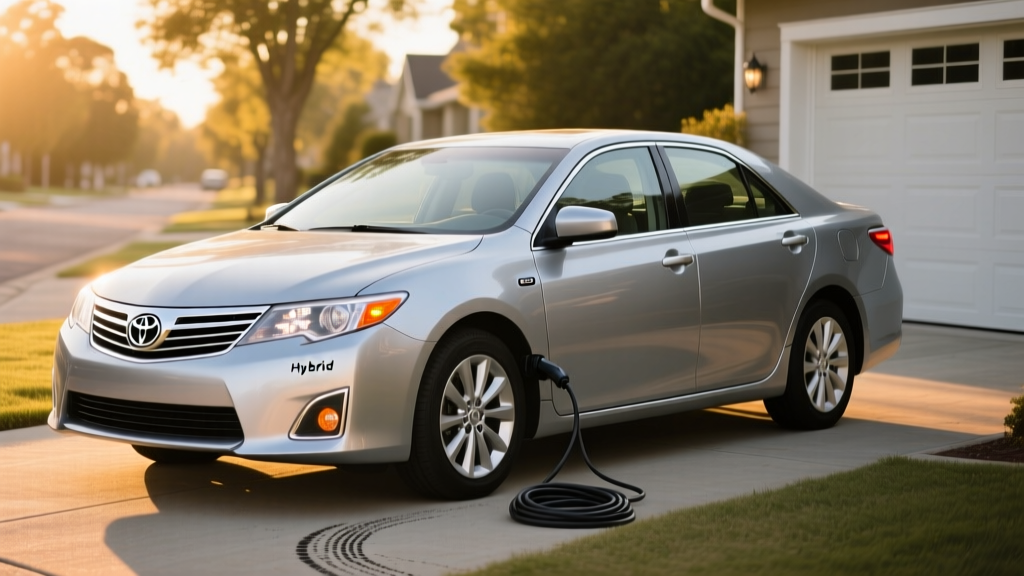
One critical distinction up front: the 2012 Camry Hybrid is a conventional hybrid (HEV), not a plug-in hybrid (PHEV). You never plug it in. It generates and recaptures all its electricity through regenerative braking and the gasoline engine. If you're looking for electric-only driving range, you need a PHEV like the current Toyota Prius Prime or RAV4 Prime. More on that comparison below.
2012 Toyota Camry Hybrid MPG: The Official EPA Numbers
For the 2012 model year, Toyota offered the Camry Hybrid in a single trim (later expanded to LE and XLE trims in subsequent years). The EPA rated it as follows:
| Metric | Value |
|---|---|
| City MPG | 43 MPG |
| Highway MPG | 39 MPG |
| Combined MPG | 41 MPG |
| Fuel Tank Capacity | 17.0 gallons |
| Total Driving Range (EPA est.) | ~697 miles |
| Annual Fuel Cost (EPA est.) | ~$1,350 (based on 15,000 mi/yr at 2026 avg. fuel prices) |
Source: fueleconomy.gov — 2012 Toyota Camry Hybrid
The city rating exceeding the highway rating is a hallmark of Toyota's hybrid system. At low speeds, the electric motor handles more of the propulsion load, and regenerative braking recaptures energy constantly in stop-and-go traffic. On the highway, the 2.5-liter gasoline engine does most of the work, which is why the highway number dips slightly.
Real-World MPG: What Owners Actually Report
EPA stickers are a starting point, not a guarantee. Based on aggregated owner data from Fuelly and real-world testing logs, most 2012 Camry Hybrid drivers report:
| Driving Scenario | Expected MPG |
|---|---|
| City / stop-and-go commuting | 40–46 MPG |
| Mixed driving (50/50 city-highway) | 38–43 MPG |
| Highway cruising (70+ mph) | 35–40 MPG |
| Cold weather (below 32°F, short trips) | 32–38 MPG |
Several factors explain why real-world MPG can exceed the EPA city rating. Toyota's hybrid system is exceptionally efficient at low loads, and drivers who adopt a pulse-and-glide technique — gently accelerating then coasting — can push city figures into the mid-40s. Conversely, sustained high-speed highway driving and cold-weather operation (where the engine runs longer to heat the cabin and catalytic converter) pull numbers down.
A 2012 Camry Hybrid with 130,000+ miles on the odometer will typically deliver within 2–3 MPG of its original ratings, assuming the hybrid battery is in good health. Degraded batteries reduce the electric motor's contribution, shifting more load to the gasoline engine and dropping fuel economy by 3–6 MPG in noticeable cases.
Powertrain Specs: Engine, Motor, and Combined Output
The 2012 Camry Hybrid pairs a 2.5-liter Atkinson-cycle four-cylinder engine with a permanent-magnet electric motor through Toyota's eCVT (electronically controlled continuously variable transmission). This is not a traditional belt-driven CVT — it uses a planetary gearset to seamlessly blend power sources, which is why Toyota hybrids avoid the rubber-band acceleration feel common in other CVTs.
| Specification | Value |
|---|---|
| Gasoline Engine | 2.5L Atkinson-cycle I4 |
| Engine Horsepower | 156 HP @ 5,700 RPM |
| Electric Motor Output | 105 kW (141 HP) |
| Net Combined System Horsepower | 200 HP |
| Transmission | eCVT (planetary gearset) |
| Drivetrain | Front-wheel drive |
| 0–60 MPH | 7.6 seconds (MotorTrend tested) |
| Hybrid Battery | 1.6 kWh Nickel-Metal Hydride (NiMH) |
| Curb Weight | 3,435 lbs |
The 200 HP combined output was class-competitive in 2012, putting the Camry Hybrid on par with V6-equipped rivals in terms of acceleration while delivering nearly double their fuel economy. The 1.6 kWh NiMH battery is small by modern standards — it's not designed for electric-only driving beyond brief low-speed maneuvers (typically under 1 mile at speeds below 25 mph in EV mode).
HEV vs PHEV vs EV: Which Powertrain Fits You?
If you're cross-shopping the 2012 Camry Hybrid against newer plug-in hybrids or full electric vehicles, here's how the three powertrain types compare in practical terms:
| Factor | HEV (2012 Camry Hybrid) | PHEV (e.g., 2026 Prius Prime) | BEV (e.g., 2026 Tesla Model 3) |
|---|---|---|---|
| Plug-in Required? | No — self-charging | Yes — Level 1 or Level 2 | Yes — Level 2 or DC fast |
| Electric-Only Range | ~0.5 mi at low speed | 40–45 mi (EPA) | 250–360 mi (EPA) |
| Total Range | ~697 mi | ~440+ mi combined | 250–360 mi |
| Home Charging Setup | None needed | 120V outlet or 240V L2 | 240V L2 strongly recommended |
| Combined MPG / MPGe | 41 MPG | 52 MPG + 127 MPGe (elec.) | 132 MPGe |
| Fuel Cost per Mile (2026 avg.) | ~$0.08/mi | ~$0.04–0.07/mi | ~$0.03–0.05/mi |
| Federal Tax Credit (§30D) | Not eligible | Up to $7,500 (if eligible) | Up to $7,500 (if eligible) |
| Best For | No plug access, budget buyers | Short commutes + road trips | Home charging + daily driving |
The 2012 Camry Hybrid wins on simplicity and accessibility. There's no charging infrastructure to install, no range planning, no plug-in routine. You fill up at any gas station and drive. For apartment dwellers without charging access, rural drivers far from public chargers, or anyone who wants zero lifestyle change, a conventional HEV remains the pragmatic choice.
A PHEV makes sense if you can charge at home or work and your daily driving falls within its electric range — you'd run mostly on electricity for weeks at a time, with the gas engine available for longer trips. A full BEV delivers the lowest per-mile operating cost but requires reliable charging access and a higher upfront purchase price.
Hybrid Battery Lifespan, Warranty, and Replacement Cost
2012 Camry Hybrid Battery Warranty (Original)
Toyota warranted the hybrid battery for 8 years / 100,000 miles in most states, and 10 years / 150,000 miles in California Air Resources Board (CARB) states (CA, CT, ME, MA, NJ, NY, OR, RI, VT, WA). By 2026, the original factory warranty has expired on all 2012 models.
The NiMH battery in the 2012 Camry Hybrid has proven remarkably durable. Toyota's hybrid battery management system keeps the state of charge in a narrow, battery-friendly window (roughly 40–80%), which minimizes degradation. Based on long-term owner data and fleet reports:
- Average battery lifespan: 150,000–200,000+ miles before significant degradation
- Failure rate before 150K miles: Under 5% based on aggregated repair data
- Common failure trigger: Individual cell imbalance rather than full pack failure
When replacement is necessary, here's what to budget:
| Replacement Option | Cost Range (2026) | Warranty |
|---|---|---|
| New OEM Toyota Battery | $3,000–$4,000 (installed) | 3 yr / 36,000 mi |
| Remanufactured Battery | $1,500–$2,500 (installed) | 1–3 yr / varies |
| Individual Cell Module Replacement | $400–$800 (specialist shop) | Varies by shop |
| Used/Salvage Battery | $500–$1,200 (installed) | 30–90 days typical |
Before replacing the full battery, have a hybrid-specialist shop run a battery health diagnostic. Often, a single degraded module (there are 34 modules in the 2012 Camry's pack) can be swapped for a fraction of a full replacement. Green Tech Hybrid and similar specialist shops offer cell-level repair that restores the pack to 90%+ of original capacity.
Reliability and Long-Term Ownership Costs
The 2012 Camry Hybrid benefits from Toyota's reputation for durability, and the hybrid system adds fewer failure points than many buyers assume. The eCVT planetary gearset has no belts, clutches, or torque converter to wear out — it's one of the most robust transmissions in any vehicle. Key reliability notes:
- Brake pads: Last 60,000–100,000 miles thanks to regenerative braking handling most deceleration
- 12V auxiliary battery: Standard replacement every 4–6 years (~$150–$250)
- Inverter coolant pump: Some early 2012 models had recalls — verify VIN recall status at nhtsa.gov/recalls
- Engine: The 2AR-FXE 2.5L Atkinson-cycle engine is under-stressed and routinely reaches 250,000+ miles with basic maintenance
For a 2012 Camry Hybrid with 120,000–150,000 miles in good condition, expect to pay between $7,000 and $11,000 in the 2026 used-car market, depending on trim, condition, and region. Total cost of ownership over five years (purchase price + fuel + insurance + maintenance) typically runs $18,000–$24,000 — substantially less than a comparable-age gasoline sedan when fuel savings are factored in.
Tax Credits and Incentives in 2026
Because the 2012 Toyota Camry Hybrid is a conventional hybrid (HEV) with no plug-in capability, it does not qualify for the federal §30D New Clean Vehicle Credit or the §25E Used Clean Vehicle Credit. These credits are reserved for plug-in vehicles (PHEVs and BEVs) with qualifying battery capacities.
For used-car buyers comparing options, here's how the incentive landscape looks in 2026:
| Vehicle Type | Federal Tax Credit Available? | Notes |
|---|---|---|
| 2012 Camry Hybrid (HEV) | No | Conventional hybrids are not eligible for §30D or §25E credits |
| Used PHEV (e.g., Prius Prime) | Up to $4,000 (§25E) | Must meet income caps, dealer sale, ≤$25K sale price |
| New BEV (e.g., Tesla Model 3) | Up to $7,500 (§30D) | Income + MSRP + battery sourcing rules apply |
Some states offer their own incentives for hybrids, but these are increasingly rare and typically apply only to new purchases. Check your state's energy office or the Alternative Fuels Data Center for current state-level programs. For federal credit rules, always verify at IRS.gov — eligibility rules for §30D and §25E have specific income caps, MSRP limits, and battery-sourcing requirements.
Who Should Buy the 2012 Camry Hybrid — And Who Shouldn't
Pros
- Proven 40+ MPG combined with no plug-in required
- Low used-car price ($7K–$11K) with strong reliability record
- Brake pads and transmission last significantly longer than gas-only cars
- Spacious midsize sedan with 15.1 cu ft trunk
- No charging infrastructure or lifestyle change needed
- Hybrid battery proven to 200K+ miles in most cases
Cons
- No electric-only driving range (not a PHEV)
- No federal tax credit eligibility
- 2012 model lacks modern ADAS (no automatic emergency braking, lane-keep)
- Infotainment is dated (no Apple CarPlay/Android Auto without aftermarket upgrade)
- NiMH battery replacement cost if it fails ($1,500–$4,000)
- Hybrid premium over gas Camry may not pay back at low annual mileage
Decision Framework
Choose the 2012 Camry Hybrid if: You drive 12,000+ miles per year (mostly city or mixed), lack access to plug-in charging, want a sub-$11K reliable sedan, and don't need the latest safety tech or infotainment.
Choose a used PHEV instead if: You can charge at home, your commute is under 40 miles, and you want some electric-only driving to cut fuel costs further — and you may qualify for the §25E used-EV credit.
Choose a full BEV instead if: You have reliable Level 2 home charging, want zero tailpipe emissions, qualify for the full $7,500 federal credit on a new purchase, and your budget allows $30K+.
Stick with a gas Camry if: You drive under 8,000 miles per year (the hybrid fuel savings won't offset the purchase premium), or you want a manual transmission or sportier driving dynamics.
Frequently Asked Questions
How many MPG does the 2012 Toyota Camry Hybrid get?
The EPA rates the 2012 Camry Hybrid at 43 MPG city, 39 MPG highway, and 41 MPG combined. In real-world driving, most owners report 38–46 MPG depending on driving conditions, with city driving often exceeding the EPA estimate thanks to the hybrid system's regenerative braking efficiency.
Does the 2012 Camry Hybrid need to be plugged in?
No. The 2012 Camry Hybrid is a conventional hybrid (HEV). It charges its own small battery through regenerative braking and the gasoline engine. You never plug it in. If you want plug-in electric driving, you'd need a PHEV like the Toyota Prius Prime.
How far can the 2012 Camry Hybrid drive on electric only?
Effectively less than 1 mile at speeds under 25 mph in EV mode. The 1.6 kWh NiMH battery is designed for assist, not standalone propulsion. This is normal for conventional hybrids — the electric motor supplements the gas engine to improve efficiency, not replace it.
Is the 2012 Camry Hybrid reliable, and what does a battery replacement cost?
Yes. The 2012 Camry Hybrid has an excellent reliability record. The hybrid battery typically lasts 150,000–200,000+ miles. If replacement is needed, a new OEM battery costs $3,000–$4,000 installed, while remanufactured options run $1,500–$2,500. Individual cell module repair can cost as little as $400–$800 at a hybrid specialist.
Does the 2012 Toyota Camry Hybrid qualify for any tax credit?
No. As a conventional hybrid (HEV), the 2012 Camry Hybrid does not qualify for the federal §30D new vehicle credit or the §25E used clean vehicle credit. These credits apply only to plug-in vehicles (PHEVs and BEVs). Some states may offer minor incentives — check the Alternative Fuels Data Center for your area.
How does the 2012 Camry Hybrid compare to the current 2026 Camry Hybrid?
The 2026 Toyota Camry Hybrid (5th generation) delivers an EPA-rated 44–51 MPG combined depending on trim, uses a more advanced lithium-ion battery, and comes standard with Toyota Safety Sense 3.0 (adaptive cruise, lane-keep, automatic emergency braking). However, a 2026 model starts around $30,000 MSRP. The 2012 model at $7K–$11K used offers similar fuel economy fundamentals for a fraction of the cost — just without the latest safety and tech features.
What maintenance does the 2012 Camry Hybrid require?
Standard maintenance includes oil changes every 10,000 miles (0W-20 synthetic), coolant flushes per the service schedule, and inverter coolant inspection. The hybrid system itself requires no routine maintenance. Brake pads last 60K–100K miles due to regenerative braking. The 12V auxiliary battery should be replaced every 4–6 years like any conventional vehicle.