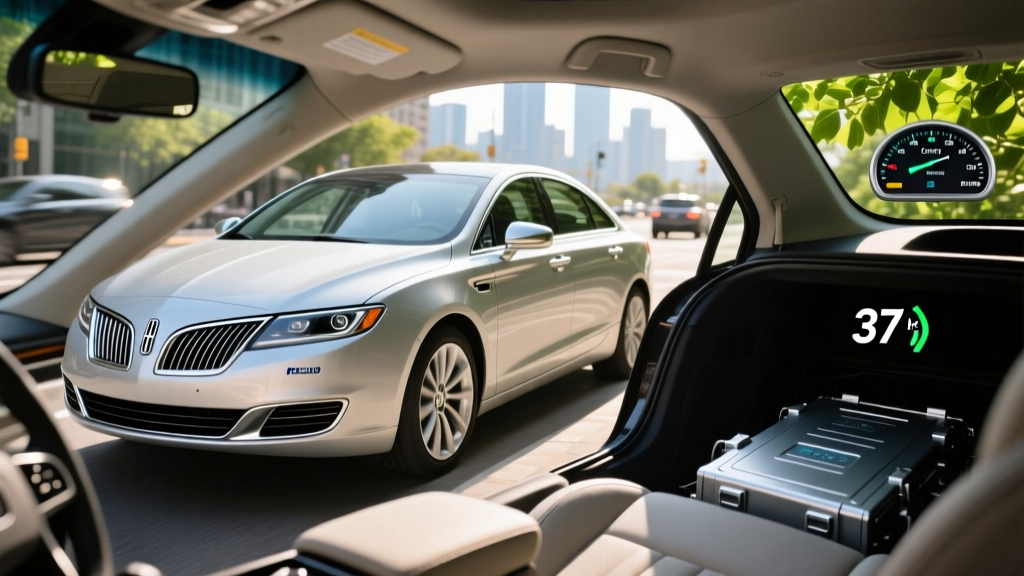
The 2012 Lincoln MKZ Hybrid occupies a specific niche in the used-car market: a luxury-badged conventional hybrid (HEV) that shares its powertrain with the Ford Fusion Hybrid but wraps it in leather, wood trim, and Lincoln's signature split-wing grille. More than a decade after its debut, it remains a compelling option for buyers who want hybrid fuel savings without plugging in — but its age introduces battery-lifespan questions that every used-hybrid shopper must confront.
This guide covers everything a 2026 used-car buyer needs to know: real-world MPG versus EPA stickers, the HEV versus PHEV distinction, battery warranty status, replacement costs, and whether this aging Lincoln still makes financial sense compared to a modern hybrid, PHEV, or full EV.
HEV vs PHEV vs EV: Where the 2012 MKZ Hybrid Fits
Before evaluating the car itself, it is critical to understand what the 2012 MKZ Hybrid is — and what it is not.
Conventional Hybrid (HEV) — This Car
The 2012 MKZ Hybrid is a conventional hybrid (HEV). It has a small battery (roughly 1.4 kWh usable) that charges exclusively through regenerative braking and the gasoline engine. You never plug it in. The electric motor assists the gas engine at low speeds and during acceleration, but the car cannot drive on electricity alone for meaningful distances. Think of it as a gas car that is significantly more efficient in stop-and-go traffic.
Plug-In Hybrid (PHEV)
A PHEV has a larger battery (typically 10–25 kWh) and a charge port. You plug it in at home or at a public charger to get 20–50 miles of electric-only driving before the gas engine kicks in. The 2012 MKZ was never offered as a PHEV — Lincoln did not introduce plug-in capability in the MKZ lineage until later generations on different platforms.
Battery Electric Vehicle (BEV)
A full EV has no gas engine, runs entirely on a large battery (60–100+ kWh), and must be charged from an external source. Examples include the Tesla Model 3, Hyundai Ioniq 5, and Ford Mustang Mach-E. Zero tailpipe emissions, but requires home or public charging access.
The 2012 MKZ Hybrid is purely an HEV. If you are looking for electric-only commuting, you need a PHEV or BEV. If you want lower fuel consumption with zero lifestyle change — no plugs, no charging apps, no range planning — this HEV delivers that.
Fuel Economy: EPA Ratings vs Real-World MPG
The headline number for the 2012 Lincoln MKZ Hybrid is strong, especially for city driving. According to fueleconomy.gov, the EPA rates it as follows:
| Metric | EPA Rating |
|---|---|
| City MPG | 41 MPG |
| Highway MPG | 36 MPG |
| Combined MPG | 39 MPG |
| Fuel Tank Capacity | 16.5 gallons |
| Total Range (est.) | ~643 miles |
The 41 MPG city figure is the standout. Hybrids excel in urban driving because regenerative braking recovers energy during frequent stops, and the electric motor handles low-speed propulsion where gas engines are least efficient. On the highway, the advantage narrows because the gas engine does most of the work at sustained speeds.
Real-World MPG Expectations in 2026
Owner reports and long-term testing consistently show that the 2012 MKZ Hybrid meets or slightly exceeds its EPA city rating in real-world urban driving — often returning 42–44 MPG in warm-weather stop-and-go conditions. Highway driving typically yields 34–37 MPG depending on speed and terrain.
Two factors work against the EPA numbers in this specific vehicle:
- Battery age: A 14-year-old hybrid battery with degraded capacity will reduce the electric motor's contribution, potentially dropping real-world MPG by 2–5 MPG below original figures. More on this below.
- Cold weather: In sub-40°F conditions, expect a 10–15% fuel-economy penalty as the engine runs more frequently to provide cabin heat and because battery chemistry is less efficient at low temperatures.
For a used example with a healthy battery, a combined real-world figure of 37–41 MPG is realistic. If the battery is significantly degraded, plan for 33–36 MPG combined until replacement.
Powertrain and Performance Specs
| Specification | 2012 Lincoln MKZ Hybrid |
|---|---|
| Engine | 2.5L inline-4 Atkinson-cycle |
| Engine Output | 156 HP @ 6,000 RPM / 136 lb-ft torque |
| Electric Motor | Permanent-magnet AC synchronous |
| Combined System Output | 191 HP |
| Transmission | eCVT (planetary gearset, no fixed gears) |
| Drivetrain | Front-wheel drive |
| 0–60 MPH | ~8.5 seconds |
| Hybrid Battery | ~1.4 kWh, Nickel-Metal Hydride (NiMH) |
| Curb Weight | ~3,752 lbs |
The 2.5-liter Atkinson-cycle four-cylinder is the same engine used in the contemporary Ford Fusion Hybrid. It prioritizes efficiency over power, running a late intake-valve-closing cycle that sacrifices some low-end torque for better thermal efficiency. The electric motor fills in the torque gap during acceleration, and the eCVT — which is not a traditional belt-driven CVT but a planetary gearset — seamlessly blends power from both sources.
Performance is adequate rather than quick. The 8.5-second 0–60 time is unhurried by modern standards, and highway passing requires planning. However, the electric motor's instant torque gives the car a responsive feel around town that belies its modest horsepower figure.
Battery Health, Warranty Status, and Replacement Cost
This is the single most important section for anyone considering a 2012 MKZ Hybrid in 2026. The hybrid battery is now 14 years old, and its condition will determine both your fuel economy and your near-term maintenance budget.
Original Battery Warranty
When new, the 2012 MKZ Hybrid's battery was covered under Ford/Lincoln's hybrid component warranty: 8 years / 100,000 miles (extended to 10 years / 150,000 miles in California and states that follow CARB emissions rules). As of 2026, every 2012 MKZ Hybrid is well beyond its original battery warranty, regardless of mileage. Any battery failure is the owner's financial responsibility.
How Long Do These Batteries Last?
NiMH hybrid batteries in the Ford/Lincoln system have a strong track record for longevity. Many Fusion and MKZ Hybrids from this era have reached 150,000–200,000 miles on the original battery. However, calendar age degrades NiMH cells even in low-mileage vehicles. At 14 years old, most original batteries have lost 20–35% of their original capacity.
Symptoms of a degraded hybrid battery include:
- Noticeably lower MPG (especially in city driving where electric assist matters most)
- The engine running more frequently and at higher RPMs
- Reduced regenerative braking feel
- A battery state-of-charge gauge that swings rapidly between high and low
- Potential check-engine or hybrid-system warning lights if a cell has failed
Battery Replacement Cost
| Option | Estimated Cost (2026) | Notes |
|---|---|---|
| New OEM battery (Lincoln/Ford dealer) | $2,500 – $3,800 | Full new pack, installed; best longevity |
| Remanufactured battery (aftermarket) | $1,200 – $2,200 | Replaced cells in original casing; 1–3 yr warranty typical |
| Used/salvage battery | $500 – $1,000 | Risky — unknown remaining life; avoid unless budget-constrained |
| Individual cell reconditioning | $800 – $1,500 | Specialist shops replace weak cells; cost-effective if available locally |
If you are buying a 2012 MKZ Hybrid today, budget $1,500–$3,000 for a battery replacement within the first year or two of ownership unless the seller can provide documentation of a recent replacement. A pre-purchase hybrid battery health check (available at most Ford/Lincoln dealers or independent hybrid specialists) is strongly recommended and typically costs $100–$150.
Pricing and Tax Credit Eligibility
The 2012 Lincoln MKZ Hybrid originally carried an MSRP of approximately $35,180 (base, before options). In the 2026 used market, examples typically sell for:
- $6,000 – $9,000 for high-mileage examples (120,000+ miles) or cars needing battery replacement
- $9,000 – $13,000 for well-maintained, lower-mileage examples (under 90,000 miles) with a healthy battery
- $13,000 – $16,000 for exceptional low-mileage, dealer-certified examples (rare at this age)
Tax Credit Status
The 2012 Lincoln MKZ Hybrid does not qualify for the federal §30D new clean vehicle credit — that credit applies only to new vehicle purchases and was restructured significantly under the Inflation Reduction Act. As a conventional hybrid (not a PHEV or BEV), it never qualified for the §30D credit even when new.
For used-vehicle buyers, the §25E used clean vehicle credit (up to $4,000 or 30% of sale price, whichever is less) applies only to used EVs and PHEVs with at least 4 kWh of battery capacity. The MKZ Hybrid's ~1.4 kWh NiMH battery falls below this threshold, making it ineligible for the used-vehicle credit.
Some states offer their own incentives for hybrid purchases, but these typically target new vehicles. Check your state's energy or DMV website for current programs. For federal rules, consult IRS.gov clean vehicle credits.
Pros, Cons, and the Used-Buyer Verdict
Pros
- 41 MPG city is excellent and achievable in real-world driving
- No plug-in charging required — zero lifestyle adjustment from a gas car
- Luxury interior with leather, premium audio, and Lincoln's THX-certified sound system
- Smooth, quiet ride quality with compliant suspension tuning
- Proven powertrain shared with Ford Fusion Hybrid — parts availability is strong
- Low used pricing makes the total cost of ownership attractive if the battery is healthy
- Strong reliability record for the 2.5L Atkinson engine and eCVT
Cons
- Battery is 14 years old and likely degraded or near end-of-life
- No federal or state tax credits available for this used HEV
- Modest 191 HP — sluggish by 2026 standards
- Dated infotainment (MyFord Touch is widely criticized for lag and glitches)
- Highway MPG (36) is less impressive than city; some modern 4-cylinder turbo gas cars approach this on the highway
- No DC fast charging, no plug — this is a feature, not a bug, for HEV buyers, but limits any electric-only driving
- Safety tech is minimal by modern standards (no automatic emergency braking, no lane-keeping assist)
Who Should Choose the 2012 MKZ Hybrid vs a Modern Alternative?
The decision to buy a 14-year-old hybrid comes down to budget, driving pattern, and risk tolerance. Here is a practical framework:
Choose the 2012 MKZ Hybrid If:
- Your budget is under $12,000 and you want a luxury-badged sedan with low fuel costs
- You drive primarily in the city (under 45 MPH, lots of stops) where the 41 MPG rating shines
- You have no access to home or workplace charging, ruling out PHEVs and EVs
- You are comfortable budgeting $1,500–$3,000 for a potential battery replacement
- You plan to keep the car 2–4 years and drive 8,000–12,000 miles per year
Consider a Modern Hybrid Instead (e.g., 2024–2026 Toyota Camry Hybrid, Honda Accord Hybrid) If:
- Your budget extends to $28,000–$35,000 for a newer vehicle with a full warranty
- You want modern safety features (AEB, lane-keeping, adaptive cruise)
- You want a fresh battery with 8–10 years of warranty remaining
- You drive a mix of city and highway — modern hybrids deliver 44–52 MPG combined
Consider a PHEV (e.g., Toyota Prius Prime, Hyundai Tucson PHEV) If:
- You have reliable home Level 2 charging and a commute under 40 miles
- You want electric-only daily driving with a gas engine for road trips
- You want to qualify for the §30D federal tax credit (up to $7,500 on eligible new PHEVs, subject to MSRP caps, income limits, and battery-sourcing rules per IRS guidelines)
Consider a Full EV If:
- You have home charging and want the lowest per-mile fuel cost (~$0.04–$0.06/mile vs ~$0.10–$0.12/mile for the MKZ Hybrid at 39 MPG and $3.50/gallon gas)
- You want minimal maintenance (no oil changes, no transmission fluid, fewer brake replacements due to regen)
- Your daily driving is under 250 miles and you are comfortable with public DC fast charging for road trips
Ownership Costs: 5-Year Estimate
Assuming a purchase price of $10,000, 12,000 miles/year, and a battery replacement in year two:
| Cost Category | 5-Year Estimate |
|---|---|
| Purchase Price | $10,000 |
| Fuel (39 MPG avg, $3.50/gal, 60,000 mi) | $5,385 |
| Battery Replacement | $2,200 |
| Insurance (avg $1,400/yr) | $7,000 |
| Maintenance (oil, brakes, tires, fluids) | $3,500 |
| Estimated Repairs (non-battery) | $2,000 |
| Total 5-Year Cost | ~$30,085 |
| Cost Per Mile | ~$0.50/mile |
For comparison, a 2026 Toyota Camry Hybrid LE ($29,995 MSRP, 52 MPG combined) would cost roughly $40,000–$43,000 over five years including purchase price, but with far lower repair risk and full warranty coverage. The MKZ Hybrid wins on upfront cost but carries age-related financial risk.
Frequently Asked Questions
How many MPG does the 2012 Lincoln MKZ Hybrid get?
The EPA rates it at 41 MPG city, 36 MPG highway, and 39 MPG combined. Real-world city driving with a healthy battery often returns 42–44 MPG. Highway driving typically yields 34–37 MPG. A degraded battery can drop combined MPG to 33–36.
Does the 2012 MKZ Hybrid need to be plugged in?
No. It is a conventional hybrid (HEV). The battery charges through regenerative braking and the gas engine. There is no plug, no charge port, and no electric-only driving range to speak of. You fuel it like any other gas car — you simply use less fuel.
How far can it go on electric only?
Essentially zero miles in practical terms. The 1.4 kWh NiMH battery can propel the car at very low speeds (under 25 MPH) for roughly one mile or less under ideal conditions. This is not a vehicle designed for electric-only commuting. If you need 20–40 miles of electric-only range, you need a PHEV.
Is the 2012 MKZ Hybrid reliable?
The powertrain — the 2.5L Atkinson-cycle engine and eCVT — is one of the most reliable hybrid systems Ford has produced. These components routinely exceed 200,000 miles with basic maintenance. The main reliability concern in 2026 is the age of the NiMH hybrid battery, which is likely degraded and may need replacement. The MyFord Touch infotainment system is also a known source of frustration (slow response, occasional freezes) but does not affect drivability.
What does a replacement hybrid battery cost?
A new OEM battery from a Lincoln/Ford dealer runs $2,500–$3,800 installed. Remanufactured aftermarket batteries cost $1,200–$2,200. Cell-level reconditioning at a specialist shop costs $800–$1,500. Budget at least $1,500–$2,500 if buying a 2012 MKZ Hybrid without proof of a recent battery replacement.
Does the 2012 MKZ Hybrid qualify for any tax credit?
No. It is ineligible for the federal §30D new clean vehicle credit (which applies only to new EVs and PHEVs) and ineligible for the §25E used clean vehicle credit (which requires at least 4 kWh of battery capacity — the MKZ Hybrid has ~1.4 kWh). No federal tax incentive is available for this vehicle. Check your state's energy office for any local programs, though most target new purchases.
Is the 2012 MKZ Hybrid the same as the Ford Fusion Hybrid?
Mechanically, yes. The 2012 MKZ Hybrid shares the same 2.5L engine, electric motor, eCVT, and hybrid battery as the 2012 Ford Fusion Hybrid. The differences are cosmetic and comfort-oriented: Lincoln-specific exterior styling, a more luxurious interior with standard leather, upgraded sound insulation, and Lincoln's THX audio system. Parts availability is excellent because of the Ford commonality.
Should I buy a 2012 MKZ Hybrid or a newer used hybrid?
If your budget is strictly under $12,000 and you accept the battery-replacement risk, the MKZ Hybrid offers luxury and strong city MPG at a low entry price. If you can spend $18,000–$25,000, a 2018–2022 Toyota Camry Hybrid or Honda Accord Hybrid will offer better fuel economy (48–52 MPG combined), modern safety technology, a younger battery with warranty remaining, and significantly lower near-term repair risk.
For official EPA fuel-economy data on the 2012 Lincoln MKZ Hybrid, see fueleconomy.gov. For federal tax credit rules, consult IRS.gov. Safety ratings and crash-test data are available at NHTSA.gov.