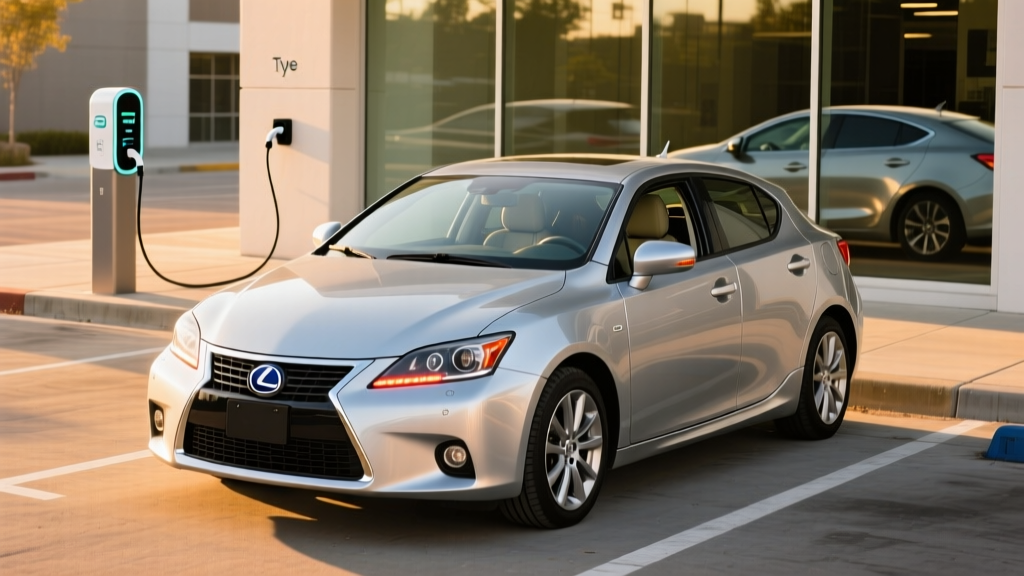
The 2012 Lexus CT 200h: America's First Luxury Hybrid Hatchback
If you're searching for a 2012 Lexus hybrid hatchback, you're looking at exactly one model: the Lexus CT 200h. Introduced for the 2011 model year and built on Toyota's proven MC platform (shared with the Prius), the CT 200h was Lexus's entry into the premium compact hybrid segment — a segment it essentially created and then abandoned when the model was discontinued in the U.S. after 2017.
In 2026, the CT 200h lives on exclusively in the used-car market, where it has become a popular choice for budget-conscious buyers who want Toyota hybrid reliability wrapped in a more refined package than the Prius. With used examples typically running $8,000–$14,000 depending on mileage and condition, the CT 200h competes against used Prius models, the Honda Insight, and early plug-in hybrids.
This guide covers everything a used-car buyer needs to know: real-world MPG, the hybrid powertrain, battery longevity and replacement cost, and whether this 2012 Lexus hybrid hatchback still makes sense against modern HEVs, PHEVs, and full EVs.
HEV vs PHEV: What the CT 200h Actually Is
Before diving into specs, it's essential to classify this car correctly. The 2012 Lexus CT 200h is a conventional hybrid electric vehicle (HEV) — not a plug-in hybrid (PHEV) and not a battery-electric vehicle (BEV).
| Feature | HEV (CT 200h) | PHEV (e.g., Prius Prime) | BEV (e.g., Tesla Model 3) |
|---|---|---|---|
| Plug-in charging | No — self-charging via engine + regen | Yes — plug in for electric-only miles | Yes — plug in for all driving |
| Electric-only range | ~1 mile at low speed | 25–44 miles (model-dependent) | 250–400+ miles |
| Battery size | 1.3 kWh (NiMH) | 8.8–13.6 kWh (Li-ion) | 50–100+ kWh (Li-ion) |
| Gas engine | Yes — primary power source | Yes — backup after battery depletes | None |
| Federal tax credit (new) | None | Up to $7,500 (§30D, if eligible) | Up to $7,500 (§30D, if eligible) |
The CT 200h never plugs in. Its small 1.3 kWh nickel-metal hydride (NiMH) battery recharges through regenerative braking and the gasoline engine. You simply fill it with regular unleaded and drive — the hybrid system manages electric assist automatically.
Fuel Economy: EPA Ratings vs Real-World MPG
The headline number for any hybrid buyer is fuel economy. The 2012 Lexus CT 200h delivers strong efficiency, though it falls slightly short of the Prius it shares powertrain DNA with, due to additional weight from luxury sound insulation and a stiffer chassis.
| Metric | Value |
|---|---|
| City MPG | 43 MPG |
| Highway MPG | 40 MPG |
| Combined MPG | 42 MPG |
| Fuel type | Regular unleaded (87 octane) |
| Fuel tank capacity | 11.9 gallons |
| Total driving range | ~499 miles (EPA combined) |
Source: fueleconomy.gov — 2012 Lexus CT 200h
Real-World MPG: What Owners Actually Report
Hybrids often exceed their EPA city ratings in stop-and-go driving because regenerative braking recaptures energy that gas-only cars waste as heat. The CT 200h is no exception:
- City driving (real-world): 44–48 MPG is achievable in moderate traffic with smooth inputs. The hybrid system runs on electric power up to ~25 mph under light load.
- Highway driving (real-world): Expect 37–40 MPG at 70–75 mph. Aerodynamic drag dominates at highway speed, and the 1.8L engine works harder than in city driving.
- Cold-weather impact: In sub-40°F conditions, expect a 5–10% MPG drop (roughly 38–40 combined). The engine runs more frequently to heat the cabin and bring the catalytic converter to operating temperature.
- Combined real-world average: Most owners report 40–44 MPG combined, closely tracking the EPA estimate.
Powertrain Specs: 1.8L Atkinson-Cycle + Electric Motor
The 2012 CT 200h uses Toyota's third-generation Hybrid Synergy Drive — the same system found in the 2010–2015 Prius, but tuned for slightly more responsive performance.
| Specification | Detail |
|---|---|
| Engine | 1.8L 4-cylinder Atkinson-cycle (2ZR-FXE) |
| Engine horsepower | 98 hp @ 5,200 rpm |
| Engine torque | 105 lb-ft @ 4,000 rpm |
| Electric motor output | 80 hp (60 kW) |
| Net system horsepower | 134 hp |
| Transmission | ECVT (planetary gearset, not a belt-driven CVT) |
| Drivetrain | Front-wheel drive |
| 0–60 mph | 9.8 seconds (Car and Driver tested) |
| Hybrid battery | 1.3 kWh NiMH (27 modules) |
| Curb weight | 3,130 lbs |
The 134 net horsepower figure is modest by 2026 standards, and the 9.8-second 0–60 time reflects that. This is not a quick car. The ECVT delivers smooth, linear acceleration without the rubber-band feel of belt-driven CVTs, but passing maneuvers at highway speed require planning. Where the CT 200h shines is in low-speed urban driving, where the electric motor's instant torque makes it feel more responsive than the horsepower number suggests.
Hybrid Battery Longevity and Replacement Cost
The number-one concern for any used hybrid buyer is the traction battery. Here's what you need to know about the CT 200h's NiMH pack:
How Long Do CT 200h Batteries Actually Last?
NiMH batteries in Toyota/Lexus hybrids have proven remarkably durable. Real-world data and owner reports indicate:
- Typical lifespan: 150,000–200,000+ miles before significant degradation or failure
- Age-related risk: Calendar age matters alongside mileage. A 2012 model is now 14 years old in 2026. NiMH cells can develop voltage imbalances between modules over time, particularly in vehicles that sit unused for extended periods.
- Failure pattern: Usually one or two of the 27 NiMH modules weakens, triggering a hybrid system warning. Full pack replacement is the dealer approach, but independent hybrid shops can replace individual modules for far less.
Battery Replacement Cost Breakdown
| Option | Cost Range | Notes |
|---|---|---|
| New OEM pack (Lexus dealer) | $3,000–$4,000 | Full replacement with new Toyota/Lexus battery. Includes labor. |
| Refurbished/remanufactured pack | $1,500–$2,500 | Reconditioned modules balanced and tested. 1–3 year warranty typical. |
| Individual module replacement | $500–$1,200 | Independent hybrid specialist replaces only failed modules. Most cost-effective if only 1–2 modules are weak. |
| Used/salvage pack | $400–$800 | From a wrecked CT 200h/Prius. Risky — unknown remaining life. |
Before purchasing any used CT 200h, request a hybrid battery health check. A Toyota/Lexus dealer or qualified hybrid shop can read individual module voltages via Techstream (Toyota's diagnostic software). Modules should be within 0.2V of each other. Wider variance signals impending failure.
Reliability, Safety, and Ownership Costs
The CT 200h benefits from one of the most thoroughly proven hybrid drivetrains ever built. The 2ZR-FXE engine and Hybrid Synergy Drive system underpin millions of Prius vehicles worldwide, and the CT 200h adds Lexus build quality on top.
Reliability Highlights
- Engine: The Atkinson-cycle 1.8L is under-stressed and routinely exceeds 200,000 miles with basic maintenance. No timing belt — it uses a timing chain.
- ECVT: Toyota's planetary-gear eCVT has no belts, no clutches, and no friction bands to wear. It's arguably the most reliable transmission type in production. Fluid changes every 60,000 miles are recommended.
- Brakes: Regenerative braking handles most deceleration, so the friction brake pads and rotors often last 80,000–100,000+ miles.
- Known issues: Water pump failure (the electric water pump was subject to a recall — verify completion), occasional 12V auxiliary battery drain if the car sits for weeks, and dashboard cracking on early models (cosmetic).
Safety Ratings
The 2012 CT 200h earned strong marks in crash testing:
- IIHS: Good ratings in moderate overlap front, side impact, roof strength, and head restraints. However, it was not tested in the small overlap front test (introduced later). Source: IIHS 2012 Lexus CT 200h
- NHTSA: The CT 200h received a 4-star overall rating. Check nhtsa.gov for the full breakdown by crash type.
- Standard safety features: 8 airbags, ABS, stability control, brake assist. Pre-collision systems were not standard on the 2012 model — that technology came in later years.
Annual Ownership Cost Estimate (2026)
- Insurance: $900–$1,300/year (varies by state, driver profile; the CT 200h is inexpensive to insure relative to modern EVs)
- Fuel: At 42 MPG combined and $3.20/gallon regular, driving 12,000 miles/year costs roughly $914/year in fuel
- Maintenance: $300–$500/year for oil changes, tire rotation, cabin filter, and fluid top-offs. No hybrid-specific routine maintenance required.
- Total estimated annual running cost: ~$2,100–$2,700/year (excluding repairs and depreciation)
Tax Credits and Incentives (Used Purchase in 2026)
Here's where the distinction between new and used matters enormously:
- Federal §30D new vehicle credit: Not applicable. The CT 200h is no longer sold new.
- Federal used clean vehicle credit (§25E): Up to $4,000 or 30% of the sale price (whichever is lower) for qualifying used EVs and PHEVs purchased from a dealer. However, the CT 200h is a conventional HEV, not a PHEV or BEV. It does not qualify for the §25E used credit. Only plug-in vehicles are eligible.
- State incentives: A handful of states offer rebates or HOV lane access for hybrids, but most incentive programs target plug-in vehicles. Check your state's energy office or DMV for current programs.
Bottom line: buying a used 2012 CT 200h in 2026 means no federal tax credits. The value proposition rests entirely on the low purchase price and strong fuel economy.
Who Should Buy the 2012 CT 200h — And Who Shouldn't
Pros
- 42 MPG combined with no plug-in required
- Toyota/Lexus hybrid reliability with proven 200K+ mile drivetrains
- Low annual fuel cost (~$914 at 12K miles/year)
- Lexus interior quality, quiet cabin, premium materials
- Inexpensive to insure and maintain
- Strong cargo versatility (hatchback with 14.3 cu ft trunk, 37.4 cu ft seats folded)
Cons
- Slow acceleration (9.8 sec 0–60) — struggles on highway merges
- Firm ride quality over rough pavement
- Dated infotainment (no Apple CarPlay/Android Auto, small screen)
- No federal tax credits available (conventional HEV)
- 14-year-old NiMH battery is an unknown liability on used examples
- Rear seat space is tight for taller passengers
Decision Framework
Choose the 2012 CT 200h if: You want a cheap, reliable, fuel-efficient daily driver under $14,000 with no charging hassle, and you prioritize build quality and low running costs over acceleration and modern tech.
Look at a used PHEV (e.g., 2017+ Prius Prime) if: You have home charging access and want 25+ miles of electric-only commuting while keeping a gas engine for longer trips. PHEVs also qualify for the §25E used credit if sourced through a dealer.
Look at a used BEV (e.g., 2018+ Chevrolet Bolt, 2019+ Nissan Leaf Plus) if: You have reliable home Level 2 charging, your daily commute is under 150 miles, and you want zero tailpipe emissions with minimal maintenance. Used BEVs may also qualify for the §25E credit.
Skip the CT 200h if: You frequently drive long highway trips (the firm ride and slow passing acceleration grow tiresome) or you need modern driver-assistance features like adaptive cruise control and lane-keeping assist — these were not available on the 2012 model.
Frequently Asked Questions
How many MPG does the 2012 Lexus CT 200h get?
The EPA rates the 2012 CT 200h at 43 city / 40 highway / 42 combined MPG. Real-world owners typically report 40–44 MPG combined, with city driving sometimes exceeding 45 MPG thanks to regenerative braking. Highway driving at 75 mph drops to approximately 37–40 MPG.
Does the 2012 Lexus CT 200h plug in?
No. The CT 200h is a conventional hybrid (HEV). It charges its small 1.3 kWh NiMH battery through regenerative braking and the gasoline engine. You never plug it in — just fill the 11.9-gallon tank with regular 87-octane fuel.
How far can the CT 200h drive on electric power alone?
Under very light load at speeds below ~25 mph, the CT 200h can travel roughly 1 mile on battery power alone before the gasoline engine engages. This is not a meaningful electric-only range — it's designed for low-speed maneuvering and brief engine-off coasting, not electric commuting. If you want substantial electric-only driving, you need a PHEV or BEV.
Is the 2012 CT 200h reliable, and what does a battery replacement cost?
Yes, the CT 200h is among the most reliable vehicles Lexus has built, sharing its powertrain with the extensively proven Prius. The hybrid battery (NiMH) typically lasts 150,000–200,000+ miles. If replacement is needed, expect $3,000–$4,000 for a new OEM pack at a dealer, $1,500–$2,500 for a refurbished pack, or $500–$1,200 for individual module replacement at an independent hybrid specialist.
Does the 2012 Lexus CT 200h qualify for any tax credit?
No. The CT 200h is a conventional hybrid (HEV), not a plug-in vehicle. It does not qualify for the federal §30D new vehicle credit (no longer sold new) or the §25E used clean vehicle credit (HEVs are excluded — only PHEVs and BEVs qualify). Some states may offer minor incentives for hybrids, but most programs target plug-in vehicles.
What should I check before buying a used 2012 CT 200h?
Prioritize a hybrid battery health check (module voltage balance via OBD-II scan), verify the electric water pump recall was completed, check for dashboard cracking, confirm ECVT fluid was changed at ~60,000-mile intervals, and review maintenance records. A pre-purchase inspection at a Toyota/Lexus dealer or hybrid specialist is strongly recommended for any 14-year-old hybrid.
How does the CT 200h compare to the Prius?
The CT 200h shares the same 1.8L hybrid powertrain as the 2010–2015 Prius but adds Lexus sound insulation, a stiffer sport-tuned suspension, premium interior materials, and a hatchback design. The trade-off: the CT 200h is ~200 lbs heavier, gets 2–3 MPG less than the Prius (50 MPG combined for the Prius vs 42 for the CT), and has less rear-seat room. You're paying for refinement, not maximum efficiency.