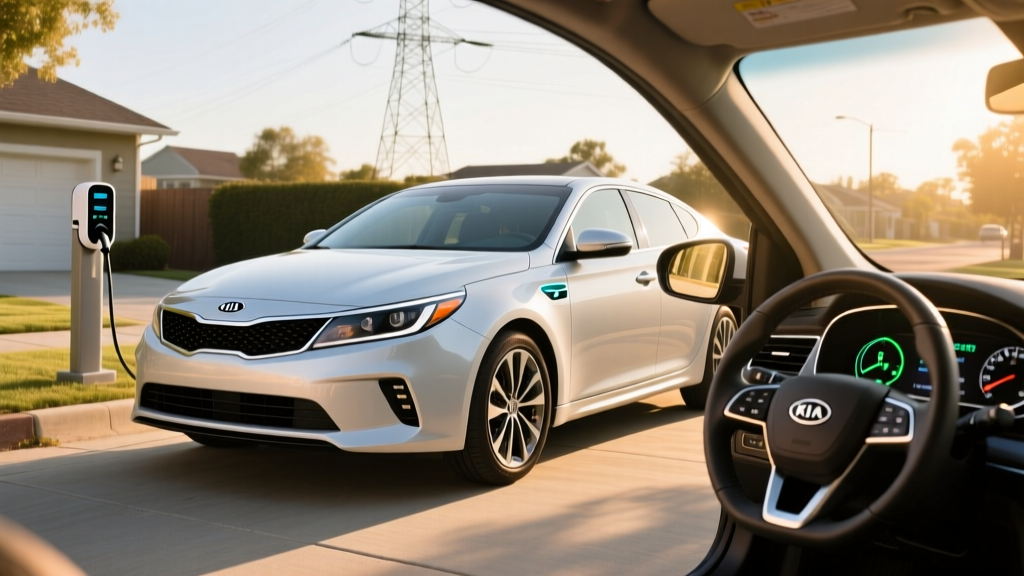
2012 Kia Optima Hybrid: Quick Verdict
The 2012 Kia Optima Hybrid is a conventional hybrid electric vehicle (HEV) — not a plug-in — that pairs a 2.4-liter four-cylinder engine with an electric motor and a compact lithium-polymer battery. With EPA ratings of 34 city / 39 highway / 36 combined MPG, it remains one of the more efficient midsize sedans from its era. In 2026, this car is strictly a used-market proposition, and its value hinges on one question: how much life is left in the hybrid battery?
This guide covers the real-world fuel economy, powertrain specs, battery longevity data, replacement costs, and whether the 2012 Optima Hybrid still makes sense compared to newer hybrids or a full EV.
Fuel Economy: EPA Ratings vs. Real-World MPG
| Metric | MPG |
|---|---|
| City | 34 MPG |
| Highway | 39 MPG |
| Combined | 35 MPG (revised EPA figure; originally rated 36) |
| Annual fuel cost* | ~$1,550 (15,000 mi/yr at $3.40/gal) |
*Source: fueleconomy.gov
Real-World MPG: What Owners Actually Report
Conventional hybrids like the Optima HEV typically match or exceed EPA city estimates because regenerative braking recovers more energy in stop-and-go traffic. Highway driving is less efficient because the electric motor assists less at sustained speeds. Based on aggregated owner data from Fuelly and EPA user reports:
- City / suburban driving: 33–37 MPG — close to or slightly above EPA
- Highway (70+ mph): 35–38 MPG — slight drop from the 39 EPA sticker
- Cold weather (below 30°F): 28–32 MPG — the engine runs more frequently to maintain cabin heat and battery temperature
- Combined real-world average: 33–35 MPG
The gap between EPA and real-world is modest compared to early-model-year hybrids from other brands. However, a 2012 vehicle with 120,000+ miles may see 1–3 MPG degradation if the hybrid battery has lost capacity, since the system relies more on the gasoline engine.
Powertrain: Engine, Motor, and Combined Output
| Component | Specification |
|---|---|
| Engine | 2.4L Atkinson-cycle inline-4 |
| Engine output | 169 hp / 156 lb-ft torque |
| Electric motor | 47 hp (35 kW), permanent-magnet synchronous |
| Combined system output | 206 hp / 195 lb-ft torque |
| Transmission | 6-speed automatic (no CVT) |
| Hybrid battery | 1.4 kWh lithium-polymer (air-cooled) |
| 0–60 mph | ~9.2 seconds |
| Drivetrain | Front-wheel drive |
| Curb weight | ~3,496 lbs |
How the Powertrain Works (HEV, Not PHEV)
The 2012 Optima Hybrid is a conventional hybrid (HEV). It cannot plug in and has no electric-only driving range of practical significance. The 1.4 kWh battery provides brief low-speed electric assist (roughly 0.5–1 mile at very low speeds under ideal conditions), but the gasoline engine is always the primary propulsion source. The battery recharges exclusively through regenerative braking and engine-driven generation.
Kia chose a traditional 6-speed automatic rather than the CVT or planetary-gear e-CVT found in the Toyota Camry Hybrid or Ford Fusion Hybrid of the same era. This gives the Optima Hybrid a more natural, stepped shifting feel that some drivers prefer, but it sacrifices a fraction of efficiency in seamless power blending.
Hybrid vs. Plug-In Hybrid vs. Full EV: Which Fits You?
HEV (This Car: 2012 Optima Hybrid)
- No plug required — refuel at any gas station
- 35 MPG combined saves ~$500–700/yr vs. a 25 MPG gas sedan
- No range anxiety, no charging infrastructure needed
- Lower upfront cost (used market: $4,000–$7,500 in 2026)
PHEV (e.g., Toyota RAV4 Prime, Kia Niro PHEV)
- 25–42 miles electric-only before the engine starts
- Plug in at home or public chargers to unlock EV miles
- Requires access to Level 1 (120V) or Level 2 (240V) charging
- Higher purchase price but potential §30D tax credit on new models
Full EV (BEV — e.g., Tesla Model 3, Hyundai Ioniq 5)
- 250–350+ miles EPA range, zero tailpipe emissions
- Requires reliable home or workplace charging
- Lowest per-mile fuel cost (~$0.04–0.06/mi on home electricity)
- Highest upfront cost but lowest operating cost
Choose the 2012 Optima Hybrid if: You want fuel savings without changing your refueling habits, have no access to home charging, and are on a tight used-car budget.
Look at a PHEV or BEV instead if: You have home charging, drive under 40 miles daily (PHEV), or want to eliminate gas entirely (BEV).
Battery Lifespan, Warranty, and Replacement Cost
Original Kia Hybrid Battery Warranty
When new, Kia covered the 2012 Optima Hybrid's battery with a 10-year / 100,000-mile warranty (10 years or 100,000 miles, whichever comes first). For the original owner, this coverage expired in 2022 at the latest. In most states, the warranty is tied to the vehicle, not the owner, but the 10-year clock has run out on every 2012 model regardless of mileage.
Note: In California-emissions states (CARB states), hybrid battery warranties were sometimes extended to 10 years / 150,000 miles. Check your specific vehicle's warranty booklet or contact a Kia dealer with the VIN to confirm any remaining coverage — though for a 2012 model, even extended coverage has almost certainly expired by 2026.
How Long Does the Battery Actually Last?
The 2012 Optima Hybrid uses a 1.4 kWh lithium-polymer (Li-Po) battery pack manufactured by LG Chem. Lithium-polymer chemistry in this era was relatively robust, and Kia's air-cooling system, while simple, avoided the thermal degradation risks of poorly managed liquid-cooled systems.
Based on owner reports and hybrid battery failure data aggregated through 2025:
- Typical lifespan: 10–14 years / 120,000–180,000 miles before noticeable capacity loss
- Failure mode: Gradual capacity reduction (not sudden death), leading to 2–5 MPG loss as the engine compensates
- Complete failure: Rare before 150,000 miles; when it occurs, the vehicle throws a hybrid system warning and may enter limp mode
In 2026, most surviving 2012 Optima Hybrids have 100,000–160,000 miles on them. If the original battery has not been replaced, it is likely in the later stages of its useful life. Budget accordingly.
Battery Replacement Cost
| Option | Estimated Cost | Notes |
|---|---|---|
| New OEM battery (Kia dealer) | $2,800–$3,800 | Includes parts + labor; dealer-only sourcing |
| Refurbished / reconditioned pack | $1,500–$2,200 | Third-party hybrid shops; 1–3 year warranty typical |
| Used salvage battery | $800–$1,400 | High risk — unknown remaining life; not recommended |
| Cell-level repair (individual module replacement) | $600–$1,200 | Specialist shops only; viable if only a few cells are weak |
For a car worth $4,000–$7,500 on the used market, a full OEM battery replacement at $3,500+ represents a significant percentage of the vehicle's value. A refurbished pack from a reputable hybrid specialist is often the most economical choice for a car you plan to keep another 3–5 years.
Pricing, Tax Credits, and Ownership Economics
Used Market Pricing (2026)
The 2012 Kia Optima Hybrid trades on the used market in the following ranges, depending on mileage, condition, and battery health:
- Fair condition (140K+ mi, battery may need replacement): $3,500–$5,000
- Good condition (100K–130K mi, battery healthy or recently replaced): $5,500–$7,500
- Excellent / low miles (under 90K mi): $7,500–$9,000 (rare)
Does the 2012 Optima Hybrid Qualify for a Tax Credit?
No. The 2012 Kia Optima Hybrid does not qualify for any federal tax credit in 2026:
- The original federal hybrid tax credit for the Optima Hybrid expired years ago (Kia's credit allocation was exhausted, and the program had phase-out caps per manufacturer).
- The current IRS §30D Clean Vehicle Credit applies only to new plug-in vehicles (PHEVs and BEVs) meeting battery-sourcing, MSRP, and buyer-income requirements. Conventional hybrids (HEVs) have never qualified for §30D.
- The Used Clean Vehicle Credit (up to $4,000 or 30% of sale price) also requires the vehicle to be a plug-in EV or fuel-cell vehicle. HEVs are excluded.
- Some states offer their own incentives for hybrids, but these are rare and vary by jurisdiction. Check your state's energy or environmental agency for current programs.
5-Year Ownership Cost Estimate
| Category | Estimated Cost |
|---|---|
| Purchase price | $6,000 |
| Fuel (35 MPG avg, $3.40/gal, 75,000 mi) | $7,286 |
| Insurance (avg $1,200/yr × 5) | $6,000 |
| Maintenance & repairs (incl. potential battery) | $3,500–$5,500 |
| Depreciation (to ~$2,500 residual) | $3,500 |
| Total 5-year cost | $26,286–$28,286 |
| Cost per mile | $0.35–$0.38 |
Compared to a similarly aged gas-only midsize sedan getting 24 MPG combined, the Optima Hybrid saves roughly $2,500–$3,200 in fuel over five years — enough to offset a hybrid battery replacement if one is needed.
Reliability and Common Issues
The 2012 Optima Hybrid received mixed reliability marks. The conventional powertrain (engine, transmission) is generally durable, but the hybrid-specific components and some non-powertrain electronics have known weak points:
Known Issues to Watch For
- Hybrid battery degradation: The primary concern. Symptoms include reduced MPG, more frequent engine cycling, and reduced regenerative braking feel.
- Hybrid system inverter: Rare failures reported; replacement cost $1,500–$2,500. Check for any hybrid system warning lights.
- Electric water pump: Some units fail around 80,000–120,000 miles. Listen for unusual coolant pump noise and check for cooling system warnings.
- Brake actuator: The electrohydraulic brake system is more complex than a conventional brake booster. Replacement runs $800–$1,500 if the actuator fails.
- Theta II engine recall: The 2.4L engine in some 2011–2014 Kia/Hyundai vehicles was subject to a major recall for connecting-rod bearing wear and potential engine seizure. Check NHTSA recall status using the VIN at nhtsa.gov/recalls before purchasing. If the recall repair was not performed, the engine is at risk.
Pre-Purchase Checklist
- Run the VIN through NHTSA's recall database — confirm Theta II engine recall was addressed
- Get a hybrid battery health report from a Kia dealer or hybrid specialist (state-of-health percentage)
- Check for hybrid system warning codes with an OBD-II scanner that supports hybrid-specific PIDs
- Test regenerative braking — it should feel smooth and consistent, not grabby or weak
- Verify the 12V auxiliary battery is in good condition (separate from the hybrid traction battery)
Who Should Buy the 2012 Kia Optima Hybrid?
Good Fit
- Budget-conscious buyers needing a reliable commuter at $5,000–$7,500
- Drivers without home charging access who still want better fuel economy
- Urban / suburban commuters who benefit from hybrid efficiency in stop-and-go traffic
- Those who want a spacious midsize sedan (104.3 cu-ft passenger volume, 15.4 cu-ft trunk)
Look Elsewhere
- Buyers who want electric-only driving or plug-in capability
- Those unwilling to risk a $2,000–$3,500 hybrid battery replacement
- Drivers in extremely cold climates where hybrid efficiency drops significantly
- Anyone seeking modern ADAS features (the 2012 model has basic stability control and ABS but no automatic emergency braking, lane-keeping, or adaptive cruise)
Frequently Asked Questions
How many MPG does the 2012 Kia Optima Hybrid get?
The EPA rates the 2012 Optima Hybrid at 34 city / 39 highway / 35 combined MPG. Real-world driving typically yields 33–35 MPG combined, with city driving sometimes reaching 36–37 MPG and cold-weather highway driving dropping to 28–32 MPG.
Does the 2012 Optima Hybrid need to be plugged in?
No. This is a conventional hybrid (HEV). It charges its own battery through regenerative braking and the gasoline engine. There is no plug and no meaningful electric-only range.
How far can it drive on electric power alone?
Under ideal conditions at very low speeds (under 25 mph), the Optima Hybrid can creep roughly 0.5–1 mile on electric power before the engine engages. This is not practical electric-only driving — it's brief low-speed assist. For meaningful electric range, you need a PHEV or BEV.
Is the 2012 Optima Hybrid reliable?
The gasoline powertrain is generally reliable if the Theta II engine recall was performed. The hybrid battery is the main risk factor at this age — expect potential degradation or failure if the original battery is still in the car. Overall reliability is average for a 14-year-old hybrid sedan.
What does it cost to replace the hybrid battery?
A new OEM battery from a Kia dealer costs $2,800–$3,800 installed. Refurbished packs from hybrid specialists run $1,500–$2,200. Cell-level repairs (replacing individual weak modules) cost $600–$1,200 at specialist shops.
Does the 2012 Kia Optima Hybrid qualify for any tax credit?
No. Federal §30D credits and the Used Clean Vehicle Credit apply only to plug-in vehicles (PHEVs and BEVs). Conventional hybrids are not eligible. The original Kia hybrid credit was also exhausted years ago. No federal tax incentive is available for this vehicle in 2026.
How does it compare to a Toyota Camry Hybrid of the same year?
The 2012 Toyota Camry Hybrid (43 city / 39 highway / 41 combined MPG) is significantly more fuel-efficient thanks to Toyota's e-CVT planetary gear system. The Optima Hybrid offers a more conventional driving feel with its 6-speed automatic but sacrifices 5–6 MPG combined. Camry Hybrid batteries also tend to last longer, though used pricing is typically $1,000–$2,000 higher.
Should I buy this or a newer used EV instead?
If you have home charging and can spend $15,000–$22,000, a used EV like a 2019–2021 Nissan Leaf (150–226 mi range) or a 2018–2020 Chevrolet Bolt EV (238–259 mi range) will offer dramatically lower per-mile fuel costs (~$0.05/mi electricity vs. ~$0.10/mi gasoline) and zero tailpipe emissions. However, the Optima Hybrid remains a strong choice if your budget is under $8,000 or you lack reliable charging access.