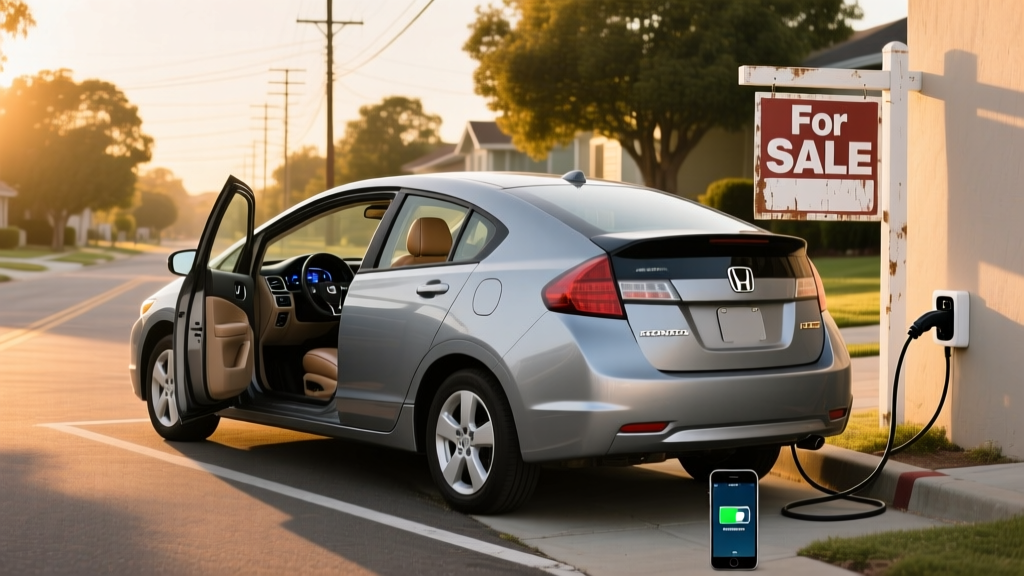
The 2012 Honda Insight hybrid occupies a specific niche in the used-car market: an affordable, fuel-sipping commuter that Honda built to challenge the Toyota Prius on price. More than a decade after its production run ended, the Insight remains a budget-friendly entry point for drivers who want hybrid fuel economy without the complexity of a plug-in vehicle. But in 2026 — with modern hybrids offering 50+ MPG and plug-in hybrids delivering 30–40 miles of electric-only range — does a 2012 Insight still make financial sense? This guide breaks down the real-world numbers, battery longevity, and ownership economics you need before buying one.
What Is the 2012 Honda Insight? HEV vs. PHEV Explained
The 2012 Honda Insight is a conventional hybrid electric vehicle (HEV). It is not a plug-in hybrid (PHEV) and does not have a charging port. The Insight uses Honda's Integrated Motor Assist (IMA) system — a parallel hybrid architecture where a small electric motor sandwiched between the gasoline engine and the CVT transmission provides supplemental torque during acceleration and enables regenerative braking. The battery recharges exclusively through the engine and regen; you never plug it in.
HEV vs. PHEV — Where the Insight Falls
| Feature | HEV (2012 Insight) | PHEV (e.g., 2026 Prius Prime) | BEV (e.g., 2026 Bolt) |
|---|---|---|---|
| Plug-in charging | No | Yes | Yes |
| Electric-only driving | Minimal (~1 mi at low speed) | 30–44 miles | 200–350+ miles |
| Battery size | 0.6 kWh (NiMH) | 13.6 kWh (Li-ion) | 65 kWh (Li-ion) |
| Gasoline engine | Yes (primary) | Yes (backup) | No |
| Federal tax credit (§30D) | Not eligible | Up to $7,500 (new only) | Up to $7,500 (new/used) |
This distinction matters because some buyers conflate "hybrid" with "plug-in." The Insight's IMA system is simpler, lighter, and cheaper to maintain than a PHEV powertrain, but it offers no all-electric commuting capability. If your goal is zero-emission daily driving, you need a PHEV or BEV.
Fuel Economy: EPA Ratings and Real-World MPG
The 2012 Insight's headline number was always its fuel economy. According to fueleconomy.gov (EPA), the 2012 Honda Insight is rated as follows:
| Driving Cycle | EPA Rating |
|---|---|
| City | 41 MPG |
| Highway | 44 MPG |
| Combined | 42 MPG |
Real-World MPG: What Owners Actually See
In practice, the 2012 Insight's real-world fuel economy tends to track close to — and sometimes exceed — EPA estimates in city driving, where regenerative braking recovers the most energy. Owner-reported data on Fuelly and similar platforms shows a median lifetime average of 40–43 MPG combined for drivers with mixed commuting patterns.
However, highway-dominant drivers should expect 38–41 MPG on extended freeway trips at 70+ mph. The Insight's 1.3L i-VTEC engine (98 hp combined with the IMA motor) is optimized for low-speed efficiency, and aerodynamic drag at highway speeds erodes its advantage. Cold-weather operation (below 40°F) typically drops fuel economy by 3–5 MPG due to extended engine warm-up cycles and increased battery internal resistance in the NiMH pack.
For context, a 2026 Toyota Prius achieves an EPA-estimated 57 MPG combined — a 36% improvement over the 2012 Insight. The efficiency gap reflects over a decade of advances in battery chemistry, engine thermal efficiency, and aerodynamics.
Powertrain Specs: Engine, Motor, and Performance
| Specification | 2012 Honda Insight |
|---|---|
| Engine | 1.3L i-VTEC inline-4 |
| Engine horsepower | 88 hp @ 5,800 rpm |
| IMA electric motor | 10 kW (13 hp) |
| Combined system output | 98 hp |
| Combined torque | 123 lb-ft |
| Transmission | CVT (continuously variable) |
| Drivetrain | FWD |
| 0–60 mph | ~10.5 seconds |
| Curb weight | ~2,800 lbs |
| Hybrid battery | 0.6 kWh NiMH (nominal) |
| Fuel tank | 10.6 gallons |
| Total range (estimated) | ~445 miles |
The IMA system is modest by modern standards. The 10 kW electric motor provides a torque fill during initial acceleration but cannot propel the car on electric power alone at meaningful speeds. Honda's IMA architecture is best understood as an engine-assist hybrid rather than a full hybrid like Toyota's Hybrid Synergy Drive, which can drive the wheels electrically at low speeds without the engine running.
The result is adequate but uninspiring performance. The 10.5-second 0–60 time means highway merging requires planning, and steep grades will tax the powertrain. The CVT keeps engine RPM in its efficiency sweet spot, but the characteristic "rubber-band" feel is noticeable during hard acceleration.
Hybrid Battery Reliability and Replacement Cost
2012 Insight Hybrid Battery: Key Facts
- Chemistry: Nickel-Metal Hydride (NiMH)
- Original warranty: 8 years / 100,000 miles (10 years / 150,000 miles in CARB states including CA, NY, MA, and others)
- Current warranty status: Expired on all 2012 models as of 2022
- Expected lifespan: 120,000–180,000 miles with normal use
- Replacement cost (OEM Honda): $2,000–$3,000 installed
- Replacement cost (remanufactured/aftermarket): $1,000–$1,800 installed
- Reconditioning (individual cell replacement): $400–$800 at specialist shops
Is the 2012 Insight Reliable?
Honda's IMA system has a strong reliability track record. The NiMH battery pack is less energy-dense than modern lithium-ion but is thermally robust and degrades more gracefully. Most 2012 Insights still on the road have their original IMA batteries, though capacity loss of 15–25% is typical at 120,000+ miles.
Common failure signs include:
- IMA warning light on dashboard
- Reduced regenerative braking feel
- Lower observed MPG (dropping to 35–37 combined)
- Engine running more frequently at stops (auto-stop feature disabled)
If you're evaluating a used 2012 Insight, ask for a battery state-of-health readout from a Honda dealer or hybrid specialist. The IMA battery's relatively small size (0.6 kWh) means replacement is far cheaper than a modern PHEV or BEV pack — a $1,200–$1,800 remanufactured pack from suppliers like BumbleBee Batteries or GreenTech can restore full function and add another 100,000+ miles of service life.
Beyond the hybrid system, the 2012 Insight's conventional components (brakes, suspension, CVT) are generally reliable. The CVT has fewer failure reports than comparable Nissan CVTs of the era. According to NHTSA data, the 2012 Insight has minimal safety recalls — check the VIN on nhtsa.gov/recalls before purchasing.
Pricing and Tax Credit Eligibility in 2026
The 2012 Honda Insight originally sold with an MSRP starting around $18,600 (base LX trim) and topping out near $23,000 (EX with navigation). In today's used market, expect to pay:
| Condition | Mileage Range | Typical Used Price (2026) |
|---|---|---|
| Excellent (dealer CPO-equivalent) | 60,000–90,000 mi | $7,500–$9,500 |
| Good (private party, well-maintained) | 90,000–130,000 mi | $5,000–$7,500 |
| Fair (higher miles, cosmetic wear) | 130,000–180,000 mi | $3,000–$5,000 |
Does the 2012 Insight Qualify for Any Tax Credit?
No. The 2012 Honda Insight does not qualify for the federal §30D Clean Vehicle Credit. The credit applies only to new plug-in electric vehicles (BEVs and PHEVs) meeting battery sourcing, MSRP, and buyer income requirements. Conventional hybrids like the Insight have never been eligible for §30D.
The now-expired Used Clean Vehicle Credit (§25E) — which offered up to $4,000 or 30% of the sale price for qualifying used EVs and PHEVs — also excluded conventional hybrids. As of 2026, there is no federal tax incentive for purchasing a used HEV.
Some states offer registration or HOV-lane perks for hybrids, but most of these programs have sunset or been restricted to PHEVs and BEVs. Check your state's DMV or energy office for current rules.
Who Should Buy the 2012 Insight — And Who Shouldn't
Pros
- Affordable entry price ($4,000–$8,000 used)
- Strong real-world MPG (40–43 combined)
- Low battery replacement cost vs. PHEV/BEV
- Honda build quality and parts availability
- Lightweight, easy to park, tight turning radius
- No plug-in charging required
Cons
- Modest 98 hp — slow acceleration
- Outdated infotainment (no Apple CarPlay/Android Auto)
- Cramped rear seat and small cargo area
- Highway MPG drops at 70+ mph
- Expired hybrid battery warranty
- No federal or state tax incentives
Choose the 2012 Insight If:
- You need a low-cost commuter for city/suburban driving under 40 miles round-trip
- Your budget is under $8,000 and you want hybrid-level fuel economy
- You lack access to home or workplace charging (no plug needed)
- You want minimal maintenance costs and simple hybrid mechanics
Look Elsewhere If:
- You commute mostly on highways at 70+ mph (a modern Prius or Corolla Hybrid is far more efficient)
- You want electric-only driving for short trips (consider a used PHEV like the 2017–2020 Prius Prime)
- You need back-seat space for adults or significant cargo volume
- You want modern safety tech (automatic emergency braking, lane-keeping) — the 2012 Insight has none of these
2012 Insight vs. Modern Hybrids: How Does It Compare?
| Vehicle | EPA Combined MPG | System HP | Used/New Price (2026) | Tax Credit |
|---|---|---|---|---|
| 2012 Honda Insight (HEV) | 42 MPG | 98 hp | $4,000–$9,500 (used) | None |
| 2026 Toyota Prius LE (HEV) | 57 MPG | 196 hp | ~$28,350 (new) | None |
| 2026 Toyota Prius Prime (PHEV) | 52 MPG + 44 mi EV | 220 hp | ~$33,775 (new) | Up to $7,500 (§30D) |
| 2026 Hyundai Elantra Hybrid (HEV) | 54 MPG | 139 hp | ~$26,500 (new) | None |
| 2026 Honda Accord Hybrid (HEV) | 48 MPG | 204 hp | ~$33,000 (new) | None |
The efficiency and performance gap is significant. A new 2026 Prius delivers 36% better fuel economy with twice the horsepower, plus modern ADAS features (Toyota Safety Sense 3.0) and infotainment. However, the price gap is equally significant: a new Prius costs 3–5× more than a used 2012 Insight. The math depends on your annual mileage, budget, and how long you plan to keep the car.
Break-even example: Driving 15,000 miles/year at $3.40/gallon, the 2012 Insight (42 MPG) costs ~$1,214/year in fuel. The 2026 Prius (57 MPG) costs ~$895/year — saving $319/year. That fuel savings would take over 20 years to offset the ~$20,000 price premium of a new Prius. For budget-conscious buyers, the used Insight's economics still hold up.
Frequently Asked Questions
How many MPG does the 2012 Honda Insight hybrid get?
The EPA rates the 2012 Insight at 41 city / 44 highway / 42 combined MPG. Real-world owner averages cluster around 40–43 MPG combined, with city-heavy drivers often exceeding the EPA estimate and highway-dominant drivers seeing 38–41 MPG.
Does the 2012 Insight need to be plugged in?
No. The 2012 Insight is a conventional hybrid (HEV), not a plug-in hybrid. Its NiMH battery recharges through the gasoline engine and regenerative braking. There is no charging port.
How long does the 2012 Insight's hybrid battery last?
Honda's NiMH IMA batteries typically last 120,000–180,000 miles before significant capacity loss. Many 2012 Insights still run on original batteries, though degraded performance (lower MPG, less regen) is common past 150,000 miles. The original 8-year/100,000-mile warranty has expired on all 2012 models.
What does it cost to replace the 2012 Insight hybrid battery?
A remanufactured IMA battery pack costs $1,000–$1,800 installed. OEM Honda replacement runs $2,000–$3,000. Individual cell reconditioning by a hybrid specialist can cost as little as $400–$800. These costs are far lower than modern PHEV or BEV battery replacements.
Is the 2012 Honda Insight reliable overall?
Yes. The IMA hybrid system is one of Honda's most proven powertrains, and the 1.3L engine is simple and durable. The CVT has a better reliability record than comparable Nissan units. Main concerns are age-related: worn suspension bushings, aging A/C components, and potential hybrid battery degradation at high mileage.
Hybrid vs. PHEV vs. EV — which is right for me?
A conventional hybrid (HEV) like the 2012 Insight is best if you lack charging access, want low upfront cost, and drive a mix of city/highway. A plug-in hybrid (PHEV) suits drivers who can charge at home and want 30–44 miles of electric-only commuting with gas-engine backup for longer trips. A full EV (BEV) makes sense if you have reliable charging, drive under 250 miles/day, and want zero tailpipe emissions with minimal maintenance. For a budget under $8,000, the HEV is the only realistic option.
Does the 2012 Insight qualify for any federal tax credit?
No. The federal §30D Clean Vehicle Credit and the §25E Used Clean Vehicle Credit apply only to plug-in vehicles (BEVs and PHEVs). Conventional hybrids have no federal tax incentive. Some states previously offered hybrid rebates or HOV access, but most have ended or been limited to plug-in vehicles.
How does the 2012 Insight compare to a Toyota Prius of the same year?
The 2012 Toyota Prius (third generation) achieves an EPA 50 MPG combined vs. the Insight's 42 MPG, and offers more interior space and a more powerful hybrid system (134 hp combined). However, used 2012 Priuses typically command $2,000–$4,000 more than comparable Insights. If you prioritize maximum fuel economy and don't mind paying a premium, the Prius is the stronger hybrid. If budget is the primary concern, the Insight delivers strong efficiency per dollar.