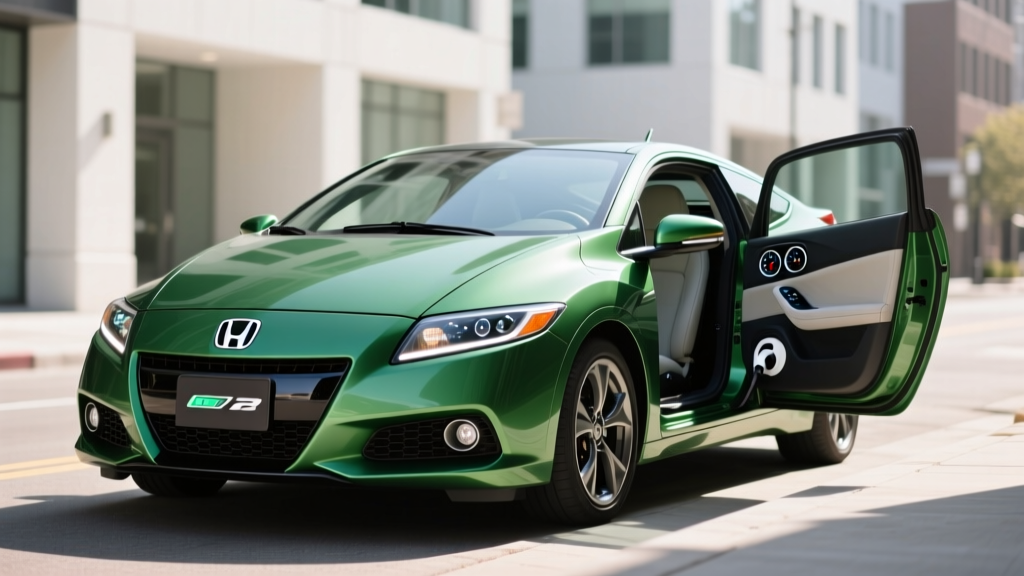
The 2012 Honda CR-Z occupies a strange corner of hybrid history: a two-seat, manual-transmission sport coupe that prioritized driving engagement over maximum efficiency. Discontinued after the 2016 model year, the CR-Z is now strictly a used-car proposition. But with examples selling for $6,000–$12,000 in 2026, it draws attention from budget-conscious commuters and hybrid-curious drivers who want something more interesting than a Prius. This guide covers what you need to know before buying one — real-world fuel economy, IMA battery health, replacement costs, and how it stacks up against modern hybrids and EVs.
2012 Honda CR-Z Hybrid: Quick Verdict
The CR-Z uses Honda's Integrated Motor Assist (IMA) system — a mild hybrid setup where a small electric motor assists the gasoline engine rather than driving the wheels independently. It cannot run on electric power alone, it does not plug in, and it is not a plug-in hybrid (PHEV). Think of it as a gas car with an electric turbocharger that improves stoplight efficiency and smooths acceleration.
For 2012, Honda offered the CR-Z with a 6-speed manual or a continuously variable transmission (CVT). The CVT model achieves better EPA numbers, while the manual sacrifices a few MPG for driver involvement. Neither variant qualifies for any federal tax credit today — the §30D credit applies only to new plug-in vehicles, and the CR-Z was never eligible even when new.
Fuel Economy: EPA Ratings vs Real-World MPG
The EPA rated the 2012 CR-Z differently depending on transmission choice. According to fueleconomy.gov, the CVT-equipped model earns 35 MPG city / 39 MPG highway / 37 MPG combined. The 6-speed manual drops to 31 city / 37 highway / 34 combined.
| Transmission | City MPG | Highway MPG | Combined MPG |
|---|---|---|---|
| CVT (Automatic) | 35 | 39 | 37 |
| 6-Speed Manual | 31 | 37 | 34 |
Real-World MPG: What Owners Actually Report
Like most Honda IMA hybrids, the CR-Z tends to meet or slightly exceed its EPA city estimate in stop-and-go traffic — regenerative braking recaptures energy that would otherwise be lost. Owner forums and Fuelly data cluster around 36–40 MPG combined for CVT models and 32–36 MPG for manuals, depending on driving style. Highway-heavy commutes at 75+ MPH will drop you toward the low 30s regardless of transmission.
Cold weather reduces efficiency by roughly 10–15% due to the engine running longer to heat the cabin (the IMA system has minimal waste heat compared to larger engines). Expect winter combined figures around 30–33 MPG for the CVT.
Powertrain and Hybrid System Specs
The CR-Z pairs a 1.5-liter inline-four engine with a 10-kW (13-hp) electric motor sandwiched between the engine and transmission. Combined output is 122 horsepower and 128 lb-ft of torque (127 lb-ft with the manual). The electric motor fills in the torque gap at low RPM, giving the car a punchier feel than its modest displacement suggests.
| Specification | Value |
|---|---|
| Gas Engine | 1.5L i-VTEC inline-4, 111 hp |
| Electric Motor | 10 kW (13 hp), integrated (IMA) |
| Combined Output | 122 hp / 128 lb-ft (CVT), 127 lb-ft (MT) |
| IMA Battery | 0.5 kWh nickel-metal hydride (NiMH) |
| Transmission Options | 6-speed manual or CVT |
| Drivetrain | Front-wheel drive |
| Curb Weight | ~2,690 lbs (manual), ~2,735 lbs (CVT) |
| 0–60 MPH | ~9.1 seconds (estimated) |
HEV vs PHEV: Why the CR-Z Is a Conventional Hybrid
The CR-Z is a conventional hybrid (HEV), not a plug-in hybrid (PHEV). Here's the critical distinction:
- 0.5 kWh battery, charged only by regen and engine
- Never plugs in
- Electric motor assists engine; no EV-only driving
- Gasoline provides 100% of propulsion energy
- 10–25 kWh battery, charges via plug or regen
- Plugs into Level 1 or Level 2 charger
- 20–50 miles of electric-only driving before engine starts
- Can run entirely on electricity for short trips
The CR-Z's 0.5 kWh NiMH battery stores a tiny amount of energy — just enough to smooth acceleration, enable brief engine-off coasting, and capture braking energy. You will never see an "EV mode" range display because the car cannot drive on electricity alone.
IMA Battery Health, Lifespan, and Replacement Cost
The IMA battery is the single biggest concern for any used CR-Z buyer. Honda's nickel-metal hydride (NiMH) pack is rated for a hybrid battery warranty of 8 years / 100,000 miles (10 years / 150,000 miles in California Air Resources Board states). Since the newest CR-Z rolled off the line in 2016, every example has aged out of its original factory warranty as of 2026.
Signs of IMA Battery Degradation
- IMA warning light on the dashboard — the most obvious indicator
- Reduced assist: the electric motor provides less boost during acceleration
- Lower MPG: without regen working properly, fuel economy drops noticeably
- Recalibration cycling: you notice the battery gauge dropping and recharging frequently while driving
- OBD-II codes: P0A7F (hybrid battery pack deterioration) or similar codes appear on a scan tool
Replacement Costs
IMA battery replacement options for the 2012 CR-Z in 2026:
| Option | Approximate Cost | Notes |
|---|---|---|
| OEM Honda dealer replacement | $2,500–$3,500 | New NiMH pack, includes labor; most reliable |
| Aftermarket/remanufactured pack | $1,200–$2,000 | Rebuilt with new cells; 1–3 year warranty typical |
| DIY cell replacement | $200–$500 | Replace individual NiMH sticks; requires skill and risk tolerance |
| Used salvage pack | $400–$800 | From a wrecked CR-Z; unknown remaining life — risky |
Many CR-Z owners report IMA batteries lasting 120,000–160,000 miles before significant degradation. If you're buying a CR-Z with under 100,000 miles and the battery hasn't been replaced, it may still have useful life — but request an OBD-II scan to check battery state of health before purchase.
Driving Experience and Practicality
The CR-Z was designed as a spiritual successor to the Honda CRX — lightweight, nimble, and fun on a back road. At roughly 2,700 pounds, it's nearly 600 lbs lighter than a Toyota Prius, and that shows in cornering agility. The steering is direct, the shifter (on manual models) is classic Honda-precise, and the low-slung seating position feels sporty.
The trade-offs are practical: rear visibility is compromised by the split rear window, there is no back seat (just a small parcel shelf), and cargo space is limited to 25.1 cubic feet behind the front seats. It's a commuter for one or two people, not a family hauler.
Honda included a 3-mode drive system — ECON, Normal, and Sport — that adjusts throttle response, steering assist, and (on CVT models) transmission behavior. Sport mode sharpens the IMA assist delivery, making the car feel livelier at the expense of a few MPG.
Reliability, Safety, and Ownership Costs
Honda's IMA system is one of the simplest hybrid architectures ever built. There's no high-voltage battery cooling system, no complex power-split device, and no electric-only drivetrain to maintain. The 1.5L engine is proven and parts are widely available. Major reliability concerns center almost entirely on the IMA battery, which we covered above.
The 2012 CR-Z earned a Good rating in most IIHS crash tests (Moderate Overlap Front, Side, Roof Strength, Head Restraints), though it received a Marginal rating in the small overlap front test introduced later. NHTSA gave it 4 out of 5 stars overall.
Insurance costs are low — the CR-Z is a 130-hp coupe with a clean safety record. Expect annual premiums around $900–$1,300 depending on your profile. Maintenance is straightforward Honda: oil changes, brake pads (which last longer thanks to regenerative braking), and typical wear items.
Tax Credit Eligibility
The 2012 Honda CR-Z does not qualify for any federal tax credit. The IRS §30D credit applies only to new plug-in electric vehicles (BEVs and PHEVs) with sufficient battery capacity. The CR-Z is a conventional hybrid with a 0.5 kWh battery that doesn't plug in. Even when sold new, it was not eligible for the federal hybrid credit that existed pre-2011. No state-level incentives for conventional hybrids remain widely available in 2026.
CR-Z vs Modern Hybrids and EVs: What's Changed
The CR-Z is a product of early-2010s hybrid philosophy: mild assist, tiny battery, driver engagement. Modern hybrids have moved far beyond this approach. Here's how it compares to what's available in 2026:
| Vehicle | Combined MPG | HP | Seats | Price Range (2026) |
|---|---|---|---|---|
| 2012 Honda CR-Z (CVT) | 37 | 122 | 2 | $6,000–$12,000 |
| 2026 Toyota Prius (HEV) | 57 | 194 | 5 | $29,445+ (new) |
| 2026 Toyota Prius Prime (PHEV) | 52 + 44 mi EV | 220 | 5 | $34,045+ (new) |
| 2026 Honda Civic Hybrid | 49 | 200 | 5 | $30,000+ (new) |
| Used 2020+ Toyota Corolla Hybrid | 52 | 121 | 5 | $18,000–$24,000 |
The efficiency gap is stark: modern hybrids like the current Prius achieve 57 MPG combined while delivering nearly 60% more horsepower. If your priority is pure fuel economy and practicality, a used 2020+ Corolla Hybrid or a new Civic Hybrid will serve you better. The CR-Z's appeal is emotional — it's a lightweight, manual-transmission hybrid coupe, and Honda has not built anything like it since.
Who Should Buy the 2012 CR-Z?
- You want a fun, lightweight sport coupe under $12,000
- You commute solo or with one passenger
- You prefer a manual transmission
- You value driving feel over maximum MPG
- You're comfortable budgeting for an IMA battery replacement
- You need rear seats or serious cargo space
- You want 50+ MPG (get a modern Prius or Civic Hybrid)
- You want electric-only driving (consider a PHEV or BEV)
- You want current safety tech (AEB, lane keeping, blind spot)
- You want a warranty-covered hybrid battery
Hybrid vs PHEV vs EV — Which Fits You?
If you're cross-shopping the CR-Z, here's a quick framework for the broader electrified-vehicle decision:
- Conventional hybrid (HEV) like the CR-Z: No plug needed, simple ownership, modest efficiency gains. Best for drivers without home charging access who want lower fuel costs without lifestyle changes.
- Plug-in hybrid (PHEV): 20–50 miles of electric-only range for daily commuting, gas engine for road trips. Best for drivers with home Level 2 charging who want EV-like daily driving without range anxiety. May qualify for up to $7,500 in federal tax credit (new purchases only, subject to IRS §30D eligibility including MSRP caps, income limits, and battery sourcing requirements).
- Battery electric vehicle (BEV): Zero tailpipe emissions, lowest per-mile fuel cost, fastest acceleration. Best for drivers with reliable home charging and predictable routes within range. Federal tax credit up to $7,500 available on qualifying new models.
Frequently Asked Questions
How many MPG does the 2012 Honda CR-Z hybrid get?
The EPA rates the CVT model at 35 city / 39 highway / 37 combined MPG. The 6-speed manual is rated at 31/37/34. In real-world driving, CVT owners commonly report 36–40 MPG combined, while manual owners see 32–36 MPG. Cold weather and aggressive driving reduce these figures by 10–15%.
Does the 2012 CR-Z plug in or have electric-only range?
No. The CR-Z is a conventional hybrid (HEV), not a plug-in hybrid. Its 0.5 kWh NiMH battery charges only through regenerative braking and the gasoline engine. It has zero electric-only driving range — the electric motor only assists the gas engine.
Is the 2012 CR-Z hybrid reliable?
Yes, with one caveat. The powertrain, suspension, and electronics are generally robust Honda components. The IMA hybrid battery is the weak link — NiMH packs typically last 120,000–160,000 miles before significant degradation. Since all 2012 models are now 14 years old, assume the battery will need replacement if it hasn't been done already.
What does a CR-Z IMA battery replacement cost?
Expect $2,500–$3,500 at a Honda dealer for a new OEM pack, $1,200–$2,000 for an aftermarket remanufactured unit, or $200–$500 for a DIY cell-level repair. The job is not overly complex — the IMA battery is located behind the seats and can be accessed without major disassembly.
Does the 2012 CR-Z qualify for any tax credit?
No. The federal §30D clean vehicle credit applies only to new plug-in vehicles (BEVs and PHEVs). The CR-Z is a conventional hybrid that doesn't plug in, and it was never eligible for federal incentives. No state hybrid credits remain broadly available in 2026.
How does the CR-Z compare to a Toyota Prius?
The Prius delivers far more interior space, five seats, and 20 more MPG (57 combined in 2026 models). The CR-Z is lighter, more engaging to drive, and available with a manual transmission. If efficiency and practicality matter most, the Prius wins. If driving enjoyment and uniqueness matter more, the CR-Z has no direct rival.
Can the CR-Z run on electric power alone?
No. The IMA system cannot propel the car without the gasoline engine running. The electric motor provides assist only — typically up to 13 hp of boost during acceleration and energy capture during braking. There is no EV mode button or electric-only capability.