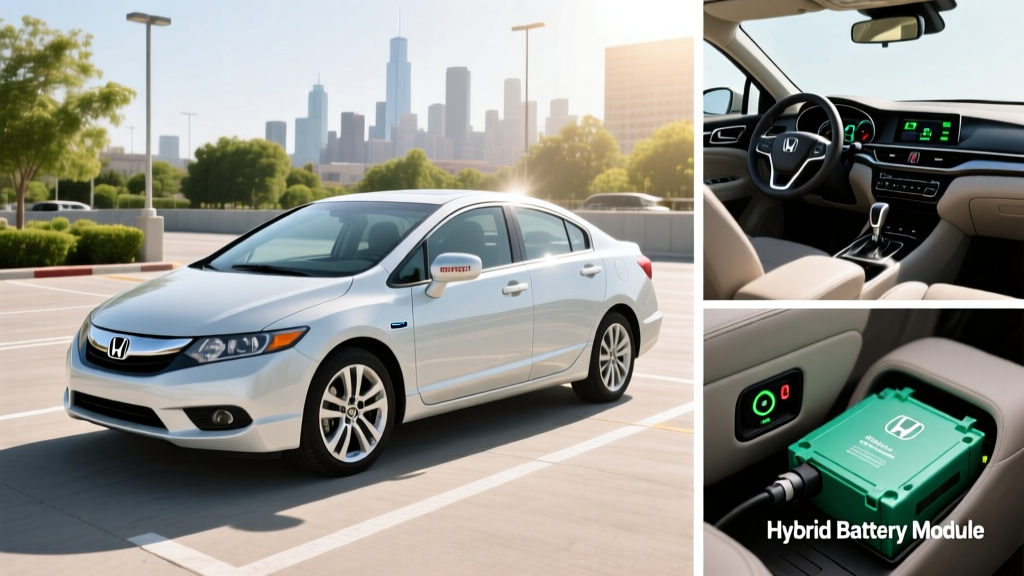
The 2012 Honda Civic Hybrid sedan occupies a specific niche in the used-car market: a compact, fuel-sipping conventional hybrid (HEV) from a brand known for longevity. Over a decade after its debut, buyers still search for this model because it represents an accessible entry point into hybrid ownership — no plug required, proven Honda engineering, and real-world fuel economy that holds up even by 2026 standards. But with hybrid battery age, evolving tax credit rules, and a flood of newer electrified options, does a 14-year-old Civic Hybrid still pencil out?
This guide breaks down the exact specs, real-world MPG data, battery health considerations, and ownership economics you need before purchasing a used 2012 Honda Civic Hybrid sedan.
HEV vs PHEV vs EV: Where the 2012 Civic Hybrid Fits
Before evaluating the car itself, it's critical to understand what the 2012 Civic Hybrid is — and what it isn't.
Conventional Hybrid (HEV) — This Car
The 2012 Civic Hybrid is a conventional hybrid (HEV). It uses a small electric motor paired with a gasoline engine, and its battery recharges through regenerative braking and engine power. You never plug it in. There is no electric-only driving range to speak of — the motor assists the engine but cannot propel the car independently at meaningful speeds or distances.
Plug-In Hybrid (PHEV)
A PHEV (like the Toyota RAV4 Prime or Chrysler Pacifica Hybrid) has a larger battery you charge via a plug, offering 20–50 miles of electric-only driving before the gas engine engages. Honda did not offer a Civic PHEV in 2012.
Battery Electric Vehicle (BEV)
A full EV (like the Chevrolet Bolt or Tesla Model 3) runs entirely on electricity with zero gasoline use. The 2012 Civic Hybrid shares no architecture with these vehicles.
This distinction matters because some used-car shoppers confuse "hybrid" with "plug-in." The 2012 Civic Hybrid requires nothing beyond regular gasoline and standard maintenance.
2012 Honda Civic Hybrid: Powertrain and Key Specs
| Specification | 2012 Honda Civic Hybrid |
|---|---|
| Powertrain Type | Conventional Hybrid (HEV) — Integrated Motor Assist (IMA) |
| Gas Engine | 1.5L inline-4 i-VTEC (90 hp, 97 lb-ft torque) |
| Electric Motor | IMA motor (20 hp, 58 lb-ft torque) |
| Combined Output | 110 hp @ 5,500 rpm / 127 lb-ft @ 1,000–3,500 rpm |
| Transmission | Continuously Variable Transmission (CVT) |
| Hybrid Battery | ~0.5 kWh nickel-metal hydride (NiMH), 158V nominal |
| Plug-In Charging | No — self-charging via regen and engine |
| EPA Fuel Economy | 44 city / 44 highway / 44 combined MPG |
| Fuel Tank | 13.2 gallons |
| Estimated Total Range | ~580 miles per tank |
| 0–60 mph | ~10.5 seconds |
| Drivetrain | Front-wheel drive |
| Cargo Volume | 10.4 cu ft (trunk; battery reduces space vs. gas Civic) |
| Curb Weight | ~2,853 lbs |
How Many MPG Does the 2012 Civic Hybrid Get?
The EPA rates the 2012 Honda Civic Hybrid at 44 MPG city, 44 highway, and 44 combined. This uniform rating across city and highway is unusual — most hybrids favor city driving where regenerative braking and electric assist shine. Honda's IMA system in this generation was tuned for consistency.
| Driving Condition | EPA Rating | Real-World Expectation |
|---|---|---|
| City | 44 MPG | 42–48 MPG (hybrids often exceed EPA in stop-and-go) |
| Highway | 44 MPG | 38–43 MPG (IMA assist diminishes at sustained high speed) |
| Combined | 44 MPG | 40–46 MPG depending on driving mix |
| Cold Weather (below 30°F) | N/A | 35–40 MPG (engine runs more for cabin heat, battery less efficient) |
Real-world note: According to fueleconomy.gov, user-reported averages for the 2012 Civic Hybrid cluster around 42–45 MPG combined. Drivers who do mostly suburban and city driving at moderate speeds often report exceeding the EPA estimate, while aggressive highway driving at 75+ mph or mountainous terrain can pull figures into the mid-30s. Cold weather reduces efficiency noticeably — expect a 10–15% drop in winter months due to increased engine runtime for heating and reduced NiMH battery performance.
For context, the non-hybrid 2012 Civic (1.8L, CVT) was rated at 28 city / 39 highway / 32 combined. The hybrid's 12-MPG combined advantage translates to roughly 130 fewer gallons per year at 15,000 miles — about $400–$500 in annual fuel savings depending on local gas prices.
Hybrid Battery Health, Warranty, and Replacement Cost
The single biggest concern for any used hybrid buyer is battery condition. The 2012 Civic Hybrid uses a nickel-metal hydride (NiMH) battery pack — not the lithium-ion chemistry found in modern EVs and PHEVs. NiMH batteries are robust but do degrade over time and mileage.
Original Battery Warranty
Honda covered the 2012 Civic Hybrid's IMA battery for 8 years / 80,000 miles (10 years / 150,000 miles in California and states adopting CARB emissions standards). As of 2026, every 2012 model year vehicle has aged out of factory battery warranty coverage regardless of mileage.
Expected Battery Lifespan
Honda IMA batteries in this generation typically last 120,000–180,000 miles before significant capacity loss triggers an IMA warning light. Many owners report original batteries lasting 150,000+ miles with normal use. However, a 2012 model in 2026 is 14 years old — age degrades NiMH chemistry even if mileage is low. Calendar aging matters.
Battery Replacement Cost
If the IMA battery fails, replacement options include:
- Honda dealer (OEM new): $2,500–$4,000 installed
- Aftermarket refurbished/remanufactured: $1,200–$2,200 installed
- DIY refurbished pack: $800–$1,500 (parts only; requires technical skill)
A failed IMA battery doesn't strand you — the car can still drive on the gasoline engine alone, but you lose most hybrid fuel economy benefits and acceleration assist. The car will also throw a check-engine/IMA warning and may fail emissions inspections in some states.
Pre-purchase tip: Before buying any used 2012 Civic Hybrid, check the IMA battery state of charge via the dashboard display. A healthy battery should charge and discharge smoothly during a test drive. Ask for maintenance records showing whether the battery was ever replaced. A recent aftermarket replacement may actually be preferable to a 14-year-old original.
Reliability and Long-Term Ownership Data
The 2012 Civic generation (including the Hybrid) has a mixed reliability reputation. The 2012 model year was part of the ninth-generation Civic, which drew criticism at launch for interior quality and ride refinement. However, the hybrid powertrain itself — specifically the IMA system — has proven durable.
Key reliability notes:
- IMA system: Generally reliable to 150K+ miles. The IMA motor is integrated into the transmission and rarely fails independently of the battery.
- CVT transmission: Honda's CVT in this era is adequate but not bulletproof. Some owners report shuddering or failure past 120,000 miles. A CVT fluid drain-and-fill every 30,000 miles extends life.
- Engine: The 1.5L i-VTEC is simple and long-lasting with regular oil changes.
- 12V battery: Like all cars, the standard 12V auxiliary battery needs replacement every 4–6 years. This is separate from the hybrid battery and inexpensive (~$150–$200).
For safety data, the 2012 Civic earned Good ratings from the IIHS in moderate overlap front and side impact tests, though it received a Marginal rating in the roof strength test (a common issue for compact cars of this era).
Pricing, Tax Credits, and the Used Hybrid Economics
As of 2026, the 2012 Honda Civic Hybrid sedan trades on the used market for approximately $5,500–$9,500 depending on mileage, condition, battery health, and region. Low-mileage examples with a recently replaced IMA battery command the top of that range.
Tax Credit Eligibility
Federal §30D New Vehicle Credit: Not applicable. This credit applies only to new vehicle purchases, and the 2012 Civic Hybrid has not been in production for over a decade.
Used Clean Vehicle Credit (§25E): Under current IRS rules, you may qualify for up to $4,000 or 30% of the sale price (whichever is less) on a used EV or fuel cell vehicle purchased from a dealer. However, conventional hybrids like the 2012 Civic Hybrid do NOT qualify for the §25E used vehicle credit. This credit applies only to battery electric vehicles (BEVs) and plug-in hybrids (PHEVs) with at least 7 kWh of battery capacity. The Civic Hybrid's ~0.5 kWh NiMH pack falls far below this threshold.
State incentives: Some states offer used hybrid incentives or HOV lane access, but these vary by jurisdiction and often sunset or change. Check your state's DMV or energy office for current programs.
The lack of tax credit eligibility means the purchase price is the purchase price — no federal offset. That said, at $6,000–$8,000 for a well-maintained example, the upfront cost is dramatically lower than any new hybrid, PHEV, or EV on the market.
2012 Civic Hybrid vs. Alternatives: What Should You Buy?
Reasons to Choose the 2012 Civic Hybrid
- Low purchase price ($6K–$9K) vs. $28K+ for a new hybrid
- No plug-in charging needed — works for apartment dwellers
- Proven Honda durability with parts widely available
- 44 MPG EPA — still competitive with many 2026 non-hybrid compacts
- Low insurance costs due to age and value
- Simple to maintain — any mechanic can service the gas engine
Reasons to Look Elsewhere
- 14-year-old battery likely near or past end of life
- No federal or state tax credit eligibility
- Modest 110 hp — underpowered for highway merging
- Shrunken trunk (10.4 cu ft) due to battery placement
- Dated interior, infotainment, and safety tech (no backup camera standard, no Apple CarPlay)
- Out-of-warranty ownership means hybrid battery replacement is your financial risk
Decision Framework: Is This the Right Electrified Car for You?
Choose the 2012 Civic Hybrid if:
- You need a sub-$10,000 commuter car with excellent MPG
- You cannot charge at home (no garage, apartment living)
- Your commute is 20–50 miles daily in mixed city/highway driving
- You're comfortable budgeting $1,500–$3,000 for a potential battery replacement
Choose a newer used PHEV (e.g., 2018+ Toyota Prius Prime) if:
- You want electric-only commuting (25 mi range) with gas backup
- You have access to Level 1 or Level 2 charging at home
- You want to qualify for the §25E used EV credit (up to $4,000)
Choose a full EV (e.g., used Chevrolet Bolt, Nissan Leaf) if:
- You have home charging and a predictable daily range need
- You want zero gasoline costs and minimal drivetrain maintenance
- You want to maximize tax credit benefits on a used electrified vehicle
Choose a newer gas car if:
- You drive mostly long highway trips where hybrid advantages diminish
- You want modern safety tech (automatic emergency braking, lane-keeping) and infotainment
- You want to avoid hybrid battery replacement risk entirely
Frequently Asked Questions
How many MPG does the 2012 Honda Civic Hybrid get?
The EPA rates it at 44 city / 44 highway / 44 combined MPG. Real-world results typically range from 40–48 MPG combined depending on driving style, terrain, and temperature. Cold weather can drop efficiency to the mid-30s.
Does the 2012 Civic Hybrid need to be plugged in?
No. This is a conventional hybrid (HEV), not a plug-in hybrid (PHEV). The battery charges through regenerative braking and the gasoline engine. You fuel it like any other gas car.
How far can the 2012 Civic Hybrid go on electric only?
Essentially zero miles on electric power alone. The IMA motor assists the gasoline engine but cannot drive the car independently at normal speeds. This is fundamentally different from a PHEV, which can travel 20–50 miles on electricity before the engine engages.
Is the 2012 Honda Civic Hybrid reliable?
The IMA hybrid system is generally reliable, with many examples exceeding 150,000 miles. The main risk is the aging NiMH battery, which may need replacement at $1,200–$4,000. The CVT transmission also requires regular fluid maintenance. Overall, it's a dependable car if the battery is healthy or recently replaced.
What does it cost to replace the hybrid battery?
A dealer-installed OEM battery runs $2,500–$4,000. Aftermarket refurbished batteries cost $1,200–$2,200 installed. DIY options exist for $800–$1,500 in parts. Given the car's value, most owners opt for refurbished units.
Does the 2012 Civic Hybrid qualify for any tax credit?
No. It does not qualify for the federal §30D new vehicle credit (it's not new) or the §25E used clean vehicle credit (conventional hybrids are excluded — only BEVs and PHEVs with ≥7 kWh batteries qualify). Some states may offer minor incentives, but there is no federal tax benefit for purchasing this vehicle in 2026.
Hybrid vs PHEV vs EV — which should I choose?
A conventional hybrid (HEV) like this Civic works if you can't plug in and want a low purchase price. A PHEV gives you electric-only short trips plus gas flexibility if you can charge at home. A full EV eliminates gas entirely but requires reliable charging access and a higher upfront budget. Your charging situation, daily mileage, and budget determine the right fit.
How does the 2012 Civic Hybrid compare to a 2012 Toyota Prius?
The 2012 Prius is rated at 50 MPG combined (vs. 44 for the Civic Hybrid), offers more cargo space (a hatchback), and has a larger hybrid battery. The Civic Hybrid drives more like a conventional car with better steering feel, but the Prius wins on pure efficiency and practicality. Both have strong reliability records, though Prius battery replacements are similarly priced.
Final Verdict: Does the 2012 Civic Hybrid Still Make Sense?
The 2012 Honda Civic Hybrid sedan remains a rational budget choice for drivers who need maximum MPG without plug-in infrastructure. At $6,000–$9,000, it undercuts every new hybrid by $20,000+ and delivers real-world fuel economy that still competes with 2026 non-hybrid compacts. The IMA system is simple and proven, and Honda's parts network makes maintenance straightforward.
The critical variable is battery health. A 14-year-old NiMH pack is living on borrowed time, and a $1,500–$3,000 replacement can represent 25–50% of the car's purchase price. If you find an example with a recently replaced battery and documented service history, the math works well. If you're looking at an original-battery car with 130,000+ miles, budget for an imminent replacement or negotiate the price accordingly.
For buyers who can charge at home and spend more, a used PHEV or EV offers greater fuel savings, modern safety tech, and potential tax credit eligibility. But for the cash-conscious commuter who just wants to fill up less often, the 2012 Civic Hybrid does exactly what it was designed to do — just don't expect cutting-edge anything.