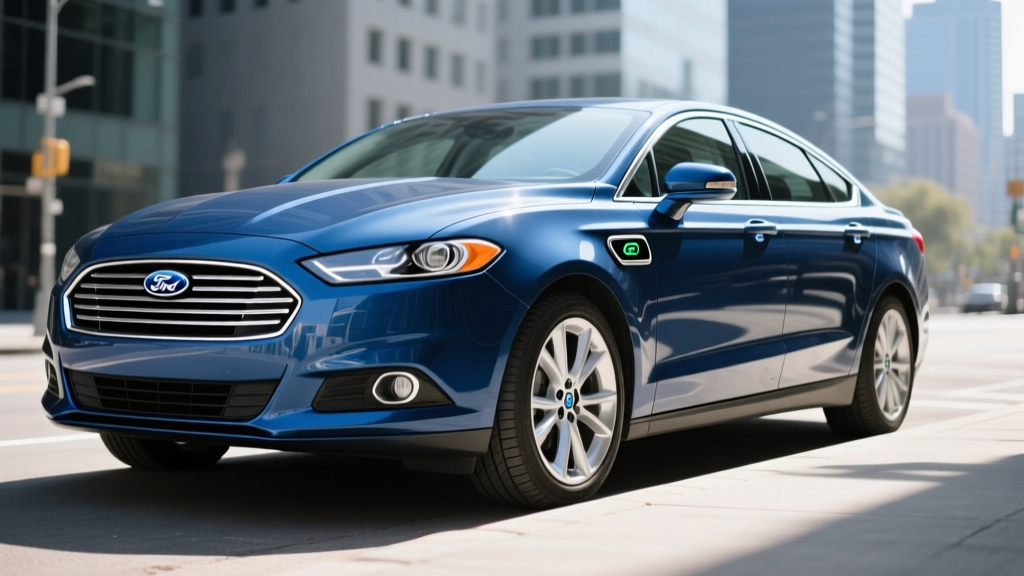
The 2012 Ford Fusion Hybrid represents an important chapter in Ford's electrification story. Built on the second-generation Fusion platform, this conventional hybrid (HEV) paired a 2.5-liter Atkinson-cycle four-cylinder engine with an electric motor and a compact nickel-metal hydride (NiMH) battery pack. It required no plug-in charging — the gasoline engine and regenerative braking handled all battery replenishment. For used-car shoppers in 2026 evaluating a 14-year-old hybrid, the critical questions center on battery longevity, real-world fuel economy, and whether this sedan still makes financial sense versus newer alternatives.
HEV vs PHEV: What the 2012 Fusion Hybrid Actually Is
Before diving into specs, it is essential to clarify what this car is — and what it is not. The 2012 Ford Fusion Hybrid is a conventional hybrid electric vehicle (HEV). It has no plug, no electric-only driving mode of any meaningful distance, and no external charging capability. The small battery (approximately 1.4 kWh total capacity) assists the gasoline engine during acceleration, captures energy during braking, and enables brief low-speed electric-only creeping, but it cannot be plugged into any charger.
Ford did not introduce a plug-in hybrid Fusion until the 2013 model year with the Fusion Energi (a PHEV with roughly 21 miles of electric-only range and a larger lithium-ion battery). If you see a "2012 Fusion" listed with plug-in capability, it is either a mislabeled 2013+ Energi or an error in the listing.
HEV vs PHEV at a Glance
| Feature | 2012 Fusion Hybrid (HEV) | 2013+ Fusion Energi (PHEV) |
|---|---|---|
| Plugs in? | No | Yes (Level 1/Level 2) |
| Electric-only range | ~0.5 mi at very low speed | ~21 mi (2013 model year) |
| Battery chemistry | NiMH (~1.4 kWh) | Lithium-ion (~7.6 kWh usable) |
| Federal tax credit (new) | None (expired) | Was eligible; no longer available for used purchases under current §30D rules |
| Fuel required | Regular unleaded | Regular unleaded + electricity |
EPA Fuel Economy and Real-World MPG
The 2012 Ford Fusion Hybrid carries EPA ratings of 41 MPG city, 36 MPG highway, and 39 MPG combined, according to fueleconomy.gov. These were class-leading numbers when the car debuted, rivaling the Toyota Camry Hybrid and edging ahead of the Hyundai Sonata Hybrid of the same era.
| Cycle | EPA Rating | Real-World Expectation (2026) |
|---|---|---|
| City | 41 MPG | 38–43 MPG |
| Highway | 36 MPG | 33–37 MPG |
| Combined | 39 MPG | 36–40 MPG |
Why City MPG Beats Highway in This Hybrid
Like most conventional hybrids, the 2012 Fusion Hybrid achieves its highest fuel economy in stop-and-go city driving. The electric motor handles low-speed propulsion where gasoline engines are least efficient, and regenerative braking recaptures kinetic energy at every stop. On sustained highway runs above 65 mph, the gasoline engine does most of the work, and aerodynamic drag reduces the advantage over a conventional sedan.
Real-World Factors That Shift MPG
Owners reporting on fuel-tracking platforms commonly see 37–42 MPG in mixed suburban driving with a healthy battery. Several variables pull that number down:
- Battery degradation: A 14-year-old NiMH pack that has lost capacity will force the engine to run more frequently, dropping city MPG by 2–5 points.
- Cold weather: Below 35°F, expect a 5–10% MPG reduction as the engine runs longer to generate cabin heat and the battery's charge acceptance drops.
- Tire choice: Swapping original low-rolling-resistance tires for standard all-seasons can cost 1–3 MPG.
- High-speed driving: Sustained 75–80 mph highway driving typically yields 32–35 MPG.
Powertrain Specifications and Driving Impressions
| Specification | Value |
|---|---|
| Engine | 2.5L Atkinson-cycle inline-4 |
| Engine horsepower | 156 HP @ 6,000 RPM |
| Electric motor output | ~105 HP (permanent-magnet AC synchronous) |
| Combined system horsepower | 191 HP |
| Transmission | eCVT (planetary gearset, not a belt CVT) |
| Battery type / capacity | NiMH / ~1.4 kWh total |
| 0–60 MPH | ~8.5 seconds |
| Drivetrain | Front-wheel drive |
| Fuel tank capacity | 16.5 gallons |
| Total driving range | ~640 miles (combined EPA) |
| Curb weight | ~3,720 lbs |
| Cargo volume (trunk) | 11.8 cu ft (reduced by battery placement) |
Ford's eCVT in this generation uses a planetary gearset to blend engine and motor power — it is mechanically distinct from the rubber-belt CVTs found in some competitors. This design has proven durable, with no belts to wear and fewer friction components than a conventional automatic. Acceleration is adequate for merging and passing, though the engine note under hard throttle has the characteristic drone of an Atkinson-cycle engine held at high RPM by the eCVT.
Battery Longevity, Warranty, and Replacement Cost
Original Hybrid Battery Warranty
Ford originally warranted the 2012 Fusion Hybrid's NiMH battery for 8 years / 100,000 miles (extended to 10 years / 150,000 miles in California and states that follow CARB emissions standards). As of 2026, all factory battery warranties on 2012 models have expired based on the time limit alone.
How Long Does the NiMH Battery Actually Last?
NiMH batteries in Ford's second-generation Fusion Hybrid have demonstrated reasonable longevity, with many original packs lasting 120,000–160,000 miles before significant degradation becomes noticeable. Unlike lithium-ion packs in modern EVs, NiMH chemistry tends to degrade gradually rather than fail catastrophically. The most common symptom is reduced electric-assist capability, which manifests as lower city MPG and more frequent engine engagement — not a sudden "dead battery" scenario.
At 14 years old, any 2012 Fusion Hybrid still on its original battery is living on borrowed time. Heat exposure (particularly in southern states) accelerates NiMH degradation. Buyers should treat battery replacement as an expected near-term cost.
Battery Replacement Cost in 2026
| Option | Estimated Cost (Parts + Labor) | Notes |
|---|---|---|
| New OEM battery (Ford dealer) | $3,500–$4,500 | Full warranty, but OEM NiMH stock may be limited for a 2012 model |
| Remanufactured battery (specialty hybrid shop) | $1,800–$2,800 | Common choice; typically 1–3 year warranty; reconditioned cells |
| Individual cell/module replacement | $500–$1,200 | Only viable if 1–2 modules are weak; requires a shop with hybrid diagnostic capability |
For a used 2012 Fusion Hybrid valued between $4,000 and $8,000 in 2026, a $2,000–$3,000 remanufactured battery replacement represents a significant percentage of the car's value. Factor this into your purchase negotiation — if the battery has not been replaced and the car has over 120,000 miles, budget for it immediately.
Used Pricing and Tax Credit Eligibility
As of 2026, the 2012 Ford Fusion Hybrid trades on the used market for approximately $4,500–$8,500, depending on mileage, condition, and battery health. Well-maintained examples with a documented battery replacement command the upper end of that range.
Does It Qualify for Any Tax Credit?
The 2012 Fusion Hybrid does not qualify for the federal §30D clean vehicle tax credit. The §30D credit applies only to new plug-in electric vehicles (BEVs and PHEVs with at least 7 kWh of battery capacity). Conventional hybrids (HEVs) have never qualified for §30D. The original federal hybrid tax credit that applied to early HEVs like the 2012 Fusion Hybrid expired after Ford reached its 60,000-unit cap, and that credit was far smaller than the current $7,500 BEV/PHEV incentive.
The Used Clean Vehicle Credit (§25E) offers up to $4,000 for qualifying pre-owned plug-in EVs and PHEVs — but again, conventional hybrids are excluded. Per IRS guidelines, only vehicles with a plug and sufficient battery capacity are eligible. The 2012 Fusion Hybrid, with no plug and a 1.4 kWh NiMH pack, does not qualify.
Some states offer their own incentives for hybrid purchases or registration, but these vary widely by jurisdiction and change frequently. Check your state's energy or environmental agency website for current programs.
Reliability Record and Common Issues
The 2012 Fusion Hybrid earned a reputation for above-average reliability within its segment. The eCVT planetary gearset has proven more durable than conventional automatic transmissions of the era, and the Atkinson-cycle engine operates under less thermal stress than a standard Otto-cycle engine.
Known issues to inspect on a used 2012 Fusion Hybrid include:
- Hybrid battery degradation: As discussed, the primary concern at this vehicle's age. Check for dashboard hybrid system warnings and verify MPG against the EPA baseline.
- 12V auxiliary battery: Like all hybrids, the Fusion Hybrid has a standard 12V battery that powers electronics. A weak 12V battery can cause hybrid system error codes even when the traction battery is healthy.
- Electric power steering (EPS): Some owners have reported intermittent EPS faults. Ford issued service bulletins for certain model years; verify recall completion via NHTSA's recall lookup.
- A/C compressor: The electrically driven A/C compressor can fail at higher mileages. Replacement runs $800–$1,400.
- Brake actuator: The regenerative braking system uses a specialized brake actuator. If the brake pedal feels unusually firm or the ABS light illuminates, this component may need attention ($1,200–$1,800 replacement).
Who Should Buy the 2012 Fusion Hybrid in 2026?
Pros
- Strong city MPG (38–43 real-world) without any plug-in requirement
- Comfortable ride quality and spacious rear seats for a midsize sedan
- Proven eCVT durability — no belt-type CVT failure risk
- Low purchase price ($4,500–$8,500 used)
- Regular unleaded fuel — no premium required
- Solid safety ratings for its era (IIHS Good in frontal offset and side impact)
Cons
- Trunk space reduced to 11.8 cu ft by battery pack (vs 17.0 cu ft in gas Fusion)
- NiMH battery near end of life; replacement cost can equal 30–50% of car's value
- No EV tax credit eligibility — neither §30D nor §25E
- Dated infotainment (SYNC 1 era, no Apple CarPlay/Android Auto without aftermarket head unit)
- Highway MPG (33–37 real-world) is unremarkable vs modern turbo-gas sedans
- Outdated driver-assistance features by 2026 standards
Hybrid vs PHEV vs EV: Which Fits Your Situation?
Choose the 2012 Fusion Hybrid (HEV) if: You want maximum simplicity — no charging, no plug, no range planning. You drive primarily in city and suburban traffic where the hybrid system excels. You need a low-cost commuter car and can budget for a potential battery replacement. You lack access to home or workplace charging.
Choose a used PHEV (like a 2017+ Fusion Energi or Prius Prime) if: You have home Level 2 charging access and a short commute (under 25 miles) that could be covered mostly on electricity. You want some EV driving experience without full range commitment. Note that used PHEVs under $25,000 may qualify for the §25E used clean vehicle credit (up to $4,000), which conventional hybrids cannot access.
Choose a full EV (like a used Chevrolet Bolt, Nissan Leaf, or Tesla Model 3) if: You have reliable home charging, your daily driving is under 200 miles, and you want to eliminate gasoline entirely. EVs offer lower per-mile fuel costs (typically $0.04–$0.06/mile on home electricity vs $0.12–$0.16/mile on gas in a hybrid at 40 MPG) and fewer moving parts, but require charging infrastructure and a higher upfront purchase price for comparable-age vehicles.
Frequently Asked Questions
How many MPG does the 2012 Ford Fusion Hybrid get?
The EPA rates the 2012 Fusion Hybrid at 41 MPG city, 36 MPG highway, and 39 MPG combined. In real-world 2026 driving with an aging NiMH battery, expect 36–43 MPG depending on driving mix, battery condition, tire choice, and climate. City driving yields the best numbers; sustained highway speeds above 70 mph drop fuel economy to the low-to-mid 30s.
Can I plug in the 2012 Ford Fusion Hybrid to charge it?
No. The 2012 Fusion Hybrid is a conventional hybrid (HEV) with no plug-in capability. The battery charges exclusively through the gasoline engine and regenerative braking. If you want a plug-in Ford Fusion, look for the 2013 or later Fusion Energi, which is a PHEV with a charging port and approximately 21 miles of electric-only range.
Is the 2012 Fusion Hybrid reliable, and what does battery replacement cost?
The powertrain itself (engine + eCVT) has a strong reliability record. The primary concern at this vehicle's age is the NiMH hybrid battery, which typically lasts 120,000–160,000 miles. A remanufactured replacement battery costs $1,800–$2,800 installed at a hybrid specialty shop. OEM dealer replacement runs $3,500–$4,500. Budget for this expense if purchasing a high-mileage example that has not had its battery replaced.
Does the 2012 Ford Fusion Hybrid qualify for any federal tax credit?
No. The federal §30D clean vehicle credit applies only to new plug-in vehicles (BEVs and qualifying PHEVs). The §25E used clean vehicle credit also requires a plug-in vehicle. Conventional hybrids like the 2012 Fusion Hybrid are ineligible for both. The original federal hybrid tax credit that briefly applied to early HEVs expired years ago after manufacturer caps were reached.
How does the 2012 Fusion Hybrid compare to a Toyota Camry Hybrid of the same year?
The 2012 Camry Hybrid (2.5L, 200 combined HP) was EPA-rated at 43 city / 39 highway / 41 combined — slightly ahead of the Fusion Hybrid on paper. The Camry also offers a larger trunk (14.1 cu ft vs 11.8 cu ft) because Toyota packaged its battery more compactly. However, the Fusion Hybrid was praised for a more engaging driving feel and a quieter cabin at highway speeds. Both use proven eCVT-type transmissions and have strong long-term reliability records. Battery replacement costs are comparable between the two.
What should I check before buying a used 2012 Fusion Hybrid?
Request a hybrid battery health report from a Ford dealer or hybrid specialist — this shows the battery's state of health (SoH) as a percentage of original capacity. Verify that all NHTSA recalls (especially electric power steering) have been completed. Test-drive in city traffic to observe how frequently the engine engages versus electric-only mode. Check for any hybrid system warning lights on the dashboard. Confirm whether the battery has ever been replaced, and if so, obtain documentation. Finally, inspect the 12V auxiliary battery, as a weak 12V system can mimic hybrid battery faults.