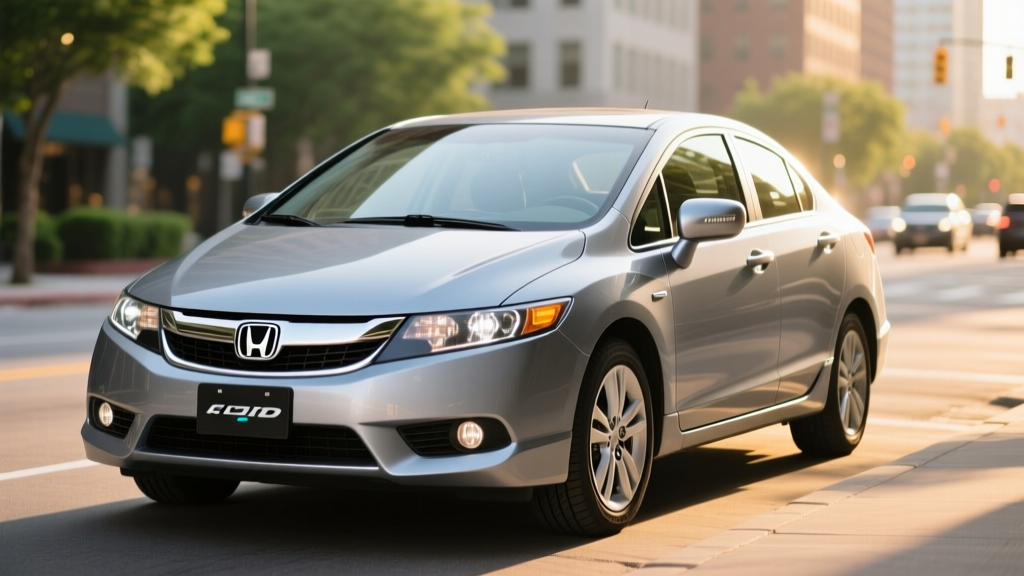
The 2012 Honda Civic Hybrid arrived during a pivotal moment for Honda's electrification strategy. Using the company's Integrated Motor Assist (IMA) system — a mild-hybrid architecture fundamentally different from the full-hybrid setups Toyota and Hyundai favor — it promised strong city fuel economy without the complexity of a plug. More than a decade later, the 2012 Civic Hybrid remains a fixture on the used-car market, attracting budget-conscious commuters looking for proven hybrid efficiency at a fraction of a new vehicle's price.
This guide breaks down everything a 2026 used-car shopper needs to know: exact EPA fuel economy, real-world MPG expectations, IMA battery health concerns, replacement costs, and how this 14-year-old hybrid stacks up against modern alternatives.
2012 Civic Hybrid Fuel Economy: EPA Numbers and Real-World MPG
The 2012 Honda Civic Hybrid is rated by the EPA at 44 MPG city / 44 MPG highway / 44 MPG combined. That uniform number across all three cycles is unusual — most hybrids score significantly higher in city driving where regenerative braking and electric-motor assist do the most work. The Civic Hybrid's IMA system, being a mild hybrid, relies more heavily on the gasoline engine, which flattens the city/highway spread.
| Cycle | EPA MPG | Real-World Expectation |
|---|---|---|
| City | 44 MPG | 40–46 MPG |
| Highway | 44 MPG | 38–43 MPG |
| Combined | 44 MPG | 39–44 MPG |
Source: fueleconomy.gov
In real-world driving, owners report a fairly wide spread. The IMA system's electric motor contributes only 20 horsepower and 58 lb-ft of torque, meaning the 1.5-liter i-VTEC engine does most of the work. In stop-and-go city traffic, the electric assist and idle-stop function help push some drivers above the EPA estimate. On sustained highway trips at 70+ mph, expect figures closer to 38–41 MPG — the mild-hybrid system offers minimal benefit at steady cruising speeds.
IMA Powertrain: How the 2012 Civic Hybrid Works
Understanding the 2012 Civic Hybrid requires understanding Honda's IMA system, which is fundamentally a conventional hybrid (HEV) — not a plug-in hybrid (PHEV). You never plug it in. The battery charges exclusively through regenerative braking and the gasoline engine.
| Specification | Detail |
|---|---|
| Engine | 1.5L i-VTEC inline-4 |
| Engine HP / Torque | 90 hp / 97 lb-ft |
| Electric Motor | IMA (Integrated Motor Assist) |
| Motor HP / Torque | 20 hp / 58 lb-ft |
| Combined System Output | 110 hp @ 5,500 rpm |
| Transmission | CVT (continuously variable) |
| Battery Type | Nickel-Metal Hydride (NiMH) |
| Battery Capacity | 0.5 kWh (nominal) |
| Drivetrain | Front-wheel drive |
| 0–60 mph | ~10.5 seconds (estimated) |
The IMA system places a thin electric motor between the engine and transmission. Unlike Toyota's Hybrid Synergy Drive, which can propel the car on electric power alone at low speeds, the IMA motor cannot drive the Civic Hybrid independently — it only assists the gasoline engine during acceleration and enables idle-stop at red lights. This makes the Civic Hybrid a "mild hybrid" rather than a "full hybrid," which explains its lower city- MPG advantage compared to competitors like the Toyota Prius or Ford Fusion Hybrid of the same era.
IMA Battery Lifespan, Degradation, and Replacement Cost
The 0.5 kWh nickel-metal hydride (NiMH) battery pack is the single biggest ownership concern for any used 2012 Civic Hybrid buyer. NiMH chemistry is durable but not immortal, and a 14-year-old pack is approaching or past its expected service life.
Signs of IMA Battery Degradation
- IMA warning light on the dashboard — the most direct indicator
- Reduced fuel economy — a failing battery provides less assist, forcing the engine to work harder (drops to 35–38 MPG combined)
- Recalibration cycles — the battery gauge suddenly drops and the engine runs at high RPM to recharge (common in late-life NiMH packs)
- Idle-stop failure — the system disables auto-stop at traffic lights to preserve battery charge
Replacement Costs
| Option | Cost Range | Warranty | Notes |
|---|---|---|---|
| New OEM Honda battery | $2,000–$3,000 (installed) | 3 yr / 36,000 mi | Limited availability; some dealers no longer stock |
| Refurbished/remanufactured | $1,000–$1,800 (installed) | 1–3 years | Most common route for used owners; quality varies |
| Aftermarket NiMH pack | $800–$1,500 (parts only) | Varies | DIY possible but requires high-voltage safety knowledge |
| Individual cell replacement | $400–$800 (specialist shops) | Limited | Only viable if specific cells have failed; requires testing |
The honest math: A used 2012 Civic Hybrid typically sells for $5,000–$9,000 in 2026 depending on mileage and condition. A $2,000+ battery replacement represents 22–40% of the vehicle's value. Before purchasing, insist on a pre-purchase inspection that includes IMA battery health diagnostics — specifically, a charge/discharge capacity test.
HEV vs. PHEV vs. EV: Which Fits Your Commute?
If you're researching the 2012 Civic Hybrid, you're likely weighing it against other used electrified options or new vehicles. Here's a decision framework based on your driving pattern and charging access:
Choose a conventional hybrid (HEV) like the 2012 Civic Hybrid if:
- You have no access to home or workplace charging
- You want a simple, proven powertrain with no plug-in routine
- Your budget is under $10,000
- You drive 10,000–15,000 miles/year and want 40+ MPG
Choose a plug-in hybrid (PHEV) if:
- You can charge at home (Level 1/120V is sufficient for most PHEVs)
- Your daily commute is under 30 miles (within electric-only range)
- You want electric driving for daily use but gas flexibility for road trips
- Budget allows $15,000+ for a used PHEV (e.g., used Prius Prime, Clarity PHEV)
Choose a full EV (BEV) if:
- You have reliable home Level 2 charging
- Your daily driving is under 200 miles
- You want minimal maintenance (no oil changes, no engine)
- Budget allows $15,000+ for a used EV (e.g., used Leaf, Bolt, Model 3)
Does the 2012 Civic Hybrid Qualify for Any Tax Credit?
No. The 2012 Honda Civic Hybrid does not qualify for the federal §30D new clean vehicle tax credit, which applies only to new vehicle purchases and has specific MSRP caps, buyer income limits, and battery-sourcing requirements under current IRS rules.
It also does not qualify for the used clean vehicle credit (up to $4,000 / 30% of sale price), because that credit requires the vehicle to be a plug-in electric vehicle (BEV or PHEV) with a minimum 7 kWh battery capacity. The Civic Hybrid's 0.5 kWh NiMH pack falls far short, and as a conventional HEV, it is categorically ineligible.
Some states historically offered rebates for hybrid purchases, but most of these programs have ended or shifted exclusively to plug-in vehicles. Check your state's current energy office or DMV website for any remaining hybrid incentives — but set expectations low.
Reliability, Safety, and Ownership Costs
The 2012 Civic Hybrid's reliability record is mixed. The gasoline 1.5L engine and CVT transmission are generally durable with proper maintenance, but the IMA system introduces a failure point that non-hybrid Civics don't carry. The NHTSA gave the 2012 Civic sedan 5 stars overall in crash testing, and the IIHS rated it "Good" in most categories, though it was not tested in the small-overlap front crash test that later became standard.
Annual Ownership Cost Estimate (2026)
| Cost Factor | 2012 Civic Hybrid (44 MPG) | 2012 Civic Gas (32 MPG) |
|---|---|---|
| Fuel (at $3.40/gal) | $927/yr | $1,275/yr |
| Insurance (avg) | $1,100–$1,400/yr | $1,000–$1,300/yr |
| Maintenance | $400–$700/yr | $400–$600/yr |
| IMA battery reserve | $200–$300/yr (saving for replacement) | $0 |
| Total estimated | $2,627–$3,327/yr | $2,675–$3,175/yr |
The fuel savings of roughly $350/year over a gas Civic are real but modest. They can be entirely wiped out by a single IMA battery replacement. The hybrid makes the most financial sense if you find one where the battery has already been replaced recently with documentation — effectively getting a "reset" on the most expensive wear item.
Pros and Cons: The Honest Verdict
Pros
- 44 MPG EPA combined — genuinely efficient for a 14-year-old car
- Honda build quality: solid interior, comfortable ride, good visibility
- No plug-in required — works for apartment dwellers and street parkers
- Low purchase price ($5,000–$9,000 used in 2026)
- Strong safety ratings for its era
- Widely available parts and mechanic familiarity
Cons
- IMA battery likely at or past end-of-life; $1,000–$3,000 replacement
- Mild hybrid — less city MPG advantage than full hybrids (Prius: 50+ MPG)
- No electric-only driving capability whatsoever
- No federal or state tax credit eligibility
- Sluggish acceleration (~10.5 sec 0–60) — highway merging requires planning
- CVT drone under hard acceleration
- No modern ADAS features (no auto emergency braking, no lane-keeping)
Frequently Asked Questions
How many MPG does the 2012 Civic Hybrid actually get?
The EPA rates it at 44 MPG combined (44 city / 44 highway). Real-world results typically range from 39–46 MPG depending on driving style and conditions. City driving with frequent stops tends to yield the best results thanks to regenerative braking and idle-stop. Sustained highway driving above 70 mph may drop to 38–41 MPG.
Is the 2012 Civic Hybrid a plug-in?
No. The 2012 Civic Hybrid is a conventional hybrid (HEV). It charges its small NiMH battery through regenerative braking and the gasoline engine. There is no plug, no charging port, and no electric-only driving mode. You fuel it exactly like a gas car.
How long does the IMA battery last?
Honda designed the NiMH IMA battery for 10–15 years of service, but real-world lifespan varies with climate (heat accelerates degradation), driving patterns, and mileage. Many 2012 Civic Hybrids in 2026 are on their original battery and showing signs of capacity loss. Expect to budget for a replacement or seek a vehicle where one has already been done.
What does an IMA battery replacement cost?
Between $1,000 and $3,000 depending on whether you choose a refurbished pack, an aftermarket unit, or an OEM Honda replacement (if available). Individual cell replacement at a specialist hybrid shop can cost $400–$800 but is only viable when specific cells have failed.
Is the 2012 Civic Hybrid reliable?
The gasoline engine and transmission are reliable with regular maintenance. The main reliability risk is the aging IMA battery, which is now out of warranty on every 2012 example. A pre-purchase inspection with IMA battery diagnostics is essential. Beyond the battery, the Civic platform is one of the most dependable compact cars of its generation.
Should I buy a 2012 Civic Hybrid or a used Prius?
If your priority is maximum fuel economy and you can spend slightly more ($7,000–$12,000 for a 2012–2015 Prius), the Prius offers 50 MPG combined as a full hybrid with more robust electric assist and a larger battery that tends to last longer. The Civic Hybrid makes sense if you find a well-maintained example at a lower price with a recent battery replacement — the Honda driving dynamics and build quality are excellent, but the efficiency advantage goes to Toyota.