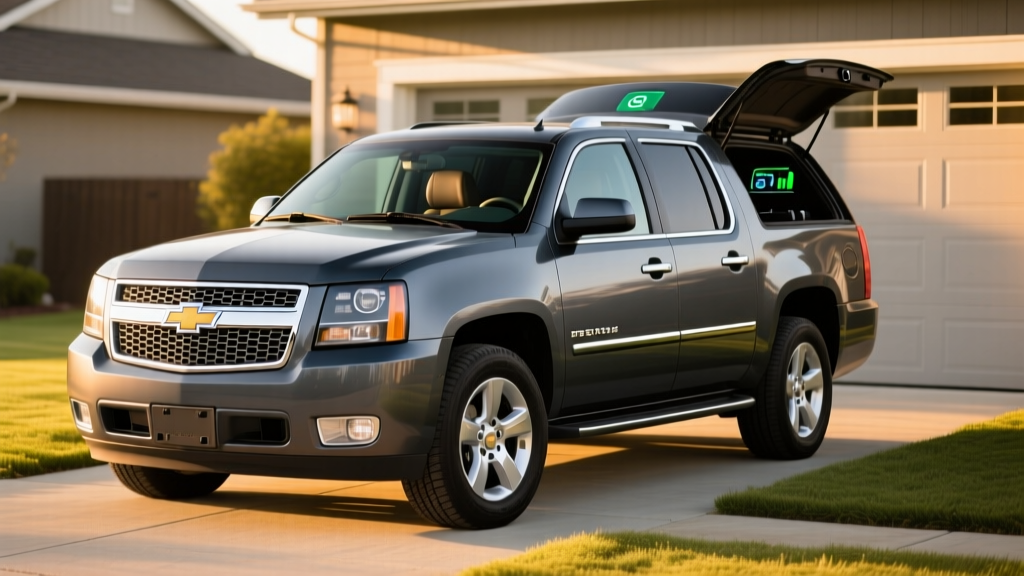
Quick Verdict: A Pioneering Full-Size SUV Hybrid
The 2012 Chevrolet Tahoe Hybrid was an engineering milestone — a 5,800-pound body-on-frame SUV that achieved 21 MPG combined using GM's Two-Mode hybrid system. It paired a 6.0L V8 with two electric motors inside the transmission, delivering 332 combined horsepower while cutting fuel consumption roughly 25% compared to the standard V8 Tahoe. Today, it exists exclusively on the used market, and prospective buyers need to weigh its fuel savings against the reality of a 14-year-old hybrid battery pack.
This guide breaks down the real-world ownership picture: EPA and observed MPG, the hybrid battery's expected lifespan and replacement cost, how this conventional HEV differs from a PHEV or full EV, and whether a used 2012 Tahoe Hybrid still makes financial sense in 2026.
2012 Chevy Tahoe Hybrid — Key Specifications
| Spec | Value |
|---|---|
| Powertrain | 6.0L V8 + Two-Mode Hybrid System (2 electric motors) |
| Combined Horsepower | 332 hp |
| Transmission | Electrically Variable Transmission (EVT) |
| Drivetrain | RWD or 4WD |
| EPA MPG (City / Hwy / Combined) | 20 / 23 / 21 (RWD) |
| Hybrid Battery | ~1.8 kWh NiMH (not plug-in) |
| Towing Capacity | Up to 6,000 lbs (properly equipped) |
| Curb Weight | ~5,842 lbs |
| Original MSRP | ~$53,075 (base) |
| Used Price Range (2026) | $6,000 – $14,000 depending on mileage/condition |
How Many MPG Does the 2012 Tahoe Hybrid Get?
The EPA rated the rear-wheel-drive 2012 Tahoe Hybrid at 20 city / 23 highway / 21 combined MPG. Four-wheel-drive models drop slightly to 20 city / 22 highway / 21 combined. For a full-size, body-on-frame SUV with a V8, those numbers were exceptional in 2012 and remain respectable today.
EPA Fuel Economy Breakdown
| Configuration | City MPG | Highway MPG | Combined MPG |
|---|---|---|---|
| 2WD Hybrid | 20 | 23 | 21 |
| 4WD Hybrid | 20 | 22 | 21 |
| 2WD Gas V8 (5.3L, 2012) | 15 | 21 | 17 |
Source: fueleconomy.gov
Real-World MPG vs. EPA Sticker
Owner-reported data on Fuelly and Edmunds forums clusters around 18–21 MPG combined in mixed driving. The Two-Mode system excels in stop-and-go city traffic, where electric-only low-speed propulsion and regenerative braking recover energy that a conventional Tahoe would waste as heat. Several owners report seeing 22–23 MPG in predominantly urban driving, exceeding the EPA city figure — a common trait of parallel hybrids that the EPA test cycle doesn't fully capture.
Highway driving at 75+ MPH tells a different story. Aerodynamic drag on a boxy, 5,800-lb SUV overwhelms the hybrid system's advantages, and real-world highway MPG drops to 17–19 MPG — below the EPA highway estimate. If your commute is mostly interstate, the hybrid's fuel economy advantage over a standard gas Tahoe narrows considerably.
Bottom line: Expect 19–21 MPG in mixed suburban driving, 20+ in city-heavy commutes, and 17–19 on long highway trips. The hybrid shines most where a conventional V8 SUV is least efficient.
Understanding the Two-Mode Hybrid System (HEV, Not PHEV)
The 2012 Tahoe Hybrid is a conventional hybrid electric vehicle (HEV) — it cannot be plugged in. The ~1.8 kWh nickel-metal hydride (NiMH) battery pack charges exclusively through regenerative braking and the gasoline engine. There is no plug, no charging port, and no electric-only range to speak of beyond very low-speed creep (under ~30 MPH for short distances).
HEV vs. PHEV vs. Full EV — Where Does the Tahoe Hybrid Fit?
| Feature | 2012 Tahoe Hybrid (HEV) | Modern PHEV (e.g., 2026 RAV4 Prime) | Full EV (e.g., 2026 Rivian R1S) |
|---|---|---|---|
| Plugs in? | No | Yes | Yes |
| Electric-only range | N/A (low-speed creep only) | 35–42 miles | 300–400+ miles |
| Combined MPG / MPGe | 21 MPG | 38 MPG (gas) / 94 MPGe (electric) | 105+ MPGe |
| Battery size | ~1.8 kWh (NiMH) | ~18 kWh (NMC) | 100–149 kWh (NMC/LFP) |
| Home charging needed? | No | Recommended (Level 2, ~2.5 hrs) | Required (Level 2, 8–12 hrs) |
| Federal tax credit | None (expired; used-EV credit inapplicable) | Up to $7,500 (§30D, if eligible) | Up to $7,500 (§30D, if eligible) |
The Two-Mode system works differently from the single-mode hybrid systems found in a Toyota Prius. At low speeds, one electric motor can propel the Tahoe on electric power alone. At higher speeds, the system blends engine and motor power through a set of planetary gearsets, and both motors can contribute to propulsion or regeneration. The V8 also features Active Fuel Management (cylinder deactivation), shutting down four cylinders under light load to save fuel.
Powertrain and Performance
The hybrid powertrain combines a 6.0-liter Vortec V8 (rated at 332 hp on its own) with two 60-kW electric motors integrated into the EVT. Combined system output is 332 hp and 367 lb-ft of torque. Despite the weight penalty of the hybrid system (~350 lbs over a gas Tahoe), 0–60 MPH times land around 8.0–8.5 seconds — competitive with the standard 5.3L V8 Tahoe of the same era.
The electric motors provide instant torque fill at low RPM, making the Tahoe Hybrid feel surprisingly responsive from a stop. The transition between electric-only and engine-assisted driving is generally smooth, though some owners note a subtle "drone" from the EVT under hard acceleration — similar to the behavior of a CVT.
Towing capacity is rated at 6,000 lbs (properly equipped), down from the gas Tahoe's 8,500-lb maximum. If you regularly tow heavy loads, the hybrid's fuel economy advantage diminishes, and the lower tow rating may be a dealbreaker.
Battery Health, Warranty, and Replacement Cost
Hybrid Battery Warranty & Lifespan
Original warranty: GM covered the hybrid battery for 8 years / 100,000 miles (extended to 10 years / 150,000 miles in California Air Resources Board states).
Current status (2026): All factory warranties have expired on 2012 models. Battery replacement is an out-of-pocket expense.
Expected battery lifespan: NiMH packs in GM Two-Mode systems typically last 120,000–180,000 miles before significant degradation, though heat exposure and infrequent driving accelerate cell failure.
Battery Replacement Cost
A remanufactured hybrid battery pack for the 2012 Tahoe Hybrid costs between $2,500 and $4,000 including labor at an independent hybrid specialist. GM dealership pricing for a new OEM pack (if still available) can exceed $5,500. Several aftermarket suppliers offer reconditioned packs with 1–3 year warranties.
Individual cell replacement is possible for DIY-inclined owners — the pack contains 30 NiMH modules, and a single failed module can sometimes be identified and swapped for under $100 in parts. However, this requires high-voltage safety knowledge and is not recommended without proper training.
Warning sign: A "Check Hybrid System" message on the dash, combined with a noticeable drop in fuel economy, typically signals battery degradation. Before purchasing a used 2012 Tahoe Hybrid, have the hybrid battery's state of health (SoH) tested with a scan tool that reads individual module voltages.
Pricing, Tax Credits, and Total Cost of Ownership
The 2012 Tahoe Hybrid originally carried an MSRP of approximately $53,075. In 2026, used examples sell for $6,000 to $14,000 depending on mileage, condition, and battery health. Low-mileage, well-maintained examples with a recently replaced hybrid battery command the top of that range.
Federal Tax Credit Eligibility
The 2012 Tahoe Hybrid does not qualify for the current IRS §30D Clean Vehicle Credit. That credit applies only to new plug-in EVs and PHEVs meeting battery-sourcing, MSRP, and buyer-income requirements. Conventional HEVs have never been eligible for §30D. The older Hybrid Vehicle Credit that applied to the Tahoe Hybrid when new expired years ago and was nonrefundable.
The Used Clean Vehicle Credit (§25E) — up to $4,000 or 30% of the sale price — also does not apply here because it requires the vehicle to be a plug-in EV or fuel-cell vehicle. The 2012 Tahoe Hybrid, as a conventional HEV with no plug, is excluded.
Estimated Annual Fuel Cost
At 15,000 miles per year and $3.40/gallon (2026 national average for regular unleaded — the Tahoe Hybrid uses regular), annual fuel cost comes to approximately:
- 2012 Tahoe Hybrid (21 MPG): ~$2,429/year
- 2012 Tahoe Gas V8 (17 MPG combined): ~$3,000/year
- Annual savings: ~$571/year with the hybrid
Over five years, that's roughly $2,855 in fuel savings — enough to offset a hybrid battery replacement if one becomes necessary, but not dramatically more. The financial case for this hybrid rests more on avoiding the gas V8's thirstier consumption than on transformative savings.
Pros
- 21 MPG combined is exceptional for a body-on-frame V8 SUV
- 332 hp with electric torque fill provides confident acceleration
- No plug-in charging required — fuel it like a normal vehicle
- Low-speed electric-only operation reduces noise and fuel use in traffic
- Strong towing capability (6,000 lbs) for a hybrid
- Used prices are low ($6K–$14K), making entry affordable
Cons
- No federal or state tax credits available for used conventional HEVs
- Hybrid battery is 14 years old — replacement likely needed ($2,500–$4,000)
- Highway MPG drops below EPA estimate at sustained high speeds
- Lower tow rating (6,000 lbs) vs. gas Tahoe (8,500 lbs)
- NiMH battery chemistry degrades faster in hot climates
- Interior and infotainment are dated by 2026 standards
- Parts availability for the Two-Mode hybrid system is narrowing
Reliability and Common Issues
The GMT900-platform Tahoe (2007–2014) is generally regarded as one of GM's more reliable truck platforms. The 6.0L Vortec V8 (LFA/LC9) is a proven engine with few systemic failures beyond typical high-mileage wear items (water pump, AFM lifter issues on some engines).
The hybrid-specific components introduce additional risk points:
- Hybrid battery degradation: The most common and costly issue. Expect reduced fuel economy and potential "Check Hybrid System" warnings as cells age.
- EVT transmission: The electrically variable transmission is complex but has proven reasonably durable. Failures are rare but expensive ($3,000–$5,000+ for replacement).
- Electric power steering: The 2012 model year uses electric power steering, which can fail and require rack replacement ($800–$1,500).
- Active Fuel Management (AFM): Cylinder deactivation can lead to lifter wear on high-mileage examples. Some owners install AFM disablers as a preventive measure.
Before buying, prioritize a pre-purchase inspection at a shop familiar with GM Two-Mode hybrids. The hybrid battery SoH scan is the single most important diagnostic step.
Who Should Buy the 2012 Tahoe Hybrid — and Who Shouldn't?
Decision Framework
Choose the 2012 Tahoe Hybrid if:
- You need a full-size, three-row SUV with V8 power and want to save ~$500–$600/year on fuel vs. the gas version
- Your driving is predominantly city and suburban, where the hybrid system maximizes its advantage
- You cannot install a home charger, ruling out PHEVs and full EVs
- You're comfortable with a used vehicle and budget $2,500–$4,000 for a potential hybrid battery replacement
- You tow occasionally but stay under 6,000 lbs
Skip it and consider a PHEV or EV if:
- You want electric-only driving for short commutes (look at a used Toyota RAV4 Prime or Chrysler Pacifica Hybrid)
- You need modern safety tech (automatic emergency braking, lane-keep assist — unavailable on the 2012 Tahoe)
- Your budget allows $35,000+ for a newer PHEV SUV with warranty coverage
- You tow more than 6,000 lbs regularly
- You want to qualify for federal or state EV/PHEV tax incentives
Frequently Asked Questions
Does the 2012 Chevy Tahoe Hybrid need to be plugged in?
No. The 2012 Tahoe Hybrid is a conventional hybrid (HEV), not a plug-in hybrid (PHEV). Its battery charges exclusively through regenerative braking and the gasoline engine. There is no charging port.
How far can the Tahoe Hybrid drive on electric power alone?
Only at very low speeds (under ~30 MPH) and for short distances (typically under a mile). It does not have a meaningful electric-only range. If electric-only commuting is your goal, you need a PHEV like the Toyota RAV4 Prime (42 miles electric) or a full EV.
What does it cost to replace the hybrid battery?
A remanufactured NiMH hybrid battery pack costs $2,500–$4,000 installed at an independent hybrid shop. OEM dealership pricing can exceed $5,500. Given the vehicle's age, budgeting for this expense is prudent when purchasing.
Is the 2012 Tahoe Hybrid reliable?
The underlying GMT900 platform and 6.0L V8 are well-regarded for durability. The hybrid-specific components (battery pack, EVT) add complexity and cost risk as the vehicle ages. A pre-purchase hybrid battery health scan is essential.
Does the 2012 Tahoe Hybrid qualify for any tax credit?
No. It does not qualify for the federal §30D Clean Vehicle Credit (new plug-in vehicles only) or the §25E Used Clean Vehicle Credit (plug-in EVs and fuel-cell vehicles only). Conventional HEVs are ineligible for current federal EV tax incentives. Check your state's DMV or energy office for any remaining state-level hybrid incentives, though most have expired for conventional HEVs.
How does the Tahoe Hybrid compare to a modern PHEV SUV?
A 2026 PHEV SUV like the Toyota Grand Highlander Hybrid MAX offers 35+ MPG combined, 30+ miles of electric-only range, modern ADAS features, and eligibility for up to $7,500 in federal tax credits — but starts above $50,000. The used 2012 Tahoe Hybrid costs a fraction of that but lacks plug-in capability, modern safety tech, and warranty coverage.
What fuel grade does the Tahoe Hybrid require?
Regular unleaded (87 octane). This keeps operating costs lower compared to some V8 SUVs that require premium fuel.
Sources: U.S. DOE / EPA fueleconomy.gov, IRS §30D Clean Vehicle Credit, Chevrolet/GM archival specification sheets.