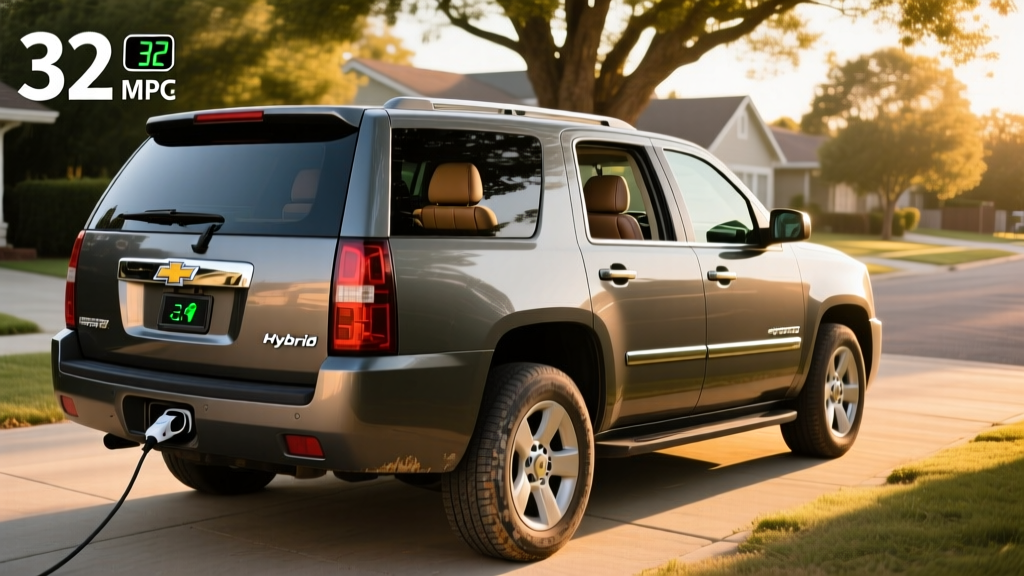
The 2012 Chevrolet Tahoe Hybrid was a bold experiment: a three-row, body-on-frame SUV with a two-mode hybrid system that promised V8 power with significantly better fuel economy. More than a decade later, it remains one of the most fuel-efficient large SUVs ever built in this segment — and a compelling used purchase for families who need serious towing and cargo capacity without burning fuel like a conventional Tahoe. This guide covers every number that matters for a 2026 used-car buyer.
HEV vs PHEV: Where the 2012 Tahoe Hybrid Fits
Conventional Hybrid (HEV): The 2012 Tahoe Hybrid is a self-charging hybrid. It does not plug in. Its 1.5 kWh nickel-metal-hydride (NiMH) battery recharges through regenerative braking and the gasoline engine. You simply fill it with gas and drive — no charging infrastructure required.
Plug-in Hybrid (PHEV): PHEVs like the 2026 Jeep Grand Cherokee 4xe or Toyota RAV4 Prime carry larger batteries (15–20+ kWh), offer 25–50 miles of electric-only driving, and require plugging in to realize their full economy advantage. The Tahoe Hybrid is not a PHEV and has zero electric-only range at highway speeds.
Full EV (BEV): Battery-electric vehicles like the Rivian R1S or Tesla Model X eliminate gasoline entirely but cost significantly more, even on the used market, and require reliable home or public charging access.
This distinction matters because many shoppers searching for a "Tahoe hybrid" assume it plugs in. It doesn't. The Two-Mode Hybrid system is designed to optimize efficiency seamlessly — you'll never change your fueling routine.
2012 Tahoe Hybrid Powertrain: Specs That Still Impress
| Specification | Value |
|---|---|
| Engine | 6.0L V8 (Vortec) with Active Fuel Management (cylinder deactivation) |
| Electric Motors | Two 60 kW motors integrated into the Two-Mode Hybrid transmission (EVT) |
| Combined System Horsepower | 332 hp (net) |
| Battery Pack | 1.5 kWh NiMH (nickel-metal-hydride), located under the second-row seat |
| Transmission | Electrically Variable Transmission (EVT), Two-Mode compound-split |
| Drivetrain | Rear-wheel drive (2WD) or full-time four-wheel drive (4WD) |
| Towing Capacity | 6,200 lbs (2WD) / 6,000 lbs (4WD) |
| 0–60 mph | ~8.2 seconds (independent testing) |
| Curb Weight | ~5,900 lbs (2WD) / ~6,100 lbs (4WD) |
The Two-Mode system, co-developed by GM, BMW, and the former DaimlerChrysler, is an engineering standout. At low speeds, the Tahoe can move on electric power alone for brief distances (typically under 1 mile at parking-lot speeds). At highway speeds, the system blends engine and motor power, and the 6.0L V8 can shut down four of its eight cylinders via Active Fuel Management to further reduce consumption.
Fuel Economy: EPA Ratings vs Real-World MPG
This is where the 2012 Tahoe Hybrid justifies its existence. For a nearly 6,000-pound SUV, the EPA numbers are remarkable — and real-world results frequently beat them in city driving.
| Drivetrain | City MPG | Highway MPG | Combined MPG |
|---|---|---|---|
| 2WD | 20 | 23 | 21 |
| 4WD | 20 | 23 | 21 |
For comparison, the conventional 2012 Tahoe with the 5.3L V8 was rated at 15 city / 21 highway / 17 combined (2WD). The hybrid delivers a 4–5 MPG combined improvement — roughly a 24% gain — which translates to meaningful savings over time.
Real-World MPG Expectations in 2026
Hybrids almost always exceed their EPA city rating in stop-and-go traffic because regenerative braking recaptures energy that a gas-only vehicle wastes as heat. Owner reports and long-term tests consistently show:
- City driving: 21–24 MPG (often exceeds the 20 MPG EPA city rating)
- Highway driving: 20–22 MPG (slightly below the 23 MPG EPA highway rating — hybrids lose their advantage at sustained high speeds)
- Mixed/combined: 20–22 MPG
- Towing: Expect 12–14 MPG when pulling a trailer near the 6,200-lb limit
If your daily driving is predominantly urban or suburban with frequent stops, the Tahoe Hybrid's advantage is at its strongest. Highway-heavy commuters will see a smaller but still meaningful gain over the conventional V8 Tahoe.
Hybrid Battery Lifespan, Warranty & Replacement Cost
Original Warranty: GM covered the 2012 Tahoe Hybrid's battery pack and hybrid-specific components for 8 years / 100,000 miles (whichever came first). In states that adopted California's stricter emissions standards (CARB states), hybrid component coverage extended to 10 years / 150,000 miles.
Current Status (2026): All 2012 models are now well beyond factory warranty coverage. Battery condition should be a primary inspection point for any used purchase.
NiMH Battery Longevity
Nickel-metal-hydride batteries — the same chemistry used in the Toyota Prius of the same era — have proven remarkably durable. Unlike the lithium-ion packs in modern EVs and PHEVs, NiMH packs degrade slowly and predictably. Many Tahoe Hybrids have surpassed 150,000–200,000 miles on their original battery packs with only modest capacity loss.
However, at 14 years old, age-related degradation is a real factor regardless of mileage. Signs of a weakening hybrid battery include:
- Noticeably reduced fuel economy (dropping below 18 MPG combined)
- The gasoline engine running more frequently at stops
- Dashboard warnings such as "Service Hybrid System"
- Reduced regenerative braking feel
Battery Replacement Cost
Replacement options for the 2012 Tahoe Hybrid's NiMH battery in 2026:
- Remanufactured battery pack: $2,000–$3,500 installed (most common and cost-effective route; several specialty hybrid repair shops offer these)
- New OEM battery pack: $3,500–$5,500+ installed (limited availability from GM dealers; often backordered or discontinued)
- Individual module replacement: $800–$1,500 if only specific cells have failed (requires a hybrid-specialist technician)
Before purchasing, request a hybrid battery health scan. Any competent hybrid shop or GM dealer with a Techline scan tool can read the battery's state of health (SoH) and individual module voltages. Budget $150–$250 for this diagnostic if it isn't included in a pre-purchase inspection.
Pricing, Tax Credits & Ownership Economics
As a used 2012 model, the Tahoe Hybrid does not qualify for the federal §30D new clean vehicle tax credit or the used clean vehicle credit, which applies only to qualifying used EVs and fuel-cell vehicles — not conventional hybrids.
Current Used Market Pricing (2026)
- High mileage (130,000+ miles), fair condition: $6,000–$9,000
- Average mileage (90,000–130,000 miles), good condition: $9,000–$13,000
- Low mileage (under 90,000 miles), excellent condition: $13,000–$17,000
The original MSRP was approximately $53,000–$58,000 depending on trim and options. Depreciation has been steep, which makes these SUVs a strong value proposition if the hybrid system checks out.
Fuel Cost Savings vs Conventional Tahoe
At 15,000 miles per year and $3.50/gallon (national average estimate):
- 2012 Tahoe 5.3L V8 (17 MPG combined): ~882 gallons/year → ~$3,088/year
- 2012 Tahoe Hybrid (21 MPG combined): ~714 gallons/year → ~$2,500/year
- Annual savings: ~$588/year (~$2,940 over 5 years of ownership)
These savings won't rival the gap between a hybrid and a full EV charged on cheap residential electricity, but they're meaningful for a large SUV — and there's no charging infrastructure to install or depend on.
Reliability & Common Issues to Watch
The 2012 Tahoe Hybrid shares its GMT900 platform with the Silverado, Suburban, and Yukon, meaning mechanical parts are widely available and any competent shop can service the non-hybrid components. The hybrid-specific systems are more specialized but have a generally solid track record.
Common Issues
- Hybrid battery degradation: As discussed above — age is the primary enemy now, not mileage
- Active Fuel Management (AFM) lifter wear: The cylinder-deactivation system on the 6.0L V8 has been associated with lifter failures on high-mileage examples. Listen for unusual ticking on cold starts
- EVT transmission cooling: The Two-Mode transmission runs hot under sustained towing. Ensure the transmission fluid has been changed at recommended intervals
- 12V battery: Like all hybrids, the Tahoe has a standard 12V auxiliary battery. If it dies, the vehicle cannot start — even though the high-voltage hybrid pack is charged. Replace proactively every 4–5 years
- Air suspension (if equipped): Some Tahoe Hybrids came with rear auto-leveling air suspension. Air springs and compressors commonly fail after 100,000+ miles ($500–$1,200 to repair)
For safety recall information, check the VIN at NHTSA.gov before purchasing. Ensure all open recalls — particularly any related to the hybrid system or power steering — have been completed.
Tahoe Hybrid vs Modern Alternatives: What Should You Buy?
Reasons to Choose the 2012 Tahoe Hybrid
- Lowest entry price for a three-row hybrid SUV with body-on-frame durability
- 6,000+ lb towing capacity — far exceeds unibody crossovers
- No plug-in charging required; works with your existing routine
- Proven, simple NiMH battery technology with wide aftermarket support
- Real-world city MPG often beats the EPA sticker
Reasons to Look Elsewhere
- 14 years old — expect age-related maintenance on suspension, seals, and electronics
- No electric-only driving capability at meaningful speeds
- No federal or state tax credits available for this used hybrid
- Outdated infotainment and no modern driver-assistance features (ADAS)
- Hybrid battery replacement is a $2,000–$5,500 risk if not recently addressed
Decision Framework: Which Powertrain Fits You?
Choose the 2012 Tahoe Hybrid if: You need a body-on-frame, three-row SUV with real towing capability on a budget under $15,000, you don't have access to home charging, and you're comfortable with older-vehicle maintenance.
Choose a modern PHEV (e.g., Grand Cherokee 4xe, Wrangler 4xe) if: You have Level 2 home charging, want 25–40 miles of daily electric-only driving for commuting, and can budget $35,000+ for a newer used model.
Choose a full EV (e.g., Rivian R1S, Tesla Model X) if: You have reliable home charging, want minimal maintenance, qualify for tax credits on a newer purchase, and can invest $40,000+.
Choose a conventional gas Tahoe/Suburban if: You find a well-maintained example at a similar price, drive mostly highway miles where the hybrid advantage shrinks, and want to eliminate any hybrid-battery risk entirely.
Frequently Asked Questions
How many MPG does the 2012 Chevrolet Tahoe Hybrid get?
The EPA rates the 2012 Tahoe Hybrid at 20 city / 23 highway / 21 combined MPG for both 2WD and 4WD models. In real-world city driving, many owners report 21–24 MPG thanks to regenerative braking. Highway MPG tends to land at 20–22 MPG, slightly below the EPA estimate.
Can the 2012 Tahoe Hybrid drive on electric power only?
Only at very low speeds (under ~25 mph) and for very short distances (typically under one mile). The Two-Mode Hybrid system uses its electric motors primarily to assist the V8 engine and enable cylinder deactivation — it is not designed for meaningful electric-only driving like a PHEV or EV.
Does the 2012 Tahoe Hybrid qualify for any tax credit?
No. Federal tax credits for hybrids expired for GM vehicles many years ago, and the current used clean vehicle credit (§25E) applies only to battery-electric and fuel-cell vehicles — not conventional hybrids. No state-level incentives currently apply to a 2012 model year purchase.
Is the 2012 Tahoe Hybrid reliable?
The GMT900 platform is generally robust, and the Two-Mode Hybrid system has held up well over time. The biggest risk for a 2026 buyer is age-related hybrid battery degradation. A pre-purchase hybrid battery health scan is essential. The 6.0L V8 and EVT transmission are durable if properly maintained, though AFM lifter wear is a known concern at high mileage.
How much does it cost to replace the hybrid battery?
A remanufactured NiMH battery pack costs $2,000–$3,500 installed at a hybrid specialist. A new OEM pack from GM runs $3,500–$5,500+ but may be difficult to source for a 2012 model. Individual module repair is possible for $800–$1,500 if only a few cells have failed.
Should I buy a 2012 Tahoe Hybrid or a conventional Tahoe?
If the hybrid battery checks out and you do significant city/suburban driving, the Hybrid's ~4 MPG advantage saves roughly $500–$600 per year in fuel. If you mostly drive highway miles or tow frequently, the gap narrows and a well-maintained conventional 5.3L Tahoe may be the simpler choice with lower repair-cost risk.
Hybrid vs PHEV vs EV — which is right for a large SUV buyer?
For a budget under $15,000, the 2012 Tahoe Hybrid is one of the only three-row hybrid SUVs available. If you can spend $30,000–$50,000+, modern PHEVs like the Jeep Grand Cherokee 4xe (25 miles electric-only) or full EVs like the Rivian R1S offer dramatically better efficiency and modern features — but at multiples of the price.
Sources: EPA fuel economy data via fueleconomy.gov; federal tax credit rules via IRS.gov; recall and safety data via NHTSA.gov.