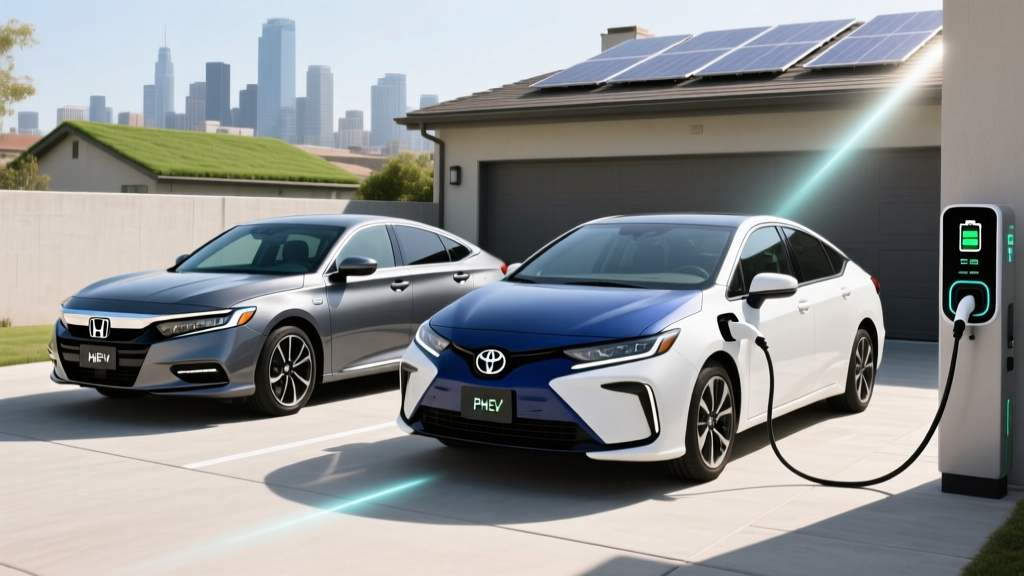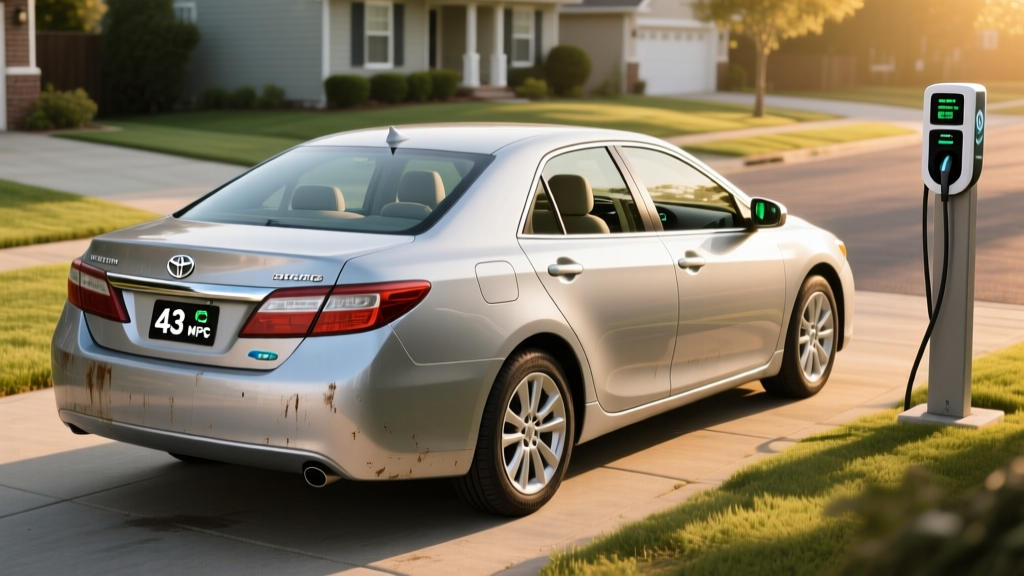
The 2012 Toyota Camry Hybrid represents a pivotal model year for Toyota's midsize sedan. It was the first Camry Hybrid to use the third-generation Hybrid Synergy Drive with a 2.5-liter four-cylinder engine, delivering a meaningful jump in both power and efficiency over the 2011 model. Over a decade later, it remains one of the most common used hybrids on the road — and a frequent target for buyers seeking dependable, low-cost electrified transportation without plug-in complexity.
This guide covers everything a 2026 buyer or current owner needs to know: EPA and real-world fuel economy, the hybrid powertrain, battery longevity and replacement costs, and how the 2012 Camry Hybrid stacks up against modern PHEVs, full EVs, and conventional gas cars.
2012 Camry Hybrid MPG: EPA Ratings vs. Real-World Results
Fuel economy is the primary reason buyers choose the Camry Hybrid, and the 2012 model delivers numbers that still hold up against many 2026 conventional gas sedans.
| Metric | MPG |
|---|---|
| City | 43 MPG |
| Highway | 39 MPG |
| Combined | 40 MPG |
Source: fueleconomy.gov — 2012 Toyota Camry Hybrid
The EPA combined rating of 40 MPG is a reliable baseline, but hybrid fuel economy is highly sensitive to driving patterns. In city-heavy driving with frequent stops, many owners report 42–45 MPG — hybrids excel here because regenerative braking recaptures energy and the engine shuts off at idle. On sustained highway trips at 70–75 mph, expect 35–38 MPG as the gasoline engine runs continuously. In cold weather (below 30°F), the engine runs more often for cabin heat, dropping city MPG to roughly 36–38. A well-maintained 2012 Camry Hybrid with a healthy battery should average 38–41 MPG in mixed driving.
Hybrid Synergy Drive: Powertrain Specs and Performance
The 2012 Camry Hybrid pairs a 2.5-liter Atkinson-cycle four-cylinder engine with an electric motor and a nickel-metal hydride (NiMH) battery pack. This was a significant upgrade from the 2011 model's 2.4-liter setup.
| Specification | Value |
|---|---|
| Engine | 2.5L Atkinson-cycle 4-cylinder |
| Engine Power | 156 hp @ 5,700 rpm |
| Electric Motor Power | 105 kW (141 hp) |
| Net Combined System Power | 200 hp |
| Transmission | eCVT (planetary gearset) |
| Battery Type | Nickel-Metal Hydride (NiMH) |
| Battery Capacity | 1.6 kWh (gross) |
| Drivetrain | Front-wheel drive |
| 0–60 mph | ~7.6 seconds |
| Curb Weight | ~3,435 lbs |
The eCVT is not a belt-driven CVT like those in some competitors — it uses a planetary gearset that seamlessly blends engine and motor power. This design has proven exceptionally durable, with no belts or clutches to wear out. The 200 combined horsepower provides confident highway merging and passing, a notable improvement over earlier Camry Hybrids that felt underpowered.
HEV vs. PHEV vs. EV: Which Powertrain Fits You?
The 2012 Camry Hybrid is a conventional hybrid (HEV). It does not plug in. The battery charges solely through regenerative braking and the gasoline engine. This is fundamentally different from a plug-in hybrid (PHEV) or a battery electric vehicle (BEV).
| Feature | HEV (e.g., 2012 Camry Hybrid) | PHEV (e.g., 2026 RAV4 Prime) | BEV (e.g., 2026 Tesla Model 3) |
|---|---|---|---|
| Plugs In? | No | Yes | Yes |
| Electric-Only Range | ~1 mile at low speed | 25–42 miles | 250–360 miles |
| Gas Engine | Yes — always available | Yes — kicks in after battery depletes | None |
| Fueling | Gas station only | Gas station + outlet/charger | Charger only |
| Battery Size | 1–2 kWh | 10–20 kWh | 50–100 kWh |
| Federal Tax Credit (§30D) | Not eligible | Up to $7,500 (if eligible) | Up to $7,500 (if eligible) |
| Best For | No home charging access; wants simplicity | Short commute + occasional long trips | Home charging available; mostly daily driving |
If you cannot install a home charger or lack reliable access to plug-in infrastructure, a conventional HEV like the 2012 Camry Hybrid eliminates charging logistics entirely while still cutting fuel consumption by 30–40% versus a comparable gas-only sedan. If you do have home charging and a commute under 30 miles, a modern PHEV lets you drive most days on electricity alone — but at a significantly higher purchase price.
Hybrid Battery Lifespan, Warranty, and Replacement Cost
Battery longevity is the single most common concern for used hybrid buyers. The 2012 Camry Hybrid's NiMH battery pack is smaller and less stressed than the lithium-ion packs in modern EVs, and Toyota's track record with this technology is extensive.
Toyota warranted the 2012 Camry Hybrid battery for 8 years / 100,000 miles (10 years / 150,000 miles in California Air Resources Board states). As of 2026, the original factory warranty has expired for all examples. Any remaining coverage would come from an aftermarket extended warranty, if purchased.
How Long Does the 2012 Camry Hybrid Battery Last?
Toyota's NiMH hybrid batteries have demonstrated a typical lifespan of 150,000 to 200,000 miles before significant degradation necessitates replacement. Many first-generation Prius and Camry Hybrid packs have exceeded 200,000 miles with gradual capacity loss rather than sudden failure. Unlike EV batteries, the hybrid pack operates in a narrow state-of-charge window (roughly 40–80%), which greatly reduces cell stress.
Signs of hybrid battery degradation include:
- Noticeable drop in fuel economy (3–5+ MPG below normal)
- More frequent engine cycling at stops
- Dashboard warning: "Check Hybrid System" or battery-related DTC codes (P0A80, P0A7F)
- Reduced regenerative braking feel
Battery Replacement Cost in 2026
| Option | Cost Range | Warranty |
|---|---|---|
| New OEM Toyota battery | $2,500–$3,500 (parts + labor) | 3 years / 36,000 miles |
| Remanufactured battery | $1,200–$2,000 (parts + labor) | 1–3 years (varies by supplier) |
| Individual module replacement | $400–$900 (specialist shops) | 30–90 days typical |
| Used/salvage battery | $500–$1,000 | None or 30 days |
Remanufactured batteries from reputable suppliers (such as GreenBean or Dorman) have become a popular middle ground, offering reliable performance at roughly half the cost of a new OEM pack. Individual module replacement — swapping only the degraded cells within the pack — is the cheapest option but requires a shop experienced in hybrid battery service.
Reliability, Safety, and Long-Term Ownership Costs
The 2012 Camry Hybrid benefits from Toyota's reputation for durability, and the hybrid-specific components have proven robust. The eCVT planetary gearset, in particular, is one of the most reliable transmissions Toyota has ever produced, with failures being exceedingly rare.
According to IIHS, the 2012 Camry earned a Top Safety Pick designation with "Good" ratings in moderate overlap front, side, roof strength, and head restraint tests. NHTSA gave it a 5-star overall safety rating.
Estimated Annual Ownership Costs (2026)
- Fuel: At 40 MPG combined and $3.20/gallon, driving 12,000 miles/year costs roughly $960/year — compared to ~$1,440/year for a 27 MPG gas sedan.
- Insurance: Comparable to a gas Camry; typically $1,100–$1,500/year depending on state and driver profile.
- Maintenance: Lower than a gas car — no spark plugs until ~120k miles, regenerative braking extends pad life to 60k–80k+ miles. Budget $400–$600/year for oil changes, filters, and tires.
- Tax Credit: The 2012 Camry Hybrid does not qualify for the federal §30D Clean Vehicle Credit. That credit applies only to plug-in vehicles (PHEVs and BEVs) meeting battery sourcing, MSRP, and income requirements per IRS guidelines. Some states may offer used-vehicle rebates for hybrids — check your state energy office.
Who Should Buy the 2012 Camry Hybrid in 2026?
- 40 MPG combined still beats most 2026 gas sedans
- No plug-in charging required — ideal for apartment dwellers
- Proven, durable powertrain with deep service network
- Low used-market price ($6,000–$10,000 depending on mileage)
- Strong safety ratings and spacious interior
- Low maintenance costs vs. gas-only vehicles
- No electric-only driving range (not a PHEV)
- No federal tax credit eligibility
- Dated infotainment — no Apple CarPlay, Android Auto, or USB-C
- Hybrid battery may need replacement at high mileage ($1,200–$3,500)
- NiMH battery less energy-dense than modern lithium-ion
- Older safety tech — no automatic emergency braking or lane-keeping assist
Choose the 2012 Camry Hybrid if: You want a sub-$10,000 fuel-efficient daily driver, lack access to plug-in charging, prioritize reliability and low running costs, and don't need modern driver-assist features.
Choose a modern PHEV (e.g., 2026 Camry Hybrid or RAV4 Prime) if: You have home charging, want 25–40 miles of electric-only commute range, want current safety tech, and can spend $30,000+.
Choose a full EV (e.g., 2026 Model 3 or Ioniq 6) if: You have reliable home Level 2 charging, drive under 250 miles/day, want zero tailpipe emissions, and want to eliminate gas station visits entirely.
Buying Checklist: What to Inspect on a Used 2012 Camry Hybrid
If you're evaluating a specific 2012 Camry Hybrid on the used market, prioritize these checks:
- Hybrid battery health: Request a hybrid battery diagnostic report from a Toyota dealer or qualified hybrid shop. Key metrics: internal resistance balance across modules and state-of-charge calibration.
- Maintenance records: Verify regular oil changes (5W-30 synthetic, every 5,000–10,000 miles) and inverter coolant service.
- Brake condition: Regen braking extends pad life, but at 100k+ miles, inspect rotors and pads. Original pads lasting 80k+ miles is normal.
- Inverter coolant: Toyota recommends replacement at 100,000 miles. Confirm this was done.
- 12V auxiliary battery: Like all hybrids, the Camry has a standard 12V battery for accessories. It typically needs replacement every 4–5 years and costs $150–$250.
- Test drive observations: The engine should start and stop seamlessly at traffic lights. Any hesitation, shudder, or warning lights during the transition warrants a professional inspection.
Frequently Asked Questions
How many MPG does the 2012 Camry Hybrid get?
The EPA rates the 2012 Camry Hybrid at 43 MPG city, 39 MPG highway, and 40 MPG combined. In real-world mixed driving with a healthy battery, expect 38–41 MPG. City-heavy routes can push it to 42–45 MPG, while sustained highway driving at higher speeds typically yields 35–38 MPG.
Does the 2012 Camry Hybrid need to be plugged in?
No. The 2012 Camry Hybrid is a conventional hybrid (HEV), not a plug-in hybrid. The battery charges exclusively through regenerative braking and the gasoline engine. You fuel it exactly like a regular gas car — at a gas station.
Is the 2012 Camry Hybrid reliable?
Yes. The 2012 Camry Hybrid is widely regarded as one of the most reliable vehicles Toyota has produced. The eCVT planetary gearset transmission is nearly bulletproof, and the hybrid components have been in mass production since 2000. With proper maintenance, 200,000+ miles is a reasonable expectation. The primary long-term cost risk is hybrid battery replacement beyond 150,000 miles.
What does it cost to replace the hybrid battery?
A new OEM Toyota hybrid battery costs $2,500–$3,500 installed. Remanufactured batteries from reputable suppliers run $1,200–$2,000 installed. Individual module replacement at a hybrid specialist can be as low as $400–$900. Given the vehicle's used-market value of $6,000–$10,000, a remanufactured battery is often the most cost-effective choice.
Does the 2012 Camry Hybrid qualify for any tax credit?
No. The federal §30D Clean Vehicle Credit applies only to plug-in electric vehicles (PHEVs and BEVs) with battery packs of at least 7 kWh. The 2012 Camry Hybrid's 1.6 kWh NiMH pack does not qualify. There is no federal tax credit available for conventional hybrids purchased in 2026. Check your state's energy office for any local hybrid incentives, which vary by jurisdiction.
How does the 2012 Camry Hybrid compare to the 2026 Camry Hybrid?
The 2026 Camry Hybrid uses a fifth-generation hybrid system with a lithium-ion battery, producing 225 hp (AWD available) and achieving an EPA-estimated 44–51 MPG combined depending on trim. It also includes Toyota Safety Sense 3.0 with automatic emergency braking, lane-keeping assist, and adaptive cruise control — features absent from the 2012 model. The trade-off is price: a 2026 Camry Hybrid starts around $30,000, versus $6,000–$10,000 for a used 2012.
Can the 2012 Camry Hybrid run on electric power alone?
Only at very low speeds (under ~25 mph) for roughly one mile or less, such as creeping through a parking lot. The battery is too small (1.6 kWh) for meaningful electric-only driving. The gasoline engine is the primary power source and engages automatically whenever more power or higher speeds are needed.