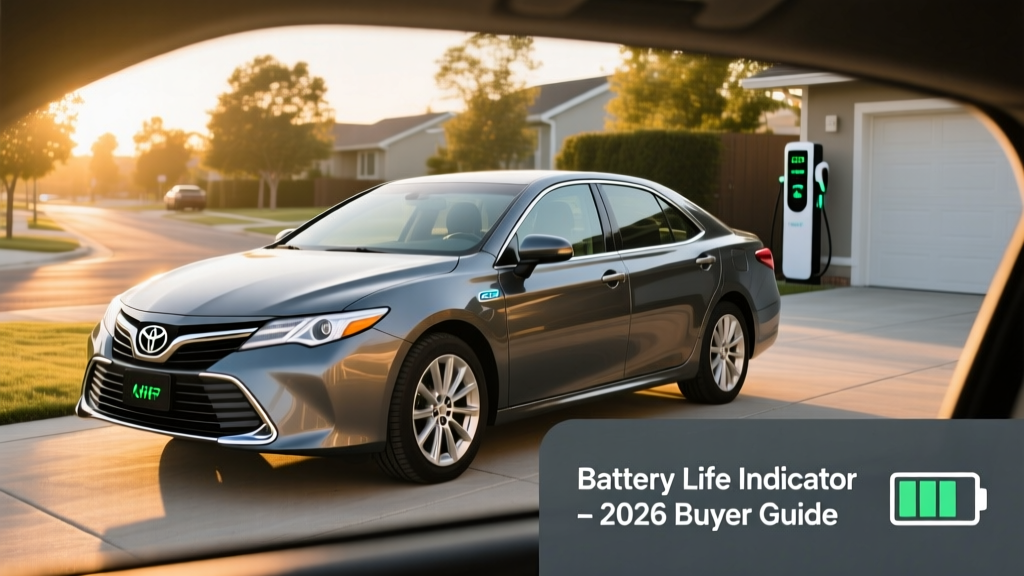
The 2012 Toyota Camry Hybrid was a turning point for midsize hybrid sedans. It was the first model year to use Toyota's revised Hybrid Synergy Drive with a 2.5-liter four-cylinder engine, delivering a significant efficiency jump over the 2007–2011 generation. For used-car shoppers in 2026 researching 2012 Camry Hybrid mileage, this sedan remains one of the most fuel-efficient and reliable vehicles in its class — even 14 years after it rolled off the assembly line.
This guide covers everything a prospective used buyer needs: EPA and real-world fuel economy, hybrid battery longevity and replacement cost, how the 2012 Camry Hybrid stacks up against modern hybrids, plug-in hybrids, and full EVs, and whether it still makes financial sense today.
2012 Camry Hybrid MPG: EPA Ratings vs. Real-World Results
The EPA rated the 2012 Toyota Camry Hybrid at 43 mpg city / 39 mpg highway / 41 mpg combined. These figures were class-leading at launch and remain competitive with many 2026 hybrid sedans.
| Driving Cycle | EPA MPG |
|---|---|
| City | 43 mpg |
| Highway | 39 mpg |
| Combined | 41 mpg |
Source: fueleconomy.gov
Real-World Fuel Economy: What Owners Actually Report
Hybrids like the Camry tend to exceed their EPA city estimates in stop-and-go traffic because regenerative braking recovers energy that gas-only cars waste as heat. However, sustained highway driving at 75+ mph reduces the hybrid advantage, as the electric motor assists less at constant high speed.
Based on aggregated owner data from Fuelly and independent testing:
- City / suburban driving: 40–46 mpg — many owners report beating the EPA city estimate in warm weather
- Highway (65–70 mph): 36–40 mpg — roughly in line with the EPA highway figure
- Highway (75+ mph): 33–37 mpg — aerodynamic drag reduces efficiency noticeably
- Cold weather (below 32°F): 34–38 mpg combined — the engine runs more frequently to heat the cabin and warm the hybrid battery
- Overall owner average: ~39–41 mpg combined, closely matching the EPA estimate
Powertrain and Hybrid System Specs
The 2012 Camry Hybrid uses Toyota's second-generation Hybrid Synergy Drive, pairing a 2.5-liter Atkinson-cycle four-cylinder engine with a permanent-magnet electric motor through an eCVT (planetary gearset, not a belt-driven CVT).
| Specification | Value |
|---|---|
| Gas Engine | 2.5L 4-cyl Atkinson-cycle (156 hp, 156 lb-ft) |
| Electric Motor | Permanent-magnet synchronous (105 kW / 141 hp) |
| Net Combined Output | 200 hp |
| Transmission | eCVT (planetary gearset) |
| Hybrid Battery | 1.6 kWh nickel-metal hydride (NiMH), 244.8V nominal |
| 0–60 mph | ~7.6 seconds |
| Drivetrain | Front-wheel drive |
| Curb Weight | ~3,435 lbs |
The 1.6 kWh NiMH battery is small by modern standards — it stores roughly enough energy for less than one mile of electric-only driving at low speeds. This is by design: conventional hybrids (HEVs) use the battery as a buffer for regenerative braking and engine-assist, not for sustained electric propulsion. You never plug it in.
HEV vs. PHEV vs. EV: Where Does the 2012 Camry Hybrid Fit?
Understanding the distinction between hybrid types is essential when comparing the 2012 Camry Hybrid to modern alternatives.
| Feature | HEV (e.g., 2012 Camry Hybrid) | PHEV (e.g., 2026 RAV4 Prime) | BEV (e.g., 2026 Tesla Model 3) |
|---|---|---|---|
| Plug-in Charging | No — refuels with gas only | Yes — Level 1/Level 2 AC | Yes — Level 2 + DC fast charge |
| Electric-Only Range | <1 mile at low speed | 35–42 miles typical | 250–360+ miles |
| Battery Size | ~1–2 kWh (NiMH or Li-ion) | ~13–18 kWh (Li-ion) | ~50–82 kWh (Li-ion/LFP) |
| Primary Fuel | Gasoline | Gasoline + electricity | Electricity only |
| Federal Tax Credit | None (expired) | Up to $7,500 (§30D, if eligible) | Up to $7,500 (§30D, if eligible) |
| Home Charging Needed | No | Recommended for EV range benefit | Essential |
The 2012 Camry Hybrid is a conventional hybrid (HEV). It generates all its electricity internally through regenerative braking and the gasoline engine. There is no plug, no charging cable, and no electric-only commuting range to speak of. The hybrid system simply optimizes the gas engine's efficiency, particularly in city driving.
Hybrid Battery Longevity and Replacement Cost
For any used hybrid buyer, battery health is the top concern. The 2012 Camry Hybrid's NiMH battery pack is one of the most proven in the industry.
How Long Do These Batteries Actually Last?
Toyota's NiMH hybrid batteries have demonstrated remarkable longevity in real-world use. Data from owner communities, taxi fleets, and repair shops indicates:
- Typical lifespan: 150,000–200,000+ miles before significant degradation
- Failure mode: Gradual capacity loss rather than sudden failure; the car remains drivable with a degraded battery but with reduced MPG
- 14-year reality (2026): Many 2012 Camry Hybrids are still on their original battery at 120,000–180,000 miles. Some have required replacement, but it's far from universal.
Battery Replacement Cost Breakdown
| Option | Cost Range | Notes |
|---|---|---|
| New OEM Toyota battery | $3,000–$4,000 | Full new NiMH pack from dealer; includes labor |
| Refurbished / reconditioned pack | $1,200–$2,200 | Replaced weak cells; varies by vendor and warranty |
| Used salvage battery | $500–$1,000 | From a wrecked Camry; risky without SoH testing |
| Individual cell replacement | $300–$800 | Independent hybrid shops can replace only failed modules |
Before purchasing any 2012 Camry Hybrid, request a hybrid battery health check from a Toyota dealer or a hybrid-specialist shop. A Techstream scan (Toyota's diagnostic tool) can read individual cell voltages and identify weak modules before they cause a check-engine light.
Reliability and Ownership Costs in 2026
The 2012 Camry Hybrid benefits from the Camry's reputation as one of the most reliable midsize sedans ever built. The hybrid system adds complexity, but Toyota's eCVT has no belts, clutches, or friction bands to wear — the planetary gearset is among the most durable transmission designs in automotive history.
Maintenance Advantages Over Gas-Only Models
Counterintuitively, the hybrid can be cheaper to maintain than its gas-only counterpart in some areas:
- Brake pads: Regenerative braking reduces mechanical brake wear. Front pads often last 70,000–100,000+ miles.
- No alternator or starter motor: The hybrid motor/generator handles both functions, eliminating two common failure points.
- No traditional transmission fluid: The eCVT uses ATF that rarely needs replacement under normal driving.
Ownership Cost Snapshot (2026 Used Market)
- Used price range: $6,500–$11,000 depending on mileage, condition, and region
- Annual fuel cost: ~$1,050–$1,250 (at 15,000 miles/year, $3.20/gallon, 40 mpg combined)
- Insurance: Typically $900–$1,300/year — comparable to a gas Camry of the same year
- Annual maintenance: $400–$700 — lower than many non-hybrid vehicles of the same age
Tax Credits and Incentives: What Applies in 2026?
The 2012 Camry Hybrid does not qualify for any current federal tax credit. Here's why:
- The original federal hybrid tax credit for the Camry Hybrid expired in 2010 when Toyota reached its cumulative sales cap under the old Energy Policy Act provisions.
- The current IRS §30D Clean Vehicle Credit applies only to new battery electric vehicles (BEVs) and plug-in hybrids (PHEVs) meeting battery sourcing, critical mineral, MSRP, and buyer income requirements. Conventional hybrids (HEVs) are excluded entirely.
- The used EV credit (up to $4,000 under §25E) also applies only to used BEVs and PHEVs — not conventional hybrids.
Some states and municipalities offer registration fee reductions or HOV lane access for hybrids, but these vary widely. Check your state's DMV or energy office for current programs.
2012 Camry Hybrid vs. Modern Alternatives
For buyers considering a used 2012 Camry Hybrid, it's worth comparing it to what's available in 2026 — both used and new.
| Vehicle | Combined MPG / MPGe | Est. Used/New Price (2026) | Fuel Cost / 15k mi |
|---|---|---|---|
| 2012 Camry Hybrid (HEV) | 41 mpg combined | $7,000–$11,000 (used) | ~$1,170 |
| 2026 Camry Hybrid (HEV) | 52 mpg combined | $30,000–$36,000 (new) | ~$920 |
| 2026 RAV4 Prime (PHEV) | 42 mi EV + 38 mpg gas | $46,000–$52,000 (new) | ~$550–$900* |
| 2026 Tesla Model 3 RWD (BEV) | 132 MPGe | $39,000–$44,000 (new) | ~$500–$700** |
*Depends on how much driving is within electric range and local electricity rates. **Depends on home vs. public charging mix and local kWh rates.
The 2012 Camry Hybrid's 41 mpg combined is still impressive, but the 2026 Camry Hybrid achieves 52 mpg combined thanks to a more efficient hybrid system and lighter platform. The question is whether the ~$20,000 price gap justifies the fuel savings — for most buyers covering 15,000 miles/year, the 2012 model's lower purchase price wins on pure economics.
Decision Framework: Should You Buy a 2012 Camry Hybrid?
Choose the 2012 Camry Hybrid if:
- Your budget is under $12,000 and you want maximum fuel efficiency per dollar
- You drive primarily in city/suburban conditions where the hybrid system shines
- You don't have access to home charging (no plug needed)
- You want a proven, low-risk powertrain with cheap, widely available parts
Look at a newer hybrid, PHEV, or EV if:
- You want modern safety features (AEB, lane-keeping, adaptive cruise) — the 2012 lacks these
- You have home charging and want electric-only commuting (consider a PHEV or BEV)
- You drive over 20,000 miles/year and the fuel savings of a 52 mpg 2026 Camry Hybrid justify the higher price
- You want federal tax credit eligibility (new PHEVs and BEVs only)
Pre-Purchase Checklist for a Used 2012 Camry Hybrid
If you're evaluating a specific vehicle, use this checklist to avoid costly surprises:
- Hybrid battery health scan: Have a Toyota dealer or hybrid shop run a Techstream diagnostic to check individual cell block voltages. Variance greater than 0.3V between blocks signals degradation.
- Check for hybrid-related DTCs: Codes P0A80 (replace hybrid battery pack) or P0A7F (hybrid battery pack deterioration) indicate battery issues.
- Verify inverter coolant pump operation: The 2012 model year had a recall for the hybrid inverter coolant pump. Confirm the recall was performed (check NHTSA VIN lookup at nhtsa.gov/recalls).
- Inspect brake actuator: Toyota's regenerative brake actuator is expensive to replace ($1,500–$2,500). Test for unusual brake pedal feel or ABS warning lights.
- Review maintenance records: Confirm regular oil changes (5W-30 synthetic, every 5,000–10,000 miles) and inverter coolant service.
- Test the A/C compressor: The Camry Hybrid uses an electric A/C compressor. If it fails, replacement is $800–$1,500 — more than a belt-driven unit.
Frequently Asked Questions
How many MPG does the 2012 Camry Hybrid get?
The EPA rates the 2012 Camry Hybrid at 43 mpg city, 39 mpg highway, and 41 mpg combined. Real-world owners typically report 39–44 mpg combined depending on driving mix, with city driving often exceeding the EPA estimate thanks to regenerative braking.
Does the 2012 Camry Hybrid need to be plugged in?
No. The 2012 Camry Hybrid is a conventional hybrid (HEV), not a plug-in hybrid (PHEV). It charges its small 1.6 kWh NiMH battery entirely through regenerative braking and the gasoline engine. You fuel it exclusively at a gas station.
How long does the 2012 Camry Hybrid battery last?
Toyota's NiMH hybrid batteries commonly last 150,000–200,000+ miles. At 14 years old in 2026, many 2012 Camry Hybrids are still on their original battery. If replacement is needed, a refurbished pack costs $1,200–$2,200 and a new OEM battery costs $3,000–$4,000 installed.
Is the 2012 Camry Hybrid reliable?
Yes. The 2012 Camry Hybrid earns above-average reliability marks from both Consumer Reports and long-term owner surveys. The eCVT planetary gearset is exceptionally durable, and the hybrid system has fewer wear items than a conventional powertrain (no starter, alternator, or traditional transmission). The main risk at this age is hybrid battery degradation and the brake actuator.
Does the 2012 Camry Hybrid qualify for any tax credit?
No. The 2012 Camry Hybrid is a conventional hybrid and does not qualify for the federal §30D Clean Vehicle Credit, the §25E used EV credit, or any current federal incentive. Some states may offer minor registration or inspection fee benefits — check your local DMV.
How does the 2012 Camry Hybrid compare to a full EV for daily commuting?
A full EV like a used 2018–2020 Nissan Leaf or Chevrolet Bolt offers lower per-mile fuel costs (electricity vs. gasoline) and zero tailpipe emissions, but requires home charging access and has range limitations on longer trips. The 2012 Camry Hybrid requires no charging infrastructure, offers 670+ miles of range per tank, and is the better choice if you lack reliable home charging, take frequent road trips, or have a tighter purchase budget.