Quick Verdict: A Proven Hybrid Sedan With Real Staying Power
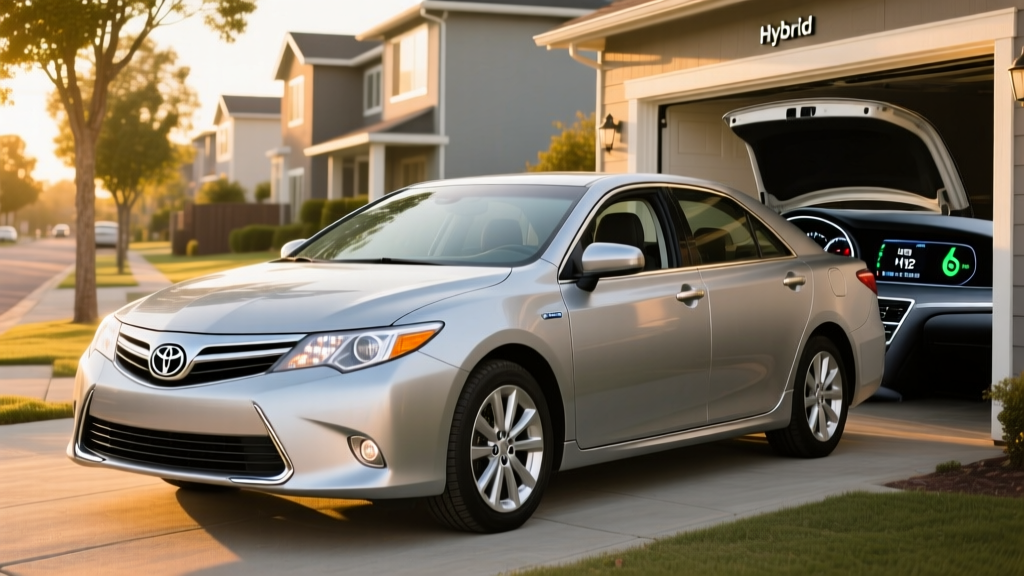
The 2012 Toyota Camry Hybrid LE was the first model year of Toyota's XV50-generation Camry Hybrid, and it introduced a significantly more efficient powertrain over its predecessor. Over a decade later, this conventional hybrid (HEV) remains one of the most dependable used sedans on the road — and one of the most fuel-efficient non-plug-in cars ever sold in the US market. If you're considering one on the used market in 2026, the core question is whether the hybrid battery still has life left and what ownership actually costs.
This guide covers the exact EPA fuel economy, powertrain specs, battery warranty and replacement economics, and how the 2012 Camry Hybrid LE stacks up against modern hybrids, PHEVs, and full EVs.
HEV vs PHEV: What the 2012 Camry Hybrid Actually Is
The 2012 Camry Hybrid LE is a conventional hybrid electric vehicle (HEV). It is not a plug-in hybrid (PHEV) and not a battery electric vehicle (BEV). Understanding this distinction matters because it determines how you fuel it, what incentives apply, and what driving experience to expect.
| Feature | HEV (2012 Camry Hybrid) | PHEV (e.g., RAV4 Prime) | BEV (e.g., Model 3) |
|---|---|---|---|
| Plug-in charging | No — gasoline only | Yes — Level 1/2 | Yes — Level 1/2/DC |
| Electric-only range | ~1 mi at low speed | 25–42 mi typical | 250–350+ mi |
| Battery size | 1.6 kWh (NiMH) | 13–18 kWh (Li-ion) | 60–100 kWh (Li-ion) |
| Primary fuel | Gasoline | Gasoline + electricity | Electricity only |
| Federal tax credit (new) | None | Up to $7,500 (§30D) | Up to $7,500 (§30D) |
| Regenerative braking | Yes | Yes | Yes |
The 2012 Camry Hybrid LE uses regenerative braking and its gasoline engine to keep its small nickel-metal hydride (NiMH) battery charged. You never plug it in. You simply fill it with regular 87-octane gasoline and drive. The hybrid system automatically manages the blend of electric motor and engine power to maximize efficiency, particularly in city driving where the electric motor handles low-speed propulsion and the engine shuts off at stops.
Fuel Economy: EPA Ratings and Real-World MPG
According to fueleconomy.gov, the 2012 Toyota Camry Hybrid LE carries the following EPA estimates:
| Metric | Value |
|---|---|
| City MPG | 43 |
| Highway MPG | 39 |
| Combined MPG | 41 |
| Fuel type | Regular gasoline (87 octane) |
| Fuel tank capacity | 17.2 gallons |
| Total range (EPA est.) | ~705 miles |
| Annual fuel cost (EPA est.) | ~$1,350 (15,000 mi/yr at $3.50/gal) |
Real-World MPG: What Owners Actually Report
The 2012 Camry Hybrid LE is one of those rare vehicles where real-world fuel economy frequently matches or exceeds the EPA sticker, particularly in city and suburban driving. The EPA city rating of 43 MPG is achievable because hybrids recapture braking energy and shut off the engine at idle — conditions that dominate urban commutes.
Based on owner-reported data from Fuelly and long-term testing archives, expect the following real-world figures:
- City / suburban: 40–46 MPG (many owners exceed 43 in warm weather)
- Highway (70+ mph): 35–39 MPG (aerodynamic drag and sustained engine operation reduce the hybrid advantage)
- Cold weather (below 32°F): 33–38 MPG combined (engine runs more to heat the cabin and warm the catalytic converter)
- Mixed driving annual average: 38–42 MPG
Compared to the 2012 gas-only Camry LE (25/35/28 MPG EPA), the hybrid saves roughly 175 gallons per year at 15,000 miles of driving — roughly $610 at $3.50/gallon.
Powertrain Specs: Engine, Motor, and Combined Output
| Specification | Detail |
|---|---|
| Engine | 2.5L 4-cylinder Atkinson-cycle (2AR-FXE) |
| Engine horsepower | 156 hp @ 5,700 rpm |
| Engine torque | 156 lb-ft @ 4,500 rpm |
| Electric motor output | 105 kW (141 hp) |
| Net combined system horsepower | 200 hp |
| Transmission | eCVT (planetary gearset, no traditional belts) |
| Drivetrain | Front-wheel drive |
| 0–60 mph | ~7.6 seconds |
| Hybrid battery | 1.6 kWh NiMH (244.8V nominal) |
| Curb weight | ~3,435 lbs |
The 2AR-FXE engine uses the Atkinson cycle, which keeps the intake valve open slightly longer during the compression stroke. This sacrifices some low-end torque in exchange for significantly better thermal efficiency — a trade-off that works perfectly because the electric motor fills in the torque gap at low speeds. Toyota's eCVT is not a belt-driven continuously variable transmission like those in some competitors; it uses a planetary gearset that is mechanically simple and extremely durable. This transmission design is a major reason the Camry Hybrid powertrain has such a strong reliability record.
Hybrid Battery Lifespan, Warranty, and Replacement Cost
Original Battery Warranty
When new, the 2012 Camry Hybrid battery was covered by Toyota's hybrid system warranty: 8 years / 100,000 miles in most states, and 10 years / 150,000 miles in California Air Resources Board (CARB) states (CA, CT, MA, ME, NJ, NY, OR, RI, VT, WA). By 2026, all original factory battery warranties have expired regardless of mileage.
How Long Do These Batteries Actually Last?
The 2012 Camry Hybrid's NiMH battery pack is one of the most well-documented hybrid batteries in existence. Based on fleet data, owner surveys, and repair-shop reports:
- Typical lifespan: 150,000–200,000 miles or 12–18 years before significant degradation
- Failure mode: Individual cell imbalance rather than complete pack death — one or two modules weaken, triggering a hybrid system warning
- Degradation symptom: Reduced electric-only assist, slightly lower MPG (2–4 MPG drop), more frequent engine cycling
Because the 2012 model is now 14 years old, any surviving original battery is on borrowed time. When shopping for a used 2012 Camry Hybrid LE, ask whether the battery has been replaced. A receipt for a recent replacement is a significant value-add.
Hybrid Battery Replacement Cost (2026)
| Option | Cost Range | Notes |
|---|---|---|
| New OEM Toyota pack | $3,000–$4,000 installed | Dealer-installed; full new pack with warranty |
| Refurbished / reconditioned pack | $1,200–$2,200 installed | Replaced weak modules; 1–3 year warranty typical |
| Used salvage pack | $500–$1,000 installed | From a wrecked Camry; unknown remaining life |
| Individual module replacement | $300–$800 | Independent hybrid shops can swap just the bad cells |
The good news: unlike early 2000s hybrids where battery replacement was economically devastating, the 2012 Camry Hybrid has a robust aftermarket ecosystem. Independent hybrid specialists in most metro areas can recondition the pack for under $2,000, extending the car's life another 5–8 years.
Tax Credits and Incentives: What Applies in 2026?
The 2012 Camry Hybrid LE does not qualify for any federal tax credit, whether purchased new (when the old hybrid credit expired for Toyota in 2007) or used. Here's the current incentive landscape:
- Federal §30D new-vehicle credit: Not applicable — this is a used HEV, not a new EV or PHEV
- Federal used-EV credit (§25E): Not applicable — this credit covers used BEVs and PHEVs with at least 4 kWh of battery capacity, not conventional hybrids
- State incentives: A few states offer hybrid-specific rebates or HOV lane access, but most state EV incentives target plug-in vehicles. Check your state's energy office for current programs
The lack of incentives is offset by the low purchase price. A well-maintained 2012 Camry Hybrid LE typically sells for $7,000–$11,000 in the 2026 used market depending on mileage and condition — far below any new hybrid or EV.
Pros and Cons: 2012 Camry Hybrid LE in 2026
Pros
- 40+ MPG real-world with no plug-in required
- Proven powertrain with 200,000+ mile longevity
- Low used-market price ($7K–$11K)
- Strong aftermarket hybrid battery support
- Smooth, quiet ride with adequate 200 hp
- No range anxiety — 700+ mile total range
- Low annual maintenance costs
Cons
- Hybrid battery likely near end-of-life if original
- No electric-only highway driving capability
- Dated infotainment (no Apple CarPlay / Android Auto)
- Modest cargo space vs modern crossovers
- No federal or state tax incentives
- Safety tech is basic (no automatic emergency braking)
- Higher-mileage examples may need suspension work
Who Should Buy This vs a Modern Hybrid, PHEV, or EV
Decision Framework
Choose the 2012 Camry Hybrid LE if:
- Your budget is under $12,000 and you want maximum MPG
- You don't have access to home or workplace charging (making a PHEV or EV impractical)
- You drive 10,000–18,000 miles/year and want to minimize fuel cost
- You value reliability and low maintenance over technology features
- You need a commuter sedan with 700+ mile range for long trips
Choose a modern hybrid (2024–2026 Camry Hybrid, Honda Accord Hybrid) if:
- You want current safety tech (AEB, lane-keeping, adaptive cruise)
- You want Apple CarPlay/Android Auto and a modern interior
- You can spend $28,000–$35,000
Choose a PHEV (RAV4 Prime, Prius Prime) if:
- You have home Level 2 charging and a commute under 40 miles
- You want electric-only daily driving with gas backup for road trips
- You want to qualify for potential tax credits (check IRS §30D rules)
Choose a full BEV (Model 3, Ioniq 6, Equinox EV) if:
- You have reliable home charging and your daily drive is under 250 miles
- You want to eliminate gasoline entirely and minimize moving parts
- You're ready for the $30,000–$45,000 price point (before credits)
Ownership Costs: Annual Budget for a 2012 Camry Hybrid LE
Here's a realistic annual ownership cost estimate for a 2012 Camry Hybrid LE driven 15,000 miles per year in 2026:
| Category | Annual Cost |
|---|---|
| Fuel (38 MPG avg, $3.50/gal) | ~$1,380 |
| Insurance (varies by state/driver) | $900–$1,400 |
| Maintenance (oil, tires, brakes) | $500–$800 |
| Hybrid battery reserve (saving for eventual replacement) | $200–$300 |
| Registration / taxes | $100–$300 |
| Total estimated annual cost | $3,080–$4,180 |
For comparison, a 2026 gas-only midsize sedan averaging 28 MPG combined would cost roughly $2,010/year in fuel alone — over $600 more than the Camry Hybrid. Over five years, the fuel savings alone can offset a significant portion of the purchase price.
FAQ: Common Questions About the 2012 Camry Hybrid LE
How many MPG does the 2012 Camry Hybrid LE get?
The EPA rates it at 43 city / 39 highway / 41 combined MPG. In real-world driving, owners typically see 38–42 MPG combined, with city driving often exceeding 43 MPG and highway driving at 75+ mph dropping to 35–38 MPG. Cold weather reduces efficiency by 5–8 MPG.
Does the 2012 Camry Hybrid need to be plugged in?
No. The 2012 Camry Hybrid LE is a conventional hybrid (HEV), not a plug-in hybrid. It charges its battery through regenerative braking and the gasoline engine. You never plug it in — you just fill it with regular 87-octane gasoline.
How far can it drive on electric power alone?
Less than one mile at very low speeds (under 25 mph). The 1.6 kWh NiMH battery is far too small for meaningful electric-only driving. The electric motor primarily assists the gasoline engine during acceleration and handles low-speed maneuvering. If you want substantial electric-only range, you need a PHEV (25–42 miles) or a full BEV (250+ miles).
Is the 2012 Camry Hybrid reliable?
Yes — this is one of the most reliable vehicles Toyota has ever produced. The 2AR-FXE engine and Toyota's eCVT planetary gearset are proven to 200,000+ miles with basic maintenance. The main reliability concern at this age is the hybrid battery, which typically lasts 150,000–200,000 miles. NHTSA records show no systemic powertrain failure patterns.
What does a hybrid battery replacement cost?
A new OEM battery from Toyota costs $3,000–$4,000 installed. Refurbished packs from independent hybrid shops run $1,200–$2,200. Individual cell module replacement (the most common repair) costs $300–$800. Given the car's value, most owners opt for refurbished packs or module-level repairs.
Does it qualify for any tax credit in 2026?
No. The 2012 Camry Hybrid LE does not qualify for the federal §30D new clean vehicle credit or the §25E used clean vehicle credit, as both require plug-in capability (BEV or PHEV). Some states may offer minor incentives for hybrid ownership, but these are uncommon. Check your state's energy department for current programs.
What should I check before buying a used 2012 Camry Hybrid?
Have a mechanic check the hybrid battery health using an OBD-II scanner that reads Toyota hybrid-specific data (voltage delta between modules should be under 0.3V). Also verify: brake actuator operation (a known wear item on this generation), inverter coolant pump function, and whether the transmission fluid has been changed. A pre-purchase inspection by a hybrid-experienced shop is worth the $100–$150 fee.