Quick Verdict: A Luxury Hybrid Ahead of Its Time
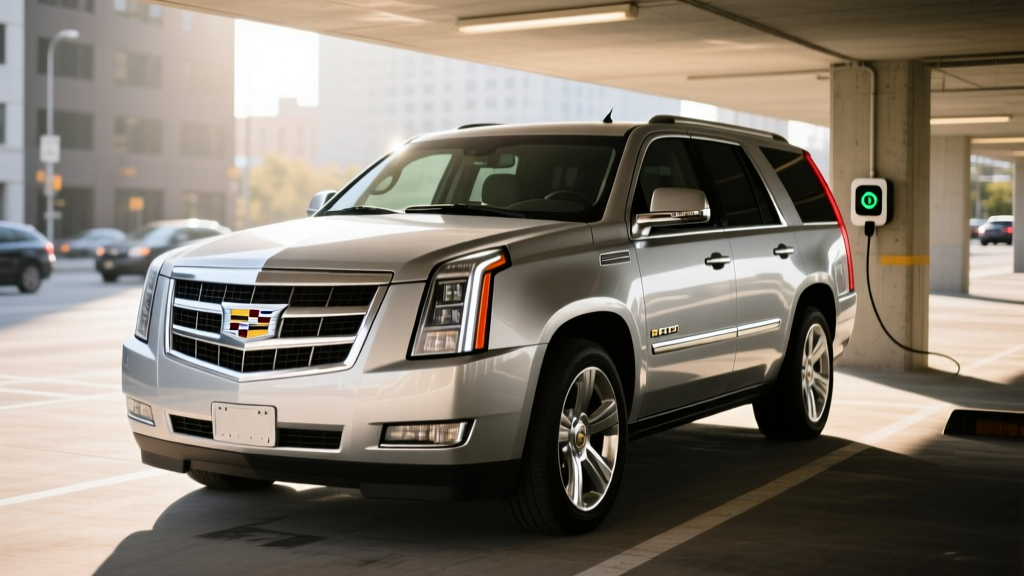
The 2012 Cadillac Escalade Hybrid was one of the first full-size luxury SUVs to pair a V8 with an electric motor system — a bold engineering bet that delivered a meaningful fuel-economy bump without sacrificing the Escalade's signature presence. In 2026, this SUV is strictly a used-market proposition, but it remains relevant for buyers who need three-row luxury, genuine towing capability, and better city MPG than a conventional Escalade — without the plug-in complexity or range anxiety of a full EV.
As a conventional hybrid (HEV), the 2012 Escalade Hybrid never needs to be plugged in. Its battery recharges through regenerative braking and the gasoline engine. This makes it fundamentally different from a plug-in hybrid (PHEV) or battery electric vehicle (BEV). Below, we break down exactly what you get, what to watch for, and how it stacks up against modern alternatives.
HEV vs PHEV vs EV: Where Does This Escalade Fit?
Before diving into specs, it is essential to place the 2012 Escalade Hybrid correctly in the electrification spectrum. Many buyers confuse conventional hybrids with plug-in hybrids — and the distinction matters for your daily routine and wallet.
| Feature | HEV (2012 Escalade Hybrid) | PHEV (e.g., modern plug-in SUV) | BEV (e.g., Cadillac Lyriq, Rivian R1S) |
|---|---|---|---|
| Plug-in required? | No — self-charging via regen & engine | Yes — plug in for electric-only miles | Yes — sole energy source |
| Electric-only range | None (motor assists engine) | 20–50 mi typical | 250–400+ mi |
| Fuel/energy source | Gasoline only | Gasoline + grid electricity | Grid electricity only |
| Battery size | ~1.5 kWh (NiMH) | 15–30 kWh (lithium-ion) | 75–150+ kWh (lithium-ion) |
| Home charging setup | Not needed | Level 2 (240V) recommended | Level 2 (240V) essential |
| Tax credit eligibility | None (discontinued; no §30D credit for used HEVs) | Up to $7,500 new (§30D rules apply) | Up to $7,500 new; up to $4,000 used (§25E) |
The 2012 Escalade Hybrid is a conventional hybrid (HEV). You fuel it with gasoline and drive. The hybrid system operates transparently — the electric motor assists during acceleration, enables brief electric-only movement at very low speeds (under ~25 mph in stop-and-go traffic), and captures energy during braking. There is no plug, no charging cable, and no electric-only highway range.
Fuel Economy: EPA MPG and Real-World Expectations
The headline reason this model exists is fuel economy. For a 5,800-pound luxury SUV with a V8, the numbers were genuinely impressive in 2012 and remain competitive against some modern non-hybrid rivals.
| Metric | 2012 Escalade Hybrid (2WD) | 2012 Escalade Hybrid (4WD) | 2012 Escalade Gas (2WD) |
|---|---|---|---|
| EPA City | 20 MPG | 20 MPG | 14 MPG |
| EPA Highway | 23 MPG | 23 MPG | 18 MPG |
| EPA Combined | 21 MPG | 21 MPG | 15 MPG |
| Real-World Combined (owner-reported) | 19–22 MPG | 18–21 MPG | 13–16 MPG |
Source: fueleconomy.gov — 2012 Cadillac Escalade Hybrid
The hybrid system delivers its biggest advantage in city driving, where regenerative braking and electric motor assist reduce the engine's workload. Expect city MPG to land near or slightly above the EPA 20 MPG figure in mixed urban use. Highway driving, where the electric motor contributes less, typically returns 21–23 MPG — close to the EPA sticker.
In real-world ownership, 2WD models consistently achieve 19–22 MPG combined. The 4WD variant loses roughly 0–1 MPG in practice. For context, that is a 40% improvement in city fuel economy over the gas-only Escalade, translating to roughly $600–$900 in annual fuel savings (based on 15,000 miles/year and $3.50/gallon regular unleaded).
Powertrain and Performance Specs
The 2012 Escalade Hybrid uses GM's Two-Mode Hybrid system — a sophisticated powertrain co-developed with BMW and Mercedes-Benz (the "Global Hybrid Cooperation"). It pairs a 6.0-liter V8 with two electric motors integrated into a specially designed electronically variable transmission (EVT).
| Specification | 2012 Cadillac Escalade Hybrid |
|---|---|
| Engine | 6.0L V8 (Vortec) with Active Fuel Management (cylinder deactivation) |
| Engine horsepower | 332 HP @ 5,100 RPM |
| Engine torque | 367 lb-ft @ 4,100 RPM |
| Electric motors | Two 60 kW AC synchronous motors (inside EVT) |
| Combined system output | 379 HP |
| Transmission | Electronically Variable Transmission (EVT) — Two-Mode Hybrid |
| Battery pack | ~1.5 kWh Nickel-Metal Hydride (NiMH), 300V nominal |
| 0–60 MPH | ~7.8 seconds |
| Towing capacity | 5,600 lbs (2WD) / 5,500 lbs (4WD) |
| Curb weight | ~5,841 lbs (2WD) / ~6,036 lbs (4WD) |
| Seating | 7 passengers (standard) |
| Drivetrain | RWD (2WD) or AWD (4WD) |
The Two-Mode system is key to understanding this vehicle. In "Mode 1" (low speed, city driving), the electric motors can move the vehicle independently at very low speeds or assist the V8 for smoother acceleration. In "Mode 2" (highway cruising), the system optimizes the engine's efficiency through cylinder deactivation (Active Fuel Management drops the V8 to four cylinders under light load) and seamlessly blends motor assist when needed.
Unlike modern PHEVs, there is no dedicated electric-only range on the EPA label. The motors assist; they do not replace the engine for sustained driving.
Battery Warranty, Reliability, and Replacement Cost
For any used hybrid buyer, the traction battery is the single biggest concern. Here is what you need to know about the 2012 Escalade Hybrid's NiMH battery pack.
Original Battery Warranty
GM warranted the hybrid battery and related components for 8 years / 100,000 miles (whichever came first). In California and states that adopted CARB emissions standards, the warranty extended to 10 years / 150,000 miles.
Since this is a 2012 model, original factory battery warranty has expired for all examples as of 2026 (14 years since production). Any remaining coverage would come from an aftermarket warranty or extended service contract purchased separately.
How Long Does the Battery Actually Last?
The NiMH battery in the Two-Mode Hybrid system has proven reasonably durable. Owner reports and repair databases indicate most original batteries last 120,000–180,000 miles before significant degradation or cell failure. Some examples have exceeded 200,000 miles on the original pack, though with reduced hybrid-system efficiency.
NiMH chemistry degrades more gradually than early lithium-ion packs — you will notice a slow decline in fuel economy (perhaps 1–2 MPG loss over 100,000 miles) rather than a sudden failure. However, individual cell failures within the pack can trigger a check-engine light and disable the hybrid system entirely.
Battery Replacement Cost
If the hybrid battery fails, replacement options in 2026 include:
- OEM dealer replacement: $3,500–$5,500 (parts + labor). New OEM packs are increasingly scarce given the model's age.
- Aftermarket/remanufactured pack: $2,000–$3,500. Companies like Green Bean Battery and Dorman offer reconditioned NiMH packs with 1–3 year warranties.
- Individual cell repair: $800–$1,500. A specialized hybrid shop can identify and replace failed cells within the existing pack — the most cost-effective option if only a few cells are bad.
Before purchasing any used 2012 Escalade Hybrid, insist on a hybrid battery health scan from a GM dealer or hybrid specialist. This diagnostic reads individual cell voltages and identifies weak cells before they cause a full-pack failure.
2026 Used Market Pricing and Tax Credit Reality
As a discontinued model, the 2012 Escalade Hybrid is available only on the used market. Pricing in early 2026 typically ranges as follows:
- Fair condition (150,000+ mi, cosmetic wear): $10,000–$14,000
- Good condition (100,000–140,000 mi, maintained): $14,000–$19,000
- Excellent condition (under 90,000 mi, documented history): $19,000–$25,000
The original MSRP was approximately $73,845 (2WD) and $76,545 (4WD) — meaning current used prices represent a 70–80% depreciation from new, which is typical for 14-year-old luxury SUVs.
Tax Credit Eligibility
The 2012 Cadillac Escalade Hybrid does not qualify for the federal §30D Clean Vehicle Credit (that credit applies only to new plug-in vehicles meeting battery sourcing and MSRP caps). It also does not qualify for the §25E Used Clean Vehicle Credit, which requires a plug-in EV or fuel-cell vehicle with at least 7 kWh of battery capacity — far above this HEV's ~1.5 kWh NiMH pack.
No state-level hybrid-specific purchase incentives currently apply to a 14-year-old used HEV. Your only potential tax benefit is the standard charitable donation deduction if you eventually donate the vehicle, or any state emissions-testing exemptions your jurisdiction may offer for hybrid vehicles.
Who Should Buy This Hybrid — and Who Should Look Elsewhere
The 2012 Escalade Hybrid occupies a narrow but real niche in 2026. Here is a decision framework:
Choose the 2012 Escalade Hybrid if:
- You need a full-size, three-row luxury SUV with genuine towing capability (5,500+ lbs) on a sub-$25,000 budget.
- You drive primarily in city/suburban conditions where the hybrid system's 20 MPG city rating saves real fuel versus the 14 MPG gas Escalade.
- You cannot or do not want to install a home Level 2 charger — this HEV requires zero charging infrastructure.
- You want Cadillac's premium ride quality, Bose audio, and commanding road presence without the $80,000+ price of a new electrified luxury SUV.
Look at a PHEV or BEV instead if:
- You want electric-only commuting (a modern PHEV like the Jeep Grand Cherokee 4xe offers 25 mi EV range, or consider the Cadillac Lyriq for full electric).
- You want current-model safety technology — the 2012 Escalade predates automatic emergency braking, lane-keeping assist, and modern ADAS features.
- You want federal or state EV tax credits (up to $7,500 for qualifying new PHEVs/BEVs under current IRS §30D rules).
- Long-term maintenance cost is a top priority — a 14-year-old luxury SUV will require significant upkeep regardless of hybrid or gas powertrain.
Pros and Cons
Pros
- 40% better city MPG vs gas Escalade (20 vs 14 MPG)
- 379 HP combined — no performance sacrifice for hybrid efficiency
- No plug-in charging required — fuel and go
- 5,500+ lb towing capacity retained
- Three-row seating for 7 with premium Cadillac luxury
- Significant depreciation means deep used-market value
- Proven Two-Mode Hybrid system shared with Tahoe/Yukon/Sierra hybrids (parts availability)
Cons
- Highway MPG improvement is modest (23 vs 18 — only ~28% gain)
- No electric-only driving range (HEV, not PHEV)
- No modern ADAS (no AEB, lane-keep, adaptive cruise)
- Battery warranty expired; replacement cost $2,000–$5,500
- No federal or state tax credit eligibility
- Heavy curb weight (5,800–6,000 lbs) affects tire and brake wear costs
- Outdated infotainment by 2026 standards (no Apple CarPlay/Android Auto)
Frequently Asked Questions
How many MPG does the 2012 Cadillac Escalade Hybrid get?
The EPA rates the 2012 Escalade Hybrid at 20 city / 23 highway / 21 combined MPG for both 2WD and 4WD models. Real-world owners typically report 19–22 MPG combined, with city driving often matching or slightly exceeding the EPA estimate thanks to the regenerative braking system. This represents a significant improvement over the gas-only Escalade's 14/18/15 MPG (city/highway/combined).
Can the 2012 Escalade Hybrid drive on electric power only?
Only at very low speeds (under ~25 MPH) for brief distances in stop-and-go traffic. This is a conventional hybrid (HEV), not a plug-in hybrid (PHEV). There is no EPA-rated electric-only range. The electric motors primarily assist the V8 engine and enable cylinder deactivation for efficiency — they do not replace gasoline for sustained driving.
Is the 2012 Escalade Hybrid reliable, and what does a battery replacement cost?
The Two-Mode Hybrid powertrain is generally reliable, with the NiMH battery lasting 120,000–180,000 miles in most examples. The transmission (EVT) and electric motors have proven durable. The main reliability concerns are age-related: suspension components, electronics, and the standard wear items on any 14-year-old luxury SUV. Hybrid battery replacement ranges from $800 (cell-level repair) to $5,500 (full OEM dealer replacement), with remanufactured packs at $2,000–$3,500.
Does the 2012 Escalade Hybrid qualify for any tax credit?
No. The federal §30D Clean Vehicle Credit applies only to new plug-in vehicles (PHEVs and BEVs) meeting battery-sourcing, MSRP, and buyer-income requirements. The §25E Used Clean Vehicle Credit requires at least 7 kWh of battery capacity — the Escalade Hybrid's ~1.5 kWh NiMH pack does not qualify. No current state incentives apply to a used conventional hybrid of this age.
Hybrid vs PHEV vs EV — which should I choose?
If you cannot charge at home and need maximum range flexibility, a conventional hybrid (HEV) like this Escalade is the right call — no plugs, no range anxiety, just better MPG. If you have home charging and a short commute, a plug-in hybrid (PHEV) gives you 25–50 miles of electric-only driving for daily errands plus a gas engine for road trips. If you want the lowest operating cost and have reliable charging access, a battery electric vehicle (BEV) eliminates gasoline entirely but requires planning for longer trips and a larger upfront investment.
What should I check before buying a used 2012 Escalade Hybrid?
Prioritize these pre-purchase inspections: (1) a hybrid battery health scan reading individual cell voltages, (2) a transmission/EVT diagnostic for any fault codes, (3) Active Fuel Management system verification (cylinder deactivation should engage seamlessly), (4) standard luxury-SUV items — air suspension function (if equipped), electronics, and climate control. Budget $1,500–$3,000 annually for maintenance on any 14-year-old Escalade.