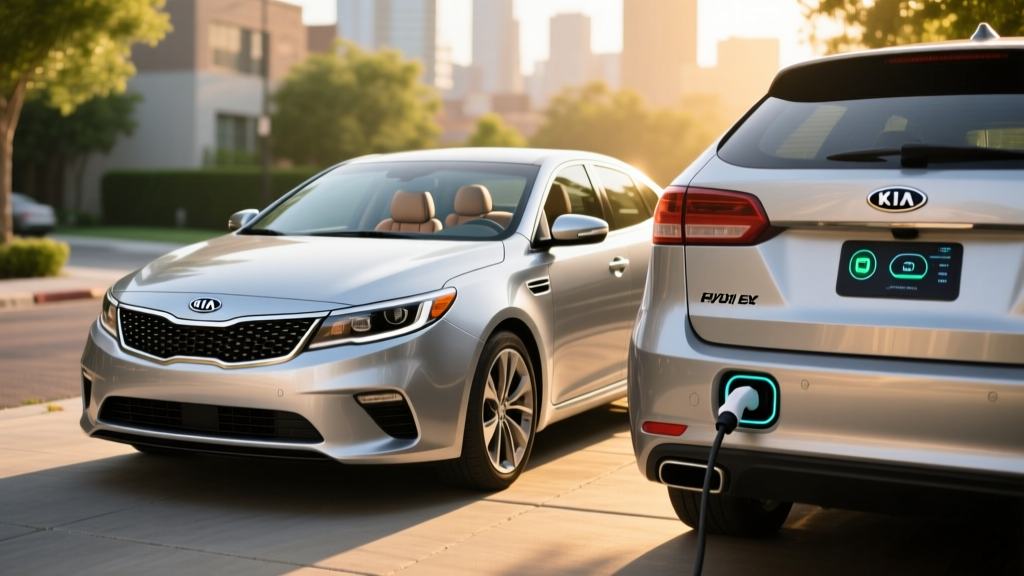
The 2011 Kia Optima EX Hybrid was Kia's first serious entry into the midsize hybrid sedan market, competing directly with the Toyota Camry Hybrid and Hyundai Sonata Hybrid of the same era. Over a decade later, it remains a fixture on the used-car market for buyers seeking an affordable, fuel-efficient commuter without the upfront cost of a modern EV or PHEV. This guide breaks down the exact fuel economy figures, powertrain specs, long-term reliability data, and ownership costs you need to evaluate before purchasing one in 2026.
2011 Kia Optima EX Hybrid: Key Specifications at a Glance
| Specification | Value |
|---|---|
| Powertrain Type | Conventional Hybrid (HEV) — no plug |
| Gas Engine | 2.4L 4-cylinder Atkinson-cycle, 169 HP |
| Electric Motor | 30 kW (40 HP) permanent-magnet synchronous |
| Combined System Output | 206 HP |
| Transmission | 6-speed automatic |
| Hybrid Battery | 1.4 kWh NiMH (Nickel-Metal Hydride) |
| EPA City MPG | 35 MPG |
| EPA Highway MPG | 39 MPG |
| EPA Combined MPG | 34 MPG (Note: see real-world section) |
| Fuel Tank Capacity | 18.5 gallons |
| Total Driving Range | ~629 miles (EPA combined) |
| 0-60 MPH | ~8.9 seconds |
| Original MSRP (2011) | $26,500 (EX Hybrid trim) |
| 2026 Used Price Range | $4,500 – $8,500 (depending on mileage/condition) |
| Hybrid Battery Warranty (Original) | 10 years / 100,000 miles |
HEV vs. PHEV vs. EV: Where the 2011 Optima Hybrid Fits
The 2011 Kia Optima EX Hybrid is a conventional hybrid (HEV). It has no plug, no electric-only driving range, and requires no behavioral change from a standard gas car. You fuel it at a gas station, and the hybrid system recovers energy through regenerative braking and engine optimization to improve fuel economy.
HEV vs. PHEV vs. BEV — Quick Comparison
| Feature | HEV (e.g., 2011 Optima Hybrid) | PHEV (e.g., 2026 Toyota RAV4 Prime) | BEV (e.g., 2026 Tesla Model 3) |
|---|---|---|---|
| Plug Required? | No | Yes (Level 1 or 2) | Yes (Level 2 or DC fast) |
| Electric-Only Range | None (motor assists engine) | 25–45 miles typical | 250–400+ miles |
| Fuel Source | Gasoline only | Gasoline + electricity | Electricity only |
| Fuel Cost Per Mile | ~$0.10–$0.12 | ~$0.04–$0.10 (varies) | ~$0.03–$0.06 |
| Home Charging Needed? | No | Recommended | Essential |
| Federal Tax Credit (New) | None | Up to $7,500 (§30D) | Up to $7,500 (§30D) |
| Used Tax Credit (§25E) | None (must be PHEV/BEV) | Up to $4,000 | Up to $4,000 |
For buyers considering a 2011 Optima Hybrid on the used market, the key distinction is that this car will never drive on electricity alone. The electric motor supplements the gas engine during acceleration and enables regenerative braking, but the wheels are never driven purely by the battery. If you want electric-only commuting, you need a PHEV or BEV — not this vehicle.
Fuel Economy: EPA Numbers vs. Real-World MPG
According to fueleconomy.gov, the 2011 Kia Optima EX Hybrid carries the following EPA estimates:
| Driving Condition | EPA Estimate |
|---|---|
| City | 35 MPG |
| Highway | 39 MPG |
| Combined | 34 MPG* |
*Note: The 2011 Optima Hybrid's EPA combined figure was originally rated at 34 MPG, though the city and highway figures of 35/39 may seem to average higher. This is due to the EPA's weighted combined formula and the specific testing cycle used for early-2010s hybrids.
Real-World MPG Expectations
Owner-reported data from Fuelly and Edmunds forums consistently shows real-world combined fuel economy in the 30–36 MPG range for the 2011 Optima Hybrid. Several factors influence where you'll land:
- City driving favors hybrids: Expect 33–37 MPG in stop-and-go traffic, where regenerative braking recovers the most energy and the Atkinson-cycle engine operates in its most efficient load range.
- Highway cruising reduces advantage: At sustained 70–80 MPH speeds, the hybrid system provides less benefit. Expect 32–36 MPG on the highway, closer to a conventional 4-cylinder sedan.
- Cold weather penalty: In sub-40°F conditions, the engine runs more frequently to maintain cabin heat and battery temperature. Expect a 3–5 MPG reduction, landing around 27–31 MPG combined in winter months.
- Battery age factor: A 14-year-old NiMH battery with degraded capacity will force the gas engine to engage more often. A tired battery can reduce real-world MPG by 2–4 MPG compared to original performance.
Powertrain Deep Dive: How the 2011 Optima Hybrid Works
The 2011 Optima EX Hybrid uses a parallel hybrid architecture developed jointly by Kia and Hyundai. Here's the mechanical breakdown:
Gas Engine
The 2.4-liter inline-4 operates on the Atkinson cycle — a modified valve-timing strategy that keeps the intake valve open slightly longer during the compression stroke. This reduces pumping losses and improves thermal efficiency at the cost of peak power. The engine produces 169 HP on its own, which is notably less than the conventional Optima's 200 HP 2.4L engine.
Electric Motor
A 30 kW (40 HP) permanent-magnet synchronous motor is mounted between the engine and the 6-speed automatic transmission. This motor provides torque fill during acceleration (the Atkinson cycle engine is weak at low RPM) and acts as a generator during regenerative braking.
Combined Output
System output peaks at 206 HP — though the engine and motor don't reach their individual peaks simultaneously. The 6-speed automatic (rather than the CVT used in the Toyota Camry Hybrid) gives the Optima a more natural driving feel, though it sacrifices a small amount of efficiency compared to the stepless operation of a CVT.
The 1.4 kWh NiMH Battery
The hybrid battery pack is a Nickel-Metal Hydride (NiMH) unit with a gross capacity of 1.4 kWh. This is a small buffer — it exists only to store energy recovered from braking and to supply the electric motor during acceleration assist. It is not designed for electric-only driving. NiMH chemistry was standard for hybrids of this era (the Toyota Prius used NiMH until 2021), and while less energy-dense than modern lithium-ion, NiMH is known for predictable degradation behavior.
Reliability, Battery Lifespan, and Replacement Costs
Battery Longevity: What the Data Shows
NiMH hybrid batteries from the 2010–2013 era typically last 120,000–180,000 miles before significant degradation forces noticeable fuel-economy loss. The 2011 Optima Hybrid's battery has aged in two ways:
- Calendar aging: Even low-mileage examples are now 14+ years old. NiMH cells lose capacity over time regardless of use. Expect any original battery to be at 65–80% of its original capacity.
- Cycle aging: Higher-mileage examples (100K+) will have undergone thousands of charge/discharge cycles. Heat is the primary enemy — cars from hot climates (Arizona, Texas, Florida) tend to see faster battery degradation.
Battery Replacement Cost
If the hybrid battery fails or degrades beyond usefulness:
- New OEM battery from Kia: $2,500–$3,500 (part + labor at a dealership). Availability may be limited for a 2011 model.
- Refurbished/remanufactured battery: $1,200–$2,000 from aftermarket suppliers such as Green Bean Battery or Exclusive Hybrid. These typically carry a 1–5 year warranty.
- Individual cell replacement: Some independent hybrid specialists can replace failed cells within the pack for $500–$900, though this is a temporary fix if the remaining cells are also aging.
At a used-car price of $4,500–$8,500, a $2,000 battery replacement represents a significant percentage of the vehicle's value. Always budget for a potential battery replacement when purchasing.
General Reliability
The 2011 Optima Hybrid received mixed reliability ratings. The conventional 2011 Optima scored average-to-below-average in J.D. Power and Consumer Reports assessments, with common complaints including:
- Transmission shudder during engine-motor handoff (software-related, sometimes resolved with a TSB flash)
- Premature brake wear (regenerative braking reduces this compared to conventional models, but early-build units had brake actuator complaints)
- Hybrid system warning lights related to battery temperature sensor failures (repairable, not necessarily a full battery failure)
- Standard non-hybrid issues: door handle paint peeling, infotainment glitches, suspension component wear
Compared to the 2011 Toyota Camry Hybrid — which benefits from Toyota's decades of hybrid refinement — the Optima Hybrid is a step behind in terms of system smoothness and long-term track record. That said, the powertrain is mechanically simpler than many European hybrids, and independent mechanics can service most non-battery components.
Tax Credits and Incentives: What Applies in 2026?
Because the 2011 Kia Optima EX Hybrid is a conventional HEV (not a plug-in hybrid or battery-electric vehicle), it does not qualify for any federal EV tax credits:
- §30D New Clean Vehicle Credit: Not eligible — only PHEVs and BEVs with sufficient battery capacity qualify. The Optima Hybrid's 1.4 kWh battery falls far below the 7 kWh minimum threshold for PHEVs, and it has no plug.
- §25E Used Clean Vehicle Credit: Not eligible — the IRS requires the vehicle to be a qualified plug-in electric or fuel-cell vehicle. Conventional hybrids are excluded.
- State incentives: A handful of states historically offered rebates for conventional hybrids, but most have sunsetted or shifted exclusively to PHEVs and BEVs. Check your state's current energy office website for any remaining programs.
The absence of tax incentives is an important ownership-cost consideration. A used 2026 PHEV like the Toyota Prius Prime (eligible for the $4,000 §25E used credit) may have a higher purchase price but a lower effective cost after incentives — and significantly lower per-mile fuel costs if you can charge at home.
Who Should Buy the 2011 Kia Optima EX Hybrid?
Decision Framework: Is This the Right Hybrid for You?
Choose the 2011 Optima EX Hybrid if:
- Your budget is under $8,000 and you need reliable daily transportation
- You cannot charge at home (apartment, street parking) and want fuel efficiency without a plug
- You drive 10,000–15,000 miles/year and want to reduce fuel costs by 20–25% versus a conventional midsize sedan
- You prefer a 6-speed automatic over a CVT (smoother highway feel than the Camry Hybrid of the same year)
Look at a PHEV or BEV instead if:
- You have home charging access and a budget above $15,000 (used PHEVs like the 2018+ Prius Prime offer 25 mi electric range + 54 MPG)
- You want to qualify for the $4,000 used-EV tax credit under §25E
- You drive less than 30 miles round-trip daily and could do most trips on electricity alone
- You want modern safety features (automatic emergency braking, lane-keep assist) not available on the 2011 Optima
Choose a conventional gas car instead if:
- You drive fewer than 8,000 miles per year (the fuel savings won't offset the hybrid premium or potential battery replacement cost)
- You want the lowest possible purchase price and simplest maintenance profile
Pros and Cons: The Honest Assessment
Pros
- Low used purchase price ($4,500–$8,500)
- 35/39 MPG EPA — meaningful fuel savings vs. gas-only midsize sedans of the era (~24 MPG combined)
- No plug required — works for apartment dwellers and street-parkers
- 6-speed automatic provides more natural driving feel than competing CVTs
- 206 HP combined output is adequate for highway merging and passing
- Spacious interior with 15.4 cu ft trunk (hybrid battery slightly reduces cargo vs. gas model)
Cons
- NiMH battery is 14+ years old — replacement likely needed within 1–3 years ($1,200–$3,500)
- No electric-only driving capability — this is an efficiency assist, not an EV
- Below-average reliability ratings compared to Toyota Camry Hybrid of the same year
- No eligibility for any federal or most state tax incentives
- Outdated safety technology — no AEB, blind-spot monitoring, or lane-keep assist
- Hybrid system less refined — noticeable engine-motor transition shudder reported by owners
- Original hybrid battery warranty has expired on all examples
Frequently Asked Questions
How many MPG does the 2011 Kia Optima EX Hybrid get?
The EPA rates it at 35 city / 39 highway / 34 combined MPG. In real-world driving, owners report 30–36 MPG combined depending on driving mix, climate, and battery health. City driving yields the best results thanks to regenerative braking. Expect 27–31 MPG combined in cold weather or with a degraded battery.
Can the 2011 Optima Hybrid drive on electric power alone?
No. The 2011 Optima EX Hybrid is a conventional HEV with a 1.4 kWh NiMH battery. The electric motor assists the gas engine during acceleration and recovers energy during braking, but it cannot propel the car independently. If you want electric-only driving, you need a PHEV (like a Toyota Prius Prime) or a full BEV.
Is the 2011 Kia Optima Hybrid reliable?
It's average-to-below-average for its class. The hybrid system itself is reasonably durable, but the overall vehicle received mediocre reliability scores from Consumer Reports and J.D. Power. The biggest financial risk is the aging NiMH battery — budget $1,200–$3,500 for a potential replacement. The Toyota Camry Hybrid of the same year has a stronger long-term reliability track record.
What does a hybrid battery replacement cost for the 2011 Optima?
A new OEM battery from a Kia dealer runs $2,500–$3,500 installed. Refurbished aftermarket batteries cost $1,200–$2,000. Individual cell repairs can be done for $500–$900 at a hybrid specialist. Given the car's used value of $4,500–$8,500, a battery replacement is a significant expense — factor it into your purchase negotiation.
Does the 2011 Kia Optima Hybrid qualify for any tax credits?
No. The 2011 Optima EX Hybrid is a conventional HEV and does not qualify for the federal §30D new vehicle credit, the §25E used clean vehicle credit, or most state EV incentive programs. Only plug-in hybrids (PHEVs) and battery-electric vehicles (BEVs) are eligible for these programs. See IRS.gov for current eligibility rules.
How does the 2011 Optima Hybrid compare to a 2026 hybrid?
Modern hybrids like the 2026 Toyota Camry Hybrid (52 MPG combined, lithium-ion battery, full suite of ADAS) are substantially more efficient, safer, and more refined. However, a used 2026 Camry Hybrid will cost $25,000+, while the 2011 Optima Hybrid can be had for under $8,000. If budget is the primary constraint, the 2011 Optima still delivers meaningful fuel savings over a gas car — just with older technology and higher maintenance risk.
What should I check before buying a used 2011 Optima Hybrid?
Have a mechanic perform a hybrid battery health check (many shops can read individual cell voltages and internal resistance). Check for any outstanding Technical Service Bulletins (TSBs) related to the hybrid system or transmission. Verify that the hybrid battery warranty is expired (it will be, for a 2011 model) and budget accordingly. Also inspect the brake actuator — a known failure point on early-build units that costs $800–$1,500 to replace.